Note: In 2025 we changed the name of this quarterly series to Big Impact of Small Solar to better reflect its aim of showing just how much distributed, small-scale (community, residential, and commercial) solar is contributing to new power capacity additions in the United States.
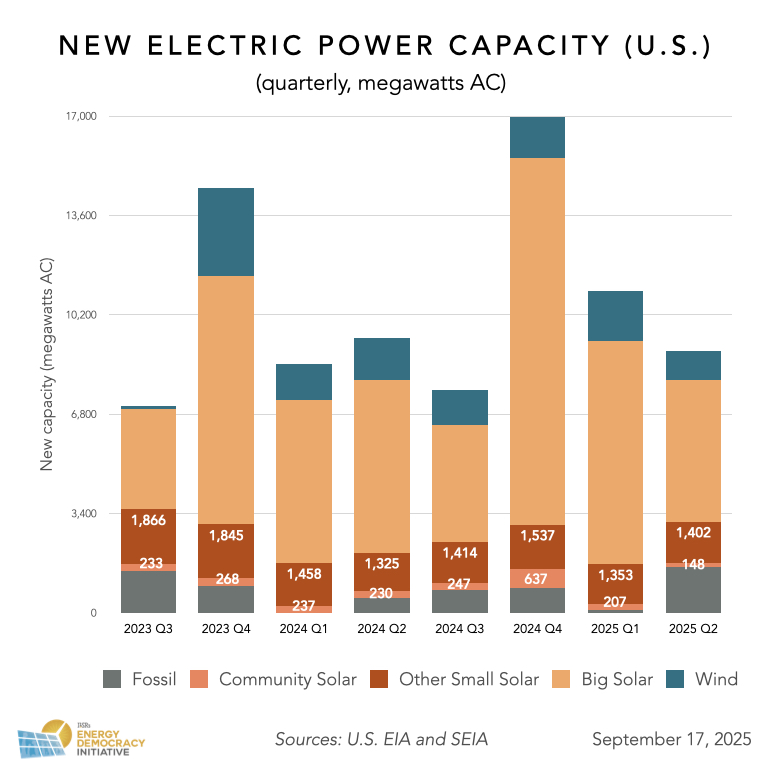
Almost nine gigawatts of new power capacity went online in the second quarter of 2025 and 82% of this capacity was renewable. Seventy-one percent of new capacity was from solar generation, with 4.8 gigawatts of utility-scale solar and 1.6 gigawatts of distributed solar. Wind energy build-out contributed just shy of 1 gigawatt, while fossil fuel power grew by 1.6 gigawatts.
The chart below illustrates the past two years of electric power capacity additions in the U.S., disaggregated by energy source, quarterly.
Big Impact of Small Solar Quarterly Q2 2025
Key takeaways:
Seventy-one percent of all new capacity installed in the second quarter of 2025 was solar – 54 percent from utility-scale solar farms and 17 percent from distributed solar installations (residential, commercial, and community solar).
As measured by both capacity (megawatts) and as a percentage of new capacity build-out, distributed solar recorded one of its slowest quarters in the past two years. The decline that started last year was the result of California’s misguided reduction in rooftop solar compensation. Other states have also recently followed suit.
1.6 gigawatts of new fossil-fired power generation capacity came online in the second quarter – more than any other quarter since 2023. This shift likely reflects the current speculative nature of demand growth forecasts and utility focus on gas plants to meet it.
Developers also installed 4.2 gigawatts of utility-scale energy storage in the second quarter of 2025. Growth in the storage sector is outpacing 2024’s performance.
For more on the advancement of clean, distributed energy, see these recent ILSR resources:
Interested in earlier trends and analysis of new power plant capacity? Check out our archive, illustrating how electricity capacity additions have shifted in previous quarters and years.
This article was originally posted at ilsr.org. For timely updates from the Energy Democracy Initiative, follow John Farrell on Twitter or Bluesky, and subscribe to the Energy Democracy weekly update.