A 2nd State Puts Utility Performance Over Profits — Episode 264 of Local Energy Rules
Oregon tries to tie utility profits to climate, cost, and reliability targets through performance-based regulation.
Imagine a city where every resident is within a 15-minute walk of a reliable, renewable power source, regardless of how many poles and wires a hurricane takes down.
For this episode of the Local Energy Rules Podcast, host John Farrell is joined by Josh Cox, CEO of Community Lighthouse developer Community Power South.
Listen to the full episode and explore more resources below — including a transcript and summary of the episode.
Apple Podcasts Spotify YouTube
Podcast (localenergyrules): Play in new window | Download
Josh Cox:
It isn’t government that’s going to save us. It isn’t capitalism per se that’s going to save us. It’s not companies that are going to save us. It is people, it is communities, it is that connection that is ultimately going to be our strength and our ability to navigate these really uncertain times.
*****
John Farrell:
By June 2026, 21 churches, schools, and other community institutions in New Orleans will be Community Lighthouses — places that local residents can turn to after natural disasters for access to electricity and support. Conceived through community organizing in the wake of Hurricane Ida and built through the community organizing of Together New Orleans, the lighthouse model has already begun expanding to other states. Joining me in November 2025 to share the story was Josh Cox, CEO of the Lighthouse developer called Community Power South.
I’m John Farrell, director of the Energy Democracy Initiative at the Institute for Local Self-Reliance, and this is Local Energy Rules, a podcast about monopoly power, energy democracy, and how communities can take charge to transform the energy system.
*****
John Farrell:
Josh, welcome to Local Energy Rules.
Josh Cox:
Hey, thanks for having me.
John Farrell:
So Josh, I’d love to ask all my guests a question about how they got to what they’re doing, knowing that there are some people who are listening who are thinking, “Maybe I want to follow in these footsteps. I’m interested in trying to do something similar.” You’ve got a background in education, in law, and in workforce development prior to coming to Community Power South. What brought you to your work? What’s the connective tissue there that got you to your current work of helping put solar and storage on community institutions?
Josh Cox:
I think the thing that remains the same through everything that I’ve done in my career is just like a desire to serve. And if I wasn’t directly serving, I was trying to get the tools to become a better servant. And so when I think back about when I graduated from college, I was really drawn to the classroom because I thought that education alone was the panacea for inequality. I just kind of thought that if you educated folks enough and if they went to a good enough college or just went to college at all, that the benefits of economic upward mobility would follow.
But my time in the classroom actually demonstrated for me that that isn’t the case, that education is a necessary component of reducing inequality, but it’s definitely not sufficient on its own. And so I went to law school with the idea of figuring out, well, maybe the law can give me this Swiss Army knife of tools with which to try to reduce inequality.
And weirdly, after graduating from law school, I ended up being so deep in law school debt that I needed to actually go work for oil and insurance companies doing commercial defense litigation. And so ultimately that was a great learning experience and I certainly did get tools, but it led me to service in government, which is truly one of the highlights of my career. I feel really fortunate that I was able to serve during some really critical times in New Orleans’ history, particularly during COVID, because I think we were able to make decisions and sort of be a leader in demonstrating what a safe shutdown looks like. And we certainly were putting the health and safety of marginalized communities in New Orleans at the forefront of our decision making, which I don’t know necessarily happened everywhere else across the country.
But those jobs in government are extremely stressful and taxing. You’re not meant to do them forever. And so I left and was basically running the for- profit arm of a climate staffing company. And the goal there was to try to reduce inequality for often migrant workers who end up being the workforce to rebuild cities after storms. They’re often preyed upon by these private equity backed disaster restoration companies. And so we were trying to come in and act as a good faith staffing broker, pairing workers with the climate projects that we need, whether it’s doing vegetation management or disaster restoration, but ensuring that the worker has protections and is getting paid a fair wage.
Then I had my second child and that was a lot of travel. And so I was looking for something that was closer to home. And I’d heard about the Community Lighthouse Initiative, but I had never actually gotten close to it. And so after months of chatting with Broderick, who’s the leader of Together New Orleans, I realized, wow, this is an amazing thing. And it feels like it’s the right next step for me to take because it was all about figuring out how do we set ourselves up to be able to manage climate change? How do we set ourselves up to be able to manage an energy grid that is getting weaker and more overwhelmed by the day? And so I feel really fired up about the work that we’re doing and I’m really grateful that I’ve got a chance to do it.
John Farrell:
I think it’s amazing when I think about being like a community solar developer, to me that is trying to do something very hard. And for you to sort of describe it along this path as like, it’s less stress than a government job and less travel. It was a way I was looking to slow down after having a second child. Well, it doesn’t sound like slowing down to me. It sounds amazing. So I have a lot of admiration for you landing in this place in that sort of throughline of battling inequality in a number of different ways.
On that topic, I’m kind of curious, how would you describe the problem that the Community Lighthouse Project is trying to address? And what is it going to mean for people that are living in the communities that are served by one of those community lighthouses?
Josh Cox:
Yeah. I mean, it’s a couple of problems. The first problem is that climate change is making storms more frequent and more intense. And so our current infrastructure, particularly in New Orleans, but also everywhere else in America is not built to withstand the environments that are coming and that are evolving. And so just the first aspect of the Community Lighthouse Initiative is to give people a place to go when these storms hit and in their aftermath so that they can survive. I mean, it is not the storm that ends up killing people. It is day five of having no power. That’s when you have elderly people who just succumb to heat exhaustion. That’s when you have folks who have generators experiencing carbon monoxide issues or running out of gas. And so if you’ve got this beacon in a community that’s within a reasonable walk, you give people a lifeline.
You give government a place to stage resources. You give people the opportunity to refrigerate medicines that are lifesaving. You give people the chance to recharge their wheelchairs. And so first and foremost, I mean, it is just a disaster mitigation recovery tool. But then secondarily, the Community Lighthouse Initiative is about reducing the burdens of increased energy costs. I mean, often these are anchors or sort of institutions of social cohesion, particularly in New Orleans. And these places are not well funded. They are almost always hand to mouth, but they’re also critical portions, they’re just critical aspects of how New Orleans operates and how New Orleans recovers from disasters or even celebrates great things. I mean, when something goes good or bad, folks are going to church, right? They’re going to go to their pastor if they’re getting married or if they’re burying a parent or a relative, they’re going to that same church.
And so these churches and schools and these other anchor institutions end up being places where people go. And so if we can reduce energy costs and deliver financial savings, we’re strengthening these social anchors economically, which is really valuable, especially as everything around us continues to get more and more expensive.
And then I think the third piece is it’s just the general sort of decarbonization component. Fossil fuels are causing the very disasters that we are so frequently experiencing. And so if we can just take even a little bit of CO2 out of the air, we feel like that is helping us get to the place that we need to be.
Fourth, and this one is not to be overlooked, we are actually strengthening New Orleans’s energy grid. Part of the reason why our grid is so weak is because we are in what’s called a load pocket. So we’re in the MISO energy market and energy gets to us basically through a very narrow pathway and it is surrounded by water, which makes the energy that’s traveling on flimsy wires and poles very susceptible to wind or to rain or to just like a big wave or to whatever. And so when you are trying to transmit energy across hundreds of miles, you’re inherently making that energy system less secure, less resilient. And so by us putting solar and battery on buildings in New Orleans, what we’re actually doing is bringing power generation closer to where it’s going to be directly used and therefore you’re actually strengthening the grid. Power doesn’t have to travel hundreds of miles to get to its end user. In our case, we’re bringing the power directly to its source. And so I think all of those things add up to something that is bigger and more important that I think I hinted at.
It’s ultimately about social cohesion. I think at the end of the day, it isn’t government that’s going to save us. It isn’t capitalism per se that’s going to save us. It’s not companies that are going to save us. It is people, it is communities, it is that connection that is ultimately going to be our strength and our ability to navigate these really uncertain times.
And so all four of those things that I’ve mentioned, I think the sum of their parts is that communities actually get stronger and better able to withstand not even just simply energy challenges or disaster challenges, but even other challenges that come because you’re building that muscle of engagement. And I think that’s a good thing and we need it now more than ever.
John Farrell:
I love that concept there of social cohesion. You mentioned a church or a school as a place where people already look to go. I was actually kind of curious too how you, once the lighthouse is constructed, once it is this place that people can go, could you talk a little bit about how there’s outreach done to community members to make them aware? Because some people might already be members of a church or have kids in this school, they’ll already know about it. Other community members might be finding out for the first time and to that point of like building the muscle and getting more people involved, you’re now telling them like there’s this new resource in your community. Can you talk a little bit about how that happens when the lighthouses are built?
Josh Cox:
Yeah, no. So I think the starting point is realizing that the Community Lighthouse Initiative is a fundamentally grassroots people-led thing. So I am a solar developer. I’m a part of managing the tax credits and figuring out how to grade the funding streams and the line of credit and all of that stuff. But the real power comes from the organizing work of Together New Orleans, which is an entity organized of 50 churches and community serving institutions. And those folks together are the ones that are actually able to have enough power to be able to get money from government to build these lighthouses. And so I just sort of say that as like an anchoring principle because it’s like you’re starting with a head start around community engagement because that’s really where this idea originated from. But to directly answer your question, each of the entities that is a lighthouse is one of the leaders of that 50 entity organization.
And so they each basically create a community lighthouse plan and it starts with a community head lighthouse keeper. And the head lighthouse keeper then is responsible for recruiting all of the other needed roles for a lighthouse. So for instance, you need someone who’s managing resource allocation like during a disaster. You’re constantly getting calls from whether it’s the food bank or whether it’s the city or whether it’s Red Cross saying like, “Hey, do you want a hundred gallons of milk?” And you probably don’t need 100 gallons of milk, but maybe you do, right? And there needs to be someone who’s making that decision and who’s helping to coordinate where resources go. You’ve got to have a person who’s multilingual. We’ve definitely got a multilingual community here. There’s generally a medical professional. And so there are all of these roles that each lighthouse keeper is responsible for staffing and for recruiting.
And then before the storm happens, each institution is responsible for going around in their neighborhood, in their vicinity and basically canvassing, right? It’s getting to know your neighbors, it’s getting their phone number, it’s better understanding their medical needs. If you know that someone has got a particular set of challenges or maybe you’ve got an elderly person who’s on dialysis and they need electricity, I mean, it just helps you be able to check on people in a more targeted way. And so each of these community lighthouses has that canvas, do it twice a year. And then when the storm hits, you wait for the storm to sort of pass and then the lighthouse has to make a determination. What can we do? Are we ready to open? Do we have the people to open? And once the answer is yes to those things, then Together New Orleans in conjunction with the church will send out a mass text message to all those people that they canvassed in that area and to just everyone generally in the area.
I mean, it’s not just simply to those canvassed. I mean, we’re getting to the place now where I believe we’re going to soon have access to the city’s emergency response communication platform so that it knows, oh, if your house is in this area, you can get a text saying, “Hey, if you need AC, go to this location.” But those text messages are sent out. And then it’s really cool. You see people who have never interacted with this particular church before saying, “Hey, I’m here. I’m looking for Pastor Sean.” And it’s like they’ve never met Pastor Sean ever, but they are welcome and they come and it’s a beautiful thing.
John Farrell:
I love it. It’s really inspiring the way … Even that last bit you were just mentioning about the connection to the city’s emergency response, you said earlier, you’re like, “We’re not relying on government to help us,” but what a beautiful connection there of being able to say, “Oh, we’ve organized the community, we’ve created a place, and at the very least the government can help us reach those people by sending out that notice.”
Josh Cox:
Well, the thing that I think we’ve all realized is that when community moves first, it actually makes it easier for government to be more effective. So for instance, now that we’ve got lighthouses, in advance of storms, government has started, the city has started staging relief materials at lighthouses because they know that these are places that are going to have power. And they also know that these are places that they don’t have to staff, which is an additional sort of hurdle to efficiency and effectiveness. And so I think that another reason that this is so great is that it is actually enabling government to be better. It should just focus on getting resources to the places so that it doesn’t actually have to worry about staffing those particular places at a time when folks are going to be spread to the wind. So that was kind of weirdly an externality that I didn’t expect, but it’s true.
It’s like the more of these places that you have, the more everything else is actually able to organize around them because the thing that you don’t have in a disaster is power. And so if you’ve got it, you’re ahead of the game.
John Farrell:
That’s amazing. I don’t know if you were involved at the beginning. I’m kind of curious where the idea for this project came from with community lighthouses and how the first locations were selected.
Josh Cox:
Yeah, I was not involved, but I experienced the event that led to it. So in August of 2021, my first child was born and two days later, Hurricane Ida hit New Orleans. It was a category five storm. Frankly, the hurricane wasn’t that damaging. Certainly there was damage. I don’t want to downplay it, but it wasn’t a storm that just razed the whole city. What it did do, however, is knock out power in the city for between two and three weeks. Those small poles and wires that I told you about that are over water, well, those got knocked over making it literally impossible to sort of repair them in a meaningfully quick amount of time. And so people in New Orleans before that were really accustomed to storms and to outages. And a three-day power outage is not, that’s not a crazy thing here, but a three-week outage, it just felt like a bridge too far.
And so this was still during COVID times. And as Together New Orleans was organizing that group of 50 pastors, they got on Zooms and basically said, “Hey, look, we can’t ever be in this position again. What can we do that isn’t reliant on the federal government, that isn’t reliant on the state government, that isn’t reliant on the city? What can we do to be sure that we are never in this position again?” And what came out of those deliberations is solar and battery microgrids with load management systems. And that sort of became Community Lighthouse. And so there was such a fervor post Hurricane Ida. It was truly like a really fascinating Overton window when this initiative, because of the grassroots organizing of pastors, et cetera, were able to win $2 million from the city of New Orleans pretty quickly, an additional $3.8 million and a congressional allocation. Remember, this was during the Biden times, right? So the federal government was oriented differently. And so that’s like $6 million to immediately just begin doing lighthouses. And so that was the capital to get going.
And then fortuitously, it was after the Inflation Reduction Act was passed. And so there was this tax credit rebate opportunity and direct pay for nonprofits was now an option. So it was the kind of the confluence of all of these really great factors, but it was precipitated by a disaster that killed about 35 people in New Orleans and was unnecessary. I mean, it was not the storm that killed people. It was heat exhaustion on day five. I mean, day five is when people started dropping. And so if you can provide a place for people to get cool, if you can have a place where there are mobile deployable batteries so that elderly folks can power a fan or an AC at night, you can keep a lot of people alive. And that desire and understanding that we’re going to be in this situation again and again and again and again is kind of the jet fuel for the project.
*****
John Farrell:
We’re going to take a short break. When we come back, I ask Josh about deployable batteries, the number of lighthouses already serving New Orleans communities, and the advice that he has for folks who want to replicate this remarkable project in other places. You’re listening to a Local Energy Rules podcast with Josh Cox, CEO of Community Power South, about the Community Lighthouse Project in New Orleans. Hey, thanks for listening to Local Energy Rules. We’re so glad you’re here. If you like what you’ve heard, please help other folks find us by giving the show a rating and review on Apple Podcasts or Spotify, five stars if you think we’ve earned it. As a bonus, I’ll gladly read your review aloud on the show if it includes an energy related joke or pun. Now back to the program.
*****
John Farrell:
You just mentioned the idea of deployable batteries. I had been thinking of the lighthouses as sort of like one place everybody goes there, but I’m kind of intrigued by this idea that because you have power after a storm, because batteries are now getting smaller and cheaper, you have the opportunity to actually do outreach maybe to people who aren’t very mobile, for example, aren’t able to come to the lighthouse, but you can now, in the same sort of idea of a lighthouse is sending out a light, you can send out energy, you can send out people, you can send out resources to folks from that hub. You mentioned as well, like the city is using lighthouses as staging areas for their own resources and disaster recovery. I just think that’s really remarkable that it’s gone from being, people think of a microgrid as kind of like inward facing like, “Well, we’re going to be fine.” And I see this as very much a different form that is really much more outward facing.
Josh Cox:
Well, I think that batteries are the future. I really do. We have these three kilowatt batteries that are maybe the size of suitcases and they’re really heavy, but they’re portable and there are going to be some elderly folks in nursing homes who they just can’t relocate and it’s probably safer for them to be in their own environments, but they’re going to need AC if they’re going to make it. And so we have these deployable batteries and we’re in the process of pioneering like, well, what does that actually look like in a storm? Because it’s certainly a logistics challenge, right? You got to have folks deliver and then pick up and then recharge and deliver. But I think it’s worth it to keep our elders alive during these disasters until power comes back. So yeah, I mean, I also see that because the tax credits are going away for solar, that batteries and deployable … And by deployable, I mean batteries that are huge, like a tractor trailer size, like maybe 50 kilowatt… I think those are going to be the future and those are going to replace generators because it’s possible to hook them up to buildings with transfer switches. And if the energy needs of the building are small enough, this battery can power a building for three days and then these batteries certainly get much bigger than that. So I see batteries as being the sort of next frontier, especially because they’re going to continue to have the tax credit subsidy.
John Farrell:
In this vein of what the future looks like, can you talk a little bit about how many lighthouses are already in operation and then maybe reflect a little bit on what’s in the pipeline and how it might be more or less challenging to develop the additional lighthouses, especially given the way that the federal incentives have changed?
Josh Cox:
Yeah, yeah, yeah. So right now we have 15 lighthouses that are operating across Louisiana. We are building our next six, so we’re going to be at 21 before the end of January and we have another pipeline of six more coming after that. And so by June, by next hurricane season, we should be at 27 lighthouses strong throughout Louisiana. We’re also exploring what it looks like to do our first lighthouse out of state in Houston. So it’s very possible that that also happens before Q2 of next year, which would bring us to 28. I see this as a concept that is proven in its infancy, but now the challenge is going to be, how do we continue to raise money to scale this? I mean, I think fundamentally, whether you’re a conservative oil and gas supporter or you’re a green environmentalist, disasters hit you just the same.
And I think one of the things that I’m realizing in Louisiana is that we’ve got a really interesting opportunity to communicate about solar and battery, not in a way that is going to shut down our more conservative friends, but in a way that they deeply understand because they go without power too. And so I think the next sort of iteration of this is figuring out how to raise money in legislatures and from governments, not about decarbonization, it’s not about the environment per se, although it is, right? It’s going to be about like, how do we help people after disasters? We know that they’re going to hit whether you’re in Houston and you’re getting flooded, whether it’s a landslide in Ohio, right? I mean, whether it’s like Hurricane Helene in North Carolina, I mean, no matter where you are, wildfires, you’re going to get touched by some calamity. And this technology is what’s going to allow your people to be able to survive and then rebuild.
And so I think that there will be, in the next five to seven years, I think a real push on our end to get better at raising money from governments and municipalities because with FEMA abdicating its responsibilities, with state governments being more stretched than ever from an emergency management perspective, this is actually the cost effective option, empower people to save themselves instead of you having to deploy to save them.
John Farrell:
I wanted to come back really quick to New Orleans. First of all, I was just thinking about a stat that I saw on the Community Lighthouse website that really struck me, which is that the average Louisiana resident has some experiences something like 60 hours without power every year, which is eight times the national average. So to your point about selling this as something that everybody experiences in terms of outages, it really is remarkable how much more of a common experience that is for folks than other places. You mentioned this idea of having one kind of close to everybody, I think it specifically said within a 15 minute walk of every resident, I was just curious how many lighthouses would you need to reach that goal in New Orleans, not thinking about some of other communities?
Josh Cox:
It’d be 86.
John Farrell:
86, okay.
Josh Cox:
And so right now we’re at 15 in New Orleans and yeah, I mean, it’s pretty good, right? I mean, almost a fourth of the way there, but we’ve got a long way to go and Rome wasn’t built overnight and we’ve been at this for three and a half years now. And so I’m hopeful that after these lighthouses continue to prove and demonstrate their worth in the next storm, which we know will come, I think the momentum will only build. I mean, after Hurricane Ida, there was a huge rush to buy generators and the generator companies were, I mean, they were cleaning up here. And I can see something similar happening here because there are sort of vulnerabilities that are linked to generators. For instance, what if everybody is trying to pull on the natural gas utilities resources at the same time? Those resources can be overloaded and then your GenerAC or your generator isn’t going to function and then you’re in the exact same position as if you had nothing. And so I think that there will be opportunities for this technology to prove its value. And I think when that happens, it’ll make it easier for us to get the resources to continue to expand.
John Farrell:
It’s interesting that you mentioned the sort of natural gas thing. I keep thinking about Puerto Rico after Hurricane Maria. It wasn’t for lack of generators necessarily that they lacked power. It was for lack of diesel fuel. And especially being on an island and having the delivery system swamped and limited, that’s the real opportunity with solar and storage is that the power is right there. The resource is there, not just the way to capture the resource.
Josh Cox:
No, that’s right. I mean, whenever energy needs to travel from where it is generated to where it is used, that is a weakness. And every mile that it has to travel, that system is weaker and more vulnerable. And so the beauty of solar and battery is that it doesn’t even have to travel too many feet, right? I mean, it is on the thing that is using it. And so yeah, that is literally why I am so bullish on it. Everything could fall down tomorrow, and if you’ve got solar and battery on your home, you’ll be able to power a fridge into perpetuity with a load management system.
John Farrell:
When I was thinking earlier, as you were talking about the sort of weakness of the grid, those sort of few lines that connect New Orleans and Louisiana with the rest of the MISO, the Midwest grid operator, it made me think about in some places we’re seeing policy now that is essentially paying people who have solar and batteries, more money in recognition that those systems are actually providing grid support. Puerto Rico has a very robust, I guess they call it virtual power plant program. People are getting paid essentially for their battery to be able to be tapped to support the grid and that’s been happening. Is there anything like that being offered in New Orleans or in other places where you’re building lighthouses? It just seems like in some ways these things could potentially pay for themselves if they were getting compensated for the benefit that they can provide to the grid.
Josh Cox:
Yeah. Great question. And the answer is yes. So Energy New Orleans was sued for basically a botched plant that they were supposed to build but didn’t and it just didn’t work out. And so there was a $32 million settlement with the city of New Orleans. And in New Orleans, the city council actually manages the utility, which is so different than it is in most other places in the country. In most other places, there’s a state utility that manages it, but here it’s the local city council, local government manages the utility. And so it creates these opportunities to have far more progressive policy than you could otherwise. So in this case, Together New Orleans was advocating for using that $32 million to subsidize a virtual power plant program where if you’re an entity that buys a battery, you would get a subsidy for that battery. And then in exchange, the utility could pull on that battery during times where it needed extra power due to surging demand.
And after an initial three-year term, then you would be getting payments based on the utility pulling from your battery when it needed it. And so the answer is yes. My understanding is that that legislation has been adopted or we are on the verge of adopting it, I think before the end of the year, word willing, which would be huge because to your point, it adds another way for us to strengthen the grid, but also subsidize adoption. Because nonprofits, these entities, regular people are cash strapped. And while this technology is great and it’s becoming cheaper, folks still don’t have the upfront capital to procure it and they certainly don’t have the ability to carry a note for their solar and battery microgrid system. And so these subsidies could reduce that barrier to entry and allow far, far, far more homes to get this technology. And hopefully it can prevent us from needing to actually build another coal fire or diesel fire power plant. We can move from dirty power to clean power and address the surging energy demands that we know that we’re going to experience in the next
John Farrell:
You already alluded to the fact that this can be done in other places like the project that’s being considered for Houston. What advice would you give to folks in other communities who are listening to this are saying, “Oh my gosh, this is a terrific idea. I want to do this in my community.” What advice would you have for them?
Josh Cox:
I would advise them to organize. I think the technical pieces are not … I mean, they are hard, right? Managing tax credits isn’t the easiest thing in the world, but those are surmountable hurdles. The hard part is building enough community power to be able to drive resources to the project and to be able to change policy such that micro grids and community lighthouses can be a reality. Because for instance, in certain places, I believe in Mississippi, you actually get penalized for having solar and battery on a building. So I guess my advice would be organize, right? Find like-minded people, build power, help them understand that their pain points are the same and that there is something that they can do about it, give them clear, actionable decision makers to influence and steps that they can take, and then just be persistent.
John Farrell:
Well, Josh, thank you so much for joining me to talk about the Community Lighthouse Project. It really is inspirational to see a community figuring out, like you said, to solve this problem for themselves that they are encountering with the failure of the grid and the challenges of natural disasters and doing it in such a community-oriented way. Yeah, I’m just really pleased to have the chance to talk with you about it.
Josh Cox:
Thanks, John. I appreciate it. And I hope I get to meet you in person one day.
John Farrell:
Sounds great. I’d love it.
*****
John Farrell:
Thank you so much for listening to this episode of Local Energy Rules about the Community Lighthouse Project with Josh Cox, CEO of Community Power South.
On the show page, look for a link to the Community Lighthouse website and a few ILSR podcasts about how direct pay unlocked opportunities for community institutions to access federal clean energy incentives. Local Energy Rules is produced by myself and Ingrid Behrsin with editing provided by audio engineer Drew Birschbach. Tune back into Local Energy Rules every two weeks to hear how we can take on concentrated power to transform the energy system. Until next time, keep your energy local and thanks for listening.
In New Orleans, hurricanes regularly wreak havoc on homes and communities. And according Josh Cox, CEO of the Community Lighthouse developer Community Power South, the biggest dangers really begin to emerge on day five of the ensuing power outage. This is the precarious time when a community’s elders in particular can succumb to heat exhaustion or carbon monoxide poisoning from generators, long after the winds have died down.
“If you can provide a place for people to get cool, if you can have a place where there are mobile deployable batteries so that elderly folks can power a fan or an AC at night, you can keep a lot of people alive.”
This is because New Orleans sits in a “load pocket,” relying on fragile wires stretched over water that are particularly sensitive to environmental shifts This vulnerability often leaves the city’s residents without power for weeks, turning what could be a manageable disaster into a lethal crisis.
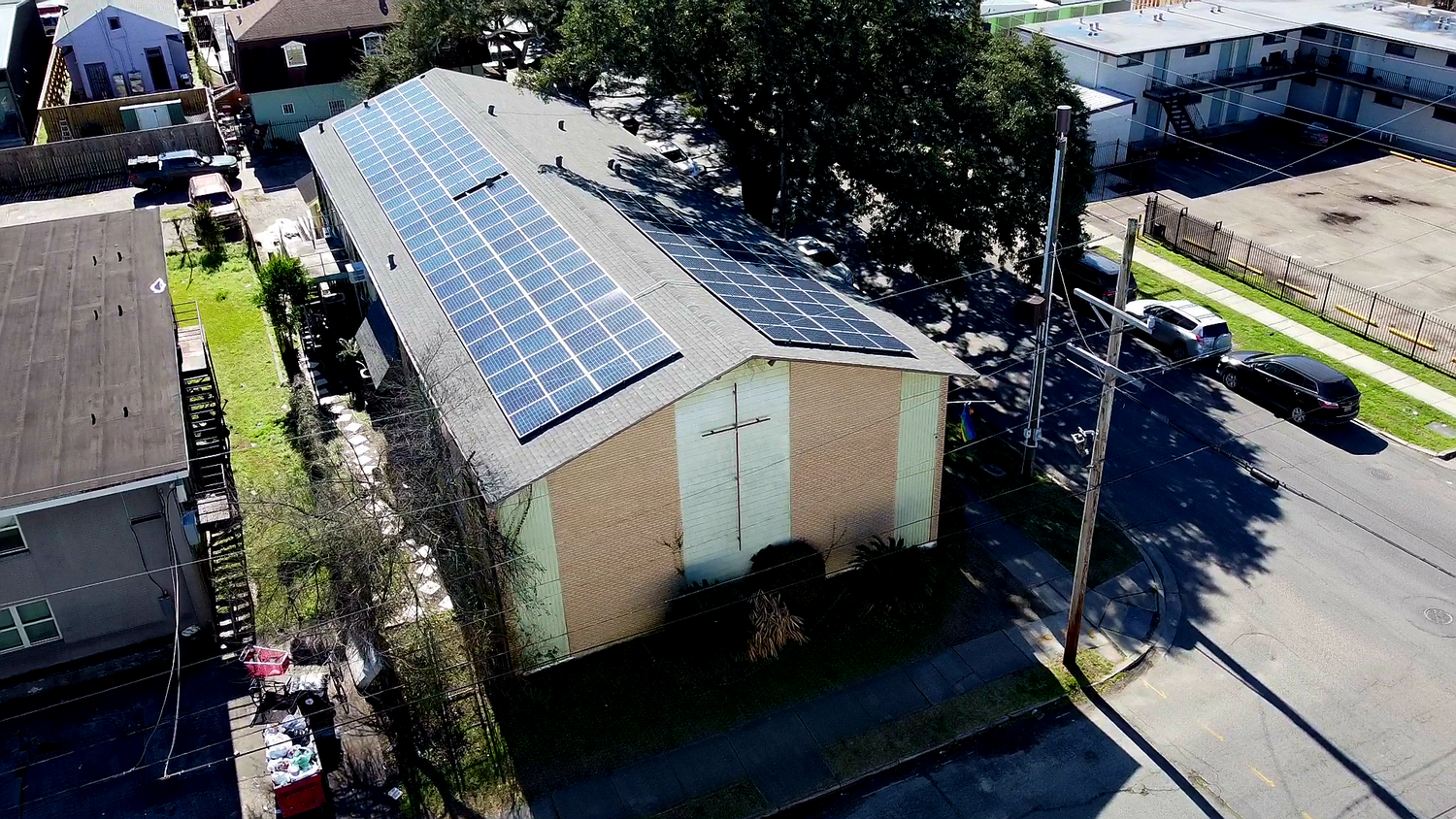
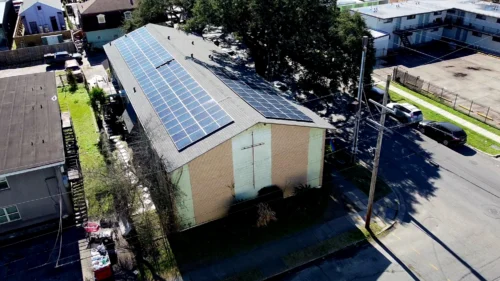
The Community Lighthouse initiative is disrupting this pattern. Specifically, the initiative transforms community nodes like churches and schools into solar-powered microgrids with battery storage. These sites provide a critical lifeline where people can refrigerate medicine, charge wheelchairs, and find air-conditioned relief. By placing power generation directly on the buildings that use it, the project bypasses the long-standing weaknesses of the regional grid.
“Fundamentally, whether you’re a conservative oil and gas supporter or you’re a green environmentalist, disasters hit you just the same.”
Actively maintained social cohesion, not just technology, is the main driver behind the Community Lighthouse initiative. Cox emphasizes that the project is a fundamentally grassroots effort led by Together New Orleans, a coalition of 50 community-serving institutions. Rather than waiting for the government to save them, these communities organized first, forcing the government to follow their lead. This “muscle of engagement” not only created the Lighthouses, but it aids the city’s own disaster response by giving them a place to stage resources, knowing the Community Lighthouses are reliable, organized, and powered hubs.
“I’m hopeful that after these lighthouses continue to prove and demonstrate their worth in the next storm, which we know will come, I think the momentum will only build.”
“This technology is what’s going to allow your people to be able to survive and then rebuild.”
The project is moving to position the Lighthouses as hubs for deployable batteries. Approximately the size of suitcases, these portable units can reach homebound seniors who cannot relocate, keeping them alive with powered fans and medical equipment.
Cox views these and other types of batteries as the next frontier for energy resilience, and hopes they will soon replace gasoline generators, which can often fail as backups when local fuel supply is limited after storms. This shift toward localized storage ensures that even if the regional grid fails, individual buildings can help support essential, life-saving functions.
“If you’ve got this beacon in a community that’s within a reasonable walk, you give people a lifeline.”
With 15 Community Lighthouses currently operating and 13 more in the pipeline, the project aims to put every New Orleans resident within a 15-minute walk of a site. Reaching that goal requires a total of 86 lighthouses, a feat Cox believes is possible through persistent organizing.
His advice to other communities is simple: organize and build local power first. Whether dealing with landslides, wildfires, or hurricanes, community-organized and locally deployed solar and batteries offer a cost-effective, self-reliant way for communities to support themselves when central systems fail.
See these resources for more behind the story:
This is the 262nd episode of Local Energy Rules, an ILSR podcast with Energy Democracy Director John Farrell, which shares stories of communities taking on concentrated power to transform the energy system.
Local Energy Rules is produced by ILSR’s John Farrell and Ingrid Behrsin. Audio engineering by Drew Birschbach. Featured Photo Credit: Community Power South.
For timely updates from the Energy Democracy Initiative, follow John Farrell on Twitter or Bluesky, and subscribe to the Energy Democracy newsletter.
Oregon tries to tie utility profits to climate, cost, and reliability targets through performance-based regulation.
Rural electric co-op members should use this new toolkit to swap coal debt for clean, affordable energy.
NOLA’s Community Lighthouse initiative creates local hubs with rooftop solar and portable batteries to save lives after storms.
These plug-in devices bypass utility hassles to offer cheap, convenient power for everyone.