A Coal Town Digs Deep for Municipal Clean Heat — Episode 267 of Local Energy Rules
How did this coal town ditch gas lines, win grants, and make municipal networked geothermal the cheapest heating option?
What if all you needed to do to reduce your electric bill was to visit your local ACE hardware, buy a solar panel, bring it home, and plug it in to a standard outlet?
For this episode of the Local Energy Rules Podcast, host John Farrell is joined by Kevin Chou, co-founder and executive director of Bright Saver.
Listen to the full episode and explore more resources below — including a transcript and summary of the episode.
Apple Podcasts Spotify YouTube
Podcast (localenergyrules): Play in new window | Download
Kevin Chou:
One of the main reasons that I think will drive millions or tens of millions of people to adopt this in the United States will be this affordability issue, the ability to get one of these devices and save money with it.
*****
John Farrell:
What if all you needed to reduce your electric bill was to visit your local ACE hardware and buy a solar panel, bring it home and plug it into a standard outlet? That vision of easy to buy and install solar drove Kevin Chou to found Bright Saver and to work to make plug-in solar possible everywhere in the United States. We spoke in November, 2025 about this promising approach to make solar as easy as buying a new TV. I’m John Farrell, director of the Energy Democracy Initiative at the Institute for Local Self-Reliance. And this is Local Energy Rules, a podcast about monopoly power, energy democracy, and how communities can take charge to transform the energy system.
Kevin, welcome to Local Energy Rules.
Kevin Chou:
John, thanks for having me on. I’m so excited to be here today.
John Farrell:
Alright, I want to start off the way I do with most of my guests, which is just asking you what brought you to leading an organization that’s focused on plug-in solar? And I’m kind of curious, are there any experiences or insights from being a mobile gaming entrepreneur that translate to the policy work of making plug-in solar widely accessible?
Kevin Chou:
John, I’ve been doing consumer technology for over 20 years and my first company that I started when I was 26 built mobile video games. And at the time, the iPhone was just being released in 2007 and the app store was following shortly thereafter. And so my company built one of the first games for the iPhone. And at the time what traditional game developers said was the iPhone, this is a small niche device, it’s never going to be a great gaming device. The processor doesn’t have a GPU, the processor is slow, the internet connection is terrible. How are you going to build a great gaming experience on this device?
And what happened was by the time the next year’s model of iPhone came out, that model was 80% more powerful at the same price. And so we launched our first game and it was challenging to build in that for the second iPhone, but the next iPhone that came out was also another 80% better at exactly the same price.
And that just kept happening year after year and soon after three or four cycles, it became almost as good as a PlayStation or Xbox to develop a game on. And so that rapid iteration, because the volumes were so much higher than the traditional game industry, led to what we now call rights law and these learning curves that when we talk about a consumer product runs at such high volumes that the prices become incredibly attractive and will only generally go down year after year. And so when I think about energy and when I think about plug-in solar, I’m so excited about this idea bringing a consumer technology and distribution channels to energy where every year a consumer should be able to expect for the same amount of money that you could get more energy, more storage for the same price compared to last year’s model.
And if you think about that, contrast it with a utility where you only ever expect the price that you pay for energy to go up a little bit every year, hopefully in a best case scenario, we’re going to see these two curves diverge, where every year the price of the utility rates will get a little bit higher and that a price that you can get in a consumer appliance will decrease. And I’m just so excited about what that’s going to do to unlock energy abundance in this country and throughout the world. So that vision is really this vision of how do we allow somebody to go to an IKEA, a Walmart, a Costco and amazon.com and buy a safe device that they could plug into their house after doing a quick IKEA project and make that a reality and get that set up in a few minutes and plug it in. That really is the vision for what we’re trying to do here in America.
John Farrell:
I just have to say a quick tangent, and I’m just curious, will there be Allen wrenches involved for my plug-in solar project if I get it at IKEA?
Kevin Chou:
Yeah, you’ll probably have a couple of leftover parts too afterwards, but yes, that’s the vision.
John Farrell:
Kevin, I wanted you to give some sort of broader picture here. What makes plug-in solar such a great idea? You’ve already talked about one part and I’m so glad you did, about helping people understand the merger of consumer technology and energy here that the vision is this gets cheaper over time in contrast to the way we mostly experience energy costs right now. But hopefully you can talk a little bit about how this works and what it can do for people who are energy burdened, paying higher bills. What can it do for the climate that may be a typical rooftop solar or community solar project, where you are either signing a contract or working with a contractor either can’t do or can’t do as well?
Kevin Chou:
Yeah, I think there’s three different dimensions that plug in solar I think is extraordinary. The first is just access. So rooftop solar is fantastic. I’m a huge solar fan in general, but you need to own your own home generally and you need to have your roof needs to face the right way. It needs to be a relatively new roof to be able to put solar on it. And plug-in solar is access for everyone else. So if you’re a renter, you can buy one of these devices, put it onto your patio, your balcony, in your yard, plug it in and take it with you if you move a year or two later. And so access is one of the first things. It just opens up to so many more people the ability to get solar.
The second is convenience. And I think even for people who are very motivated to get rooftop solar, it can be a very frustrating process calling around for different quotes, getting the installers and designers come going through permitting and interconnection. These are all processes that take a long time. So even if you’re highly motivated, you really have to have that motivation for a while to get you through the entire process. Versus plug-in solar, it should be a project that you read an article about it, you drive to Home Depot, you buy the thing, you do a 15 minute IKEA project, you plug it in and you’re done on the same day. So that convenience factor and not having to maintain, go through a month long frustrating process is really a key turning point as well.
And then the third point I think is affordability. And so in rooftop solar because of all the other people involved in those projects, they generally, there’s a lot of soft costs. In fact, soft costs are generally roughly 50% or more of the total final value of the rooftop solar and you get a lot of power for that, which is great. But for plug-in solar, we really eliminate all the soft cost and we sort of make it a DIY consumer product that somebody can go to the store, buy themselves do the labor themselves, plug it in, and so their ROI for these devices will be significantly higher on a percentage basis even if the energy generated is a bit less.
So those are, I think the things that are really compelling about plug-in solar and I think it’s a great on-ramp for people who are renters and earlier in their careers, for example, to get solar and then maybe when they buy their house a few years later, then they can already be familiar with solar in an upgrade into a bigger rooftop system.
John Farrell:
You mentioned about access being one of the key issues here. I’m thinking about not just renters but maybe low income folks that might benefit the most. Do you have any thoughts about how to particularly give access to those folks? I mean I think coming from consumer tech, I think you already understand this in a way that maybe others don’t. Usually what we see when the iPhone comes out is the first people who get iPhones are people who are wealthier, right? People who can afford them, but then it sort of starts to diffuse and then everybody gets access. I’m just kind of curious, is there any sort of way to put the thumb on the scale and really help get access to the people who are paying those really high energy bills right now?
Kevin Chou:
Yeah, I think that’s a great question. I think if you think about a policymaker today, what are the tools available? The tools available are basically direct assistance for a low-income community. And so basically it’s the teach a man to fish versus giving a man a fish every day analogy where you’re basically giving a low income community energy assistance every year, year in and year out. Versus in a world where you can give somebody a solar device that can last 15 to 20 years if not more, you then basically you turn this around and basically give the person a fishing rod and teach them how to fish. And so I think with low-income communities, you can’t really just give them a rooftop solar system. You might be able to say, Hey, we’re going to build a community solar project and we’re going to structure it in such a way that can help a low-income community.
And those do happen and those are fantastic, but I think this ability to take these consumer level devices and ride the cost curves down year after year, this is going to create so much more access for these communities. One for example, when you talk about the iPhone is that different markets tend to develop, so number one, you have, yes, every year there’s the new Pro Max whatever ultra thing, and that’s going to be the flagship and cost the most, but guess what? That last year’s model or the model two years ago that’s still being sold in some stores and those you could get a new one for dramatically less than what you would’ve paid the year before. And then even more importantly, a really robust secondary market starts to develop where you could go onto eBay or there’s all sorts of different secondhand markets for phones where you can get an almost like new or gently used phone for a fraction of the price.
And so all of those kind of markets develop that you lower the price for more and more people to be able to afford this. And then with the safety certifications that I think are absolutely important for plug-in solar, then when you start getting the ability to ensure these products, you get the ability to take a loan against these products and with the ROI being that much better than other comparable energy products, you just have the ability to take a loan and immediately generate positive cash flow with these devices, which I think is such a compelling, it’ll be the first really consumer product where you generate positive cash flow immediately in several states. And I’m really excited about that.
John Farrell:
Something I wish we had more conversation about, I’ve been thinking about this for years where we talk about comparing solar loans to car loans and the same thing, right? As soon as you drive that car off the lot, everybody says it depreciates thousands of dollars and here’s something that actually pays you back.
Kevin Chou:
That’s right in the world of car, obviously if you need that car to get you a job, there is a quote ROI for that. But that is obviously really important for a lot of people. But a lot of people get cars for so many other reasons and not all of them are kind of ROI positive, whereas the main reason there’s obviously climate or resilience reasons for you to get a plug-in solar device, but one of the main reasons that I think will drive millions or tens of millions of people to adopt this in the United States will be this affordability issue, the ability to get one of these devices and save money with it. And I think that will be it. One of the first products that will have such a clear ROI where you could say, Hey, it costs me X dollars to buy this and I’m making Y dollars every single month with this product.
And the projections and work that we’ve done on our white paper, that payback will get to be two to three years nationwide without any subsidies, even with the ITC going away. We’re going to see that type of ROI, it will essentially be the best financial investment you can make as a household. And so that’s why I’m really excited this and that’s why we see, I think in Germany or other parts of Europe and Pakistan, I mean there’s a lot of different reasons why solar is growing so fast, but one of the main things is just it’s becoming one of the cheapest form of energies that you can get and we’re going to turn that into a consumer appliance for people.
John Farrell:
I think it’s so interesting and it makes so much sense that you have this background in consumer tech and are this advocate for plug-in solar because I think about the evolution of computing technology. We had mainframes, it was basically like they were for businesses, they were for large entities, they required a lot of centralized management, then they were personal computers. Now with phones, we basically have computers in our pockets and everybody has one. As you alluded to, if you want solar in the prior world, I got to call a contractor, I need to work with bids. There’s a lot of overhead in doing that. Now you’re talking about just getting to go to the store. I guess one of the things I’m actually kind of curious about is in what way might this actually be helpful competition for rooftop and community solar — if this becomes something where people can just go out and get it? You kind of alluded to this already. One potential relationship is this is like an onboarding for people. So they get some plug-in solar, they see that it has a good return and they’re like, oh, I’m really excited about figuring out how to put this on my house. But I wonder if it also might help maybe inject a little bit of competition into the market to say, oh, if it’s so cheap for someone to go to Costco or Home Depot or IKEA and get a solar panel, maybe we need to figure out how to drive down the costs of rooftop solar to make it more competitive.
Kevin Chou:
That’s a great point, John. And we’re actually really excited. We work with a number of other advocacy groups all across the country in the work that we do. And one of the other organizations that we’re really excited about partnering with is called Permit Power. And what they try to do is automate the permitting process, which basically takes away a significant chunk of the soft cost for a rooftop solar installation. And so I think you’re exactly right, the more competition that’s out there and the more ways and methods that we can develop to get energy safely into the hands of people, and especially with this distributed energy type of model, I think we’re going to see just more innovation come to the market that should benefit everyone. And I think one of the things to know about the legislation that we’re running across the country is that we’re generally limiting these to some relatively de minimis form of power.
So in Utah, the first state that we were successful in, the limit is 1.2 kilowatts. We’re generally running that in most of the states that we’re working with because if you take a 15 amp a circuit, you’ve got a lot of safety headroom to put 1.2 kilowatts into that circuit. 1.2 kilowatts is nothing. It will certainly power all of your appliances, it’ll power your coffee maker, it’ll power your lights, your refrigerator, it’ll power your baseload for sure. But part of my hope in seeing energy abundance and seeing energy costs come down generally is that if we can switch to a world where we’re driving EVs, we’re driving electric bikes, which I personally love, and we switched to heating and cooling, that’s also driven by electricity. I think we’re going to see the energy usage of homes in general sort of creep up. And so I think while 1.2 kilowatts is a great starting point for the current base loads for a house, I think even with one EV, I think a household would want to see, Hey, I love what I’m getting out of my plug-in solar device. I have the ability to get rooftop solar. I’m ready to take that step now because I’ve had such a great experience with my plug-in solar. I think it will be of a nice complimentary onboarding for rooftop solar over time.
John Farrell:
That’s a helpful comparison there at 15 amp, so for people who don’t live in the electric world, a 15 amp circuit is basically like that’s what most of the plugs in your house are. So we’re talking about being able to put panels on one of those basically in one of those plugs. And I think it’s also good context, like the 1.2 kilowatt maximum. So just for some context, I got an eight kilowatt solar array installed almost 10 years ago now, and right after that we bought our first electric car and almost immediately it was not enough to provide for all the electricity that our home uses between air conditioning and we have an electric stove and whatnot, and then we got a second plugin car after that. So the solar is certainly helpful, but at this point, yeah, I think it’s good to nod at the fact that we are hoping to increase electricity use in homes because ultimately it’s a much less costly and more efficient way to power our economy in addition to having a lot of climate benefits.
Kevin Chou:
Yeah, absolutely. It sounds like you need a much larger solar rate than if you’ve got two cars.
John Farrell:
I feel like I’m in the jaws moving and I’m like, we’re going to need a bigger roof is my problem.
*****
John Farrell:
We are going to take a short break when we come back, I ask Kevin why we need policy for plug-in solar, how it compares to rooftop or community solar, and whether the overwhelming political support in the Utah legislature could be replicated in other states. You’re listening to a local Energy Rules podcast with Bright Saver executive director Kevin Chou. Hey, thanks for listening to Local Energy Rules. We’re so glad you’re here. If you like what you’ve heard, please help other folks find us by giving the show a rating and review on Apple Podcasts or Spotify, five stars if you think we’ve earned it. As a bonus, I’ll gladly read your review aloud on the show if it includes an energy related joke or pun. Now back to the program.
*****
John Farrell:
I want to talk a little bit about the policy change. You kind of talked about just now, the limit that’s being set in order to make this feel reasonable, get it accommodated within the energy regulation system specifically around the safety stuff. So I am plugging this into an outlet in my own home. You’ve just kind of talked about the limit that you set in the Utah legislation is essentially protective of I’m not even plugging in enough that I could override the amount of capacity on a single circuit. And the plug-in solar panels have the same kind of safety features that rooftop ones do, which is that they shut off when the grid goes down and they’re not going to send electricity out in a way that could harm electrical workers. So what kind of safety stuff is needed? There’s a part of me that’s just like why do we need regulation at all? This is lovely. People can go out and buy solar panels, plug them in, what could possibly go wrong?
Kevin Chou:
That’s right. There are certainly areas of the world where that’s going to happen in emerging markets. We see this happening in Pakistan, not because there’s been policy put in place to enable distributed solar, but it’s just taking off because there’s such a great need and the economics are so good for distributed solar. I think in developed countries we are going to need the right policy. So in the United States in particular, every single state has a natural monopoly that the state grants to organizations to develop power. And so this has happened because in the early days you would see in New York a single block, you see multiple competing companies put up power lines, and it was determined a long time ago that this is inefficient, it doesn’t look good, it’s potentially dangerous. And so this regulatory framework got established and it rolled out across all 50 states.
And so now for any state, if you’re going to generate any source of power, generally the utilities will have a rule that says you can’t do this without an interconnection agreement to the utility. So that’s really the first barrier that we identified as if the utilities, yes, you can do this at a small scale and for prosumers who are pretty electrically savvy, they can go do this thing, buy some parts, cobble it together, and that’s possible even now. You can see YouTube videos where people do this. But I think if we’re going to get to that world where tens of millions of people, hopefully even more are doing this and it becomes an everyday acceptable thing, we’re going to need the right policies that basically create a form of exemption from interconnection for these small de minimis generators.
So the analogy I like to give here is if you’re going to get on the road and you’re going to drive a car, we say rightfully so that you need to go take a test. You need to learn the rules of the road, you need to go through the licensing requirements, and that all makes sense if you’re going to drive a car that has the ability to create significant harm. But if you’re going to get on a bicycle and you’re going to go down the road, we just allow people to do that because it’s just a different class of vehicle. And I think that’s what we’re seeing here for energy generation is that rooftop solar with eight kilowatts, you’re putting a significant source of generation in place that could be potentially dangerous, whereas if you’re going to put 1.2 kilowatts into play, that’s more of a bicycle and that people should just be able to do it and that’ll be great for everyone. So that’s really the thinking behind how we came up with this and we looked at Germany a lot for the inspiration and how fast this can develop when the right policies are in place.
John Farrell:
Yeah, I really appreciate the analogy to the road there about the ability to do harm as the scaling for what are the policy protections that are needed or not needed in this case in order to implement it. I think that’s really insightful. Can you talk a little bit about, one of the things we have a lot of fights about in the policy world is how do we compensate people who generate energy on their own property? So how does plug-in solar fit in with things typical rooftop solar compensation methods? People probably listening to this podcast, you’re familiar with net metering. There might be things like value of solar and also how do batteries potentially fit into this? Now that we’re talking about relatively small scale consumer devices, people can get those and plug them in as well.
Kevin Chou:
So very much consistent with the bicycle analogy. We try to make a economic differentiator for these class of generators too. So typically for a rooftop solar system, whether it’s net metering or some sort of feed-in tariff arrangement with the utility, the utility installs a new meter to be able to accurately measure the amount of energy coming from your residence back into the grid and then to compensate you for that. That economics has been a key part of making the overall return for a financials of a rooftop system work. And with this plug-in solar approach, because we take out so much of the soft cost and solar has just in general decreased to a price point now that’s so competitive, we make the case that if there’s any excess energy being generated by these devices that are then being fed into the grid, utilities, you just get this for free because it’s exempt from interconnection, you don’t need to put in a new meter, which number one costs money, which number two also takes a bunch of time to get a truck roll up to the residents and for what? These devices are generally self-consumed energy or if let’s say there’s a bright sunny day and you leave for lunch, well, maybe there’s a little bit of energy flowing back to the grid, but it’s de minimis amount in that as a utility you should get this for free.
So we try to really frame this in a way that is quite different from rooftop solar from an economics point of view, and we hope that that has generally been one of the things that makes this legislation really popular with the lawmakers that we’re working with.
John Farrell:
It’s useful to see that you’re able to avoid some of the politics around some of these other forms, although there is a little bit of bitterness in my heart about giving the monopoly something for free, Kevin, but I will let it go.
So, you mentioned before, Utah was the first state to give its blessing to plug-in solar and that the legislation also passed with overwhelming majorities. I was kind of curious, is this the advantage of surprise? Nobody’s heard of this before. I’m worrying that incumbent utilities, even if you’re saying there’s some free energy that you’re getting off of these occasionally have the same incentive to go after plug-in solar as they do any other kind of consumer owned stuff like rooftop solar or community solar. Do you anticipate the politics changing around this or do you feel like, oh, the scale of this in terms of individual project size is likely to at least have utilities sort of pay at no mind or be neutral on it? I guess I’m just thinking too like it’s going to be natural for lawmakers to go to utilities and ask them, what do you think of this? I’m curious if you have any thoughts about what they might say about it or if you’ve had them speaking up publicly about it yet.
Kevin Chou:
We field a lot of questions from utilities all over across the nation. I am positively surprised by the wide diversity of utility companies and their incentives. And so I think we have states that have upgraded to a more modern form of policy and regulations for utilities where it’s not just taking CapEx and saying, all right, you get to take that CapEx, earn a rate of return and then charge that to rate payers. We have states like Hawaii that have created a multifaceted scorecard that says, Hey, utilities, we want you lined up with all of the things that our citizens care about and that’s how you’re going to be compensated as a utility. We have utilities that are in areas where there’s challenges to add more energy to the grid, and they tend to be really focused on peak shaving and demand response efforts and really finding really creative and innovative ways to do that. And of course then we have deregulated markets like Texas that create a lot of interesting innovations as well.
So I think that at the end of the day for utilities in states, we’re going to see some states where solar is just not a big factor in that state. Utah’s a great example. If I can recall the stats correctly. I think roughly 1% of Utah homeowners have solar, so it’s a very small market. The utilities in Utah generate a lot of energy from hydro and other sources. And so you’re absolutely right to characterize Utah as probably a state where the utilities were like, yeah, that’s probably okay I guess. It just kind of slipped under the radar. And I think there’s going to be a few dozens of states kind of like that where there’s just not a whole lot of market activity of solar in that state thus far.
Then we’re going to see states like the state that I live in, California, where solar, the solar industry and the utilities have been battling for quite a while, and those states are going to be hard battles. And so I think we expect a big fight and we also think about how do we get as broad of a coalition to bear and then try to find the right lawmakers to champion this. So we call that inside game in terms of how do we work with the legislators and their staff to get them excited about this, to understand the politics around this? And then we think about the outside game where how do we use media? How do we talk to communities such as your community, John, about why this is such a good thing and try to get popular opinion on our side to really give the lawmakers more fodder to go into that fight and fight behind the scenes of what’s necessary to get these types of bills introduced and then passed into law.
John Farrell:
It is really heartening though, I think when I think about California, so much of the battle there has been around solar compensation and to some degree your approach here with plug-in solar diffuses that because you’re essentially saying if there is excess, it’s free. You don’t have to pay us for it. And that really is fundamental to the arguments, which I’ve unfortunately spent a lot of time getting very deep into and trying to understand. So I do think there’s an opportunity there.
That actually reminds me though, I did want to make sure that you got a chance to talk about how batteries might work here. I assume that we’re talking about as well, having batteries be a consumer device now that I can buy alongside plug-in solar, they can only help improve the economic, I mean, you already have a two to three year payback, which is amazing.
So maybe people who don’t have a lot of money are, well, I’ll start with the solar panels, I’ll come back for the batteries. Other people might be like, I’ll buy batteries on day one because I hate the idea that any of the energy that I generate on that sunny afternoon when I’m out getting coffee or whatever is going back to the utility. How might that work? And I guess I’m kind of curious about this in a few different facets too, if you’re able to talk about it. One would be the economics. What does adding batteries look like? Another one would be how does it work technically? Am I saving the energy from the solar panels on that circuit and then the battery is just supplying energy to that circuit? Can I strategically use that battery in some way to make sure that my refrigerator, if it’s not on the same circuit as the solar would be available if the power goes out? Just yeah, talk to me a little bit about how batteries might work with this.
Kevin Chou:
Yeah, we could probably spend quite a bit of time on batteries. I’m so excited about batteries. I think at the end of the day, the grid should just be a big battery and that we should be able to, if we think about a world where there’s a lot of distributed energy generation sort of everywhere, then what is the purpose of the grid? The grid is to be a battery in the case that people need more energy than what they’re generating locally. And so I think lemme start with the economics first, and I’ll talk about the technical aspect. On the economic side, we see batteries having a learning curve. That is one of the steepest in terms of energy technology. It’s of course being driven by EVs, but also utility scale batteries and lots of other things. And so batteries have been falling about 30% for every doubling of capacity of batteries.
So it’s even steeper than photovoltaic, which is decreased by about 20% on the learning curve basis. So we’re seeing batteries drop quite a bit in China right now. You can buy a retail battery for less than a hundred dollars a kilowatt hour. In America, if you search online and you try to get some Black Friday deals or whatever, we might be able to find these at $400 a kilowatt hour. And I think doing some analysis, we wrote a white paper at Bright Saver with a bunch of great collaborators, given your utility rate for states like California, when a battery falls to about $400 a kilowatt hour, that’s when batteries really start to become economically viable for deployment. And so we’re seeing that in states right now. And so in California for rooftop solar, I mean there’s also the net metering battle here, but the rooftop attachment with batteries is very, very high.
And I think in Germany we see with these plug-in solar devices that their attach rate for batteries with the plug-in solar is well north of 50% already in 2024. And so I think at 2025, we haven’t seen the numbers yet, but I think we’re going to see battery attach rates be well north of 50% for the whole year of this year.
Batteries, I think do a few things. One is that economically, we’re at that state where plug-in solar and batteries as Germany preceded us by about four years. And so I think if we think about plug-in solar taking hold in 2026 in the United States, we’re going to see batteries generally become economically viable in most states that are thinking about legalizing plug-in solar. And I think we’re going to see from a technology standpoint that it’s really interesting. It provides resilience, it provides more economics if you’re on a time-of-use rate plan for example.
And it just has a lot of benefits of being able to use your energy more effectively or increasing what we call the self-consumption rate. If you’re just doing solar, if you’re not using that energy as we talked about, you’re basically sending that back to utility for free and you’re not making any money off of it. But if you’ve got a battery now, you can just store that energy and then use it during the evening hours yourself without giving it away for free. And so I think with the batteries, what we’re going to see is that solar is going to come in, it’s going to feed the battery directly, and then the inverter will then sit between the battery and the plug. And so you’re going to say the battery will then discharge into the inverter, which will then turn it into alternating current and then feed that back into the outlet and into the rest of your house.
And so it’s just a very simple way to basically use all of the energy that you’re generating for yourself. And then the other thing I think we’ll see other innovative uses like Hela is another great company that’s creating these much smaller batteries that you can plug in. You can kind of slide in between a major appliance and the plug like your refrigerator. And so you could see a solar system feeding in electricity into the house and then batteries all throughout the house storing that energy and then be able to run it, run appliances when there’s a grid outage or run appliances when the sun goes down. And I think we’re going to see all sorts of use cases of that as the cost of batteries decline.
John Farrell:
That’s awesome. Kevin, I want to wrap it up, but I wanted to just ask you one last question, which is, if I hear this podcast and I get excited about plug-in solar in my state, what should I do?
Kevin Chou:
Well, we’re working with a few organizations to create online petitions and that make it really to figure out who your state legislator is that’s representing your district. And we certainly encourage people who are passionate about this to call or email their state legislators, a call is even more effective. So we have to recognize that a lot of state bills get very, very little attention. And so even a couple dozen calls to a state legislator, which is again a significant notch down from even a congressman, for example, when a state legislator gets a couple dozen calls from their constituents and they hear, Hey, I’m excited about this bill that’s being introduced in my state, I hope that you’re going to support it. That does a tremendous amount for a lawmaker in a state to consider a bill that they might not have really thought about before. And so we’re going to really try to get out the word next year.
So this year, the work that we’ve been doing right now has been a little bit behind the scenes where we’re working to find the right champions in each state to author the bill, and then introduce the bill. That generally happens in the January time period of a year, and then from January through May, that’s where phone calls to your state legislator can have a huge impact to get these bills across the finish line. And so that’s where people can do, who are excited about this.
John Farrell:
Well, Kevin, thank you so much for bringing this concept to the US and getting people so excited about it. I’ve been hearing a lot about it in the last six to 12 months, so it’s really lovely to have a chance to talk to you about the work that you’re doing and about the potential for plug-in solar to really make solar more accessible.
Kevin Chou:
Well, thanks for having me on, John. And then I probably should have added that you could go to brightsaver.org and in the new year, we’re going to point to some resources where you can easily find your state legislators for the states that have announced legislation. And my guess is that we’ve announced five states already for 2026, which is New York, Pennsylvania, Maryland, Vermont, and New Hampshire, and I think we’ll have potentially a dozen more states that will be running legislation in 2026, and hopefully we can encourage the listeners here to come out and support these bills if you’re excited about what we’re talking about for plug-in solar. Thanks for having me on, John.
John Farrell:
You’re welcome. And I’ll just say one last thing that I’m making a plug for Alabama to be on your shortlist because if anybody needs help having an alternative to their incumbent utility, it is folks who are paying bills to Alabama Power.
Kevin Chou:
We’ll get on it.
John Farrell:
That’s great. Kevin, thanks again. Really appreciate it.
Kevin Chou:
John, thank you.
*****
John Farrell:
Thank you so much for listening to this episode of Local Energy Rules with Kevin Chou, executive director of plug-in solar advocacy organization Bright Saver. On the show page, look for a link to the Bright Saver white paper mentioned in our discussion. We’ll also have a link to some ILSR resources discussing ways to reduce the cost and barriers to rooftop solar.
Local Energy Rules is produced by myself and Ingrid Behrsin with editing provided by audio engineer Drew Birschbach, tune back into Local Energy Rules every two weeks, hear how we can take on concentrated power to transform the energy system. Until next time, keep your energy local and thanks for listening.
Hey, hold on a sec. I know that’s usually our signoff, but you’re still here. And that means we share an interest in great research and storytelling to advance energy democracy. So keep in mind that you can support this work at ilsr.org/donate. Nice. Now I wonder what it’ll start autoplaying next.
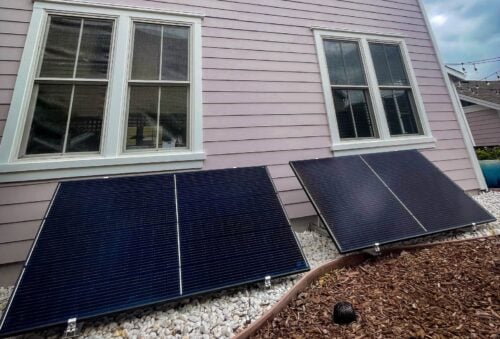
Plug-in solar is a safe, do-it-yourself (DIY) consumer appliance that allows individuals, including renters, to purchase, set up, and immediately begin generating power by plugging solar directly into a standard outlet. And it’s set to revolutionize how Americans power their homes.
Kevin Chou, co-founder and executive director of plug-in solar organization Bright Saver, is a former mobile gaming entrepreneur, and has seen the same consumer electronics get cheaper and more powerful year after year. He predicts the same will happen for plug-in solar, forecasting that consumers can expect solar efficiency and storage capacity to improve annually for the same price.
This downward pressure on solar and storage costs stands in sharp contrast to the steady rise of utility rates. And with plug-in solar, people who don’t own their homes or can’t put solar on their roofs can take advantage of these savings.
“The main reason that I think will drive millions or tens of millions of people to adopt this in the United States will be this affordability issue, the ability to get one of these devices and save money with it.”
Plug-in solar makes accessing solar more affordable by eliminating the “soft costs” – the non-hardware expenses – which often account for 50% or more of total rooftop system value. This savings increases the return-on-investment for plug-in solar users.
Unlike traditional rooftop solar, which usually requires home ownership, a specific roof orientation, and a relatively new roof, plug-in solar is accessible to everyone. Renters, for instance, can install a device on a patio or balcony and take it with them when they move.
The added convenience stems from being able to totally skip the frustrating, months-long processes involving quotes, installers, permitting, and interconnection associated with standard rooftop systems. Instead, users can complete the project—buying, setting up, and plugging in—on the same day.
“Payback will get to be two to three years nationwide without any subsidies, even with the [solar investment tax credit] going away.”
These small-scale solar devices promise to be one of the best financial investments a household can make. Chou projects that a payback period of just two to three years nationwide, even without subsidies, will soon be the status quo.
For low-income households, plug-in solar can mean instant and dependable economic relief. The device immediately reduces electricity bills, and is a long-term solution that can reduce dependence on annual energy assistance plans that can precariously hinge on state and federal policy shifts. States can play an active role by subsidizing plug-in solar for low- and moderate-income households upfront.
Batteries, whose costs are declining rapidly, can further boost the economic viability of plug-in solar. They allow users to store any excess energy instead of sending it to the utility for free, improving self-consumption, especially during evening hours or for those on time-of-use plans. In countries like Germany, battery connection already exceeds 50% among plug-in solar users.
“It will essentially be the best financial investment you can make as a household.”
Widespread plug-in solar adoption depends on smart state policy. Advocacy groups are currently focused on creating policy that exempts these small electricity generators from mandatory utility interconnection agreements.
This exemption is crucial because utilities typically hold a state-granted monopoly on power generation that allows them to control access to the grid. Treating a small 1.2-kilowatt plug-in solar unit as a “bicycle” with little barrier to entry allows it to bypass the stringent interconnection and permitting regulations applied to an 8-kilowatt rooftop system – the “car” of the analogy.
To ease political tensions, proponents propose that any (minimal) excess energy that a plug-in solar device feeds back to the grid be gifted to the utilities in order to avoid complex, politicized battles over net metering compensation.
To ensure plug-in solar legislation passes in New York, Vermont, and other states, constituents should contact their state legislators to voice their support. Even a few dozen calls can dramatically influence the outcome of these statewide bills.
See these resources for more behind the story:
This is the 261st episode of Local Energy Rules, an ILSR podcast with Energy Democracy Director John Farrell, which shares stories of communities taking on concentrated power to transform the energy system.
Local Energy Rules is produced by ILSR’s John Farrell and Ingrid Behrsin. Audio engineering by Drew Birschbach. Featured Photo Credit: Kevin Chou.
For timely updates from the Energy Democracy Initiative, follow John Farrell on Twitter or Bluesky, and subscribe to the Energy Democracy newsletter.
How did this coal town ditch gas lines, win grants, and make municipal networked geothermal the cheapest heating option?
Who should pay for upgrades to the high voltage transmission network?
San Diego may be the only city to have secured upfront funding from utility shareholders to make clean energy cheaper.
Oregon tries to tie utility profits to climate, cost, and reliability targets through performance-based regulation.