A Coal Town Digs Deep for Municipal Clean Heat — Episode 267 of Local Energy Rules
How did this coal town ditch gas lines, win grants, and make municipal networked geothermal the cheapest heating option?
Hundreds of US cities have utility franchise contracts that govern the utility’s relationship with the city. But San Diego may be the only one to have secured upfront funding from utility shareholders to meet local priorities like providing solar to low-income residents.
For this episode of the Local Energy Rules Podcast, host John Farrell is joined by San Diego City Councilmember Sean Elo-Rivera.
Listen to the full episode and explore more resources below — including a transcript and summary of the episode.
Apple Podcasts Spotify YouTube
Podcast (localenergyrules): Play in new window | Download
Sean Elo-Rivera:
The general idea that SDG&E needed to be taking, not rate payer dollars, but their profits, their shareholder resources, and investing them in the city. That was important to us.
*****
John Farrell:
Hundreds of US cities have utility franchise contracts that govern the utility’s relationship with the city, but as far as I know, San Diego is the only one to have secured funding from utility shareholders to meet local priorities like providing solar to low-income residents. Joining me in January 2026, San Diego City Council member Sean Elo-Rivera explained how they won a major concession in the city’s latest franchise negotiations, and he explained the importance of cities preparing well to negotiate these infrequently renewed contracts with large corporate utilities. I’m John Farrell, director of the Energy Democracy Initiative at the Institute for Local Self-Reliance, and this is Local Energy Rules, a podcast about monopoly power, energy democracy, and how communities can take charge to transform the energy system.
*****
John Farrell:
Councilman Elo-Rivera, thank you so much for joining me on Local Energy Rules.
Sean Elo-Rivera:
Thank you for having me.
John Farrell:
I love to start off by just asking people how they get involved in what are often sort of weedy topics that they come on this podcast to talk about. So I was kind of curious what drew you to it in your role on city council and whether or not energy was an issue that you came to the council interested in working on.
Sean Elo-Rivera:
Yeah. I came to the city council by way of my work in the community. Immediately prior to being elected, I ran a nonprofit where I worked with young people to organize and advocate for changes that they wanted to see in their community. Prior to that, I worked at a nonprofit, a neighborhood-based nonprofit where again, worked with community members to organize and advocate for changes that they wanted to see in their community. I was inspired to run for a position on the San Diego Community College board of trustees, doing that community work, registering students to vote, have their voices be more heard and represented at the community college district, and politics, it’s a crazy world and very unexpectedly the seat that I currently sit in went from looking like it would be an uncontested or barely contested reelection campaign for my predecessor to a longtime serving a congresswoman announcing her retirement, my predecessor deciding to run for that seat, and then a number of folks encouraging me to run for this position.
So I’ve done the best that I could to continue that community work from the seat of the city council and in terms of energy. Yeah. One of the things that we talked about very explicitly in our first run for office and in re-election, it was about a clean and healthy environment for everyone in all neighborhoods. I represent the most diverse part of San Diego, and I mean that in every sense of the word, race, religion, national origin, immigration status, socioeconomic status. All of those things are very diverse within my community, but there are some things that are maybe not universal, but close to universal desires for folks, and one of those is to have a clean and healthy environment that they live in, and we know that where we get our energy from and how we power things plays in a very important role in the health of our communities and the long-term wellbeing of not just the city of San Diego or the state of California, but the planet as a whole.
The last thing is, I actually, I said this when I was running for office the first time and continue to believe it, that while the challenges of climate change can seem almost overwhelming at times and the problem almost too immense to address, the solutions are actually quite exciting when you think about them at the local level, what they mean for a community, the cleaner air, the lower utility bills, the good jobs that can come from that. And I think that that part about being able to envision what the world looks like if we were successful in procuring and producing more clean energy and putting that into the hands of everyday people. That’s very exciting to me.
John Farrell:
I love the background and the way that you connected in the community and the youth and to your interest here, and I especially like the way that you gave that context of it’s exciting to think about what we can do at the local level to fight climate change. I’d love to then get right into the issue here. So many cities that are served by for-profit utility companies have these so-called franchise contracts that are between the city and the utility. These contracts can be 20, 30, 40, 50 years between renewals. So what were some of the important issues for the city when San Diego was negotiating its latest renewal? What was on the table?
Sean Elo-Rivera:
Well, the issue just landed on our laps. Very, very early in our first term, the franchise became one of, if not the, dominant city issue in the context of this was 2021 at that time, and we were in the midst of a global pandemic that there’s a lot going on, but in terms of municipal issues, the franchise agreement was front and center. I chaired the environment committee, so a lot of the run up to the ultimate decision ran through my committee, my longstanding relationships with some of the climate activists and climate organizers in town and working in coalition with them. And from my previous work, my personal beliefs about not just the importance of having cleaner energy but making it more affordable for folks and detaching what is a basic human need from a purely profit-driven model. Those were important beliefs of mine, and unfortunately, we were at the end of a 50 year franchise agreement that had very little to no work done by the city side to prepare us to be in a good position for maximum leverage and maximum options as a city. So we had to navigate that negotiation and ultimately the decision from a place of having far less than ideal circumstances to negotiate from it, in my opinion, and the city being in a tough spot in terms of workforce capacity, per capita revenue in comparison to other big cities, San Diego’s being quite lower than other cities that are major American cities. Those all played important factors in the decision that was ultimately reached.
John Farrell:
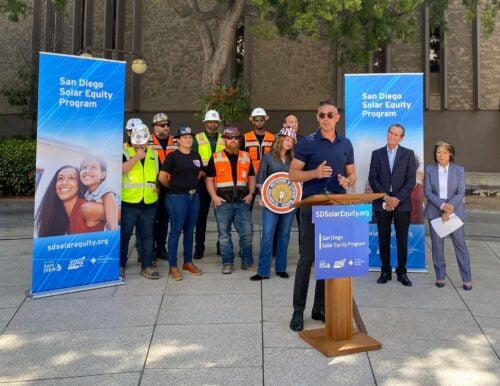
One of the things I thought was amazing, and really my interest in interviewing you is that so many of these franchise negotiations have taken place a lot of times in the context of public power campaigns where folks are actually hoping the city will take over the utility company or take over the service from the utility company, but San Diego won a concession maybe even more amazingly now in the context you give about the sort of sense of not having been well prepared for it, you got this $10 million commitment to a low income solar effort that’s called the San Diego Solar Equity Program, and most notably, the investment is not coming from city coffers or from utility customers, it’s coming from utility shareholders. I just would love if you could talk a little bit about how that idea even came forward and how the city did generate the leverage or the trade-offs in order to win that provision.
Sean Elo-Rivera:
Yeah, so in the run up to the decision, there were obviously very, very, very strong loud voices on both sides. There was a strong call to fire SDG&E as the advocates say and to pursue the municipal route. There were lots of voices also in supportive of keeping SDG&E as the franchisee. And in that conversation, if you’re listening to stakeholders, you can start to draw out what is important to folks. And we had a few different things that we thought were important and from a broader perspective than just the solar equity program, the general idea that SDG&E needed to be taking not rate payer dollars, but their profits, their shareholder resources and investing them in the city, that was important to us. So that starts as kind of a principle and then what those dollars fund is one of the details that needs to be sorted out.
I want to give credit, one of my colleagues, Councilmember Campillo, he actually, I think probably said it before me about the solar program specifically. Where I came in probably most aggressively was on a couple fronts. One was when these dollars needed to hit the city, and that wasn’t just a solar equity program, we also required a commitment to the city’s climate equity fund. And similarly, I wanted those both paid on the front end of the deal, what was on the table in front of us, put these investments on the backend of a 20 year franchise and meaning in order to opt out at 10 years, we wouldn’t see any of those investments necessarily. And so I made it clear early on that there was an expectation shared early on we didn’t see progress, but on the day of the vote, and this is one of those, a little bit of a peek behind the scenes because it was COVID and we were not back in council chambers, the meetings were happening on Zoom and the conversation looked different than it would look like on a dais, and I represent District nine, which meant I had to sit and wait my turn the ninth of nine council members, while my eight colleagues all took their shot at stating what their position was, what they wanted.
And when it got to me, it was actually, it seemed to be four four, and that seemed like an important moment to ensure that the community would actually see the benefits that were being promised and see them in a meaningful, tangible way that wasn’t ultimately going to be used as a bargaining chip against the city, but instead as a real win for the community. And certainly the solar equity program is an important part of that. This is a way of creating an opportunity for everyday people to secure the solar energy that they may very well otherwise not be able to afford that would’ve a tangible benefit on their lives. And again, that climate equity fund was super, super important to us as well because those dollars result in investments in communities that are most vulnerable to climate change and have historically been under-resourced, and we were able to push that money forward and ensure that it gets into the hands of the community without it coming from the rate payers who can’t afford to pay more than they already are.
John Farrell:
Yeah. How much money did the utility put in the climate equity plan? I wasn’t aware that there was a second program that they were funding.
Sean Elo-Rivera:
The number’s going to come back to me.
John Farrell:
Yeah, no worries. We can circle back. Let me just ask you about the solar equity program. Can you talk about who runs it? What does it do exactly? What’s the impact been so far with that money being invested upfront?
Sean Elo-Rivera:
Yeah, yeah, yeah. So the equity program, it’s a $10 million, 10 year program. There’s an income qualification for it. It’s run by the Center for Sustainable Energy. They’re the program administrator and the runup to that. Our office worked closely with council member Campillo’s office and the mayor’s office and SDG&E to ensure that this was going to be, again, a thing that folks could actually access. And it’s always nice to see the physical, tangible results of the programs that we fund, especially for folks who we’re talking about working families and middle class families. So to see them be able to have that rooftop solar and what that’ll mean for their families has been great.
John Farrell:
Do you have off the top of your head, sorry to put you on the spot with and ask you about a number, but how many folks have been able to benefit from it so far already?
Sean Elo-Rivera:
I don’t know that number off the top of my head. Funny enough, you asked me that. And so the other number, it was 20 million for the Climate Equity Fund, so I remembered that one. And apologies for not remembering the number of folks who participated in the program. We’re going to keep looking. We know that in the second year of the program, there was 38 projects, average incentive being $25,000 with a $960,000 value to homeowners upfront value. And about 90% of those folks were under 80% or less of the area median income.
*****
John Farrell:
We are going to take a short break when we come back, I ask council member Elo-Rivera, what else felt like a big part of the franchise negotiations for the city and what advice he has for other cities and his successor city council members in preparing for future negotiations. You’re listening to a Local Energy Rules podcast, the city council member Sean Elo-Rivera from San Diego’s ward nine.
Hey, thanks for listening to Local Energy Rules. We’re so glad you’re here. If you like what you’ve heard, please help other folks find us by giving the show a rating and review on Apple Podcasts or Spotify, five stars if you think we’ve earned it. As a bonus, I’ll gladly read your review aloud on the show if it includes an energy related joke or pun. Now back to the program.
*****
John Farrell:
These are two, I think, huge wins and frankly in the context of other franchise conversations across the country, really historic because most of them do not have a feature like this of utilities actually putting money into anything frankly. And utilities often squirm a lot about the idea that they might be asked to do any kind of investment like that. These are obviously very big things. Were there other things that felt like they were a big part of the franchise negotiations? For example, you mentioned this kind of 10 year exit thing, and that actually became important in the negotiation about how the money would be dispersed, but I was curious if there were other important priorities that the city had had.
Sean Elo-Rivera:
So from my perspective, ensuring that the city was going to be in a better position to hold SDG&E accountable was super important. And that accountability comes in different forms. It comes in SDG&E having to show up to council on an annual basis and answer questions and hear from the council and give the public a chance. As I’m sure the folks who listen to this know the rates themselves. We don’t have a say over that as a city council and as a city and everyday people, they don’t know that or care, right? They know that their bill is going up and we’re the decision-making body that it feels closest to them. By having those conversations and requiring SDG&E to come and meet with the council, I think it makes it more difficult for SDG&E to kind of hide behind the Public Utilities Commission and to avoid public scrutiny.
That was very important to us. The time component of this is important as well. Making it short enough in duration where we would be able to demand a certain level of service for our residents, a certain level of responsiveness, responsiveness to the concerns they express, whether that’s around affordability or safety or anything else. And SCGE being a better partner to the city was also super important. At the time of the franchise agreement, and this is something that I ultimately wasn’t able to get a concession on, there were major disagreements about who would foot the bill for certain infrastructure projects when SDG&E equipment needed to be moved. And there was significant litigation between the two parties, and I was very candid in saying that I didn’t think SDG&E was being a good partner to the city, and their willingness to be as litigious as they’d been, even as the franchise agreement was coming to an end, was a demonstration of the lack of work the city had done to give ourselves options and prepare for that moment.
Outside of the deal itself, one thing that I’d asked for alongside a couple of my colleagues, and we initially got a commitment from the mayor for and some investments via our budget in what we called an energy independence fund, which took some of those franchise payments from SDG&E and put them into paying for a study of municipalization. And the theory back then was to stash away some of the money that would be needed for it to pay an exit fee. So when the time came for the next round of negotiations included in the considerations for the city council that’s here at that time is not a scramble to find the money to pay that exit fee on top of everything else that goes into that, but there’s been some saving for that moment. So we’ve got that commitment. We’ve made those investments the first couple years the mayor pulled back that funding as our budget situation’s gotten more challenging here at the city. But those were all important factors to us. Again, responsiveness to community members, giving the council a direct line to SDG&E on behalf of the community and alongside the community. And then again, not sitting and waiting for the next round of negotiations, but kind of starting this agreement with the intent of positioning the city as well as possible to have the best options and the most leverage possible when that time comes.
John Farrell:
So you have a 10 year opt-out it sounds like, which I guess would be 2031. If you’re still on the council, then what do you have in mind that you want to bring up or what might be a high priority for you in terms of what you want to have on the agenda?
Sean Elo-Rivera:
Well, I won’t will be termed out. It was a very early decision in my time on the council, but a really important one and really needing to sit with one of the most important parts of this job, which is doing what needs to be done over the long term for the city. And sometimes that means, oftentimes that means positioning our successors to be in a better situation than we’re in, even if that means maybe taking a little bit less for ourselves now. And I think this is a really good example of that because everything that we were asking for is part of the kind of global agreement and the things that we’re asking for down the road are things that makes it a little bit more difficult to get things in the now. So we were able to get some things in the now: the climate equity fund, the solar equity program, but there are other things that I would’ve loved to see.
When that time comes though, the intent is for San Diego to be better positioned to demand more affordability, cleaner energy, and if those things can’t be delivered or committed to or won’t be by SDG&E or another potential bidder, then for us to have a real option in terms of having public power in San Diego. And one of the very important shifts that is occurring and will definitely have occurred from the moment that franchise agreement was signed to where we will be when the 10 year period runs to a close is the establishment of an expansion of San Diego Community Power, our community choice aggregator. And that I think is a very important factor and adds its very important dynamic to the energy conversation and power conversation here in San Diego. What I hope for is the city to be in the best, and this isn’t like a politician answer, it’s genuinely what I want, the best position possible to demand affordability, to demand clean energy and a deal that is in the city’s best interest rather than a multi-billion dollar corporation.
John Farrell:
Given what you experienced going through that, and I’m thinking right now maybe this is the chance this part of the podcast will be the part that you share with your future, your successor council member, what advice do you have maybe for other cities or for your successors on the San Diego City Council as they are going to be approaching utility franchise negotiations and maybe who are some of the important allies that you found within and outside of city government that helped you get some of the things that you were successful at winning?
Sean Elo-Rivera:
Yeah, I think the first one, and this is no secret for any negotiation or basically anything we do in life is to prepare for it, is to not wait until the last minute to build a foundation and create positioning that is beneficial to the city. If we’re dealing with a negotiation with a energy monopoly, we are dealing with a multi-billion dollar corporation whose sole job is to make money from agreements like this. And cities have a million things that we’re trying to do from keep the water running to keep people safe, to make sure there’s library books on the shelves in our libraries. And if you wait until the last second, the city’s ability to be on equal footing with that investor-owned utility is, I mean, it’s really hard to imagine that that’s going to be a real situation.
So make sure that you’re planning for it. Make sure you’re making moves to give yourself leverage and have a clear understanding of what the goals of the agreement are. Now, the goal determination, I think that’s the part that’s probably most important from the community perspective. Having a clear understanding of what are the most important things to come from this agreement for the community. Is affordability number one, and clean energy second, is it vice versa? Is it something else? Because once those priorities are established, that is the thing to lean into during those negotiations and everything that you’re doing to build leverage and create better positioning is with the intent of securing those wins for the community. And if there isn’t clarity about what those priorities are, then there’s a couple of risks you’re running. One is to just miss, is to do all this work and fight hard and get something that feels like a concession, and you bring it back to your community members and they say, well, that’s not what we wanted. It’s not what’s important to us in the moment, bad job. And then the other risk there is that you can’t be as certain that what you’re getting is actually the thing that you think you’re getting, if that makes sense.
So are we being specific enough in the language that we’re using around the concession that we’re asking for? Is it being delivered to us on the timeline that we want it to be delivered in and need it to be delivered in? Is it coming from rate payers or the shareholders? All of those details I think are incredibly important. And unless you’re doing that pre-work again of around positioning and leverage building and communication with the community, you’re running the risk of missing.
John Farrell:
Well, council member Elo-Rivera, thank you so much for joining me to talk about your terrific work on the franchise in San Diego. I’m excited about sharing it with all the other folks who are doing public power work across the country. There’s a couple dozen communities where public power and franchises have been on the table that we know of already, and many more I’m sure that will come across this and say to themselves, gosh, when does my agreement come due? And what might be on the table for us? So thanks so much for that work and for coming on here to talk about it.
Sean Elo-Rivera:
Thanks, John, appreciate it.
******
John Farrell:
Thank you so much for listening to this episode of Local Energy Rules with San Diego City council member Sean Elo-Rivera about the concessions won by the city during its last franchise contract negotiation with San Diego Gas and Electric.
On the show page look for a link to the San Diego Solar Equity Program website, as well as a recent interview with advocates from Public Power San Diego, episode 260, about their research on the affordability benefits of public power. We’ll also have links to a Local Energy Rules podcast interview with Randy Knight about how a well negotiated franchise agreement led to a successful public power takeover in Winter Park, Florida, episode 184, and also to the fourth episode in our public Power series, episode 167 that discusses franchise negotiations in Minneapolis and in Boulder, Colorado.
Local Energy Rules is produced by myself and Ingrid Behrsin with editing provided by audio engineer Drew Birschbach. Tune back into Local Energy Rules every two weeks to hear how we can take on concentrated power to transform the energy system. Until next time, keep your energy local, and thanks for listening.
In 2021 the city of San Diego faced a 50-year-old problem. Its utility franchise agreement with San Diego Gas & Electric (SGD&E) was expiring, and Councilmember Sean Elo-Rivera realized that his city was once-again ill-prepared to negotiate with a multi-billion dollar investor-owned monopoly utility.
Nevertheless, Elo-Rivera was determined to ensure that the new franchise agreement – a type of legally-binding contract that authorizes a utility to serve customers within a jurisdiction for a specific term, often spanning decades – would detach essential services from SDG&E’s entrenched profit-driven model. Despite the city’s initially weak leverage, Elo-Rivera and his colleagues turned the renewal process into an effective campaign for energy equity.
Elo-Rivera and fellow ratepayer advocates secured historic concessions like a $10 million Solar Equity Program and a $20 million Climate Equity Fund. The Solar Equity Program provides income-qualified working and middle-class families with the opportunity to install rooftop solar they otherwise could not afford, whereas the Climate Equity Fund provides investments for historically under-resourced communities that are most vulnerable to the effects of climate change.
“Being able to envision what the world looks like if we were successful in procuring and producing more clean energy and putting that into the hands of everyday people. That’s very exciting to me.”
Elo-Rivery challenged the status-quo by demanding these program budgets come directly from utility shareholder profits, rather than from ratepayer bills. Most importantly, he fought aggressively to have these funds paid upfront. This strategy ensures that low-income and middle-class families receive rooftop solar benefits now, rather than having to wait until the tail-end of the 20-year agreement.
Accountability advocates also made regular dialogue with the City Council a non-negotiable priority. Specifically, Elo-Rivera forced a provision requiring the utility to appear before the City Council annually to face public scrutiny. He believes this strategy prevents the company from hiding behind the Public Utilities Commission when it tries to hike up rates.
In addition, by securing a 20-year term with a 10-year “opt-out” clause, Elo-Rivera fought for his city to have a mid-point exit strategy if SDG&E fails to meet standards for affordability, safety, and responsiveness.
The strategy that Elo-Rivera and his collaborators employed wasn’t just about maximizing wins with the current franchise. It was also about ensuring future leverage. For example, they fought for and established an “energy independence fund” that can be used to finance municipalization studies and potential future exit fees.
“[Do] not wait until the last minute to build a foundation and create positioning that is beneficial to the city.”
His advice to other cities is to prepare early. By defining community priorities years in advance, cities can finally move from a position of weakness to one of strength against investor-owned utilities like SDG&E.
See these resources for more behind the story:
This is the 265th episode of Local Energy Rules, an ILSR podcast with Energy Democracy Director John Farrell, which shares stories of communities taking on concentrated power to transform the energy system.
Local Energy Rules is produced by ILSR’s John Farrell and Ingrid Behrsin. Audio engineering by Drew Birschbach. Featured photo courtesy of Sean Elo-Rivera.
For timely updates from the Energy Democracy Initiative, follow John Farrell on Twitter or Bluesky, and subscribe to the Energy Democracy newsletter.
How did this coal town ditch gas lines, win grants, and make municipal networked geothermal the cheapest heating option?
Who should pay for upgrades to the high voltage transmission network?
San Diego may be the only city to have secured upfront funding from utility shareholders to make clean energy cheaper.
Oregon tries to tie utility profits to climate, cost, and reliability targets through performance-based regulation.