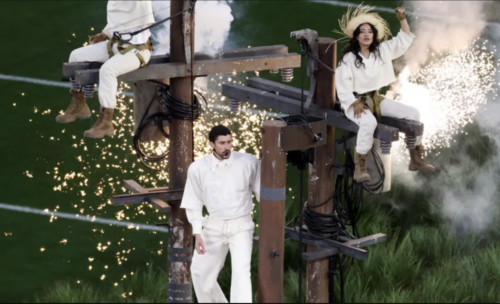
Pop music superstar Bad Bunny used an electrifying Super Bowl halftime performance of his song “Apagón” (blackout) to make a powerful critique of the U.S. government’s failure to properly support Puerto Rico’s electric grid. If you want a great thread explaining how Bad Bunny’s music and lyrics combine to make his critique, check out Becky Hammer’s Bluesky thread. You can also read some backstory on the island’s colonial past (and present) and how Hurricane Maria devastated its power infrastructure.
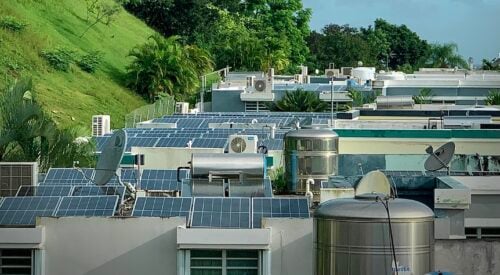
In spite of systemic abandonment by the federal government, Puerto Ricans are literally building their own power and climate resilience via local, distributed clean energy. Below are a few of their stories, as told on our Local Energy Rules podcast.
Marcel Castro Sitiriche, professor of electrical engineering and Co-Director of Cohemis at the University of Puerto Rico Mayagüez, explained in a 2019 podcast interview how localized power generation could help overcome some of the worst effects of Hurricane Maria (and the poorly designed island power grid). He explained why this powerful storm was able to cause a monthslong power outage: centralization of power generation, vulnerable long-distance transmission, and aging power plants that used imported fuel. Professor Sitiriche also noted that the residents who suffered most were those living in remote areas, where existing infrastructure was extremely vulnerable. He saw an opportunity to build resilience from the bottom up:
“We need to start with the rooftops. I call it the ‘bottom up grid approach.’ We need to build a new power grid starting with the rooftops of the houses and business and industry. Then we need to look at the community level… build microgrids. As you go up the bottom up grid, if you all have a strong system…other systems might not be needed,” explains Sitiriche.
Ingrid Vila is also an engineer, and helped found Queremos Sol, a coalition convened to provide a community-based alternative to calls to privatize the island’s grid (before the hurricane) and to demand that the hurricane recovery be used to fix the broader problems that made the grid vulnerable. She explained in a 2019 interview (and in a 2nd chat in 2021) how the Puerto Rican grid was undermined by corruption that diverted essential maintenance funds, as well as a misguided focus on using methane gas power plants instead of abundant, local clean energy to meet electricity needs. Like Professor Sitiriche, she saw privatization as a threat to meaningfully solving the problems with the island’s grid (Bad Bunny’s “Apagón” includes lyrics that translate to “I give Pipo a slap,” to criticize the former governor who approved the grid’s privatization). Queremos Sol published an in-depth report about the potential to rebuild the island’s power grid better:
“One of the greatest results from that study is being able to demonstrate that Puerto Rico’s resiliency, and individual home and community-level resiliency, could be quite different if money were put and focus were put on transforming the grid via renewable energy,” noted Vila.
The story of Puerto Rico continues to be one of abuse by the federal government and local resilience. The Trump administration recently canceled a $400 million grant meant to help 30,000 low-income households get solar and batteries. FEMA completely ignored the value of rooftop solar in its $12 billion grant to rebuild the island’s electricity system (although advocates recently won a court ruling that FEMA must revisit rooftop solar). Even the governor has been backsliding from renewable energy commitments that would reduce the island’s reliance on imported fossil fuels.
Some good news came recently from Javier Rúa-Jovet, Chief Policy Officer of the Solar and Energy Storage Association of Puerto Rico. In a 2025 interview, he explained how a distributed power plant program on the island has sown the seeds of a transformation. Small solar and battery storage systems, networked together, provide a combination of benefits: resilience for the host households and businesses, and more stability for the island’s grid. Over 70,000 households (five percent of the island) have enrolled in a battery energy sharing program that, fueled by hundreds of thousands of rooftop solar arrays, can provide a substantial amount of grid backup power in crucial evening hours.
To end his Super Bowl performance, Bad Bunny exclaimed, “seguimos aquí” — which translates literally to “we continue to be here.” Puerto Rican communities and community leaders continue to fight hard for (energy) independence on the island.
A Local First Approach to Rebuilding Puerto Rico’s Electricity System — Episode 77 of Local Energy Rules Podcast
In this episode of Local Energy Rules, Energy Democracy Initiative director John Farrell speaks with Marcel Castro Sitiriche about the challenges Puerto Rico faces in...