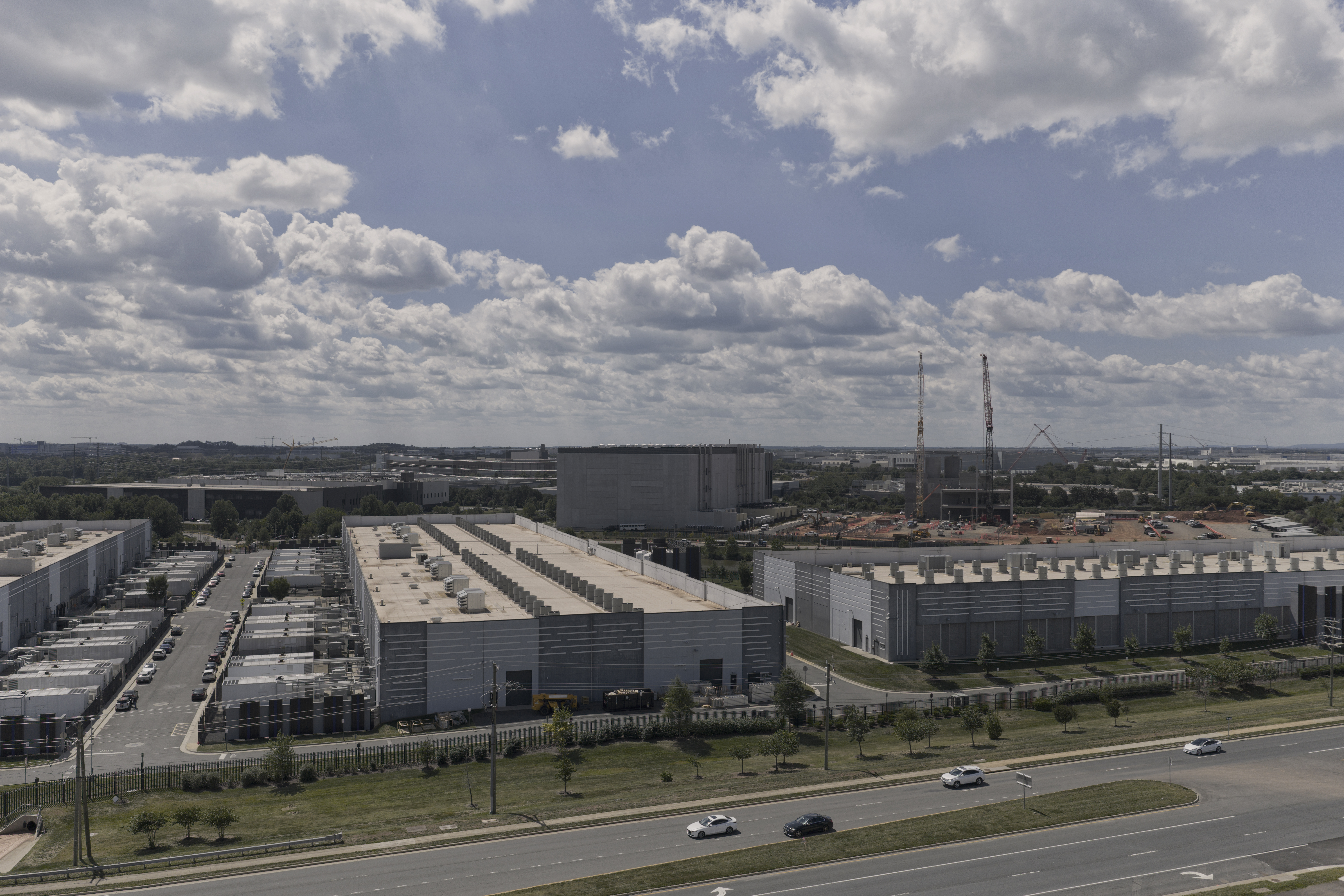
To consolidate control over generative AI and deepen their monopoly power, dominant tech firms are driving a wave of hyperscale data center construction that is colliding with communities nationwide. In response, the Institute for Local Self-Reliance has developed a policy framework to help communities reassert public authority, curb monopoly power, prevent public cost-shifting, and ensure digital infrastructure is developed transparently and in the public interest.
The massive wave of hyperscale data center construction underway today is not a neutral response to public need. It is a speculative race among a handful of dominant tech firms — Amazon, Google, Meta, and Microsoft — seeking to control artificial intelligence (AI) and extend their already formidable monopoly power. Together, these companies are projected to spend a staggering $700 billion in capital expenditures in 2026, much of it on AI data centers.
Other companies are playing supporting roles in this buildout. NVIDIA has profited enormously as the primary supplier of the specialized chips that make large-scale AI possible. Firms such as OpenAI and Anthropic are developing AI models, but depend entirely on the dominant tech platforms for both their computing and capital needs. Data center developers, private equity firms, and utilities are also racing to capitalize on the spending surge. Together, these relationships have reinforced, rather than challenged, the concentration of economic power in the hands of the tech giants.
The data center buildout is now colliding with communities nationwide. Tech companies and their developers are pushing into communities with proposals for massive facilities that demand enormous amounts of land, electricity, and water. They are often doing so with limited transparency, relying on non-disclosure agreements and closed-door political influence to secure permits and generous public subsidies. In many cases, these deals allow companies to shift infrastructure and energy costs onto households and small businesses. These facilities are often out of scale with the communities where they are sited, straining natural resources, driving up utility costs, creating persistent noise and pollution, putting neighbors’ health at risk, and degrading their quality of life.
The grassroots opposition to data centers, now widespread across the country, is not simply a “not in my backyard” reaction to development. It reflects a deeper frustration and anger: that a few Big Tech companies have amassed extraordinary power and are using it to steer the direction of the economy and society. Data centers have been key infrastructure of digital life since the 1990s, but not at hyperscale. Communities are now being asked to absorb the costs of building a generative AI future that is poised to eliminate jobs, expand surveillance, and provide corporations with new tools to manipulate prices and wages. Meanwhile, the gains will accrue to a small group of billionaires.
These concerns point to deeper questions about democracy: whether people will have meaningful control over their lives and communities, or whether we will be ruled by a handful of large corporations and Wall Street. Rising electricity bills, for example, may be attributed in part to new hyperscale facilities, but they are also the product of an electricity system that has long been rigged by monopoly utilities. AI isn’t simply a neutral, if disruptive, new technology; the imperatives guiding its development are set by a handful of unaccountable monopolies.
Addressing the impacts of data centers, therefore, requires more than project-by-project mitigation of local harms. Rather, it requires a policy framework that reasserts public authority, safeguards community self-determination, prevents public cost-shifting, curbs monopoly power, and ensures that digital infrastructure is developed in ways that are transparent, accountable, and aligned with the public interest.
1. Safeguard Community Self-Determination and Well-Being
Guarantee transparency and public oversight
States should ban non-disclosure agreements between governments and data center developers. Any proposed facility must be subject to full public disclosure, including its ownership, end users, electricity and water demands, environmental impacts, and any public subsidies or incentives.
Maintain local and state siting authority
Federal policy should not preempt the ability of states and local governments to restrict or reject data center development.
Require comprehensive impact review and local approval
States should require local governments to conduct comprehensive evaluations of proposed large-scale development projects, including data centers, in addition to environmental impact and other reviews conducted by state agencies. These evaluations should assess impacts on energy systems, water resources, the environment, public infrastructure, the local economy, and neighboring communities. Where projects have regional impacts, states should either enable or require review by regional bodies that represent multiple municipalities. States should also establish clear statutory authority for localities to deny projects based on these findings or to impose conditions to mitigate harms.
Establish high standards for public subsidies
States and localities should adopt high standards for any tax abatement, incentive, or public subsidy for development. These giveaways should be limited to projects that deliver substantial, broad-based local economic benefits, such as creating significant numbers of good jobs or fostering new businesses that meet local needs. Infrastructure that primarily serves the internal operations of large technology firms, including most data centers, generally does not meet these criteria.
Require data centers to pay their full cost of utility service
Data centers must bear the full cost of the infrastructure required to serve them, including generation, transmission, and distribution upgrades. Regulators should prohibit cost-shifting onto residential and small business ratepayers and require large loads to provide demand flexibility. All new electricity demand should be met with clean energy, with priority given to reducing existing demand — such as by paying nearby households to invest in efficiency — and to building distributed energy resources, such as community and rooftop solar and batteries located near the facility.
Impose and strictly enforce limits on air, water, and noise impacts
States and localities should adopt bright-line standards for water use, air pollution, and noise. Federal limits should serve as a floor, not a ceiling. Permits should include clear thresholds and automatic penalties for violations, including suspension of operations.
Require performance bonds
States and localities should require data center developers to pay into performance bonds sufficient to cover deconstruction and site reclamation should a data center cease operating.
2. Tackle Monopoly Power
Impose structural separations in cloud and AI markets
Amazon Web Services, Microsoft Azure, and Google Cloud control roughly two-thirds of global cloud infrastructure. These firms not only control the underlying computing infrastructure; they are also vertically integrated across the AI stack, owning or partnering with leading model developers (e.g., OpenAI, Anthropic), designing chips, and building end-use applications. Congress and antitrust enforcers should require structural separation between cloud infrastructure, AI model development, and downstream applications to prevent self-preferencing and foreclosure of competition.
Block Big Tech mergers and acquisitions
Amazon, Google, Meta, and Microsoft have all used acquisitions as a means of gaining an advantage in AI, rather than competing on the merits. The Federal Trade Commission and Department of Justice should block these acquisitions, including “acqui-hires,” in which a firm hires a startup’s key talent and licenses its technology rather than fully acquiring the company — an approach that can allow them to sidestep merger review. Congress should establish a clear statutory presumption against mergers by dominant digital platforms.
Regulate AI in the Public Interest
Federal and state governments should establish rules governing data collection, model training, and deployment, including clear protections for intellectual property and limits on the use of copyrighted and proprietary data in training. This includes prohibiting uses of AI that enable price discrimination, wage suppression, or invasive surveillance, and equipping regulators with the authority and technical capacity to audit systems.
Restructure the electricity system
State officials should separate the operation of the electric grid from the ownership and development of power plants to eliminate conflicts of interest. The entities responsible for running and planning the grid should be public. Electricity generation should be provided either by public entities or through robust competition among private companies, with clear performance standards tied to delivering clean, affordable energy, expanding local ownership of generation (e.g., rooftop solar), and enhancing system efficiency.
Prevent systemic financial risk from the AI buildout
AI-related development now accounts for a significant share of economic growth. This surge in speculative investment carries risk to the financial system. Tech companies are relying on circular financing: investing in one another and buying one another’s services to sustain growth. Data center buildout is increasingly financed through complex financial products and rising levels of debt, including private credit. Congress and federal regulators should step up oversight, limit leverage, and impose safeguards to prevent a crisis.
3. Build Small-Scale Distributed Alternatives
Support distributed, small-scale data centers
Many computing needs (though not all) can be met by — and benefit from — smaller, local facilities. Policy should prioritize and shape the development of a distributed network of smaller data centers that can serve local businesses, public agencies, and community services. This approach can reduce latency, improve system resilience, and enable data and processing to be managed by local companies or cooperatives rather than ceding it to dominant tech firms. Smaller facilities also make it easier to capture and reuse waste heat, for example, to heat nearby buildings.
Develop community-based computing infrastructure
Governments, public universities, and utility cooperatives should develop publicly or cooperatively owned data centers that serve public agencies, research institutions, and local businesses.
Leverage public procurement to shift the market
Federal, state, and local governments should use procurement policy to reduce dependence on dominant cloud providers and expand opportunities for alternative suppliers. Procurement policy should also set clear standards for security, interoperability, and data governance as a condition of public contracts.
Require community access
As a condition of approval, data centers should be required to allocate a share of their compute capacity for local use, similar to requirements that cable franchises provide local access television channels.
Special thanks to Reggie Rucker, Danny Caine, Susan Holmberg, Katie Kienbaum, Ingrid Behrsin, Ron Knox, Ry Marcattilio, Brenda Platt, and Lauren Gellatly for comments and suggestions.
BLP's new season, "The Data Centers are Coming," uncovers how deeply the data center conflict is steeped in America’s legacy of monopolies versus motivated communities.
The Hidden Costs of Electric Utility Monopoly Power with John Farrell
ILSR co-director, John Farrell, discusses his recent report on the costs imposed on society from granting private exclusive power over the public resource of electricity.