The Data Centers Are Coming: Ep. 2 – They Underestimated Us
A proposed data center galvanizes resistance in a small West Virginia community, sparking a fight over state vs. local control.
Welcome to Building Local Power’s “The Data Centers Are Coming,” where we journey to some of the most active places in the cross-country battle over data centers in our local communities. We start at the epicenter: Data Center Alley in Loudoun County, Virginia. This once semi-rural community has now been transformed by Big Tech’s sprawling data centers, sparking a fight for land, autonomy, and transparency from local residents. What does it feel like living there now? How is it impacting home values, affordability, energy and water usage, electric bills, and the overall well-being of the people who live nearby? We took a road trip to find out.
In this episode, we hear from:
Building Local Power host Danny Caine“Lots of people are looking towards Loudoun County, Virginia as an example. But the question is, an example of what?”
Reggie Rucker: [00:00:00] All right. I can’t even look. I’m having a hard time like sort of wrapping my mind around. These are just…
Elena Schlossberg: And look through that way. I mean, they just, it’s endless action.
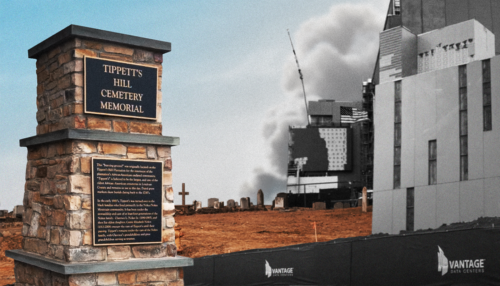
Danny Caine: Oh my god. That’s a cemetery right here.
Elena Schlossberg: That’s what I mean. Yes. This is, this is what I mean.
Danny Caine: This parking lot is filled with like barricades and construction dudes and electric vans and then wow. Whoa.
Elena Schlossberg: I mean, this is totally representative of what is — you have real death and then you have environmental death. It’s like, I’m really honestly surprised that more people are not — that when people understand it, they don’t just give up, because it would be easy to just ’cause, like, how do you fight this? But you know, I mean, from my perspective, we’ve come a long way.
INTRODUCTION: THE DATA CENTERS ARE COMING
Danny Caine: Welcome to Building Local Power, “The Data Centers Are Coming.” I’m your host, Danny Caine. In this six-part series, we’re reporting to you directly from the front lines of a fight consuming countless communities across the United States: the question of data centers and where to build them, what kinds of resources they’ll use, and who gets to make those decisions. These are not decisions in the abstract. The questions of where, when, and why to build data centers are questions that weigh heavily on everyday people’s lives in numerous ways. We’re here to tell that story and to search for some answers about how to do it right.
It’s worth saying off the bat that I am a proud AI skeptic. Of course, I’m aware that what we call AI refers to a broad range of technologies, some of which I used in the creation of this very podcast, namely things like automated transcriptions of interviews and spell check. But what has come to be known as generative AI is much more troubling to me. I’m an author, and I recently learned that one of my books, How to Resist Amazon and Why, was used to train Claude, Anthropic’s AI interface, without consent from me or my publisher. Here’s a technology that claims to be able to write, illustrate, design, and even think on its own, ostensibly replacing the labor of human writers and artists using my human writing to develop skills that could eventually replace the work I’m so passionate about.
Ethical questions about generative AI are worthwhile and important, but they’re for another podcast. In the process of learning more about this technology, I found another compelling story, one with immediate and concrete local consequences. While I feel lost and powerless when thinking about what to do about generative AI in general, this other story is all about immediate local action: what’s happening with data centers?
The massively popular technology of generative AI requires staggering amounts of computational power, a need that’s only exacerbated by AI companies’ relentless pursuit of scale at all costs. The power needs of this technology are so vast that few Americans at this point have been spared the consequences of the race for resources to power the tech, whether they use or care about the technology at all.
I have felt hopeless more times over the past few years than I really care to admit. The blatant, in-the-daylight rise of corporate power and political authoritarianism have left me feeling like there’s nothing I can do to fight back. What better metaphor for the rise of corporate power than a physical manifestation of a corporation? A huge warehouse with unprecedented thirst for electricity, water, land, and other resources. Talk about corporate power.
Many people are facing structural manifestations of corporate power — power in multiple senses, mind you — in their own backyards. I include myself in that, of course. In late 2025, my colleague at the Institute for Local Self-Reliance, Ron Knox, published a galvanizing article in The Nation about the wave of populist anger directed at data center development.
At the top of the article was a picture of a hulking, bland, apocalyptic looking building called the Cologix COL4 AI-ready data center. The caption said COL4 was located on a seven acre campus in Columbus, Ohio. I, too am located in Columbus, Ohio. Consulting Google Maps, I discovered that COL4 was less than two miles from my house on the north side of the metro. It’s across the street from my dentist. I drove up there to see it. It took me less than five minutes, less than the time it takes me to drive my son to his piano lessons in the same area.
Standing on an abandoned sidewalk looking at this huge facility, I felt an urgent need to learn more. So I hit the road. I wanted to see the heart of Data Center Alley, a corner of Northern [00:05:00] Virginia that’s known as the worldwide capital of data centers. I wanted to learn what it was like when data center development grows unchecked. I wanted to see what Big Tech’s dream for the American landscape looked like when these corporations were given a blank check. So I hopped in the car and pointed myself east.
An early stop on my journey was the home of Greg Pirio. A longtime resident of Sterling, Virginia, Greg lives in the heart of Data Center Alley. He’s heavily involved in neighborhood organizing efforts to hold a corporation called Vantage accountable for their data center’s noise and the lies they told about it.
He lives in a row of attached town homes in a sleepy alcove of this outer ring, Washington D.C. suburb. I’d call it quiet, but it’s not. Greg’s modest town home is in the literal shadow of a huge Vantage data center.
GREG PIRIO: AT HOME IN THE SHADOW OF A DATA CENTER
Greg Pirio: Well, our, our major impact is all the noise that it makes. This is the only data center in Loudoun County that has its own power plant. It’s not connected to the grid. It has gas turbine engines that make a lot of noise. Today is relatively quiet, but some days at my doorstep there are 70 decibels, which is in far excess of the county code for that. And then in addition to that, they have backup diesel generators that go on occasionally and make even more noise. Okay. It’s almost like having a couple of jet planes going off all the time near your house. And the, and, and the facility is only 150 yards from my front door.
Danny Caine: The data center noise causes all kinds of headaches for Greg and his
neighbors. Not only political nuisances, but actual health impacts.
Greg Pirio: People don’t hang out in front of their house as much anymore. Neighbors have
complained to me about headaches. At one time, I was taking care of my daughter’s dog and I
went for a walk, and I got a headache from the noise a quarter mile away. There’s somebody
who’s put mattresses up against his bedroom window.
And now he’s bought plexiglass inside his house that he puts up, which costs him $250 per
window so at night he can sleep easier. Some of the neighbors with kids whose bedroom
windows are near have complained their kids having a hard time to sleep. There’s one woman
who has come to our meeting who has had brain surgery, and she says, this gives her terrible
headaches.
Danny Caine: Greg mentioned that people don’t hang out outside anymore, which got me
thinking about how that impacts the community feel of the neighborhood. Not to mention the
potential for organizing.
Danny Caine: Like I’m thinking about, especially in terms of what you said about the power
and importance of neighborhood organizing.
If you have less people on their front porches, all
Danny Caine: of a sudden that work becomes more complicated and difficult. Right, because
so much of the fabric of a neighborhood is just like running into each other outside.
Greg Pirio: Oh, absolutely. Yeah.
Danny Caine: And so like the data center, it’s like in a way preventing neighbors from even
meeting or talking to yourself, right?
Greg Pirio: And then the sound blows it. You know, there are people who live half a mile
away who have showing up to meetings because it’s hard to predict how the sound flows.
That area is predominantly Hispanic, and now we have. Hispanics, many of them whom are
recent immigrants or children of recent immigrants, and now with all the anti-immigrant
policies of the federal government, it’s hard to get them to go to meetings. And they’re fearful.
They’re fearful. That’s an important dynamic that we have to solve too.
Danny Caine: Yeah, and that’s the government decisions. Limiting community engagement
on several levels. ’cause you’ve got the federal integration policies and then you’ve got the
local people building the data center.
When I asked Greg about how this loud data center ended up in his front yard in the first
place, he told me about a planning process that he claims was full of misinformation based on
what he heard. He says the data center was never supposed to be this loud.
Greg Pirio: We’re asking for our county supervisor, Sains and the at large Phyllis Randall to
have a meeting with us with representatives of Vantage, because we are hearing also that
Vantage says that they were gonna be connected now within three years to the grid.
But we don’t trust them at all. I reached out to our state, my state senator and his office, tried
to find out from Dominion Energy when that would occur and. They said, oh, we can’t
discuss that because it’s private. Between Dominion Energy, which is the electrical supplier
here, and with our client Vantage, they didn’t tell us that they were gonna have a power plant
[00:10:00] on site.
They showed us a building of which much smaller and that there were only diesel engines on
the far side of it within a few months. They got approved a much bigger one, and it has diesel
engines on both sides and has a power plant. It feels like bait and switch.
Danny Caine: This will come up again and again in our investigation.
The planning processes for these data centers is often opaque and designed to exclude the
public shell companies. Unpublicized meetings, corporate misstatements and misleading
claims are all common elements of people’s stories about fighting data centers. I wonder if
this will become even more common as opposition to data center projects grows across the
country. To Greg, this is all even more reason to get it right.
Greg Pirio: I grew up in Southern California when we regularly had smog alerts. I lived in a
town that had a steel mill. I know people who died from air pollution, who had asthma and all
that sort of thing. The thing about data center, it sounds all great, all this stuff that can be
done, but this is almost like a second industrial revolution. And so we really need to be able
to regulate how this happens and make sure that human values are in place.
Danny Caine: The view from Greg Pirio’s front stoop is dominated by that vantage data
center. Even on a quiet day, there was a deep industrial hum in the air. When I was walking
around out there in that corner of Sterling, it was always clear that I was very close to
massive and powerful industrial facilities.
It felt like standing near an airport. I knew there were many places like this in Loudoun
County, Virginia, which has fast gained a reputation for being the data center capital of the
world. A combination of factors including proximity to Washington DC, high capacity
electric grid infrastructure and local politicians in deep throttle of big tech in the data industry
have led to a huge change in the landscape of Loudoun County.
What was once semi-rural, far-flung suburbs of the nation’s capital have become heavily
developed industrial land. The building local power team wanted to see it firsthand. So we
enlisted the help of local activist Elena Schlossberg.
A DRIVING TOUR OF DATA CENTER ALLEY
Elena Schlossberg: So I have been on many an adventure in Data Center Alley. Okay. So,
uh, you’ll get the flavor of it.
Danny Caine: Elena is ready to talk data centers to whoever will listen deeply passionate
about the issue. She founded the advocacy Group Coalition to protect Prince William County
in 2014, aiming to prevent Loudoun County’s data center boom, from spreading to adjacent
rural Prince William. In the decade plus since Elena has become central to the data center
fight in Northern Virginia, along with my producers Ilana Nevins and Reggie Rucker.
I met Elena on a breezy day in January, 2026 in an Aldi parking lot in Haymarket, Virginia.
We climbed into her Ford Explorer and off we went for the Elena Schlossberg tour of Data
Center Alley.
Elena Schlossberg: When my husband and I bought our property in 2000, none of this
was here. There was a gas station and a McDonald’s, and that was it. This all appeared years
later, so it was much more rural, uh, which is why we bought here. So Prince William
County. Serves as a critical resource for a drinking water supply for about a million people in
Fairfax, Eastern Prince William Alexandria. And that’s because Prince William County is
very swampy, which I think is why it sort of got a reputation of being less than maybe
because it started out nobody wanted to live here.
Danny Caine: Our first stop on the tour was an Amazon web services facility in its
associated electric infrastructure. A campus that galvanized an early part of Elena’s activism
and organizing.
Elena Schlossberg: What we are about to drive by is the beginning of how we discovered
the kind of power that data centers required. To your left is a substation, and that substation
was built for an Amazon campus, which was hidden from the community, the application.
And you see that still today, that NDAs, non-disclosure agreements are. Utilized by your
planning staff, by local government, by state government, and it’s a way for the data centers
to stay hidden. This is the Amazon web services campus that triggered a massive extension
cord. That’s what we called it, because that’s what it was.
And you see how close these homes are to this AWS campus on Rose Lane.
Danny Caine: It’s hard to explain to you, listener, just how much these buildings dominate
the surrounding areas, standing on the sidewalk in front of people’s homes. The only way to
describe this Amazon complex was that it was looming over us, and it’s not even one of the
big ones.
These older data centers could be built like this [00:15:00] because the tech companies took
advantage of how unprecedented the technology was and the fact that municipalities and their
residents weren’t ready to define or contain them.
Elena Schlossberg: Data centers had no definition, so they were the same as like a Best
Buy computer store, so they could build anywhere basically with little to no oversight.
Danny Caine:Of course, it’s now widely known that data centers require exponentially more
resources than a Best Buy, and they’re only getting bigger. The current generation of data
centers are much, much larger than this, already huge AWS facility, and they’re sprouting up
everywhere across data center Alley. Later in our tour, Elena drove us by one of those huge
construction sites, all cranes and workers and buzzing activity. The site already had patriotic
decorations.
Elena Schlossberg: Okay, so I want you to take a look. See that American flag? Yeah.
Okay. Because data centers are patriotic and what you will see when we go through data
Center Alley, this is the antithesis of democracy, what we are experiencing. Just wanna say
that. And when we go through Data Center Alley, now, they all have them
Danny Caine:Later in the drive Reggie brought up a question about jobs. The question is
more than relevant, data center projects often pull massive tax breaks from local
governments, ostensibly, based on the promise that these projects create jobs.
Reggie Rucker: Say more about what that looks like and like why it’s a problem. There are a
lot of people that’d be, oh, well, isn’t there something about the age of industry that was good
for us?
Elena Schlossberg: I don’t know. Look at Pennsylvania and look at the industrial era of
the steel mills. How did that work out? These are robber barons on ster, like, hold my beer,
20th century robber barons. Let me show you how you absorb entire public utilities, local
government, state government, federal government. So once you understand and what this
industry is actually doing, then you cannot unsee it.
It’s like coming out of the matrix. So. The jobs, what jobs? Construction jobs. I’ve been in
land use almost 25 years. The jobs that economic development talked about historically were
the jobs on site, like Target will provide onsite hundreds of jobs.
You look in a data center for such massive buildings. Why are the parking lots so small?
Well, they’re all computerized. The people that are in the data centers are just, you know,
watching the computers, making sure that the air conditioning is correct, that the humidity is
correct, that the servers are operating.
So maybe a campus of 500,000 for each building might have, you know, like that campus
over in Haymarket. Those are, that’s a small campus. Maybe each building has 10 workers.
They don’t bring jobs and construction jobs are temporary jobs. You’ll see when we get into
data center alley buses that all like literally say construction.
They bring their teams with them. They have got it down to a science. They build the walls
on site, or they bring them, they’re all prefabricated. That’s the danger of also putting all your
eggs in this one basket is what happens. When this industry changes, how do you repurpose
these behemoth buildings?
So they’re not the jobs. And what you are hearing about now are all these college graduates
who are struggling to get jobs. They’re not bringing the jobs, people are losing jobs.
Danny Caine: Data centers are well known for their power needs. These huge and powerful
computers not only use a lot of electricity themselves, they require constant cooling in order
to function.
If power ever goes off, the machines overheat and the whole thing shuts down. I’ll pause right
here to share a thought. The whole dialogue around data centers and electricity hinges on the
idea that they can never, ever shut down. If you ask big tech companies, it’s absolutely
verboten for these to turn off ever.
I feel like I don’t hear the same urgency around power needs for say, hospitals, but is it really
more important for chat GPT to have more reliable electricity than ventilators? The amount
of electricity needed is truly wild. Later in this series, we’ll talk about Memphis, where Elon
Musk is planning the world’s largest data center.
The plan facility will use two gigawatts of power. That’s enough to power 1.5 million homes.
That’s enough to power all the households in the city of Memphis almost six times over.
[00:20:00] The consequences of hyperscale data center power demands are enormous. One
such consequence is that the electric grid in Loudoun County is oversubscribed, and any
added capacity is already claimed for years to come. That means data centers and the
corporations that build them have to get creative. Much to the detriment of the communities
these data centers are in.
Elena Schlossberg: So we’re gonna drive by a vantage campus that doesn’t wanna wait for
power. ’cause now it’s a seven year wait to get connected to the grid. And so what data centers
are doing is they’re creating these like bridges of micro grids using gas turbines, which are
akin to a jet engine.
Imagine living next to that. And so. Okay. Maybe you don’t care. Maybe you’re willing to
sacrifice somebody else’s quality of life ’cause it doesn’t affect you personally. But you know
what? When the utility bills are doubling and tripling, maybe then you’ll care.
Danny Caine: The data center in Greg Pirio’s front yard didn’t want to wait for grid power and
that’s why it’s generators are noisy enough to give Greg and his neighbors chronic headaches.
It’s worth noting why exactly. Data centers need so much power. The internet runs on data
centers, of course, and has done so for years. But new AI technology requires exponentially
more computing capacity, often referred to as simply compute. And the need for evermore
compute has led to the invention of new data centers called hyperscalers.
Why the demand for all this compute? A few of the biggest AI companies, anthropic open ai,
Google and the like, are currently in an arms race to build the most powerful large language
model AI systems. These companies are perhaps better known by their products. Open AI
makes chat. GPT Andro runs Claude and Google has incorporated Gemini into basically all
of its products.
At least for now, these companies have decided that the best way to build a more powerful
model is simply to build bigger models. LLMs are powered by huge data sets that are
analyzed for patterns and outputs. Like Claude or Chat GPT are based on that pattern
analysis. The bigger the data sets, the more powerful the model.
So the companies need more and more computing power to handle ever larger data sets. Not
only are the data sets larger, they’re also sloppier. According to Karen Hao’s definitive book,
Empire of AI earlier, AI data sets like the one Anthropic built in part by stealing my book,
were focused on curated high quality data.
As the AI scale race heated up the luxury of curating data disappeared in AI models.
Basically ate the whole internet according to how OpenAI built chat GPT on articles and
websites that had been shared on Reddit and received at least three up votes on the platform.
By the time chat GPT-4 rolled around data needs were so much higher that OpenAI gobbled
up whatever they could find on the internet, scraping links shared on Twitter, transcribing
YouTube videos, and cobbling together a long tail of other content, including from niche
blogs, existing data dumps, and a text storage site called pastebin. That’s how you get issues
like Elon Musk’s grok, spitting out simulated child pornography.
Some of the biggest AI companies no longer care about the quality of data they feed their
models, motivating these corporations even more than simple market share, is the fact that
each wants to get to general artificial intelligence first. That’s a tricky term to define, but if
you ask them, it’s the endpoint of ai, a self-aware, truly intelligent machine. Each company
thinks they’re the only ones that can handle AGI Responsibly.
Each company thinks all the other companies will use a GI for nefarious means, and so
they’re each desperate to scale up until they’re the ones that reach whatever a GI means.
That’s how we get to a place where these companies can’t build data centers fast enough.
That’s how we get to a place where there’s not enough electricity in the world to power this
effort.
That’s how you get to a single industry completely remaking the landscape of Northern
Virginia. That’s how you get to what we saw as we dramatically climbed a Virginia Highway
off ramp into a landscape I can only describe as apocalyptic.
Elena Schlossberg: Okay, now we are entering. You wanna get your cameras out, we’re
going into the belly of the beast.
We are going into data center alley, where everything you will see is data centers. So when
you go over this overpass, everything in front of you is data centers. As far as the eye can see,
and this is 26 million square feet
data center development, and this is all joking aside, a mental health crisis for people that are
looking at this and thinking about their one investment and terrified that this is what is in
front of them. Noise. The constant noise. [00:25:00] It’s awful. The construction of data
center development, it’s the last thing…
Danny Caine: Everything is just covered in dust.
Elena Schlossberg: Yes.
Danny Caine: These cars are covered in orange dust, like a, like post nine 11, like ash. This
Elena Schlossberg: is like apocalyptic. So these are like getting to three story, two and
three stories. ’cause don’t forget, a data center story is 37 feet tall. So when they say, oh, we’re
only one story, it’s not really one story.
Danny Caine: Every bit of the landscape here is shaped by the data center boom, including
cemeteries. After circling around a data center alley for a few deeply unsettling miles, Elena
steers us towards Tippets Hill Cemetery.
TIPPETS HILL CEMETERY
Elena Schlossberg: When we talk about impacts, it goes from the beginning of when
people get married. These churches in Old Town, Manassas have an Amazon campus behind
them and it is awful. And then all the way to death, nothing is sacred.
I just lost my mom in January. I say just it feels like, just like an awful, always feel like just in
January of 2023, she’s buried. Not far from me. This beautiful cemetery that is surrounded by
two conservation easements. The second one is just recent, but I picked it because I knew
there would be no data centers and that she would love it.
And I tell you, not for everybody, but for me, and I’m sure other people when they go to visit
someone that they really loved, like it’s a sacred moment. It, it really is. And you’ll see the
best of the worst. And then the worst of the. So Tippets Hill is the best of the worst. It’s a
historical African American cemetery, but it also, um, is still active in that there are still
burials that occur.
There are people still bring flowers, and so that is the part of the Vantage Data Center
campus, and they’ve put up a s they kept a buffer around it, so it is. It is the best of of the
worst because when we get into Gainesville, you’ll see how atrocious it can be.
Danny Caine:This brings up a question for me. Big tech companies will often toss some
relatively small benefit towards the communities that they’re building in, like rehabbing a
public park or like Vantage building an obelisk in the parking lot at Tippe Hill Cemetery. I
ask Elena what her take on these deal sweeteners is.
Elena Schlossberg: vantage, I think. Understood. Definitely the industry is very conscious
of pretending to look like they care. We’ll give you a park, we’ll buy you computers for your
kids. At some we are gonna pollute their air and chat. GBT may want, you know, convince
them to, you know, jump off a second story window, but we’re gonna give you some tablets.
So, you know, there’s definitely an effort to. Do that. So Vantage, and it’s actually, for them,
it’s like cheap pr. They put up an obelisk and then they keep some trees. It’s like when you
hear the data center industry talk about, we pay our electricity, we pay our fair share. Well
like, do you pay your electric bills? I pay my electric bills. I don’t expect an award or a prize
and I don’t make anybody else pay for it.
Danny Caine: Even though Tippets Hill represents allegedly the best case scenario for data
centers encroaching on sacred ground with Vantage’s minor upgrades to the site, it’s still
shocking to see a small historic cemetery in the middle of, well, all that.
Danny Caine: God, that’s a cemetery right here!
Elena Schlossberg: That’s what I mean. Yes, this is, this is what I mean.
Danny Caine: This parking lot is filled with like barricades and construction dudes and
electric fans and then Wow. Whoa. Runs the cemetery and like what was their reaction to,
Elena Schlossberg: I think this was the best they could get. And trust me, like you still
see, uh, some trees are out. I mean, but look at all the vines, all the like, they haven’t planted
new, it’s just full of brush and like these trees are dying. I mean this is totally representative of
you have real death.
And then you have environmental death. It’s like, I’m really honestly surprised that more
people are not, that when people understand it, they don’t just give up because like, how do
you fight this?
From my perspective, we’ve come a long way. Uh, you guys are here, right? And that’s what I
think, and that’s why I keep doing the tours because at some point [00:30:00] before it’s too
late,
Reggie Rucker: Of course, maybe outta the barn like here on this one. But to let this be a
cautionary tale, like don’t, like, don’t let your community be next.
Elena Schlossberg: Yeah, the cumulative impacts that all of this is having on everyone,
whether you live next to it or not, we’re all gonna feel it one way or another. And of course,
you know, people who were enslaved do not have actual markers. You’ll see very specifics.
Stones throughout here that are where people were buried.
Reggie Rucker: I was thinking about the gross disrespect, but like rest in peace. Oh. Like, I
mean, no, you don’t. You don’t get that. You will get no peace.
Elena Schlossberg: No, there’s no peace for the living. There’s no peace for the dead.
Yeah.
Danny Caine: Standing in that bizarre and frankly disturbing cemetery, it’s easy to feel
overwhelmed, but as widespread as data center construction is spreading in parallel is
resistance to ai corporation’s attempts to transform the American landscape. There’s some
evidence that this resistance has surprised people with that its strength and spread.
Elena Schlossberg: They miscalculated, they underestimated the level of anger that the
community was feeling watching their entire future be industrialized.
THE RISE OF THE RESISTANCE
Danny Caine: The anger against the spread of data centers has coalesced into a wave of
community organizing around the issue. Elena makes an interesting point in saying that the
coalitions forming around data centers are broad and effective because the issue is so new
that mainstream partisan talking points have yet to form, allowing people to make up their
own minds.
Elena Schlossberg: There was already a foundation for people to align on this issue, and
so that has been the superpower. I was in a meeting last year with a group that was definitely
progressive and they were just now coming to this issue and one of them said, you know, it’s
great because nobody’s party has told them what to think. Correct. And I was like, exactly.
And that’s where the data center industry missed the boat. They just miscalculated. Imagine
the wealthiest corporation in the world. Imagine they get to utilize your public utility to take
your property. It is a feeling that is hard to describe. It makes people really, really, really
pissed off because we work really hard, whether you own a quarter of an acre, whether you
own an eighth of an acre, whether you own 10 acres, it’s yours. You worked hard for it.
The property we bought was overgrown with brush and ivy and you couldn’t even walk
through it. My husband rehabilitated that property tree by tree by tree. It took him over five
years. Allergic to poison ivy. So he’d cut a vine and then he’d come back, bought this
50-year-old tractor, he labored, and we’re supposed to give that up for a transmission line. Oh,
no, no, no, no, no. Let me just put on the old Rambo makeup, like I’m there with him and I
am like, like a peacenik.
But I mean, we worked really hard. Nobody built that house. We built it. Me pregnant was on
top of, you know, like the second store. I mean, like my husband left for four months after
nine 11 to live in a tent and had an eight week old baby. He came back to that house and that
it was done. I had a bed in the living room, people are connected to their homes. This isn’t
just a house and people are fighting for it, whether you live in a town home and the
transmission light’s gonna back up so that you can almost hang your laundry line. Or you’re
on 10 acres or more. It’s everywhere in between. And then you have to pay for the
transmission line.
I mean, come on, nobody should be okay with that and then add in the diesel generators that
are gonna be kicking on. It’s all of it is so wrong, and that’s what people are fighting.
Danny Caine: The fact that this is all happening in Virginia brings up striking layers of
meaning and history. People have battled over this land since the United States. Were just an
idea. There’s the Battle of colonists stealing the land from indigenous people. There’s the
battle over [00:35:00] slavery and African Americans human rights standing in Tippet Hill
with its unmarked graves for enslaved people, it’s impossible not to think about the Civil War
battlefields a few short miles away.
The irony only stacks from there. In the 1990s in Haymarket, Disney was planning a civil war
themed amusement park called Get This, Disney’s America. Now some folks are working to
build data centers on that land. In Northern Virginia, not even history is safe from corporate
power. It’s as if tech companies are trying to steal land that was already stolen. American
flags hang from data center construction sites. The same story has been playing out for 250
years. But remember, the Boston Tea Party was an anti-monopoly protest. American history
has countless examples of land theft and corporate violence. Yes, but it also has countless
examples of localized uprisings against that corporate power, and those local uprisings can
turn national. Just ask Greg Pirio with the data center in his front yard.
Danny Caine: Do you see this kind of hyper-local neighborhood organizing as a step in that
direction? Is that the answer of how to start?
Greg Pirio: Oh, absolutely. I think what I’m discovering in this whole process is people don’t
know how to do this, like. In organizing the community, it’s like taking baby steps. They
haven’t been involved in the community and in government in this way. Mm-hmm. So getting
them out there and finding their voice is very important. It doesn’t happen overnight, but there
is a process of taking steps we’re trying to do is this petition and all this make progress, praise
those who are getting engaged, taking a stand and encourage them to encourage their
neighbors and all this. For me, it’s like a revitalization of, of democracy at the local level.
That is really key because in the United States we’ve lost so much of that over the years, and
especially with neoliberal ideology that the marketplace will solve everything.
We’re actually at a place where. It doesn’t. Mm-hmm. And so who’s gonna solve the problems
is a government responsive to the people. I’m that kind of person who says that every crisis is
an opportunity. And so it’s up to us to find that and to find our agency.
Danny Caine: So what’s the opportunity in this crisis?
Greg Pirio: Well, I think it is a revitalization of our democracy. It’s a lot of work, but it has to
be done. I’ve just seen throughout my lifetime, people standing up about the Vietnam War
ending that apartheid in South Africa. I mean, civil rights movement. I’m old enough to have
gone through that, and I see, you know, the kinds of positive changes that we can bring.
Danny Caine: What do you say to someone who. It’s like this isn’t Vietnam. This is a bunch
of data centers in one county in Virginia. How is this approach being equal importance with
those historical movements and events?
Greg Pirio: Let me quote, Martin Luther King, Martin Luther King. It was all about creating
a beloved community. Mm-hmm. And that’s a community where people look out for each
other, that they’re involved in politics for the greater common good. That’s done through
people getting involved. In community life and in politics and making alliances and moving
forward. That’s history and that’s how we move forward. What choice do we have? This is
where we, we can act.
Danny Caine: Elena takes the same long view that this moment is historic and to her history
will judge The local fighters is the heroes, not the tech billionaires.
Elena Schlossberg: I mean, really the real heroes of this entire saga that will be written
one day are the citizens just regular, everyday people who decided that something didn’t seem
right.
CONCLUSION: AN EXAMPLE OF WHAT?
Danny Caine: While Greg and Elena make fragile progress in the heart of data Center Alley,
lots of people are looking towards Loudoun County as an example. But the question is an
example of what some people see Loudoun County as an example of the power of local
organizing. Some see it as a worst case scenario, a cautionary tale. Others, however, view it
as an example of much needed new revenue for cash strapped local governments. An episode
two of the data centers are coming will head to a quiet corner of West Virginia, known for its
natural beauty and friendly small town life. Who will win? The people who want to preserve
the region’s unique character are the developers and politicians who see the data center boom
as a financial boon to one of the country’s poorest states.
Mayor Al Tomson: The revenue that would be potentially available through these microgrid
and data center processes is huge, and it [00:40:00] dwarfs the existing budget that the county
has right now. So it would be, uh, a tremendous. Uh, improvement in our financial situation.
Danny Caine:Stay tuned to hear about my time in Tucker County, West Virginia, an unlikely
yet feisty front in the data center wars building local power. The data centers are coming as a
project of the Institute for Local Self-Reliance. This episode was produced by Reggie Rucker
and Ilana Nevins. It was written by me, Danny Kane, based on my travels to the region in
January, 2026. Many thanks to Greg Pirio and Elena Schlossberg for their contributions.
If you like what you heard, make sure to subscribe to Building Local Power wherever you get
your podcasts. Thank you for listening and see you next time.
A proposed data center galvanizes resistance in a small West Virginia community, sparking a fight over state vs. local control.
Not only does AI technology have severe climate impacts, it exacerbates environmental inequity. UC Riverside professor Dr. Shaolei Ren joins us to explain.
Affordability and clean energy are driving a public power campaign to take over Tucson’s investor-owned utility.
Blair Levin returns to reflect on the decisions that built today’s Internet—and why we may not be ready for what comes next with AI