How This City Got Low-Income Solar On The Utility’s Dime — Episode 265 of Local Energy Rules
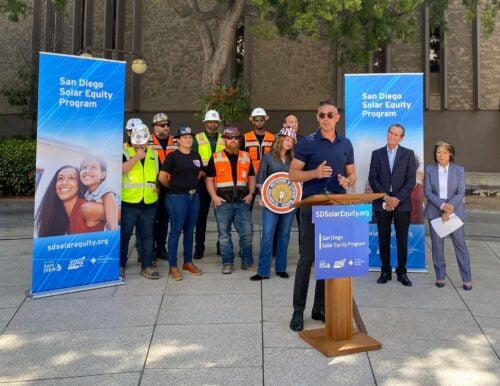
San Diego may be the only city to have secured upfront funding from utility shareholders to make clean energy cheaper.
How does a landmark utility proposal to own energy storage on customer property also cement its monopoly power?
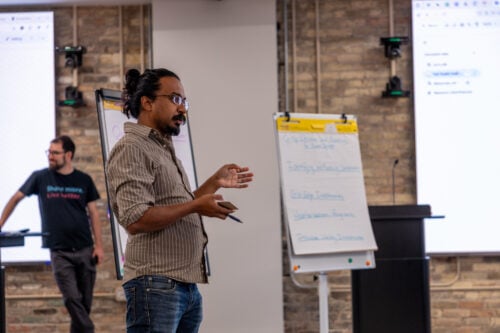
For this bonus episode of the Local Energy Rules Podcast, host John Farrell is joined by Will Kenworthy, Senior Regulatory Director, Midwest, at Vote Solar.
Listen to the full episode and explore more resources below — including a transcript and summary of the episode.
Apple Podcasts Spotify YouTube
Podcast (localenergyrules): Play in new window | Download
Will Kenworthy:
It’s not a trivial problem, but it’s an important problem. And just because something’s hard doesn’t mean you shouldn’t do it.
*****
John Farrell:
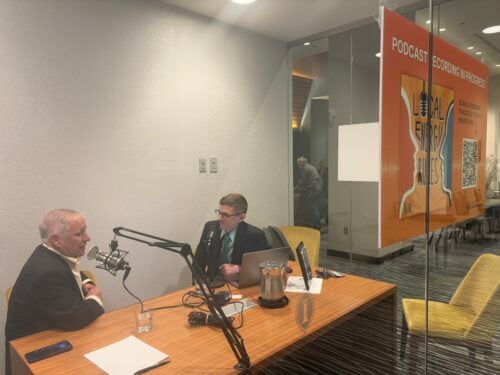
Hey, you’ve stumbled on some bonus content from my two-day, nine interview podcast recording marathon at the Gateway to Solar Conference in October, 2025. Consider donating to ILSR to keep conversations like this flowing. Now let’s hear from Vote Solar’s Will Kenworthy about distributed solar as a resource and the concerns about a landmark utility proposal to own battery storage on customer property.
*****
John Farrell:
Will Kenworthy from Vote Solar, so glad to see you here at Gateway to Solar in Minnesota, and so glad to have the chance to talk to you about solar as a resource and distributed capacity and all sorts of things that you have worked on for many, many years. Welcome to the podcast.
Will Kenworthy:
Thanks, John. I have been listening to you forever and I’m excited to be here finally.
John Farrell:
It’s probably an injustice to only do a mini podcast on these subjects, but we’ll absolutely have you back for another longer conversation. My goal for today was to talk about some work that we did together over the past five years on this concept of solar as a resource or distributed solar as a resource specifically into the utility planning process. And then I want to talk a little bit about a very interesting proposal that Xcel Energy has put on the table here in Minnesota. We got a preview last year during their resource plan about this thing called a distributed capacity procurement, and I’d love to chat with you about that. But let’s start with this bigger picture, which is when utilities do resource planning, hopefully people live in a state where their utility is required to do it and it’s required to be reviewed with a commission, which is not always the case, but when they do this process, it’s usually pretty top down.
They say, okay, you look at load growth, maybe we’re looking at data centers or we’re looking at electrification, we’re just looking at people’s electricity use. We say, okay, we come up with a round number, say a hundred thousand megawatts, 5,000 megawatts, and then they start adding up large scale energy projects that are going to meet that demand and to the degree they even care about what happens on consumer property, they’re basically like, we’ll just subtract that from that number. So 5,000 becomes 4,852 and we’re still building this large scale stuff. What you came up with and that what we worked together on was this idea that actually we could count distributed solar as a resource, and if we did, we might be able to change the way utilities actually plan around this. So have at it will tell folks what it is that we were trying to do in this process.
Will Kenworthy:
Yeah, so this was something you refer to that we’ve been working on this a long time. I think the first time you and I met about this was in 2018 in anticipation of the IRP that Xcel filed in 2019 and what we were working on and what the idea is is that you sort of alluded to it, is that distributed generation has always been something that the utilities treated as something that happened to them rather than something they could A) do something about and B), use as a tool in their toolkit to meet their customers, the whole system needs. And so what we worked on and what we tried to do was to try to find a way to make distributed generation as a resource that the utility could then offer into their integrated resource plan based on the idea that if the utility provided incentives for distributed generation, that you would increase adoption of it and then by increasing adoption of it you would reduce the need for other kinds of resources. And so that idea, that concept, which we call DG As A Resource, we developed throughout the last Xcel integrated resource plan and for various reasons that plan took several years to fully complete. But when it came out the other end and the commission approved the integrated resource plan in 2022 or 2023, I can’t remember,
John Farrell:
It took a long time, I think 2022, but I could be wrong.
Will Kenworthy:
Yeah, I think 2020, you’re right. 2022. So when the commissioned approved it, they put in an order point that required Xcel to model distributed generation as a resource. And so I know we were talking about this in the inter aum and then when Xcel filed their most recent integrated resource plan just a little over a year and a half ago, turns out they actually did it kind of right. They actually did the framework. The basic methodology is pretty close to what we had recommended and it was pretty exciting. And Xcel actually did benefit cost analysis of it and found that it was cost effective and we were rolling along until Xcel also then had the idea that they wanted to leverage distributed energy resources themselves as a tool for their own toolbox. And so they offered this plan called the distributed capacity procurement as an idea.
They offered this in comments that they filed on August 9th of last year in their own plan. Typically you wouldn’t do comments in your own plan until they were doing reply comments to our comments, but they filed their comments the same day that we were essentially applauding them for doing something and pointing out some methodological tweaks that we wanted to see them do. They filed this distributed capacity procurement and they said, we think that we can cost effectively deploy 440 megawatts of solar and 400 megawatts of energy storage. And we have this idea, we’re not ready to fully do it yet, but we would like to pursue this idea.
John Farrell:
So let me cut in for just a second and say, I will happily provide some links to some of the comments that — we were called the distributed solar parties and that procedure — , and we’ll put them up in the show notes so that folks, if once really want to dive into some of the details and the weeds here, we will invite you to get weedy.
Will Kenworthy:
We will invite you to get weedy and we are always happy to talk about it.
John Farrell:
Absolutely. So let’s talk about the distributed capacity procurement. So they throw in at the very last second in the resource plan proceeding. It sort of buried our feedback on the modeling, but it was also exciting. It was like, oh my God, I am reading words written by a utility that are talking about all the things that we have been talking about collectively forever, which is distributed energy resources have real value. They can be used to meet capacity, they can offset transmission line losses, they can potentially offset other capacity investments. They can be coordinated together to do good things. I mean, it was wild reading these initial comments. And then here about a year later, Xcel just earlier this week filed the initial plan for the program. So I don’t know if you want to talk a little bit about, it’s not quite the same as what they had put together last year. What does it look like?
Will Kenworthy:
Well, I would just say you’re right about sort of the excitement around that. And I talked to Ryan Long who was the president of Xcel, and I told him that he sounded like me sometimes seeing what they wrote on August 9th and then actually Xcel, Ryan Long from Xcel was on a panel at RE plus a couple of weeks later with Jigar Shah and Pier LaFarge, who’s the CEO of Spark Fund and Ryan and then a, I can’t remember her name. She was a vice president with Jones Lang LaSalle talking about her customers, her tenants of commercial buildings that they operate that would be enthusiastic participants in this. And when Ryan spoke there, we put comments, we took comments from Ryan’s speech at RE plus and added it to our comments in the settlement that led to the Xcel IRP. And that enthusiasm was genuine and real and reflected what we’ve been trying to get in front of utilities forever. So it was exciting and I think it was a transitional moment for us and for advocates who want to see distributed energy resources treated broadly.
John Farrell:
And then here we go. We’re a year later, Xcel has now actually laid out the details of the program. The scope is smaller, modest, modest is a good way to phrase it. It’s 50 megawatts initially, then maybe up to 200 megawatts. It sounds like there are some kind of steps in the process envisions roughly over a five year time period where they’re going to be kind of reporting back, gathering more information and whatnot. It’s now just storage. The solar’s been tossed out from the project. And it also, this was a little bit hard to parse, but it sounds like the initial stages are deploy storage at front of the meter locations on commercial industrial property. But the coordinating part, the sort of distributed power plant model is coming maybe a little bit later sort of developed sequentially perhaps and notably, although we did with some other folks, say, Hey, it would be lovely if this program is designed to be open to participation from ownership of these assets by other folks. There is no bring your own battery program as it were. It is Xcel is planning to use their bidding process. There will be competition to do the construction and whatnot, but Xcel is planning to own all of the assets.
Will Kenworthy:
Right. That’s exactly right. And I think that it’s important for us to distinguish here, like we said, this is a front of the meter program, it’s front of the meter, customer sided. It does not, like you said, include storage in this phase. I think that’s something that we’ll be looking at. The question about whether or not the whole thing needs to be utility owned or not for the front of the meter assets is an open question. And then the scope of it is one of the things, I mean, one, the features of this when Xcel was first introducing this was that this is a way to scale distributed resources to meet capacity needs from growing load generation. All over the country we’re talking about load growth, a lot of it’s from data centers, but not all. We’ve got transportation and building electrification that are starting to happen, that we’re starting to see have an impact on load requirements.
And so that’s another thing that we’ll look at is just whether or not they’re being ambitious enough in the scale of what they’re talking about. We definitely want to see where it’s viable and where it’s valuable. I think the value proposition for solar paired with storage, I think it’s a viable, and it’s not going to work every place, right? Not everyone’s going to be able to accommodate a five megawatt solar array to be paired with a five megawatt battery, but some places will be, there’ll be some tweaks, but I think we will be looking hard at what Xcel filed. Part of what they filed included a request for an approval of a limited distributed energy resource management system, which is DERMS. And we are actively advocating not just with Xcel in other dockets that I’m involved in with them, but around the region in Illinois and in Michigan and both major investor and utilities in Michigan about if you want a DERMS, show me what you’re going to use it for, what’s the use case for it?
What makes your investment in a DERMS cost effective? And part of that is going to be using distributed energy resources for grid services and for grid benefits. And we’re starting off with limited DERMS is what Xcel’s proposing, but we’ll want to take a look at the cost effectiveness of the DERMS that they’re both proposing and what their roadmap is for rolling out DERMS and how they’re wanting to use it. It’s not just going to be for operating and managing their batteries out in the field. It’s going to be eventually for deploying a fleet of other resources and hopefully behind the meter resources. I think that’s the next step. And I think one of the things that, I mean it’s going to into the, maybe there’s another question on this, but one of the main benefits that we see to this proposal and this realization that the company has had about the value of distributed resources is that there’s value on the distribution grid.
And that’s one of the hardest things in DER valuation is identifying where there is value on the distribution grid of the opportunity for avoided distribution system capital and the avoided transmission costs. They’re now motivated since they’re going to buy these resources and own them in order to justify those with the commission and demonstrate that those are cost effective, they’re going to have to put a number on that and what is the value of this resource operated in the right way on the distribution grid. And so we can take that to behind the meter compensation. And I think that’s the real value and opportunity of this for the industry, for advocates who care about cost effectiveness and affordability and for the clean energy industry to make these sales to their customers because their customers are providing a service also, not just to themselves, but also to the grid by having these resources available and on the grid.
John Farrell:
Alright, so let me summarize a little bit before I ask you my next question. We love the fact that the utility is finally saying, Hey, building stuff in a distributed way makes sense.
Will Kenworthy:
Yep.
John Farrell:
We love the fact as well that they’re talking about and recognizing we’re going to need to dispatch this stuff in certain ways that can capture more benefits than just the location. It’s not just I’m sticking this thing here in a place where hey, having some capacity or some shock absorption capacity would be useful, but with the DERMS, which I still every time think of it as like a dermatology kind of thing, I’m having a little trouble getting it fixed in my brain. But with the DERMS, with this management system, there’s the chance to coordinate these resources to align with peak demand on the grid as a whole to align with peaks that are on these distribution feeders in these various grid neighborhoods. I’m feeling more optimistic than I was when you were saying they will need to do this well in order to prove to the commission that they should own these resources.
Because I look at some of the history here and I look at the 2019 IRP, I think it was the one that we initially did our own intervention on about solar as a resource. Xcel basically failed to deliver on the demand response, which is similar in nature here to the front of the meter battery in terms of the kind of performance that you can get out of it. And the commission really had to run at them to try to get them to deliver on that. Another thing was this was in a 2023 docket, R Street Institute did a little analysis of Xcel’s existing demand response programs, the air conditioner program, and found that in a six year period they basically dispatched it once for a grid emergency, but there were the dozens of times when grid prices in the Midwest were really high and Xcel could have been selling excess power if they had used that program or avoided buying power from the wholesale market.
Both things that are, I think in the realm of what we want them to do with these batteries and that they weren’t really interested in doing. So I am cautiously optimistic now, Will that, you said this because I really think that is my concern is that Xcel makes the money on the capital deployment of the batteries. They don’t necessarily make money for using them well, it really is going to be up to those regulators at the commission to make sure that this gets deployed in a way that is in fact useful and cost effective for consumers.
Will Kenworthy:
Yeah, well, so a couple points. So yes, it always depends on having good regulators and there’s no substitute in a vertically integrated utility for having good regulators.
John Farrell:
Here, here.
Will Kenworthy:
So them paying attention to that. And I think this commission is genuinely interested in ensuring cost effectiveness and I think they will try to do their best to make sure that that value, that opportunity is realized for the customer’s benefits. That said, you’re right. We will have to look out for that.
A couple of things have changed. One, the need for capacity is for them to be able to serve new loads that they would love to be able to say yes to data centers. They will need to have new capacity. And we’re quite frankly, in a constrained situation nationwide and the ability to add new resources and you can’t get a new gas turbine before early in the next decade. And we have constructability and queue issues on new clean energy, utility scale, clean energy, and so we need to lean on distributed resources if we want to be able to meet this current need. Xcel realizes that, and they also know that this is a cost effective way to deliver capacity.
And so capacity is a little bit different than meeting reliability concerns in the way that they did with demand response. They weren’t doing economic demand response, weren’t using the demand response when the demand was there, when the price signal was there to deliver it. But if they’re going to deliver capacity, they are going to have to use these resources to deliver capacity. And so that will mean them discharging and being available and being activated when MISO capacity obligations are set.
And the other thing is that it’s pretty well known that the capacity price has spiked all over the country and especially in miso in the last year and capacity prices are forecast to remain high for the foreseeable future. So that economic incentive to actually use them for that is there now.
John Farrell:
So when we first started talking about this program, you used the word modest to describe it, 50 to 200 megawatts at the outside over a five-year period. I don’t recall from the resource plan exactly what their capacity expansion plans were, but in the scale of what they were saying they would need this seems very small, and it sort of brings to mind a couple of things we’ve seen in some other places. So California had sadly a just defunded virtual power plant program that was run through I think the energy commission independent from the typical utility process that was bringing on new capacity really fast. Now also, they were coordinating behind the meter resources and a lot of this, so it’s a little bit different in design. I guess I’m sort of thinking about a few different things here.
One would be why do you think Xcel is not being more ambitious given both the, I would say, growing pressure for more capacity and the fact that this is even lower than they started in their opening bid last year. And then the second one would be, wouldn’t this be a great reason then to figure out how to make this program work, even if it’s a bring your own battery kind of thing, where other people can build batteries and basically say, we’ll respect the same rules that you want in terms of dispatch for capacity needs and whatever. Just write the rules for us and we’ll get in and we can bring additional investment and get this to scale up faster.
Will Kenworthy:
Yeah, there are models out there for utility owned behind the meter batteries. I am thinking of Holy Cross energy in Colorado as a co-op. I think I believe some co-ops even here I’m not sure about this, are offering sort of similar things. That’s a potential model. I think the more powerful model is for behind the meter resources is going to be not just participating in this but to do a real VPP like Sunrun and Tesla just demonstrated in California that you alluded to where this past summer they demonstrated that they could bring 500 megawatts of capacity when needed. We’re not there yet here in Minnesota we have a lot fewer batteries behind the meter, but that doesn’t mean that if we didn’t design a program to get all that value that we wouldn’t get a hockey stick of adoption. And I think that’s the theory that we’re working on with the behind the meter.
As far as the front of the meter resources go, and why so modest? I mean I think it’s little c conservatism inherent in regulated utilities who don’t want to get too far out ahead of where their regulators want to go. And I think there will be an opportunity during this process for the commission and especially the Department of Commerce here in Minnesota, which plays a unique role in terms of setting and driving energy policy to set the expectation for aggressiveness and ambitiousness in this. So I think that’s one of the things that we’ll be talking about I think over the next several months with this DCP.
John Farrell:
Alright, you’ve had two days to absorb this filing, so this is maybe a little ambitious for me, but top three bullet points, what are you thinking about wanting to talk about when you prepare to respond to Xcel’s distributed capacity procurement?
Will Kenworthy:
Well, I think we’re going to want to talk about demonstrating the cost effectiveness of it and demonstrating the cost effectiveness of the DERMS. I think the cost effectiveness is there and I’ll be interested to interrogate it and learn more about it. I, just on a cursory scan, I think that we might want to see a more robust investigation of the value of the avoided distribution system capital. I think this is a really important part of the program. It’s a really important part of what Spark Fund and Xcel have both talked about as the potential value for this, and so we will want to really dig in on that. I agree that we probably want to look at whether or not it’s ambitious enough and whether or not there might be some uses for including generation along with it. I would love to see some sort of commitment or signal from Xcel that they intend to work on a behind the meter program, a VPP.
John Farrell:
I just thought of one last thing to illustrate, which is the avoided distribution capacity. So this idea that these batteries or ideally batteries paired with solar could offset potential upgrades needed on the grid. It’s sort of interesting here because in Minnesota we have this value of solar tariff that we’ve used already that has a component for that that has traditionally been very low and we haven’t had a lot of record building or evidence building behind that number. It’s been a very generic kind of calculation. I’m super intrigued to see how we might get some more robust evidence behind that through this and how that might inform some of the ways that we’re supporting development of community solar projects and other things in Minnesota around that capacity, especially if we have opportunities to pair them with storage as well.
Will Kenworthy:
I one hundred percent agree. I was talking with our mutual friend, Dr. Gabe Chan yesterday about this very topic and some of the work that he was doing on trying to advance the way that we value avoided distribution system capital, and I guess this was pre-COVID even. I think that’s an important pathway that we can, I think that’s one of the benefits of the DCP is that we’re going to actually be investigating this and pushing the ball down the court on that. It’s a hard problem. We talk about this in Illinois a lot. There’s a framework that we’re moving down the road on trying to put a value on this. We talk about it a little bit in Michigan. It’s not a trivial problem, but it’s an important problem. And just because something’s hard doesn’t mean you shouldn’t do it.
John Farrell:
A hundred percent. Well, I think that’s a great way to wrap this up. Will I look forward to bringing you back on a longer podcast discussion of this as we go through the development of comments and responses and see how this Xcel proposed program morphs into something broader and more ambitious to advance distributed energy.
Will Kenworthy:
Thanks, John, and I’m looking forward to going down this path more with you.
*****
John Farrell:
Thanks for listening to one of my nine mini podcasts from the 2025 Gateway to Solar Conference with Will Kenworthy from Vote Solar. We’ll have links to the regulatory filings we mentioned in the notes, including my report that kicked off the idea, Why Utilities Need to Plan for More Competition, published in 2020.
Even these mini versions of Local Energy Rules are produced by myself and Ingrid Behrsin with editing provided by audio engineer Drew Birschbach. And as always, we’re talking about taking on concentrated power to transform the energy system. Until next time, keep your energy local and thanks for listening.
For years, investor-owned utilities have dismissed distributed generation as a nuisance, treating it as something that simply “happened to them.”
But since Will Kenworthy and his colleagues at Vote Solar started championing the concept of “distributed generation as a resource,” arguing that utilities should incentivize customer adoption to offset the need for massive new power plants, the idea has been making inroads, even among the most skeptical of utility executives.
In 2022, Minnesota’s Public Utility Commission approved an Integrated Resource Plan requiring Xcel to model distributed generation as a core resource (Order Point 15), and subsequent utility analysis found that distributed energy is cost-effective.
In 2025, Xcel followed up with a plan it calls Capacity*Connect, embracing distributed energy but also cementing its monopoly by proposing it own all of the proposed 50 to 200 MW of customer-sited battery storage. Without clear aims to use the distributed storage to reduce distribution system costs, and with no competition, the plan will be very vulnerable to underperforming.
See these resources for more behind the story:
This is the 247th episode of Local Energy Rules, an ILSR podcast with Energy Democracy Director John Farrell, which shares stories of communities taking on concentrated power to transform the energy system.
Local Energy Rules is produced by ILSR’s John Farrell and Ingrid Behrsin. Audio engineering by Drew Birschbach. Featured Photo Credit: Ingrid Behrsin.
For timely updates from the Energy Democracy Initiative, follow John Farrell on Twitter or Bluesky, and subscribe to the Energy Democracy newsletter.
San Diego may be the only city to have secured upfront funding from utility shareholders to make clean energy cheaper.
Oregon tries to tie utility profits to climate, cost, and reliability targets through performance-based regulation.
Rural electric co-op members should use this new toolkit to swap coal debt for clean, affordable energy.
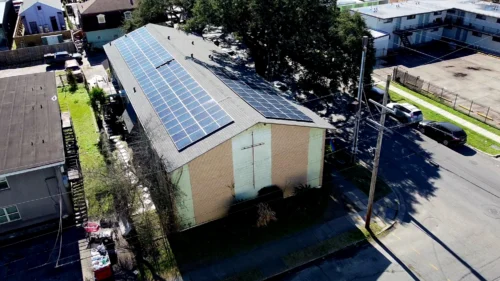
NOLA’s Community Lighthouse initiative creates local hubs with rooftop solar and portable batteries to save lives after storms.