A 2nd State Puts Utility Performance Over Profits — Episode 264 of Local Energy Rules
Oregon tries to tie utility profits to climate, cost, and reliability targets through performance-based regulation.
What has Minnesota done recently to improve its community solar program, and how can it better encourage cooperative ownership models?
For this bonus episode of the Local Energy Rules Podcast, host John Farrell is joined by Charlie Rybak, Chief Operating Officer of Cooperative Energy Futures.
Listen to the full episode and explore more resources below — including a transcript and summary of the episode.
Apple Podcasts Spotify YouTube
Podcast (localenergyrules): Play in new window | Download
Charlie Rybak:
I think there’s a lot more that we could do to make it easy to get community solar on the grid in ways that would be really important for policymakers to focus on next.
*****
John Farrell:
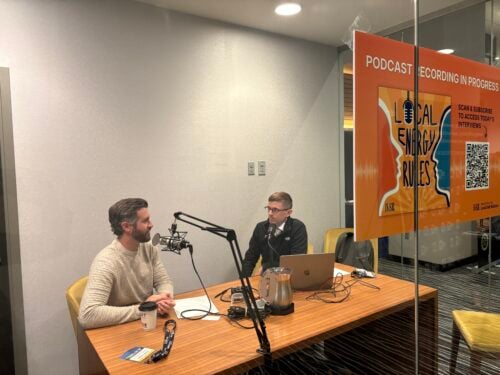
Hey, you’ve stumbled on some bonus content for my two-day, nine interview podcast recording marathon at the Gateway to Solar Conference in October, 2025. Consider donating to ILSR to keep conversations like this flowing. Now here’s my conversation with Charlie Rybak from Cooperative Energy Futures, where we discussed what we’ve learned from the improvements made to Minnesota’s community solar program and how we can do more to encourage cooperative ownership models.
*****
John Farrell:
Charlie, welcome to Local Energy Rules.
Charlie Rybak:
Thank you so much. I’m delighted to be here. I’ve listened to this podcast for a while, so it’s really, really fun to be behind the microphone.
John Farrell:
Awesome. Well, I am so pleased to have you here because there’s really, in my opinion, no better organization to talk about community solar as one that develops it in a way that I think is best in alignment with what we want to see in the world, which is community solar really in service creating community benefits. But I want to talk about Minnesota’s community solar program specifically. It’s obviously been a nation leader. We have almost a gigawatt of capacity on the grid. It’s gone through some interesting ups and downs in the past few years in terms of policymaking. Without getting into the weeds of that yet, I just want to say knowing that Minnesota has gone through some of these iterations and some lessons learned, what do you think that we’ve learned to do well with community solar?
Charlie Rybak:
We were really early developing community solar within Minnesota’s new system, and I think early on we really prioritized how can we build this in a way that benefits the people that need it — renters, people that don’t own a roof, people that may not be able to afford a lot of the fancy expensive renewable energy devices in their home. And I think over time, and especially with the new community solar system, there are many more incentives that have aligned the program with that kind of goal, which has always been one of Cooperative Energy Futures biggest values is how do we focus the resources on the people that need it most? And I think really at the beginning of the program, Minnesota did a great job of just saying, community solar is good. We’re going to incentivize it. Let’s make it easy to build. And I think since then we’ve continued to do a pretty good job, but other states have caught up to us and so we’ve gone from really being, arguably the national leader to a national leader. And I think there’s a lot more that we could do to make it easy to get community solar on the grid in ways that would be really important for policymakers to focus on next.
John Farrell:
I think it’s helpful to give that context too, because the way that you described what Cooperative Energy Futures wants to do, I think is what most policy makers are thinking about when they think about developing community solar policy is that they’re not saying, let’s just create another route for people who can already afford to do solar, to do solar, but how are we giving choices to people who don’t currently have them effectively, they don’t own their roof, their roof is shady, et cetera, giving them that. So I think that’s really helpful to understand how the mission of your organization is really in alignment when the program in Minnesota was first created almost a decade ago now, and before the recent changes in the 2023 legislature. I guess what I would describe it as, and I’m curious if this aligns up with your concept of it as well, that it was yes, able to serve those purposes, but it was really very open-ended in terms of, hey, anybody who wants to subscribe can subscribe. Anybody who wants to build and own these projects can build and own them. So it grew really quickly because it was very open, which was awesome. We got a lot of new capacity, but it arguably could have done better, at least at serving some of those populations that we imagined really wanting to serve who didn’t have those choices previously.
Charlie Rybak:
I think that’s exactly right, and I mean all community solar is good to a certain extent and a lot of it is a lot better than others. And so I almost don’t want to go too far down a road of, oh, this is the bad type of community solar because it’s distributed, it can be very good. But I do think that you’re right that policymakers have looked at this as a tool for how can we deal in the rest of the community into a clean energy future? And I think that’s the really exciting thing about the changes made in 2023 is the legislature really sat down and said, okay, how do we further incentivize this program to say, let’s really focus on the people who can’t put solar on their roof, can’t afford to do a lot. And I think when we’re looking at some of the electric bill increases that are coming our way, really vulnerable populations are the ones who are going to be harmed the most by this. And having a program that is targeted towards helping those people the most, I think is not just important, but is going to be really essential for the next three, four years in particular.
John Farrell:
So let’s talk a little bit about the changes that were made. Some people are talking about this as community solar 2.0, I think that was the title of the panel that you were just on talking at the conference here about community solar. So what are the changes that the legislature made? And I’ll amend my previous statement and say maybe not to fix things, but just simply make the program stronger in terms of its orientation, just serving the most vulnerable folks with community solar.
Charlie Rybak:
I think that’s exactly right, and I mean, I think the way that I’ve thought about some of the changes are the smartest companies launch a product, try it out and then come back and refine it. I think that’s really what the legislature did. They put together a really good program and then they saw how it was working and they said, here’s some ways that we can make it even stronger. And then they made those changes. And I think that process is really good and is one that policymakers should embrace. You don’t always get things exactly a hundred percent of the way right the first time, but that doesn’t mean that it wasn’t a success. And I think the community solar program is a great example of that.
Some of the big changes that were made, there were more income caps put on the people that could subscribe to the projects. So the benefits are more narrowly focused on working class people, which we thought was a really good change. We pushed for that change. There were big changes made to the size of projects you could build. So instead of building one megawatt projects, we can now build up to five megawatt projects, which just mean A, we can help so many more people. B, it’s much more economically feasible for us to build projects. And I think we have really good partnerships with folks that own farmland and for a lot of farmers, they still want to have crops on their land. They want to keep the family farm and the family, and they want to balance that out by having a steady, predictable revenue source and cleaning up the grid at the same time. And so for them, if they want to put five megawatts on their land and have the benefits go back to the community through community solar, they should be able to do that. I think that’s a great change. So those were a couple of the really big changes that we see as making a big difference. And then aside from that, just having really good bill credit rates for folks and really delivering huge benefits to people at 150% of area meeting income at the state level, which again, we were really excited about and we’re already seeing really exciting changes that are going to really target these benefits of the people that we think need the most.
John Farrell:
I want to ask you about something about where the projects were developed. I just want to note before we go any further into the weeds that the State Department of Commerce did a nice study of the community solar 2.0 pointing out that on net this is going to be a big significant benefit to Minnesota and its economy and to consumers. I know we get into the weeds sometimes with community solar or even rooftop solar and people are like, oh, is it worth it? Is it worth it? This has been analyzed pretty conclusively by the Department of Commerce. So I think one of the things that’s really exciting about this program is that even though the rules are somewhat new, we already know that the design of it is such that everybody benefits. If you’re a participant, you’re going to get benefits, you’re going to get bill credits if you’re not a participant, we get cheaper energy on the grid close to where we use it. It’s a win-win-win.
Charlie Rybak:
The study that was done, I think it’s somewhere between two and two and a half times as many benefits as there are costs. That to me is an obvious win for everyone. We have a lot of folks that with our new community solar gardens, we’ve worked with a bunch of mobile home parks, for example, that have really high energy bills are really energy burdened and aren’t living in places where they can put any renewables on the roof. So instead of just exposing those people A to the elements and B, to whatever rate increases come along, there’s actually now a tool to protect them and to say, there are a bunch of people that are making a lot of money off the renewable energy economy right now, you should be benefiting as well, which I think was something that is really exciting to us.
And I think people also need to know that developers bear a lot of costs as a part of this. So one of the big things that rarely comes up with the legislature when people are talking about this program is the developers actually pay for distribution grid upgrades when we have to build projects, that we are the ones who are bearing the cost of further developing the grid. And I think that is a huge benefit across the board that rarely gets talked about is if you allow people to go out and build these projects, A you can deliver the benefits to people that need them, and B developers are the ones who are actually on the hook for costs of just making our grid able to handle more load and more modern. We are the ones who are actually paying for that as well. So that’s another way that there are common benefits that are born by us rather than being spread across rate payers.
John Farrell:
That kind of leads me to my next question, or at least I’m going to take advantage of this discussion about kind of upgraded infrastructure. One of the things that I noted about the 1.0 version of community solar in Minnesota, and I think this is true of most other programs, is that the compensation rates aren’t really differentiated by where you put the project. And so you have this incentive to find the easy to develop places, and that’s a complex formula, right? It’s available capacity on the grid, it’s available land, somebody who’s willing to lease it to you or to be a part owner of the project, et cetera, et cetera. A lot of different considerations. One of the things that people talk about when they talk about solar and community solars is this opportunity to use the built environment. We have parking lots, we have parking ramps, Cooperative Energy Futures is one of the few developers that I know of that is doing built environment projects, but I know having to talk to Timothy, the general manager, that that can be more expensive to build projects in that way. Do you think that was a missed opportunity in 2.0? Do you think there’s a 3.0 opportunity? I mean, just full disclosure, I’m a subscriber to Cooperative Energy Futures Midtown Project, which is one of the few that are on the built environment, which I think is very exciting, but…
Charlie Rybak:
Thank you.
John Farrell:
We have most of the people who live in the Twin Cities metropolitan area and who thereby are the majority of folks served by Xcel Energy, which is where this community solar program operates, are living in cities and are living in the built environment. It’s a real shame that we haven’t seen more opportunity to tap that.
Charlie Rybak:
I think that’s exactly right. I mean, I think with the changes that are coming to just load growth, broadly speaking, I think that very soon we need to be looking at every single available opportunity to put more resources, especially distributed resources, especially community-owned distributed resources on the grid. And with our Allina Hospital project, Abbott Northwestern Hospital right in the center of Minneapolis, they were building a brand new parking ramp. We needed some incentives to be able to build community solar there. They also bore the cost of a canopy that sat on top of the parking ramp and as a result, we’re delivering reduced bill savings to something like 130 households, most of which are in the direct community right around the project. We’re really excited about that. Most of that we did because that is the type of thing that we believe in. There weren’t a lot of financial incentives for us to do that.
And I think adding financial incentives and saying if there are resources being built in your community, you should benefit more by having those subscriptions focused on the area where the projects are being built is a great idea. And it’s something that is I think, pretty foreign to way that we’ve structured our whole utility system is that the places that the resources get built are often not the ones that benefit from it. And I think there’s an interesting split where a lot of folks who live right in the cities have not typically benefited from the program because the projects had to be built further away from where they live. Now you’re able to subscribe anyone. I think that’s great, but I also think that the areas right around where the projects are being built should really benefit from those projects. We do that because we believe in that as part of our mission, but I do think that there’s a 3.0 where maybe further benefits could go to the people that are in the areas where these are being built so that resources that are being built in a community are benefiting people in that community.
That’s something that makes a lot of sense to me.
John Farrell:
It seems too that there, when you talk about creating incentives maybe in a 3.0 version to support that kind of development, that there’s a rationale behind it too from a grid perspective of if you were to say, as you pointed out earlier, that as a developer paying the upgrade costs for the grid in some other place, maybe there’s existing capacity in the distribution system, maybe there is a reason that a utility could say, Hey, instead of the substation upgrade that we would otherwise have to build, we’ll encourage somebody to develop a community solar project in this place. Maybe in addition, we haven’t seen because the design of the program doesn’t really talk about it, but how could we include energy storage, for example, which could provide resilience benefits, which could be grid supporting, et cetera. I guess sometimes I think about these programs and I’m like, man, they go so well at addressing this issue of access to solar, but we have this sort of next level up of making them as useful as possible to the grid system. Utilities haven’t traditionally been that interested in figuring out how to make community solar work. In fact, in our circumstances we often find them lobbying to try to kill the program entirely. So I don’t know. I’m very interested in that next level.
Charlie Rybak:
And I think we think and talk a lot about battery storage and what it could do. Just thinking about grid resiliency, we have these resources that are sitting on the grid. We would love to be able to have the incentives to make battery storage work. I think it makes all the sense in the world to pair battery storage with community solar, but until we have some sort of rate structure or incentive structure that allows for that, it’s very difficult to finance that and we would love to be able to build that, but we would just need, I think a little bit better incentives to get there. And I think no matter what kind of future you want, we’re going to have to build lots of transmission and distribution, but every mile of that that we don’t have to build is such a massive cost saving.
Not to mention the fact that it is very hard to push through in a regulatory environment. People in municipalities, counties, states often fight against things like this. So if we don’t have distributed programs like this, if we don’t have incentives like that, if we don’t have incentives for battery storage, we’re just going to have to build more and more and more wires, which is really expensive and is going to drive up the cost of everybody’s rates a lot. So the more we can do this stuff, the more that we can site it close to where people are actually using the energy, the more of those costs we’ll avoid. And I think we may be able to do a little bit of cost relief for people who are going to be facing these really big electric bill increases no matter what.
John Farrell:
Not to mention when you talk about those larger scale investments, they take forever. Permitting development processes can take 10 years or more.
I always, when I get a chance to talk to anyone from Cooperative Energy Futures, love to point out again the word cooperative in there, love you to just share a little bit about how it differs from sort of traditional relationships between customers and community solar developers. Not trying to knock on that, but just about this next level up that you provide for folks. And then what I’m really interested in you giving me some perspective on after that is what can we do in terms of state policy to encourage these ownership structures that really intentionally give people more say in what happens with their energy dollars, but also potentially getting more back for themselves?
Charlie Rybak:
Yeah, great question. Very excited to talk about us being a cooperative. I didn’t have a bunch of experience with cooperatives until I joined Cooperative Energy Future, so it’s been really interesting to just learn about the myriad benefits that come from being owned by your members. I like to sort of joke, but not really joke that our, quote, customers, our members and our subscribers to our projects. And if I’m not doing my job well, they could fire me. And that is a very cool structure to have. And beyond that, I think when we have assets that are accumulating in value, when we have projects that are creating cash for the organization, that is money that ends up back with our members and our membership. We’re doing a lot of really deep membership engagement work right now to really say to folks as we continue to grow, as we continue to have more community solar projects, more projects on the grid, what should we do?
How should we use that money? Should we invest it, build a lot more projects? Should we bring down people’s bills? What do you want? And I think we’re trying to go from being member owned to really member directed and really try to arrive in a place where we say to our membership, you are actually in the driver’s seat here. How can we equip you with the tools to help us make those big decisions? And that is something that is so foreign to people because you move into a new apartment, you turn the light switch on, somebody tells you who you pay your bill to. That is people’s typical experience with the system, right? There’s no choice. There’s no real price transparency. And what we really try to do is say, here’s why we’re making decisions. Here’s how we’re making decisions. As we start to grow and accumulate more capital, you get to tell us what we want to do.
And I think that’s a really exciting thing about cooperatives. I think the legislature and state policy makers could and should do way more to encourage organizations like this. Minnesota has a wonderful number of nonprofits, but I think people really fall back on that as a default option a lot of times, a way to benefit the community. And I think really looking at cooperatives as being this organization that is community rooted, community grounded, builds power within its membership, and also presents an alternative to being investor-owned. And we go out and we have to work with banks and raise capital and things like that. So we operate a lot like a private company does, except that instead of the benefits from our organization, the profits from our organization flowing to a couple of people, it flows to all of our members. When you think about us as being an organization that primarily does community solar and we do energy efficiency, we have affordable housing solar, we’re getting into district heating, but really now being in a community solar program where at least half the benefits have to flow to income-qualified working class people that is who is at the root of our membership, and really incentivizing more organizations to empower people like that, especially in this utility-based system where those people typically don’t have much or any power, I think is really exciting.
And I think there are a bunch of different industries that it could work great in. Childcare is one. I know Paper Moon is a cooperative that is in the childcare space, and I think there are all these places that people are facing huge cost increases. People are feeling like they don’t have a lot of economic power or a place to really be able to push back against some of the huge cost increase that people are facing. I think the cooperatives and the cooperative movement offers a really interesting opportunity for people to, in a bunch of different industries, begin to build more power that way.
John Farrell:
I think it’s so interesting when you look at the history too of cooperatives. We, especially in the upper Midwest, the progressive era, early 19 hundreds, late 18 hundreds, you had monopolization of railroads. You had farmers basically looking at situations where the prices that they could get for their crops were controlled by these distant entities that controlled their access to the rails, to the green elevators. Cooperatives a rose up during those times because farmers recognized, Hey, we’re not going to have a chance to actually survive because there’s all this extraction happening from our community by these owners of these key elements of infrastructure. So you got cooperatives designed around agriculture to support them to make sure more the money stayed in the community. There’s an interesting energy parallel with farmer owned ethanol plants, and this is actually where I want to bring up this idea and kind of come back to the idea of state policy.
So in the nineties, and let me just say this. With the context that we have now 20 years later of this, we all know that electrification is the way that we should be going when it comes to transportation rather than growing a lot of corn and putting it into ethanol and then putting it into vehicles. But at the time, it was kind of the one alternative fuel we had. And what Minnesota did that I think was fascinating is they said, we will give you an incentive to produce ethanol in the state of Minnesota, but only for the first 10 million gallons a year. So it was a relatively small facility, so a big facility could still get an incentive, but it would be a drop in the bucket. It didn’t really matter, but it would support a lot of smaller facilities really well, and it actually helped stand up a lot of these cooperatively owned ethanol plants, so corn farmers who are always subject to the whims of commodity prices, and as you kind of articulated earlier, right, they’re looking for some guaranteed revenue, solar, community solar can offer that to them now. So the state really deliberately set out and said maybe not explicitly you have to be cooperatively owned, but are there ways that we can support the size and scale that can be complimentary to cooperative ownership? Yeah, I guess I’m just kind of curious, and I might be throwing this at you sort of blank, so don’t feel like you have to have amazing, great ideas.
Charlie Rybak:
Let’s do it.
John Farrell:
But I’m just kind curious, what do you think, I assume that we’re in agreement the state should do more to encourage cooperative ownership given the returns that it gives. Curious if you’ve had any thoughts about how the state could do that for community solar?
Charlie Rybak:
I think there are lots of ways that policymakers could make our lives easier. And I only say that thinking about it in the Cooperative Energy Futures lens because I think there are lots of ways that that would make other people’s lives easier as well. And I think really where cooperatives get really interesting and exciting, and the ethanol example that you listed is a great one, is where there are people that are facing a market that clearly does not work in their favor, but they maybe are organized, they know each other and they say, wait a second, we should be the ones that are gaining the benefits off of this. They provide really interesting opportunities for people to do that. And I think the community solar program is a great sort of foundation for this because it really takes a type of solar that is really geared towards delivering broad-based community benefits and cooperative movement being an economic system that delivers broad-based community benefits and marries them together.
And I think one person going out and having to raise money to build a community solar farm or garden is a difficult task, but a bunch of neighbors banding together to work on something is a much easier one. And then you look at all the different parts of the process having to work within the utility system, you really want a number of people together working to stand something like that up. So that’s what we’ve tried to do. I think there are a bunch of other opportunities for more folks to do it. We’re working with groups across the country to try to create new cooperatives where they are, and I think that’s the future of this stuff is not one Cooperative Energy Future as an international conglomerate. It’s a bunch of different cooperative energy futures around the country or even around the state of Minnesota standing up and organizing in their communities and saying, we have a system that isn’t working for us and we want to create a way for us and our neighbors to benefit off of it.
John Farrell:
Charlie, what do you have in the pipeline for community solar right now from Cooperative Energy Futures? How many projects are you looking at developing? How many megawatts? And also what is that likely to add up to in terms of how many more members you’re going to be bringing into the cooperative structure?
Charlie Rybak:
So today we have close to 13 megawatts of gardens that are either operating or will be operating within month from now or maybe depending on when this podcast goes up. By the time this podcast is live and we are probably looking at through the end of the year, somewhere between 20 to 40 new megawatts of leases, then we have sort of a race against time to figure out the tax credit situation with the expiration of the investment tax credit on the horizon. So there are a bunch of different things we’re going to have to figure out there. One of the big bottlenecks to knowing exactly how many projects we have in the pipeline is the system for getting connected with the utility is very difficult, is pretty opaque, and it can be quite expensive. The legislature has taken steps to address that, which we’re really excited about, but a lot of the cost sharing work that the legislature’s done, which I’m very excited about, is not going to actually go live, I think, in time for us to be able to use it for exactly this round of projects that we have to figure out in the next couple of months.
So I’m not sure exactly how many megawatts we’re going to end up with, but if we’re able to develop another 13 megawatts that would double our capacity and that would probably mean another, something like 1300 households that are able to benefit from this, which would be really exciting.
If we’re able to double that, you’re looking at 2,500 to 3,000 households that will benefit from this, which is really exciting, and it’s still not enough. So we are trying to do more to build those projects than, as I mentioned before, we have an affordable housing solar program where we’re working directly with residents in affordable housing units and having ways for them to save 30 to 40% on their bills and pay nothing upfront, which we’re really excited about. We have an energy efficiency program that’s going live. That’s once again, I think intended to say to folks that can’t afford a heat pump or might not be able to afford window seals and things like that, that would actually not just save the money on their bills, but also reduce the amount of load on the grid, which is fantastic. We’re trying to figure out ways to bring that on.
And then we have this district heating program that’s coming live that I know we’ve been talking with you a lot about because you’ve done really smart thinking about this is how do you structure that in a way that can be cooperatively owned, the benefits can be shared widely. And I think you put all those things together and we’re just trying to find more and more ways to say when community members come together, when they want to save money, when they want to build power, and when they want to clean up the grid, we have a bunch of different tools to do it and we’re really excited about all four of those. But I think the big one is going to be the community solar. It’s going to come online next.
John Farrell:
I’m glad you mentioned the district heating. I am doing, I’m calling it like a walk along podcast. I’m hoping to talk to Paulo over at your shop every three to six months or so to kind of follow along in the development process because one of the things I have found with a lot of these innovative models for clean energy development is that you find out the case study happens a year or more after the project is developed and you’ve forgotten a lot of things about the struggles that you went through. So I’m interested to see how that might play out. Anyway, Charlie, it was great to talk to you. Great to have you on. Now you get to listen to your own voice on the podcast, not just listen to my voice. So I’m really delighted that you took the time.
Charlie Rybak:
I can’t wait. Thank you so much for having me, and thanks for all the great work that you do.
*****
John Farrell:
Thanks for listening to one of my nine mini podcasts from the 2025 Gateway to Solar Conference with Charlie Rybak from Cooperative Energy Futures.
We’ll have links on the show page to episode 202, celebrating 10 years of community solar in Minnesota, episode 57, about CEF’s first cooperative project in Minneapolis, and episode 127, about the effort to build a national network of community-owned community solar project developers.
Even these mini versions of local energy rules are produced by myself and Ingrid Behrsin with editing provided by audio engineer Drew Birschbach. And as always, we’re talking about taking on concentrated power to transform the energy system. Until next time, keep your energy local and thanks for listening.
“Policymakers have looked at this as a tool for how we can deal-in the rest of the community into a clean energy future.”
Minnesota once led the nation early in community solar, focusing intensely on serving those who need clean energy most: renters and individuals unable to afford or access solar on their own roofs.
A cooperatively owned developer, Cooperative Energy Futures uses community solar as a vital tool to include everyone in a clean energy future. Their mission is even more salient now, as the most vulnerable are increasingly exposed to skyrocketing energy prices.
Cooperative Energy Futures prioritizes resources for these individuals, for example, by partnering with residents in highly energy-burdened locations like mobile home parks.
“I think there’s a lot more that we could do to make it easy to get community solar on the grid in ways that would be really important for policymakers to focus on next.”
Rybak recommends other state policymakers embrace an iterative process, as Minnesota has, seeking to improve their community solar programs over time.
For example, Minnesota’s newest iteration, which Rybak refers to as Community Solar 2.0, introduced income caps for participants, focusing benefits more narrowly on working-class participants. In addition, project size limits climbed significantly, up to five megawatts, making projects more cost effective and enabling farmers to gain stable revenue.
The larger project size also means policymakers need to recognize the greater responsibility developers bear for grid upgrades, says Rybak, and that these upgrades help modernize the grid for all ratepayers.
“When we have assets that are accumulating in value, when we have projects that are creating cash for the organization, that is money that ends up back with our members.”
Cooperative Energy Futures operates under a cooperative structure, which guarantees profits flow back to members, not distant investors. This approach empowers their subscribers – often income-qualified, working-class individuals – to make decisions such as whether to lower bills or build new projects.
Rybak urges state policy makers to encourage and incentivize this community-rooted cooperative approach. This system builds economic influence among participants who traditionally lack power within the utility structure, offering a strong alternative to the investor-owned system.
“The legislature and state policymakers could and should do way more to encourage organizations like this.”
“We need to be looking at every single available opportunity to put more resources, especially distributed resources, especially community-owned distributed resources on the grid.”
Future community solar policy iterations (3.0), Rybak says, should financially incentivize urban and suburban development and pair community solar with battery storage for critical grid resiliency. Investments like these, Rybak explains, maximize distributed energy and at the same time help avoid building expensive, hard-to-permit transmission wires. The result is massive cost savings for all ratepayers.
Historically, community solar has mostly been built in more sparsely populated areas, where the beneficiaries often live farther from the solar site. But Cooperative Energy Futures is pursuing urban community solar projects, like the Abbott Northwestern Hospital site, to better serve local communities. They are doing this, despite limited financial incentives, because they firmly believe this is the right approach.
“It makes all the sense in the world to pair battery storage with community solar, but until we have some sort of rate structure or incentive structure that allows for that, it’s very difficult to finance that.”
See these resources for more behind the story:
This is the 255th episode of Local Energy Rules, an ILSR podcast with Energy Democracy Director John Farrell, which shares stories of communities taking on concentrated power to transform the energy system.
Local Energy Rules is produced by ILSR’s John Farrell and Ingrid Behrsin. Audio engineering by Drew Birschbach. Featured Photo Credit: Ingrid Behrsin.
For timely updates from the Energy Democracy Initiative, follow John Farrell on Twitter or Bluesky, and subscribe to the Energy Democracy newsletter.
Oregon tries to tie utility profits to climate, cost, and reliability targets through performance-based regulation.
Rural electric co-op members should use this new toolkit to swap coal debt for clean, affordable energy.
NOLA’s Community Lighthouse initiative creates local hubs with rooftop solar and portable batteries to save lives after storms.
These plug-in devices bypass utility hassles to offer cheap, convenient power for everyone.