A 2nd State Puts Utility Performance Over Profits — Episode 264 of Local Energy Rules
Oregon tries to tie utility profits to climate, cost, and reliability targets through performance-based regulation.
What happens when you combine cooperative solar ownership with a clever standardized design meant to match the scale and capacity of local communities and their grids?
For this episode of the Local Energy Rules Podcast, host John Farrell is joined by Tyler Adkins, CEO of the Maine Community Power Cooperative.
Listen to the full episode and explore more resources below — including a transcript and summary of the episode.
Apple Podcasts Spotify YouTube
Podcast (localenergyrules): Play in new window | Download
Tyler Adkins:
There’s a lot less uncertainty on the landowner’s side about what this project is ultimately going to look like. There’s a lot less uncertainty on our side around what the risks of development are. We have far fewer permitting requirements and we have a lot greater confidence that a project is going to get approved for interconnection.
*****
John Farrell:
What happens when you combine cooperative ownership with a clever standardized design meant to match the scale and capacity of local communities and their grids? Tyler Adkins, CEO of the Maine Community Power Cooperative joined me in October, 2025 to explain how their model combines collective ownership and standard design to get economies of scale that result in solid economic returns for Maine communities.
I’m John Farrell, director of the Energy Democracy Initiative at the Institute for Local Self-Reliance, and this is Local Energy Rules, a podcast about monopoly power, energy democracy, and how communities can take charge to transform the energy system.
*****
John Farrell:
Tyler, welcome to Local Energy Rules.
Tyler Adkins:
Yeah, thanks John. Good to be here.
John Farrell:
Now you have a kind of varied past, not just in the energy sector, but doing many other things, teaching, you’re on a library board, you’ve been involved in some political efforts. I’m just kind of curious if you feel like any of those experiences in particular have prepared you for what you’re doing now to do community solar development?
Tyler Adkins:
Yeah, I think, I’m from a small town in the woods of Maine, and so a lot of the energy development that’s taken place over the last couple of years has been from out-of-state companies that kind of swooped in looking to take part in the land rush and captured their next deal. Many of them had no local connections and were operating based on the maps and red substations and all that kind of stuff.
And a lot of the landowners that we’re working with on these projects, they’re not sophisticated commercial real estate property owners. They’re normal people that maybe are farmers or have a couple extra acres that they’ve acquired over the years. And so what I’ve found is that just being a normal person, it goes a long way in this industry. Having local connections that allow you to make more of those introductions through word of mouth. A lot of the projects that came across my plate were just personal connections that found their way back. A family friend who was approached by a developer and wanted to know what I thought about it or my dad running into somebody at the hardware store. Those types of personal connections go a long way. And when it comes to something like a long-term arrangement to partner with somebody on building a complex power plant like a solar farm, it is also very helpful when they know where you live.
John Farrell:
It reminds me of my colleague Chris, who does our broadband work, used to talk about the mayor of Lafayette, Louisiana who is interested in developing a city-owned broadband network. He talked about the strangle effect, which is that you like to know that you have someone you can reach out and strangle if something goes wrong.
Tyler Adkins:
Absolutely.
John Farrell:
So one of the things I would love you to talk a little bit about the model. So you’ve described the Maine Community Solar Cooperative as, quote, the first scalable cooperative ownership model. Can you talk a little bit about what that means, how ownership and operations work at a single project level and then how made it scale up?
Tyler Adkins:
So there have been a lot of people that have been trying to crack the nut of cooperative energy systems for a long time, and one of the challenges is that the approaches today have typically taken the form of say, a rooftop solar project in a building where a bunch of the tenants are coming together to build a system to offset their own needs. And what we felt we needed to do is take a bigger picture view here and look not at the individual project necessarily, but to build a business model that was scalable in serving as many households and small businesses as we could by developing a standardized approach to project development that reflected the nature of our energy system, the policies, the ways that people want to engage cooperatively, et cetera. And so what we came up with was a particular system size that we can replicate over and over again given the unique characteristics of Maine’s grid.
And what that is at a high level is that we have a very rural, very fragile grid that does not have a lot of robust grid infrastructure to support the larger projects. And already most of that grid capacity has been absorbed by the projects that have been built to date. And to your point, Maine very quickly became a leader in by far distributed generation per capita, but also just an absolute megawatts plugged into the grid is in the top three or top five I believe so very much near the top of the list, but most of Maine’s grid infrastructure is rural, single phase power lines. And so we wanted to take an approach that allowed us to develop lots of small projects quickly and therefore scale up the total capacity and the number of households we’re able to serve by implementing an approach that was different than what others were trying to accomplish.
John Farrell:
I love this. There’s a fun history here because Sacramento’s municipal utility way back in the nineties was interested in rooftop solar, California great solar state, and they did a project called Solar Pioneers. I interviewed one of their former managers about the project years ago. This is one of the first interviews I did for the podcast and that it was a similar idea. It was a standardized system, it was like five kilowatt system. We’re going to build it exactly the same way on every roof. It doesn’t matter how big the person’s roof is or whatever, we’re just going to do the same exact thing in each place. And they had a remarkably low cost for solar in the 1990s as a result of doing that. So I think it’s interesting to me that so few other folks have tried to learn that lesson of the advantages of standardization and really intriguing that you are doing that.
Tyler Adkins:
Standardization in the commercial scale solar space is the holy grail, right? Everybody wants to have standard contracts, standard design, standard processes, and it’s very difficult to do that because as companies evolve and grow, we’re navigating a constantly shifting landscape. If you’re doing rooftop solar with a commercial real estate owner, every property owner is going to want to redline their own lease to death and the designs are going to be bespoke and the arrangements are going to be unique with the off-takers, et cetera. And so we thought it was really important to, from the very beginning, say we’re not trying to build a cooperatively-owned solar project. We are building a cooperative energy company that will develop and own many projects. And so the ownership level here, the engagement level for the members is at the organizational level. And that is a very unique approach in this space. And I think it really is only possible because we started from a place where we said we’re going to do this lots of times, and so how can we build our organization and our infrastructure around this scalable approach as opposed to the individual project approach?
John Farrell:
So I often think about, when I think about solar cooperatives, I think about food cooperatives, which is probably the sort of retail level cooperative that most Americans would have some familiarity with. You often join these, you pay a little fee upfront or something and then you get maybe some coupons or a dividend or whatever. You’re usually tied to a particular building. There’s one building that this cooperative has. It’s one grocery store and that’s the one that you go to. I just love you thinking about here. Sort of like, no, we’re going to build, maybe a chain isn’t the right way to put it, but we’re going to build a series of grocery stores and you’re a member to all of them wherever they are in terms of how this works. So could you talk a little bit about, I’m trying to build the metaphor here with the food cooperative. I don’t know if I’ve explained it very well. Is the only way to join being a subscriber then to a project I have to be an offtaker, I have to be getting some benefit from that or is it really just I’m signing up, my membership agreement is with the broader main community solar cooperative and I’m not necessarily tied to any particular project, or is it both? Also, can somebody be a member and a participant if they have no relationship with any of your community solar projects?
Tyler Adkins:
Yeah, so the way that we’ve designed it is that households or non-residential customers, municipalities, churches, small businesses, anybody who basically pays a utility bill to, in our case right now, Central Maine Power is the largest investor-owned utility in the state and that’s where we’re focused for the time being. Anybody who pays them is eligible to join our co-op. And when you join the co-op, just like the food co-op, you buy a membership share and in our case, it costs a hundred dollars. You could pay it upfront or you could pay it through the savings on your bill once you get into a project. And so there shouldn’t be any upfront financial barrier to joining the co-op when you are assigned to one of our projects, you will stop paying the utility company and you will pay us instead. And the amount that you pay us is literally what your utility bill would have been minus your fixed discount per month is what you pay us, and then you’ll remit that payment to us and then we take care of all the work with the utility on the backend.
And so it’s just a dramatically simpler way to manage a community solar relationship compared to what others are doing in the marketplace. And we thought that it was really important that this model be just much simpler for the end user because Maine has very quickly established a hundred thousand or so households participating in community solar and almost all of them are very confused about what’s going on. The customer experience has been very complicated. There’ve been a lot of billing errors and you have to get your credits one time of the year and use them another time of the year and manage multiple bills. And so in addition to the kind of what we’re doing on the project side, we said from the beginning that this needs to just be very clear to the member what’s going on here. And there’s this, I don’t know if it’s a fact or just an anecdote, but I’ve heard this number many times over the years that the average American spends like nine seconds a month thinking about their energy bill.
And it was really important for me that we not try to get people to spend more time thinking about energy. We’re not trying to get them to become nerds and really become experts in energy development or the grid. We just want that nine seconds to not be one of terror and fear, but to be one where they look at their bill and say, oh yeah, okay, this makes sense and I can go on about my life. And so making sure that each step of the way that when we interact with our members that it’s reinforcing that trust that we’ve got their back and that we’re acting in their best interest and that things are very simple and make sense, we’re allowing people to live their lives.
John Farrell:
I want to come back to this feature of your project development where you’re focusing on the standardized design. The thing that you kind of wrapped up with was talking about how Maine’s grid has all of these in the rural areas, these single phase power lines, so you’re looking to make smaller projects that are compatible with the infrastructure that’s out there, which allows you then to go to places where presumably the other developers weren’t interested because building larger projects. Could you also talk about how that standardized approach is helping you reduce construction costs or development costs or what are the other advantages of the standardization, not just how it’s making it more compatible in terms of the available capacity to develop projects.
Tyler Adkins:
So when deciding what our project approach is going to be, we face the same challenge that all other distributed generation developers face, which is that it’s more expensive to build a smaller project, and so how do you offer something better than what others are doing, but somehow do something that’s both small or more complicated at the same time and kind of net it out at the end. And so for us, we said, okay, if we’re going to be successful in this initiative, we can’t go straight for the same thing that everybody else is doing. The 20 acre fields on three phase power lines that are all congested and have these indefinite wait times with interconnection queues that are going on for years and years and unknown, surprise, interconnection upgrade costs, all of that, we need to do something different. So when we were deciding what we wanted our standard project to be, there were a couple of values that informed how we approached the opportunity.
One is that while we knew that we couldn’t go head to head with the larger, more established, well-capitalized developers, we also didn’t really want to do those larger projects because one of the biggest complaints that people have is about how these large infrastructure projects are taking up valuable land or are eyesores or are just imposing on the landscape. And so we felt there was an opportunity to do something smaller that was more scalable, that could also be more human scale. When we look at this single phase part of the grid, not only are there a lot two acre fields in the outskirts of Maine that we can plug these systems into, but having a one acre solar array with Agrivoltaic components is a much more human approach to the challenge of generating clean energy and the land use challenges that we face. And so what we have seen is that people are very welcoming of these projects because they often don’t even see them.
They’re just tucked away in a corner of a field or are otherwise blending into the landscape, but that we had a lot more space to work with and that the benefits overall would be much greater. And so the reason we chose this one acre footprint is that it ended up being the case that was around the size of a project that was the largest that you could plug into a single phase power line without causing trouble on the interconnection side. And so we built our standard model around that. And by having these standard system designs, we can eliminate a lot of the design work and engineering that goes into each project. We can go to a landowner and say, this is specifically what we are proposing to do on your property and work with them to find the right portion of their property to install this on.
There’s a lot less uncertainty on the landowner’s side about what this project is ultimately going to look like. There’s a lot less uncertainty on our side around what the risks of development are. We have far fewer permitting requirements and we have a lot greater confidence that a project is going to get approved for interconnection. And that allows us to then develop more projects more quickly and then also build relationships with the equipment suppliers to get better deals on our equipment and also to open doors that wouldn’t necessarily be open.
I was talking with another installer recently about the use of single access trackers and they said, well, how did you even get these companies to talk to you? Because they generally don’t want to talk to smaller companies unless you’re going to order many, many megawatts. And so the same thing could be said for finance partners. The banks don’t really want to talk about very small projects, they want to talk about big projects. And so having this approach allows us to say, yes, we’re building, we built two projects this year. Yes, we plan to build eight projects next year, but you can see that this model is scalable well beyond that, and so it opens the opportunity for economies of scale at the project level that would not otherwise be there if you were just doing this on a one-off basis.
John Farrell:
I just love that. I just have to roll back and summarize too because I think this is something really crucial in our broader understanding of how the energy system works. We get into these odd political fights about, Do big stuff because it will be cheaper and missing out on the idea that actually the thing that has really been the engine of capturing economies of scale has always been about how much if something can you do and how much do you repeat it all the way back to the model T, the success of the assembly line was do the same thing over and over again, not build one really big car. The success of solar in general is we’re producing millions and millions of these very standardized panels and you’re taking that one step further and you’re saying, let’s standardize what the project looks like in order that we can capture all of the potential economies of scale from supply to interconnection, et cetera.
I just love it. I just think there’s too little thinking like this and ignoring the fact that when it comes to what has succeeded in this economy generally what has been workable, it is about getting smaller and scaling up. I mean, just think about cell phones, right? They kicked the butt of what we used to use. There are these little tiny computers that we all have now and it’s because we made this small and we made a lot of ’em as opposed to lots of mainframe computers. I don’t know. I got a lot of admiration for the way that you’ve been thinking about this and it’s exciting that you layered it on top of this cooperative ownership model because somebody else could have come in and said, we’re just going to build solar projects and do this, and yet you’re thinking about it as a way that’s also connected to how are we building local ownership and giving real benefits to the people who are participating.
Tyler Adkins:
One of the things that we’ve found in working with the local planning boards is that a lot of them, these are citizen boards, they’re volunteer positions. They are there because they care about their towns, not because they have any particular expertise in any of this specific development work. And as the land rush kind of kicked off in Maine back in 2019, 2020, there was a rash of planning boards that implemented very strict ordinances or more towns implementing moratoriums, and they were really scared that there were going to be these developers that came in and just steamrolled the town with these huge projects and changed the character of the town, et cetera, and also didn’t really provide much benefit to the host communities. And so a lot of the work that we’re doing is showing up and saying, yeah, we’re a solar company and that gets people’s hair standing up on the back of their neck, but then when we show them what we’re doing specifically, the tone changes dramatically.
And so this is really, it is community development in kind of the truest sense in that we’re showing up building support not just with the landowners who are going to host the sites, but the neighbors who are going to be around there and hopefully the implementation of a particular project yields an increase in membership by the neighbors who want to be a part of this overall and ultimately get the benefits that the projects generate. And so there’s very much a regenerative approach here where we’re by the cooperative ownership model kind of recycling the energy dollars back into the community, but in a very literal sense here, where the communities that are hosting these projects are gaining the bulk of the benefits by having the infrastructure in their communities in the first place.
John Farrell:
Is there anything that I missed in the laundry list of ways that you’ve made this scalable that you still want to talk about? I feel like we’ve covered most of what I had in mind, but I might’ve missed something.
Tyler Adkins:
This initiative is the result of many people’s work over a long period of time, and it started well beyond when I showed up about two years ago. And so the question here around what does this organization want to be and how do we define success in all of that has evolved over time because of the nature of the people at the table, but also the policy landscape that has set the stage for what is practical at any given time. And when I look back at a year ago, the conversations that we were having around what our approach was going to be is very different than how it is today. And I say that just because what we started by doing actually is building the kind of master data set here for identifying all of the locations across the state where we could build one or two of these small scale projects.
And the opportunity there is enormous. Just looking at the existing fields of Maine, there were over a hundred thousand land parcels that met the criteria for hosting one of our projects. And then if you look at just the existing grid infrastructure, it was our thesis that we could build about 2000 of these projects without triggering any major grid upgrade requirements. And even if that number is off by order of magnitude, that’s still many, many projects. And so there is an enormous opportunity here to spread the wealth across the state with this model. One of the challenges has been of course, that the policy landscape has changed quite dramatically in the last year. And so now one of the main topics of discussion, of course, is how to best prioritize what types of work in the meantime, given where everything is at and to position ourselves for the longer term opportunity, which is of course that renewables are simply cheaper than the other options on the grid. And so we know that there’s something here over the long term, but just what specifically that looks like and what that pace of growth looks like between now and then is up for discussion.
John Farrell:
I want to go right into this because my colleague Ingrid, when trying to write up our page on Community Solar in Maine was talking to some various people just trying to get some context from folks in Maine about the changes that the legislature had passed earlier this year, and one of the people that she spoke with, I didn’t get the name essentially said that it ended Community Solar in Maine. First of all, do you agree with that assessment? Second of all, can you explain a little bit about what the actual changes, is there any way in which the measures that were passed are sort of less harmful to your business model that is much more invested in community benefits?
Tyler Adkins:
Yeah, I think that the changes at the federal level are problematic, but it’s actually the changes at the state level that are most acute for now because yes, the legislation that was passed this summer ends new community solar in Maine after the end of the year. And so we’re on the one hand in a race to safe harbor as many projects as we can under the existing program and on the other hand, trying to understand what our pathways forward will be for new projects thereafter. The legislation does call for the implementation of a successor program that prioritizes solar plus storage based on rate payer benefits, et cetera. But the realities are that the timeline required to implement a new program do not align with the remaining timeline for the tax credits. And so there will be a gap period here where basically everything evaporates. And so realistically we’re looking at the end of community solar, end of new community solar, in Maine and some time before any sort of future program emerges.
Another piece of the legislation was that it implemented a grid access fee for community solar projects that are serving residential and small business customers, as we do. The fees are different depending on how big your project is, and they get adjusted over time.
One of the things that we were able to secure is an exemption from that grid access fee for cooperatively owned projects. And so what I would say is that our experience has been that members of the legislature are sympathetic to our business model, not least of which is because the economic benefits to the end users are much more material than they are under the kind of investor-owned community solar model. And I think there’s an appetite to, whether it’s future legislation or activity at the Public Utilities Commission or other regulatory arenas, to find a way to allow this model to continue, but that is by no means certain and will require a lot of education by decision makers on how this model actually works and why it’s so beneficial to not just the households that are getting the credits and reducing their bills, but to rate payers in general.
*****
John Farrell:
We are going to take a short break. When we come back, I ask Tyler about solar models in other states. We discuss how the incumbent investor-owned utilities are raising barriers to community solar, and we discuss how the legislature has, and could do , favor cooperative ownership models. You are listening to a Local Energy Rules podcast with Tyler Adkins, CEO of the Maine Community Power Cooperative.
Hey, thanks for listening to Local Energy Rules. We’re so glad you’re here. If you like what you’ve heard, please help other folks find us by giving the show a rating and review on Apple Podcasts or Spotify — five stars if you think we’ve earned it. As a bonus, I’ll gladly read your review aloud on the show if it includes an energy related joke or pun. Now, back to the program.
*****
John Farrell:
I’m kind of curious, I spoke with Corey Neely who is the executive director at Solar Share in Wisconsin. I dunno if you listened to that podcast or are familiar with the model, but what’s interesting about their model is that they don’t have enabling legislation. What they were doing was creating relationships with rural electric cooperatives in Wisconsin. I think that’s it. I don’t think they have any investor owned utility off takers. So they would build the project sell to the co-op at apparently a reasonable rate that probably accounted for the local delivery, and then members were essentially sharing the revenue from that. So it didn’t rely on the typical enabling legislation that allows for the sharing of bill credits. I’m kind of curious if there’s an opening to do that in Maine, if I assume that the bill credits model was what Maine had and what is now going to be at least on hiatus until a successor program is developed.
Tyler Adkins:
Yeah, exactly. So the current program is just a one for one kilowatt hour crediting system, call it net metering. In Maine it’s called net energy billing, and there is a broad interest by the developer community in general to work with regulators, with the utilities, with others to find a path forward to connect more distributed generation to the grid under flexible terms, whether it’s flexible interconnection or curtailment or establishing mechanisms to monetize the benefits of energy storage. The solar industry wants that and we want that too, but what we have found is that it has been very challenging to work with the utilities to identify solutions that are outside of the very strict definitional confines of the screening interconnection screening processes and the engineering screens that they apply. There are a lot of examples of the way the kind of microaggressions that the utilities commit to trim or kill projects death by a thousand cuts style, and the opportunity ahead is going to be reliant on policymakers changing that dynamic so that it’s more focused on performance outcomes or flexible solutions rather than these very strict screens that are by all accounts outdated measures. The IREC and Sandia and the others that have established these best practices have since implemented new versions of all of these screens, and yet the utilities are often using the very conservative outdated versions that are more restrictive. And so there’s a lot of ways that industry stakeholders will have the opportunity to work together to find flexible solutions, but as it stands right now, there’s a big gap between where we’re at right now and where we need to go.
John Farrell:
I mean, it feels a little bit like as with so many things in this business, it comes back to that idea of what is the utilities’ state-approved business model? How do they make their money, highlighted a lot in Maine in recent years with the Pine Tree Power ballot measure that was kind of talking about, Hey, these utilities make their money in a certain way and they’re terrible. I mean, this is part of what is funny to me about this is you have, if I remember correctly, some of the worst ranked utilities in the country on affordability, the costs are really high. You would think there’d be a great opportunity, especially for your model, where you’re looking at essentially the potential to reinforce distribution grids in areas that probably have a lot of outages, difficult to maintain or whatnot. And I’m sure the utility is kind of like, well, yeah, it’d be great if we had better reliability, but what we really want to figure out is how we make money doing that, not how we pay somebody else to help us boost reliability even if the way that they want to do it is really cost effective and strategic.
Tyler Adkins:
No, exactly. And the two investor in utilities in Maine consistently have some of the highest rates, the lowest customer service rankings and are not beloved. It’s funny, Central Maine Power, specifically, when I was growing up, was a beloved local power company and there was the famous ice storm of ’98 where they worked around the clock for weeks to get the power back on after this really intense storm, and they were up there after probably one of the highest ranked energy companies in the country. But as we’ve seen with this shift to profit extraction model of these larger publicly traded companies acquiring these smaller local distribution utilities and squeezing out the profits, increasing rates, et cetera, the quality of service has declined precipitously. But the discussion around the need for improved grid infrastructure, the actual grid infrastructure and the ways that you monetize those benefits has really been focused on how they can use the existing regulatory regime to add more scope to that model as opposed to allowing for a broader range of stakeholders to participate and ultimately deliver a system for everybody that is more cost effective, it ultimately simpler as well, but delivers those benefits at a much lower cost. They’re just not set up to have that conversation because it is very clearly not in their interest.
John Farrell:
Yeah, it’s really unfortunate that we continue to stick to this model when the evidence is so clear that something is needed to be changed. I want to come back to you mentioned, which is really exciting, that the legislature was receptive around understanding that the cooperative business model has real advantages and exempted cooperatively-owned projects from the grid access fees that they implemented. I’m kind of curious if there are other ways, knowing that the legislature is already recognizing that or that with more education, they may recognize this, that the more of these financial benefits of community solar or solar in general, stay in the community, that communities have more say over how projects work if there’s cooperative ownership. Are there other ways that you think that a legislature could do this? I mean, I’m just throwing this out there. You could in theory say to them, would you be willing to reinstate, I’m dreaming here, right?
You could reinstate the previous program and only allow it for cooperatively owned projects, for example, which I think would obviously drive other folks then into this space. I think maybe this would come from the successor program, this idea of how do you do compensation around storage or whatever. It just seems to me that figuring out some way to design policy that specifically supports cooperative ownership would be really important. So I’m curious if you’ve been thinking about other ways that legislatures in Maine or in other states should be thinking about, Hey, how do we encourage this business model that is much more likely to result in a significant portion of the benefits of clean energy development staying in our state?
Tyler Adkins:
Yeah, no, exactly. And this is something I brought up with the Energy and Utilities committee that was debating this bill earlier in the year, is that there’s truth to the idea that the rapid deployment of community solar under the existing policy framework has resulted in a windfall of profits for developers. It is not actually the profits of the long-term project owners necessarily because they bought the projects from the developers at the rates that were negotiated at the time of the project’s construction. And so basically as natural gas prices rose over the last couple of years, the value of the projects in their pro forma rose. And so the acquirers of these projects were willing to pay higher prices. The legislature has really been focused on those windfall profits, which are real, but they’re also gone. That money is not coming back. And so the question here I think is what do we do moving forward? And there are reasonable measures to be taken to kind of reign in the cost of the net energy billing program overall. There’s no question that there’s opportunities to do that.
One of the challenges has been getting the legislators and other regulatory officials to understand that one, that this project model is different. And so it is not just that all front of the meter solar is the same. It is looked at as the same. Our 150 kilowatt AC projects are viewed by those who are assessing the cost of net energy billing as the same cost, on a per unit basis, as these five megawatt projects. They’re just not the same, and they’re in different parts of the grid, they provide different grid values, all this kind of stuff, but there’s no mechanism to differentiate between these types of projects. My main point to them has been that as important as it is to understand the program structure and to make appropriate policy around crediting mechanisms and all that kind of stuff, the business model also is really important.
If you have one solar company that is building a five megawatt solar project and they are offering a 10% discount on their rate to the general public, that is not the same thing as a solar cooperative that is offering a 20% or even a 10% discount on the whole bill to members who are majority low income households who have these astronomical energy burdens. And if we look at the impact of putting this money back into our communities, it is entirely different. And so how do we ensure that we’re taking this into consideration as we’re shaping the future programs? I don’t think we’re looking for special treatment. I think we’re just looking for the approach to be fair and recognize the value that this model brings to communities who are ultimately the constituents of these legislators. And so I think in general there’s an openness to that.
It’s just a question of what does that end up looking like and what the timeline would be for implementing something like this. If I were to give you three specific examples of what this could look like, it is that this legislation eliminated the community solar model for front of the meter projects. At the same time the federal government eliminated the tax credits for residential solar at the end of this year. So this means that at the end of this year, the price of solar is going up by 30% for the residential customer, which means that there’s essentially no meaningful economic return on that type of investment. If we look at some of the practical implications of the current policy framework in Maine for community solar, I think there are a couple examples of things that we could adjust to make the cooperative model much more attractive to both potential members and then also decision makers.
And one of those things is like you mentioned, just extending the timeline for participating in the existing net energy billing program for these small scale projects. And the reason I think that is reasonable is because they do preserve net energy billing for onsite behind the meter projects, but the practical implication of the changes at the federal level are that there will be very little to no new residential solar in Maine after the end of the year when the tax credit expires.
There are also a couple of other examples. Like initially all community solar was exempt from personal property taxes, and that was changed a year or two ago to limit it to onsite or residential projects. And so the reality is that most people are not eligible to have their own onsite solar system, whether that is for financial reasons or site conditions or a million other reasons. You really do need some sort of offsite program to allow people to participate in a meaningful way. And so extending the property tax exemption to cooperatively-owned projects, this is people have an ownership share in these projects and they’re just generating their own need offsite is, for grid purposes, essentially the same as doing it on their own roof, but in a way that actually makes it feasible for them to participate in this system. So there’s a lot of little policy tweaks that the legislature or the public utilities commission could implement that would make a big difference for projects like ours.
John Farrell:
I want to go back to one thing you said, not to dwell on it, but one of the things you mentioned this idea of windfall profits for community solar developers, and I understand the reaction here of like, oh, we’re taking money collected from all rate payers, electricity bills are fairly regressive, and the idea that we’re then giving a lot more than was necessary to get this development, certainly understandable that there’s a concern about that. I also want to point out though that it’s possible that that can happen and they’re still worthwhile, that the costs of the alternatives could also have been really expensive. We have in New England limited natural gas supply. There are long timelines now to build fossil fuel infrastructure to bring new capacity online. So if electricity needs are growing or if plants are being retired or whatever, it could simply be very expensive to do new capacity and that whatever was paid for community solar under this policy was still bringing stuff online in a way that was, the price paid was still less than the value that was given to consumers.
And I think that’s just one piece that we struggle with a lot in this conversation about clean energy of sometimes when if you mentioned natural gas, Minnesota has a value of solar tariff that is pegged to natural gas prices and natural gas prices go through the roof. The value of solar goes through the roof because it’s offsetting use of natural gas for electricity consumption. So I don’t want to dwell on that too much, and I think it’s still very reasonable for legislatures to want to be as efficient as they can with what is essentially public money when we talk about rate payer money. But I think also just worth noting that just because people make a lot of money doing something that’s socially useful doesn’t mean that it wasn’t actually still socially useful.
I love what you said here about what the legislature can do about cooperative ownership and specifically targeting some of these either exemptions or extension of program rules, acknowledging the fact that you are capturing those benefits. I mean, I think that’s a great response to this concern about how are we most effectively spending public money to be able to say, Hey, we’re not making windfall profits here because our projects are being designed in a way that uses these more available, more community centered human scale as you put it, places, and that money, so much of it is returned. That was actually one of the questions I want to ask you. You may want to respond to my other comment, which is totally fine. Feel free to do that. But I also wanted to say, you talked about how the billing relationship works for your cooperative members, but what you didn’t say yet is that if there is surplus revenue that isn’t incorporated into the fixed discount you give people on their electric bills, that still belongs to the co-op, and the co-op then can decide how to invest that you can invest in more projects, you could give dividend to members.
So I think that’s also just important to tie in here of if there were windfall profits for you, for some reason, your cooperative members get to decide how to invest that in a way that they as Maine residents can say, we can do more of this, or we can make sure that the discounts really help people pay off their bills even more as opposed to potentially going to out-of-state developers. I don’t know. That to me, those things are very interconnected of how much is paid matters of course. It can still be really valuable to the grid, and that’s still really important that we think about the ownership models because then no matter how much you’re paying, you are making sure that money is staying in your communities.
Tyler Adkins:
For sure. And ultimately, this all goes back to the ‘what are we solving for?’ question or the split incentives question here. We’ve studied the value of distributed generation so many times and the conclusion ends up being the same every time, which is that these systems are very valuable, but exactly how valuable, valuable to whom over what timeframe where matters, right? And so just last year did an updated cost and benefits analysis of the net energy billing program. And when you look at the societal level, it’s no-brainer. It pays in spades. When you look at the regional level, the New England level, it is very cost effective because we’re offsetting so much natural gas, depressing peak demand, all that kind of stuff. When you look at the state level, it’s also very valuable. But when you get down to narrower and narrower scope, the rate payer level specifically, you’re cutting out a lot of those non monetizable benefits or even some of the monetizable benefits are getting squeezed out because they’re not being paid directly to that rate payer population.
The math starts to change, but at the end of the day, it’s just a question of what lens are we looking through here? And the energy world is very complex. It’s got a lot of very sophisticated stakeholders that are protecting very valuable interests. And so I’ve just been actually a bit surprised by how quickly the narrative has changed in Maine from the value of energy savings through distributed generation to rate payer costs through the program structure. And one thing I’ll highlight is that if you look at the costs, the rate payers of the kilowatt hour net energy billing program in Maine, which is the one that we use, that’s the one that any person who has rooftop solar on their home uses. The number is that the utilities will say and that the public advocate’s office will repeat is that it’ll cost about a hundred million dollars a year to rate payers.
Well, that a hundred million dollars has actually lost revenue to the utility because you’re not buying their energy because you are generating your own energy. And so you could make the same argument that anytime you don’t use a kilowatt hour of energy, you are costing the utility and therefore rate payers x cents per kilowatt hour. And so this idea that lost revenue to the utility is directly a rate payer cost that needs to be offset somewhere is preposterous because what the net effect of doing that in our model is is providing steeply discounted energy to the people in the state that have the highest energy burdens. And so when you actually kind of zoom back out and look at what the impact of this is on the people of Maine, it is wildly profitable.
And then these same stakeholders will sit in other groups like the electricity rate payer advisory council and brainstorm ways to reduce energy costs for low income households and say, oh, we need to spend $400 million over here because electricity is too expensive for low income households. And all this stuff just gets moved around in such a way that it is so confusing and doesn’t really make sense to the general public. There are some very simple ways to really multiply these benefits for Mainers, and I think our model is not the only way to do that, of course, but I think it is one meaningful example of how to do so.
John Farrell:
Tyler, thanks for taking the time to chat with me about what you’re doing with the Maine Community Solar Cooperative. I really hope the legislature listens and is open to finding ways to keep the cooperative model humming along even in this fraught time of retrenching federal policy because it seems like you’re doing a lot of good for people in Maine, and I hope other folks can get in touch with you too and learn about how they could potentially bring this model to other states. It seems like something that would be really useful in a lot of places.
Tyler Adkins:
Yeah, we spend a lot of time thinking about what this might look like elsewhere and for our team and me specifically, the next decades of our careers I think will be very busy figuring out how to best serve the people of Maine with this model, but in different forms. And it’s very much applicable in other places. And so if there are other people in other places who would love to get something going, I’d be happy to chat with them. They can reach out anytime. I’m Tyler @ Maine Community Power.
John Farrell:
Very good. I’m sure you will be getting some emails. Tyler, it was so great to talk to you. Thanks again for joining me.
Tyler Adkins:
Thank you so much.
*****
John Farrell:
Thank you so much for listening to this episode of Local Energy Rules about Cooperative Community Solar in Maine with Tyler Adkins, CEO of the Maine Community Power Cooperative.
On the show page, look for a link to news stories about Maine’s community solar program, including ILSR’S program overview. We’ll also have links to my long ago conversation with Brent Sloan about the Sacramento Public Utilities standardized rooftop solar program, episode 27, as well as several other conversations with leaders of solar cooperatives from Boston to Minnesota to Hawaii.
Local Energy Rules is produced by myself and Ingrid Behrsin, with provided by audio engineer Drew Birschbach, tune back into Local Energy Rules every two weeks to hear how we can take on concentrated power to transform the energy system. Until next time, keep your energy local and thanks for listening.
The challenge of creating viable, scalable cooperative energy systems has long plagued developers, but Tyler Adkins and the Maine Community Power Cooperative believe they have finally found the blueprint. The key to success, the coop says, is standardization.
Specifically, that means standardizing contracts, solar array designs, and processes. In consultation with community members, the company has developed a specific one-acre footprint model. This project size is the largest that can be plugged into single-phase power lines, which dominate Maine’s grid system, without causing interconnection issues. The size also bypasses the costly grid upgrades associated with the 20-acre fields favored by larger developers.
Standardization, Adkins explains, also allows the co-op to approach equipment suppliers and finance partners with a scalable pipeline, and access economies of scale that might not be available to other small companies. The “human scale” of the projects also means that the developments blend into the landscape more easily, and thus tend to face less pushback from local communities.
Another distinction that sets the coop apart from other community solar approaches is that its members subscribe to the cooperative at the organizational level, rather than to specific solar garden sites. The co-op is open to nearly anyone who pays an electricity bill to Central Maine Power, including households, small businesses, churches, and municipalities. Membership costs $100, which can be paid upfront or covered through bill savings, ensuring no immediate financial barrier to joining.
One of the coop’s primary goals was to simplify the customer experience, especially since many of the 100,000 households already participating in community solar in Maine are “very confused” by complicated billing and errors. The co-op dramatically simplifies the process: members simply pay the co-op the amount their utility bill would have been, minus a fixed monthly discount.
Adkins argues the cooperative’s objective is to ensure that the nine seconds the average American spends thinking about their energy bill each month is not filled with “terror and fear,” but rather clarity and trust.
Despite the cooperative’s localized successes, Maine’s solar policy landscape has become tumultuous. Legislation passed this summer effectively ends new community solar in Maine after 2025, creating a regulatory gap before any successor program emerges. The state also imposed a grid access fee for projects serving residential and small businesses.
However, the co-op did manage to secure a critical victory: an exemption from that grid access fee for cooperatively-owned projects. Adkins notes that legislators are sympathetic to the co-op model because the economic benefits to end users are more tangible than under the traditional investor-owned utility model, or even than other non-utility community solar projects.
Despite state-wide solar setbacks, Adkins remains optimistic. His data shows over 100,000 land parcels that could host the co-op’s small-scale projects, and at least 2,000 projects that could be built without triggering any major grid upgrades.
The organization now needs policymakers to implement low-lift regulatory adjustments that could make a big difference in terms of getting affordable, clean, locally-owned energy to more residents.
Specifically, Adkins wants legislators to:
Adkins is confident the model is applicable elsewhere and invites others to reach out to learn how to replicate this community-centered success nationwide.
See these resources for more behind the story:
This is the 257th episode of Local Energy Rules, an ILSR podcast with Energy Democracy Director John Farrell, which shares stories of communities taking on concentrated power to transform the energy system.
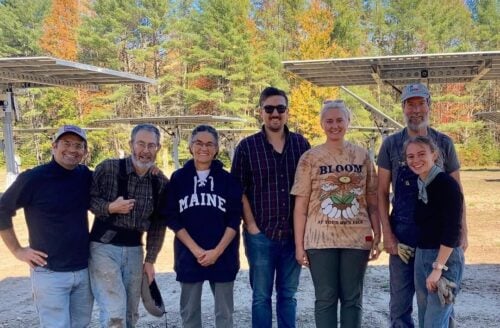
Local Energy Rules is produced by ILSR’s John Farrell and Ingrid Behrsin. Audio engineering by Drew Birschbach. Featured Photo Credit: Maine Community Power Cooperative
For timely updates from the Energy Democracy Initiative, follow John Farrell on Twitter or Bluesky, and subscribe to the Energy Democracy newsletter.
Oregon tries to tie utility profits to climate, cost, and reliability targets through performance-based regulation.
Rural electric co-op members should use this new toolkit to swap coal debt for clean, affordable energy.
NOLA’s Community Lighthouse initiative creates local hubs with rooftop solar and portable batteries to save lives after storms.
These plug-in devices bypass utility hassles to offer cheap, convenient power for everyone.