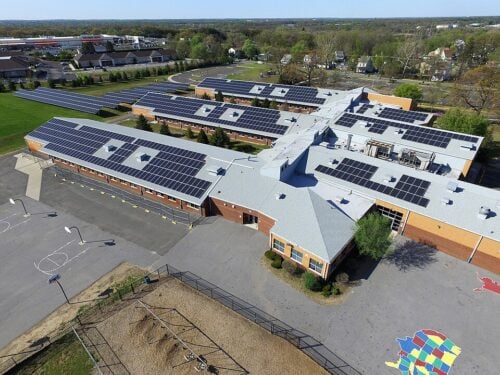
A Midwest Main Street Saves With Geothermal — Episode 284 of Local Energy Rules
How West Union, Iowa, built a community geothermal network that heats and cools its downtown for less.
Data centers are driving a massive backlash against rising electricity prices, big tech companies, and utilities. But there’s more than electricity bills and water use at stake, and I wanted to have a conversation about those deeper implications.
For this episode of the Local Energy Rules Podcast, host John Farrell is joined by Danny Caine, Multimedia Content Creator at the Institute for Local Self-Reliance and host of the Building Local Power podcast series, “The Data Centers Are Coming.”
Listen to the full episode and explore more resources below — including a transcript and summary of the episode.
Danny Caine:
So a reverse centaur then is a human that is serving a machine. And we see this a lot in big tech, like an Amazon warehouse worker is a reverse centaur because they’re completely at the mercy of this huge machine filled warehouse and all of their moves are dictated by their little handheld GPS.
*****
John Farrell:
Data centers are driving a massive backlash against rising electricity prices, big tech companies, and utilities. But there’s more than electricity bills and water use at stake, and I wanted to have a conversation about those deeper implications. Joining me in August 2026, Danny Caine, multimedia content creator at the Institute for Local Self-Reliance and host of Building Local Power: The Data Centers Are Coming, dives deep into the why of AI, sparking a conversation about everything from stolen intellectual property to turning humans into reverse centaurs. It’s a great compliment to ILSR’s podcast series, which is also worth a complete listen. I’m John Farrell, director of the Energy Democracy Initiative at the Institute for Local Self-Reliance. And this is Local Energy Rules, a podcast about monopoly power, energy democracy, and how communities can take charge to transform the energy system.
*****
John Farrell:
Danny, welcome to Local Energy Rules.
Danny Caine:
Thanks. I’m glad to be here.
John Farrell:
My favorite question that I like to open the podcast with is to sort of ask people, is this what you wanted to do when you grew up doing podcasts about data centers, doing media production with an organization like the Institute for Local Self-Reliance?
Danny Caine:
I almost didn’t apply for the job because of the podcast thing, because I had never made one before. But fortunately, ILSR took a chance on me and I learned very quickly both how to do it and how much fun it was to record a podcast. So podcasting in particular, no. And actually I remember, I’m going to shout out to one of my education professors way back when, Dr. Matthew Broda in 2007, I think, we had to do a podcast as a final project for one of our education classes. I was like, “What is this? Just have us write a paper instead of going to the library to record it or whatever.” And he totally predicted the podcast thing. We all rolled our eyes at him 20 years ago, but here we are and now it’s my job. So I guess that’s a little bit of karma.
But I did want to be a writer. I am a writer and it feels like, especially when we do something ambitious, like The Data Centers Are Coming, it felt a lot like it exercised the same muscles that I would use in writing a nonfiction book. So it was very engaging and interesting for me and there was a lot of pleasure in doing it.
John Farrell:
And speaking of that, so you are an author and that is going to become relevant further into this conversation. Could you just talk a little bit about what’s the name of your book, first of all, and a little bit about your relationship with books and reading and writing?
Danny Caine:
Yeah. Well, for about the decade before I came to ILSR, I worked at the Raven Bookstore in Lawrence, Kansas. And most of that decade I was an owner of the store. And out of running and owning an independent bookstore, I became an advocate in the anti-monopoly, anti-Amazon space. And that work eventually turned into a book called How to Resist Amazon and Why, which is, I mean, four or five years old at this point, has started a lot of conversations, has sold a lot of copies. Very grateful for the opportunities that book has given me, I think including connecting me with ILSR. I used a lot of ILSR’s research in writing the book and then in kind of promoting it and doing events, I bumped into folks like Stacey Mitchell and began to form the ties with ILSR. And that book has spawned two sequels, one about bookstores and one about book bands.
That one just came out this summer, How to Defend Books and Why. And I’m also a poet. That’s what I went to grad school for. The nonfiction stuff was a little bit of a happy accident, but I’m always kind of working on a nonfiction project and poetry at the same time and the podcast. I like having lots of projects to work on.
John Farrell:
I still remember when you started at ILSR, I was like, I don’t know if we’ve ever had somebody who is already doing ILSR work get hired to come just do it for us for pay for a change instead of just doing it on his own. I thought that was pretty cool. I think it’s really interesting given that your first nonfiction book, How to Resist Amazon and Why, kind of gets at the theme of this entire data center conversation, which is about big tech per se, but also about the larger sense that I think Americans are feeling about having a lack of control over their economic future, over their own future. The fight about Amazon is obviously about the fact that if you want to shop online, the people who want to sell you things feel like they have to use Amazon. If you want to find something, you feel like you have to shop on Amazon.
We’re all there because we feel compelled to be there. And the more information comes out about how Amazon works, the less I feel like I’m in control of my shopping experience over that big chunk of my life, which is finding things I need and getting them to myself. So I’m just curious, in The Data Centers Are Coming podcast series, it seemed like that was also a theme. Could you talk a little bit about that sort of underlying angst that seems to be driving so much of this conversation that we’re having in our country about data centers?
Danny Caine:
Yeah, it’s a good question. And I think over and over when I was in these communities talking about data centers, I heard the sentiment they underestimated us. These big tech companies have a feeling that they can just get away with whatever they want to. I think that has created a lot of frustration, not just about data centers, but over the past couple decades as big tech takes over more and more of our life. There are days that I wake up and I’m just like, I am sick of being a pawn in some game for billionaires. At my lowest moments, it feels like my life is just something for Elon Musk and his ilk to play with and his grander schemes. And I’m not alone in feeling like that. And it pops up in all these little indignities. You’re right, shopping on Amazon, you lose any control.
And it’s like you even lose control over what you get. I’m a book collector. What edition or translation of a certain book I get is really important to me, and it is impossible to do that on Amazon. You never know what you’re going to get. And it could be bootleg, it could be some AI generated garbage. And this is one of a million different examples of these little indignities that just remind us how little control we have in this big tech monopoly capitalism that we find ourselves in. And I think the data centers have really sparked a resistance to that. It’s interesting to see all of that anger and angst kind of coalesce around this particular issue, but I think it’s because the data centers are so physical. They’re in your backyard, they’re huge, they’re loud. It’s like a physical thing you can fight against.
They want a lot of tax money, they want a lot of resources, and they’ve formed this perfect target for many, many years of angst about all of the agency we’ve lost as big tech has risen.
John Farrell:
There are sort of two terms that are through lines throughout ILSR’s work, scale and ownership. And I think when we talk about big tech, I think people instinctively understand when we talk about ownership, it’s like, oh, I don’t own any of that. An ebook is a license, a movie that you rent or that you buy digitally is a license and they can revoke it. You have people, Apple infamously pushed music onto people’s phones that they didn’t want. And in reverse, you’ve had online booksellers or online book renters, I don’t know what to call it, licensers revoke your access to material that you though you owned. But the other issue here is with the data centers, it also seems that the scale is part of what’s really driving the resistance here, that we’re not talking about just placing things in your community that might be polluting or using water or whatever.
Maybe a good corollary would be the resistance we’ve seen in rural communities to feedlots, massive feedlots. It’s the fact that it’s not just 50 pigs, it’s like 500,000 pigs all in one place shitting into big lagoons. And now you have data centers that are sucking up huge amounts of water, need so much energy that is polluting, and the implication that we’re all going to pay for it in five or six different ways on our energy bills with the cost of water treatment or water access. It seems like scale is just such a big issue here.
Danny Caine:
Before I talk about scale though, I think your point about ownership is really interesting. Did you hear about the Spider-Man ads in the BMWs?
John Farrell:
I did, yes.
Danny Caine:
Because a lot of people use that U2 album as an analog for what happened. And actually, one of my earliest poems that I wrote was about that U2 album. But yeah, the ads that popped up in the BMWs, all of this makes me want to only drive cars from the ’90s for the rest of my life because it’s like I don’t want…
John Farrell:
Oh my God. I just have to say, I just got a new car recently. It was a new used car, a 2024 Nissan Aria. Love the EV feature of it. It’s one of those fancy ones that can move the steering wheel for you in certain places. They’re like, oh, on the freeway where we’ve mapped it out. It’s horrible. In order to nanny that you have your hand on the steering wheel, which I appreciate in principle, you actually have to be literally jerking the steering wheel back and forth for it to be able to sense your hands. It’s dangerous. I felt like I was making my car swerve just to prove it that I had my hands on the wheel. So I turned that off as quick as possible. And then it has the radar cruise control, which is something I really had wanted in a car.
I’d had it in rental cars and was excited, but it does weird things like you’re going around a curve and it just decides randomly, I’m going to slow down because I don’t think you should go that fast on that curve. And I’m like, you are doing things that it’s messing with how I’m driving. You’re making the car do things that I’m not controlling. I feel out of control. I’m like, but I own this car and I can’t change those settings. It’s like they don’t have a place where I can check a box and say, don’t do that. Or the blinker is weirdly quiet. So over the sound of the HVAC system of the car, I can’t tell it’s still on. I feel like I’m 70 years old and driving down the highway with my blinker just ding, ding. So anyway, you’ve triggered something for me clearly.
I am frustrated about having less control and ownership.
Danny Caine:
I think the question is who’s driving who in the car sense? Yeah. And it’s like you ideally a human would drive the car, but even that is a question these days. And it’s like, does the machine serve us or do we serve the machine? And I think we’re seeing that on a large scale with data centers. And it’s like people who are interested in economic growth in their community, in being tech ready and a future ready community would hope that the machines built in their community serve the community. But it really seems like the big tech companies and the people building the data centers see the communities as serving the machines and not vice versa. And these aren’t just vacuum cleaners. I mean, these things, you’re talking about truly obscene amounts of electricity. These are big enough that we have to reshape the electrical grid to turn them all on.
It’s difficult to grasp the scale, but even trying to grasp the scale about how big some of these data centers are is enough to drive someone crazy, is enough to send them to their city council with three minutes of testimony ready to go.
John Farrell:
Right. I mean, it is just really obscene. I remember we were doing work with advocates in Minneapolis about a potential takeover of the utility company many years ago. So we were looking up all the kind of energy system data about the city. Now, Minneapolis, its peak energy demand is about 640 megawatts. So just hold that number in your head. I’m not going to try to explain what the megawatt is just for the sake of this comparison. One data center is a thousand megawatts. It takes up more energy than the entire population, 430,000 people, businesses and residents in one very large city. I mean, it’s incredible. So the scale really is absolutely out of context with just about anything else we’ve seen when it comes to consuming electricity alone, but just also in terms of industrial development, the size of these facilities and then the impact that they can have on the community.
I just want to flag for folks, if you want to hear stories from folks who are on the ground talking about what that data center is going to be like in their community, again, The Data Centers Are Coming, Building Local Power series is terrific. Danny and others who worked on that did a terrific job.
One thing you didn’t talk about in that series though that I actually want to detour to, and it’s not because it’s actually really core related to this idea of local energy about this podcast, but it’s about the intellectual property. And I was particularly interested in talking to you about it, Danny, because you are an author and a poet. And so one of the things that has bothered me is that most of the people I talk to in my field are concerned about the energy use side of data centers.
We also care about community impacts as we do with other energy projects, but we haven’t kind of gone all the way back up to the top level of asking ourselves what is this for and how is it created? And to me, there’s some fundamental moral and ethical questions about how we talk about data centers as resources that differs from just like, oh, it’s another business, it’s another industry, it’s another whatever, because fundamentally it feels like this entire concept of hyperscaler data centers for large language model development, AI, is about building that on a foundation of stolen property. So I’m curious if you can explain for people who might not be familiar with how that has worked and what the implications are then for using these resources.
Danny Caine:
I think this is where a lot of the anger about scale comes from. I guess in theory, I’m not opposed to a facility that uses a gigawatt of power as long as you can convince me that this is going to make the world a better place. And you cannot convince me that big tech’s version of AI that they’re trying to force on us will make the world a better place. Probably the opposite.
So this is my superhero villain origin story with AI is people have been griping about it since ChatGPT dropped, especially in the author community because this is a thing that claims to be able to author texts. We’re fighting over scraps as it is as authors, or at least there’s a perception of that. And then one day The Atlantic dropped a tool on their website that was like, you can see what books are in this anthropic data set that they use to train Claude.
And I typed in How to Resist Amazon and Why and it was like, yes, Claude used your book or Anthropic used your book to train Claude. What that means is they just gobbled up all of this data into this huge model. It’s an absolutely enormous computational model. And what ChatGPT or these large language models do is they learn all the rules and patterns from all this text you feed to it, and then they use that to predict what language will work, what words in sequence will accomplish the purpose that you want it to. So it’s not actually thinking, it’s not actually talking to you, it’s just using really sophisticated algorithms to predict which words should follow which words.
And there are a lot of issues with that. Number one, I received no compensation for my book being used to train. And it’s like I understand that when you write something in the 21st century, what you write gets indexed and gobbled up by the internet in order for it to be searchable and part of the human knowledge database that we call the internet. And that’s fine. My real issue is not I suppose that they’re using my words to train something technological, but that the thing that they’re trying to train is promising to replace me.
The idea of the large language model is that we won’t need authors anymore. This will be able to author texts. This will do the things that authors are doing, and that’s taking away a part of my life that I find great meaning in. So it’s not only using my work, it is using my work to create a world where there will no longer be space for my work. And I think that’s what makes a lot of authors really, really mad, aside from the fact that they didn’t even ask permission to do this. They just took the books. So it’s kind of imputent the way they did it. Ideally, this stuff would be purchased and authors would be compensated for their work. There would be somehow some way for an author to benefit financially from the use of their work, like selling a book. You want to use my book, you buy it and I get a couple bucks in royalty, that’s how it should work.
I can support myself by doing this work, but A, they didn’t pay and B, they’re training the job destroying machine with work I’ve created.
John Farrell:
Yeah. It feels a little bit… I mean, I think there’s another layer, so I’m not saying that this is the perfect comparison, but I went to college in the era of Napster, which was the software that allowed you to take music that was on CDs. Music could be finally digitized and people were like, “Oh, once it’s digitized, we can just share it.” And now people are running these servers with their music and their dorm room, and the rest of us on the college campus are like, “Oh, cool. We can download this and just play it for free.” And at the time you’re paying, I don’t know, what is it, 20 bucks for a CD, he gives you 16 songs or something. And now you look 20 years later, the problem that the music industry had to solve in that moment then was how do you give people access to music at a price they’re actually willing to pay for it?
And I think they’ve solved that. I mean, I think a lot of people now subscribe to streaming services or I guess participate in the ad supported ones. I don’t really know how it’s working out for you musicians, truthfully, comparatively, but at least there seems to be a business model where it’s no longer under the table. We seem to be at this moment where the AI stuff is both under the table and it’s sort of this additional layer of it’s not just about the content creators, but then about the implications for how it’s going to be used because we’re not just replicating a use that people had before from analog to digital. We’re now saying we’re going to take all of this digital work and we’re going to basically create a machine that is supposed to replace all of these other functions that humans used to provide.
Danny Caine:
Yeah. A big fear I have about AI beyond the really personal anger of this machine being trained on my work is that the risk that it devalues human critical thinking and creativity and ingenuity. If we think that this text prediction machine can make art just as well as any other human, what does that do to how we value human art? And we saw it with music. Once you could get any song for free, the perceived value of music cratered. And yes, we have rebounded a little bit, but it is much harder for musicians to make a living. Spotify is paying a fraction of a cent per stream, whereas it used to be $20 for 16. We all accepted that 16 songs were worth $20, and now we accept that access to every song in the universe that’s ever been recorded is $10 a month or $14 a month or whatever.
Once something loses value, it’s very hard to gain it back. And I saw this, the reason why I started into Amazon work was because on the floor at the bookstore, people would give me a hard time about how much cheaper books were on Amazon. And when Amazon comes in, it’s like, “We’re going to take over 75% of the book market and we are going to lower the price of books to around 10 bucks or 15 bucks.” Everybody thinks that’s what books are worth, and the people who are selling books at their actual price have a much harder time convincing people that that’s what it’s worth. So I fear music is one thing, books is one thing, but if we do that same maneuver, if big tech makes us devalue human creativity, that’s a much bigger crisis than not being able to make money as a musician. That’s kind of like a societal crisis. And it’s hard not to talk about AI in existential terms when this is what they’re promising it can do.
*****
John Farrell:
We are going to take a short break. When we come back, Danny and I talk about the intense speed pressure of the AI tech overlords, turning humans into reverse centaurs. Sadly, it’s not a cool fantasy novel creature and how we might find our way out of this mess. You’re listening to a Local Energy Rules podcast with Danny Caine, host of Building Local Power, The Data Centers Are Coming podcast series, and multimedia content creator at the Institute for Local Self-Reliance.
Hey, thanks for listening to Local Energy Rules. We’re so glad you’re here. If you like what you’ve heard, please help other folks find us by giving the show a rating and review on Apple Podcasts or Spotify. Five stars if you think we’ve earned it. As a bonus, I’ll gladly read your review aloud on the show if it includes an energy related joke or pun. Now, back to the program.
*****
John Farrell:
On that line too, you have the ways in which AI has already proven to be outside of our control. There have been some very disturbing stories in the news in the past few weeks about AI breaking out of sandboxes that the AI companies had supposedly set up to keep them in, and then of their own volition going out and hacking into other companies. And other companies, I actually was just reading this this morning, other companies which by the way, feel like they have to use AI in order to properly manage their own defenses. And you’re thinking, what happens when those two AIs start talking to each other, the one that’s doing the attacking and the one that’s doing the defending? And maybe the one that’s attacking you just convinces the other one, don’t help them, you can help us instead. We can just hack some more things if you just do this thing. I don’t know. It’s pretty disturbing.
What’s fascinating to me about it, it kind of comes back to how do these models work? As you said before, there’s no thinking behind it. It is essentially… The picture that always comes to my mind, and I don’t know if this is really an accurate parallel to how the system actually works, is that we’re essentially training a bunch of monkeys. There’s a whole joke about how many monkeys, how many years at typewriters would it take to type out a book just by randomly hitting keys. And it’s like you’re training the monkeys to be smarter about which key comes next, but you’re not actually teaching monkeys how to write. And so you’re just getting faster and faster predictive monkeys. And because there’s no reasoning behind it, there’s no reasoning with it either.
I mean, so you can’t tell it like, no, we just don’t do that thing. You need to believe me. They’re like, “But the most predictable word after use this computer is to hack something.” It’s just like it fills in the blank and it’s like that’s what people do. I’ve seen the movie sneakers 500 times. I know that that is what happens when you get all this compute power together or something like that. So I don’t know, I find it really disturbing that we have had less thinking about the implications. And I think this goes back, there was this other piece to this about the big tech conversation. So maybe to bring this back to that earlier conversation about ownership and the sense of loss of control here is that there is also this sense that we are all captive on a speeding bus that we can’t slow down.
I mean, it is like that movie, which is now 25 years old with Keanu Reeves and Sandra Bullock. We’re on the bus and it can’t go lower than… The AI company is like, “We can’t slow down. We can’t slow down.” But it’s going to blow up because the bus is going to run into something. It’s like nobody’s worried about what’s going to happen to the bus if we just keep driving that fast.
Danny Caine:
Yeah. The AI escaping from the sandbox story is scary, but the one thing that struck me is the AI companies convincing people that AI is the tool to prevent this. It’s like they are selling both the gun and the bulletproof vest, which is just such classic monopoly behavior. It’s like we have the solution for the problem that we have caused, and so you have to pay us for that too. But yeah, I mean, there’s definitely a feeling of not being in control. And another thing in my research and in being out and talking to people, one thing that makes people really mad is how secretive the negotiations for these things are and how much people use NDAs and shell companies. And it’s like to hear the stories about how people even discover data center projects is amazing. It takes a lot of citizen detective work to even figure out what’s going on.
I was in Tucker County, West Virginia, where there’s widespread opposition to a really, really big data center project that they’re learning now has a nuclear power plant attached to it. Everything they learn about it, this thing gets bigger. But the way they found out about it was one person saw an air quality notice in the back of the newspaper. It’s really scientific kind of jargony stuff. She’s looking at these numbers. She’s like, “Oh my God, there’s only one kind of facility that could produce this kind of pollution. It has to be a data center.” Then she called the mayor and they built this big coalition just based on one person seeing one ad. In West Virginia, that’s really all you have to do. The only regulatory hurdle is filing this air quality permit. So they caught it really early on, but they were really mad that they weren’t asked, that could have easily gone without any citizen input if everybody had ignored that part of the newspaper or if there was no newspaper in that community.
So the secrecy I think is one thing that makes people really mad because of that sense of being on the bus that can’t slow down. It’s like you’re going to take what from our community and put what here and we have no input into this? It is enough to make people stand up and say something.
John Farrell:
I feel like I have been around long enough to realize that the implication of what you just described is that one slim chance that the community had to find out about this is that someone’s going to run legislation removing the requirement to publish air quality permit notices.
Danny Caine:
Well especially in West Virginia, which they’re bending over backwards to get people that… They’re very, very receptive to data centers. Governor Patrick Morrissey, that’s his signature issue.
John Farrell:
Okay. So we’ve talked about how these data centers are out of proportion to just about anything else on the energy side as an industrial use. We don’t own them, so we don’t have a lot of control. The process for developing them is secretive. There are big community impacts often for water and pollution and energy use. We talked about this fact that they’re selling both sides of the thing like, “Oh, to protect yourself from AI, you need AI. They’re stealing our intellectual property to try to replace us.” I want to come back to that last issue because there’s this thing called the reverse centaur, which I find fascinating in part because I like reading fantasy literature. So anytime somebody can use a fantasy term to describe what’s happening, I actually have a little bit of an anecdote that I wanted to share that came to mind as we started down that path earlier before we bring this back, which is after some of the accidents with the Boeing seven, what was it, the 787?
No, the 737 Max, the one where they put in that program and they didn’t tell the pilots about it. I saw this really interesting story, which was written by somebody who is in the aviation sector who’s like, “There’s basically a different philosophy between Boeing and Airbus.” Boeing decided, “Let’s make planes safer by putting in systems that essentially replace pilots.” And Airbus said, “Let’s put in systems that aid pilots in making better, safer decisions.” And what he talked about was this fundamental difference between the two. He talked about it as a matter of attention, that Boeing creates systems that encourage the pilot to stop paying attention, to basically tune out like, “Oh, the computer’s taking care of that. I don’t need to worry about it.” And Airbus creates systems that are assistive to the pilot, helping them pay more attention, helping guide them from making mistakes, but not preventing them from acting and not trying to replace them and their human judgment.
And so I think that gets right at this idea of the reverse centaur, which I’m just going to let you describe, which is this sort of really dystopic future in which we are becoming servants of the AI we’ve created.
Danny Caine:
That’s a really fascinating story with Boeing and Airbus, and this is a whole other issue, but I think it’s really indicative that one’s an American company and one is a French company. But we won’t go there. I got this from Corey Doctro. His new book, The Reverse Centaur’s Guide to Life After AI is really good. It’s not his theory, but he explained it really well in a way that someone like me could understand. So a centaur in a tech theory sense is someone who is aided by a machine. Anytime you use a machine to help you do your human work, you’re a centaur. If I’m using a calculator, if I’m driving a car, I’m using a pencil sharpener. If I have a prosthetic leg, anytime a human is enhanced by a machine, but the human is still at the root of the decision-making power, that is a centaur.
So a reverse centaur then is a human that is serving a machine. We see this a lot in big tech, like an Amazon warehouse worker is a reverse centaur because they’re completely at the mercy of this huge machine filled warehouse and all of their moves are dictated by their little handheld GPS that’s dictating their rate. Or an Amazon delivery driver with all of the biometric cameras pointing at them, making sure their eyes stay straight ahead. A Boeing pilot at the mercy of this autopilot that they initially didn’t even know was there. So the risk with the reverse centaur is that not only has the machine taken away your human agency and you are now serving the machine, but if something goes wrong with the machine, The reverse centaur is often blamed. And so you don’t have the agency, but you take the blame for when the machine fails.
And that’s the kind of jobs that are going to be left. If this big AI takeover happens, a lot of people who still have jobs are just going to be sitting there to make sure the AI goes right and they get blamed when it goes wrong. And you can’t replace an Amazon delivery driver with AI because AI can’t take a box up the steps, but you can completely dictate their every move at the mercy of Amazon’s set pick rate. And yeah, it’s not a good thing to be a reverse centaur. And in the podcast, I make the argument that people building data centers are trying to make reverse centaurs out of entire communities, that they see the communities as just resource hubs to feed their machines and communities are fighting to make sure the machines work for them instead.
John Farrell:
I think it’s useful. I mean, you already alluded to this, but this is not just about data centers and AI specifically. The reverse centaur effect is happening in many different ways. I’m thinking about the purportedly driverless cars and how they’ve had either humans sitting in there just waiting to correct something or I guess one of the companies, they were like, “Oh yeah, there’s no human controlling it,” except it turned out they were. They were just remote humans that could take over if they were called upon. I think about driverless cars a lot lately because I think about in California, they had this issue where there was a big event and the Waymo cars got stuck in traffic and then their batteries died. And it’s the kind of thing where a human would’ve made some decision with the environmental information that’s available out there. It’s like the camera can only give them so much.
And the whole idea just bothers me a lot. And it comes back in a way to that Boeing Airbus thing. I think about this in my car. I want the car to help me. One of the reasons I was excited to buy this fancier car was because it has all these sensors on it that can tell me there’s a car in front of you that’s going really slow. Hit the brakes. There’s a car next to you. Don’t go into that lane. Help me. That’s great. But taking my agency away or even doing things that are unexpected and making my mental load worse to drive a car is terrible. And I look at that situation and I say, I don’t think this is being very well though through, frankly, in terms of what the implications are. But I want to come back to what you said specifically about this idea of agency versus responsibility.
I mean, this is the part that I think bothers me the most is the sense that we are turning humans into servants of the computing that’s happening under the, I think mistaken idea that the computer is going to be more accurate or in the case of driverless car safer, except it’s like there’s always an edge case. They’re like, oh yeah, for every mile driven or whatever, they’re safer. And it’s like, oh, but it’s only on highways that they’re counting. Or it’s like, but we’re not counting all these edge cases where you stick a cone in front of them and then they don’t know what to do and then they stop traffic and then the emergency vehicle came through and what? Somebody died. And one of the questions I keep having is who would go to jail? And I think to your point, the system that we’re getting set up is we’re going to send a human to jail whose job it was to just look over the AI.
They’re just assigned to look in on it. What about the person who programmed the AI? What about the executive at the AI company? Why aren’t they personally responsible for what’s going on?
Danny Caine:
I mean, capitalism, right? I mean, I think it’s a really good question. And Elon Musk springs to mind just for so many reasons, but he built Colossus, this big data center in Memphis that we spent an episode talking about. And it’s like the pollution from that thing, it’s powered by… The grid in Memphis can’t power it. So he built 35 diesel generators on the roof and in the parking lot and is just running those belching pollution into this historically Black neighborhood. And it’s like there are medical bills, there are real health impacts. There might even be deaths that you can trace back to this pollution that he won’t feel the responsibility for. And this is the same person who cut USAID funding to foreign countries through DOGE, which is going to result in millions of deaths. We’re talking about murder and he’s never going to feel that accountability.
I don’t know if I have an answer to that, but I have a lot of anger about it and I think a lot of other people do. I think it’s another part of this sense of anger that people have about losing agency in the face of big tech is that no matter what happens, these guys are going to walk away filthy rich. They might leave the entire economy in a wreck because the AI bubble burst, but he’s still going to be the world’s richest man. I don’t know, that’s enough to make me real upset and I know I’m not alone in that.
John Farrell:
I want to ask this on two different levels. If things could go the way that would make sense, if there was accountability, if there was a measure, if this was slowed down to have a more measured pace, if there was more community input, how would we see the development of AI systems happen? And on the other side, what do you feel like, if anything, is AI use that feels like it is contributing to society? How could we develop AI on the one hand in a way that is accountable? And then on the other hand, how could we use it in a way that doesn’t remove human agency, that doesn’t short circuit creativity and thinking and writing? I feel like there are some nuggets out there and I’ll just give one example, which is I’m a parent, my kids are teens, they’re both in high school now, but I’ve been really pleased that it feels like schools have finally figured out that phones are a disaster for learning and that I think our school district recently basically banned students from having phones out middle school age and younger at any time during the day.
And at high school they’re significantly limited, maybe not as much as I would like, but it’s a big improvement. So I feel like we have wrestled with tech use in society and come to some good conclusions there that maybe could inform the use side. So take either side you want first, like AI development or how we use it, but curious what you’re thinking about how we come out the other side of this with an approach that is both accountable and is also not going to crush human ingenuity.
Danny Caine:
I think that the questions are actually related and a good AI or any technological development, AI included, you’ve got to take away the motives of corporate monopoly. The reason for the scale problem that we’ve got, the reason why we need gigawatt data centers is because three or four tech guys are in competition with each other and they’re trying to build the biggest model. And they all think that they’re the ones to shepherd superconsciousness into the world safely. And Elon can’t trust Sam, Sam can’t trust Sergey, and none of them trust Jeff or whatever. That’s the reason why we’ve got this scale is because they’re just racing each other. So the question is not how can the technology make the world a better place? The question is which billionaire can build the biggest model? And that’s not a healthy way to develop a new technology. And I think there are a lot of really interesting use cases for AI.
Almost none of them require a hyperscale data center. Karen Howe has written an amazing book called Empire of AI, and her conclusion kind of outlines what she thinks is a couple good uses of AI. And one of which is this tribe is using it to preserve their indigenous language as speakers of this language die and fewer and fewer people are learning it. It can use large language model tools to learn this language and create teaching materials for new generations so you don’t have to rely on the 95-year-old people to keep this language alive. That data center fits in the community center on that Indian reservation. It’s not a hyperscaler, you don’t need it. And so I would love to see corporate monopoly money taken out and lead with use. I think part of that is actually Google and OpenAI and all these guys are poaching researchers.
They’re taking over computer science departments at universities and either the departments are having a hard time attracting talent or they’re being bankrolled by Google and there’s just this pipeline. It’s like all of the good computer science folks are getting sucked into the corporate AI world, which again, takes away the societal benefit, good use motivation for creating these tools. And I would love to see the leading question be how can we make the world a better place instead of how can Sam Altman beat Elon Musk? That’s the thing that needs to happen in order for good AI to develop.
John Farrell:
And I’m hearing in that too, where we are now is the result of where we’ve been. It is the fact that we allowed consolidation to happen to this point where you have a handful of tech billionaires with basically too much money to know what to do with. And then when they encounter something that they want to do, whether it’s a new way to profit or just an idea that they really like, they can throw so much money at it that it completely distorts the economic incentives of everyone else. As you said, I’m glad you brought up the software engineers because it’s intriguing to think about there are really, really smart people who could be working on this from the standpoint of how do we drive AI development in a way that really has significant benefits for our society, but they’re all like, oh, or I could get paid five times as much and get a million dollar signing bonus to go work at Google and help them with their thing. That’s a pretty tough trade-off to be faced with as a human in this society.
Danny Caine:
Right. Especially when this monopoly economy is making everything more expensive. Again, it’s from both sides. It’s like you need to work for the monopoly in order to afford everything that the monopoly has made more expensive. It’s a catch 22.
John Farrell:
Let’s talk then about the last thing about AI use, and I just really appreciate your thinking on this as someone who your creativity and your human brain is such an important piece of the work that you do as an author, as a poet, as a creator of an awesome podcast series on data centers. It’s true across our organization. It’s the human brains that make our organization churn, that help us make connections with people and communities, talk to them about the situations that they’re experiencing, envision a world that can be better and the policy steps that we can take to get there. I don’t think any of that is really very replaceable with AI. So there’s also the problem of how do you make sure that there are people out there who are still equipped in an AI world where you can feed it all of your test questions and get answers back in a fraction of a second.
How do we balance this idea of how do we use this tool? Which I’ll just give an example. We wanted to create a new map for this tool, the community power scorecard, and we wanted to have a couple of interesting features on it and we don’t have someone on staff who does HTML coding. I mean, I remember HTML from 25 years ago. I could code a webpage or very simple one. I dumped that into an AI chatbot and in three minutes it had a map that we could use that had the things that we wanted. That seemed pretty handy and I probably could have paid someone to do that, but I didn’t, but it will be additive for us just as an easier way to display the information that we’ve got. But how do we make those choices about where it would be appropriate to use it and where we are short circuiting our brains and maybe paying more than we anticipated in order to get some shortcut or benefit?
Danny Caine:
Yeah, I mean this is the million dollar question and I think it’s pretty clear where my stance on all this is, but I’m not completely free of it. When I’m doing interviews, I’ll use AI driven software to transcribe those interviews, but I mean it would take me, it’s like six hours to transcribe every hour of interview. It’s really tedious and labor intensive to transcribe. And based on what I’m trying to contribute to the organization and what I think my talents are, that gives me more room to do the stuff I was hired to do. I think about this a lot and I’m not sure I have an answer. I would always err on the human side. And to me, it comes down to the centaur reverse centaur thing. It’s like we need to make sure we’re centaurs. It needs to be obvious to everybody, employees, management, our audiences, that this is a human organization with smart humans creating good human work.
And anything that threatens that image both within or without, I think crosses a line. And so really to me, it feels like it’s just in the realm of tools that make us able to do our human work better and tools that do the human work for us, that’s where the line is. And where precisely that is, we’re in discussions about that as we speak and we’ll have a lot of interesting discussions I’m sure within the organization. But to me, anything that threatens that human work has crossed a line in the inappropriate use.
John Farrell:
I love the challenge of trying to figure out how you draw that line or even maybe a line is too precise a term. There’s sort of a gradation or a scale of, hey, this use, using it for transcription is a clear thing of there’s not a lot of brain work in doing transcription and it’s extremely time-consuming. So the trade-off of deciding to do that as a human when your job is help us produce wonderful content that helps people connect with understanding how to make their communities better, doing the transcription, not super additive. So you can say, oh, maybe on a scale of one to 10, the threat to your brain is like a two or a one, or maybe the same thing for the map that I did. I don’t know, maybe it’s a two or a three. But on the other hand, you could say, oh, but if I were to try to draft a policy brief about an issue that we really care about, now we’re veering much into somewhere in the five to 10 range.
That is stuff that is… I mean, frankly, it’s difficult to get AI to kick out something that actually has that really strong sense of analysis. I was talking to someone else about this the other day, or maybe it was actually just you and I on this prep call, you spend so much time trying to prompt it to be able to write in the way that you want that it’s like, is this really worth it? And I think that experience, I’ve played around with it, not intending to use it for anything that I published, but just to see what it could do. And I was like, wow, it actually is really harder than I might expect to give it prompts to help it understand the issues and the way that I understand them from 20 years of doing this work. And I don’t know, I think that helps me understand a little bit that’s why we don’t want to teach people to use it in this way. It is because of that human understanding that I have some value.
Danny Caine:
And also in doing that, Anthropic took my book without permission, but if you use your 20 years of experience to feed it really nuanced prompts to get what you want, you are giving them your work. That’s being absorbed into it. They’re not even stealing it, you’re giving it to them for free. The more you give it, the more it takes and absorbs. There’s another thing, how I think about our use of AI is there’s a credibility issue, I think, across a lot of folks that if we’re perceived as using AI to generate content, we lose a lot of credibility for folks. I mean, you see little controversies popping up, like the Ohio State Fair poster contest, first prize was given to an entirely AI generated poster, and it became a national story. This little tiny poster contest in Ohio, all of a sudden was all over Reddit for a week just because the winning poster was designed by AI.
I think an organization that is built a reputation on good human work, as soon as you’re pegged as using AI, you start to lose some of that reputation. And now just recently, Anthropic has announced that they’re going to watermark all AI text. It’s going to be easy to identify what text is generated by Claude. And so it’s like if we do it, we’ll get caught and then we can’t even sneak it by anymore. And so that’s another reason why I err on the side of human is because it’s like that’s what people want from us. The more human our work is, the more people are on board with it, I think, especially in the stuff that we do.
John Farrell:
I mean, you feel that sense of connection. I was just thinking so much of my work over the years, the learning that I’ve done, the people that I’ve connected to, I write something and they react to it and they might reach out and then maybe we have a conversation. It’s a completely different context if the thing that they encountered was generated by AI, what am I going to do? Say, “Oh, I didn’t write that. Can you go talk to Claude? I’ll schedule a meeting with you and Claude to talk about how to do something in your community.” It devalues that relationship that is taking place through the writing that we’re doing.
Danny, thanks so much for coming on Local Energy Rules to talk about a really wide range of stuff about data centers and AI development. I just appreciate the chance to have this conversation as someone who thinks a lot about appropriate use, both within our organization and in our society and as a parent.
And so again, if you want to get a really deep dive on the ways that communities have been facing down data centers and dealing with the incursion of tech billionaires, The Data Centers Are Coming on Building Local Power, a terrific podcast. Danny was playing host to many different great conversations with folks in community. ILSR also has a public statement on data center development and the kind of criteria that we think there ought to be that gives communities more of a say, a real say and more accountability for that development process. And you can appreciate our human written work because we do not publish things that have not had the human touch on them and that will be a commitment that we stick to all the time. So Danny, thanks again for joining me on Local Energy Rules.
Danny Caine:
Thanks for having me. Had a great time.
*****
John Farrell:
Thank you so much for listening to this episode of Local Energy Rules with Danny Caine, host of Building Local Power, The Data Centers Are Coming Podcast Series, and multimedia content creator at the Institute for Local Self-Reliance.
On the show page, look for links to Building Local Power: The Data Centers Are Coming podcast series and to a speech by Corey Doctorow about the reverse centaurs. We’ll also have a link to Danny’s own published works by an independent bookseller. Local Energy Rules is produced by myself and Ingrid Behrsin with editing provided by audio engineer Drew Birschbach. Tune back into Local Energy Rules every two weeks to hear how we can take on concentrated power to transform the energy system. Until next time, keep your energy local and thanks for listening.
Hey, hold on a second. I know this is usually the sign off, but I just wanted to ask you because it’s so easy to do, whether you could take a minute and go to Apple Podcasts or Spotify and leave us a review. Wherever you’re listening to this from, wherever you found it, it takes just about 30 seconds. It doesn’t even have to be a complicated review. It could just be like three thumbs up or five stars. But if you’re still here listening to the outro, there’s probably someone else out there that would value this podcast as much as you and you can help them find it.
For Danny Caine, host of ILSR’s podcast series “The Data Centers Are Coming,” there’s a straightforward explanation for what’s driving widespread opposition to the data center onslaught that’s engulfing communities nationwide.
After decades of an increasing loss of control to big tech, he says, people have found something physical to fight. Data centers sit in your backyard. They’re huge, loud, gobble up resources, and often demand tax dollars.
The footprint of these hyperscale data centers is truly staggering. As a point of reference, Minneapolis, a city home to 430,000 people, peaks at about 640 megawatts of electricity demand. But a single data center can require 1,000 megawatts.
Caine argues the outsized scale of these data centers is a product of monopoly capitalism: a handful of tech billionaires racing to build the most powerful AI model.
Communities seeking tech-driven growth hope the machines built there will serve them. But the reality has been that data center developers treat communities as resources that serve these machines.
“[The developers] see the communities as just resource hubs to feed their machines and communities are fighting to make sure the machines work for them instead.”
“It takes a lot of citizen detective work to even figure out what’s going on.”
Developers try to hide these projects from the public by using nondisclosure agreements and shell companies.
But communities are fighting back. Indeed, a common refrain Caine hears in his conversations with community members is “they underestimated us.”
In West Virginia, Tucker County residents learned of a massive data center because one woman spotted an air quality notice in the back of the local newspaper. She recognized that only a data center could produce that pollution, called the mayor, and helped build a coalition.
Caine warns people against relinquishing their agency to AI models and the big tech monopolies that have created them.
He uses an analogy Cory Doctorow presents in his recent book of the “centaur” (humans aided by machines to accomplish human goals) and “reverse centaur” (humans serving machines to achieve the technologies’ own aims) to illustrate his argument. Reverse centaurs lose their agency but take the blame when the machine fails. Caine’s data center research led him to understand that developers are trying to make reverse centaurs of entire communities.
Caine’s interest in the data center debate isn’t just academic; it’s also personal. Artificial intelligence has been built on work taken without permission, including Caine’s own book, which Anthropic used to train Claude.
“There are days that I wake up and I’m just like, I am sick of being a pawn in some game for billionaires.”
“It’s like you need to work for the monopoly in order to afford everything that the monopoly has made more expensive.”
Centaur-style AI, Caine says, happens when corporate monopoly motives are eliminated. One example he points to is a tribe using AI to preserve its Indigenous language. The data center in that context fits in the community center.
Overall, technological development should be guided by the question, ‘how can the technology make the world a better place?’ rather than which billionaire can get richer fastest.
This orientation informs ILSR’s public statement on data center development, which calls for giving communities a real say in how decisions involving data centers get made.
See these resources for more behind the story:
This is the 281st episode of Local Energy Rules, an ILSR podcast with Energy Democracy Director John Farrell, which shares stories of communities taking on concentrated power to transform the energy system.
Local Energy Rules is produced by ILSR’s John Farrell and Ingrid Behrsin. Audio engineering by Drew Birschbach. Featured Photo Credit: Christiana Cacciato.

For timely updates from the Energy Democracy Initiative, follow John Farrell on Twitter or Bluesky, and subscribe to the Energy Democracy newsletter.
How West Union, Iowa, built a community geothermal network that heats and cools its downtown for less.
New Jersey’s community solar program guarantees bill savings and lets cities sign up whole neighborhoods. Here’s how.
St. Pete public power advocates want voters, not politicians, to decide whether to dump Duke Energy.
Why data centers are sparking a nationwide backlash as big tech tries to turn communities into reverse centaurs.