Ban Restrictive Covenants That Chains Use To Prevent Competition
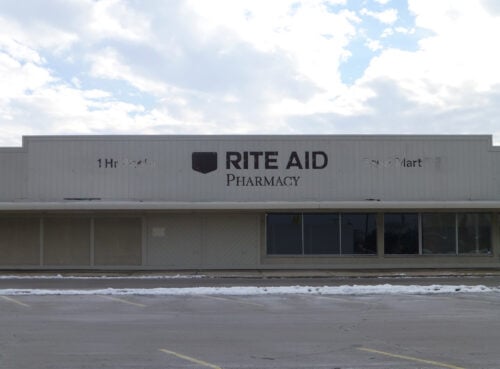
When a chain grocery store closes, or a chain pharmacy moves out of a neighborhood, the space it leaves behind can stay vacant for years. Often, these stores aren’t empty due to a lack of interest from other businesses, but rather because a clause in the property’s deed — called a restrictive covenant — prevents them from being used by potential competitors. But healthy competition is essential for a healthy economy. It helps keep prices in check, ensures better access to necessities, and spurs innovation. Local and state governments can ban restrictive covenants, particularly for businesses vital to public health, like grocery stores and pharmacies.
Restrictive covenants, which chain businesses often use to keep competitors from moving in, are legally binding clauses that limit how buildings or land parcels can be used. They are attached to a property’s deed and “run with the land,” meaning that they stick with the property when it changes hands and require future property owners to adhere to its restrictions.
Restrictive covenants have been used in the U.S. for at least two centuries. Some of these have been helpful, like covenants that prohibit polluting industries from locating near homes and schools. Houston, the largest U.S. city without a zoning code, relies heavily on deed restrictions to shape neighborhood development patterns. But some have been harmful, like racial covenants that prevented Black residents from living in certain neighborhoods, a practice the Supreme Court and the 1968 Fair Housing Act eventually invalidated. And for decades, national retailers have used restrictive covenants to block competition, with harmful, far-reaching consequences. Even when a property is sold, the new owner must adhere to the restriction. And the restrictions often last for years; in at least one instance, Stop & Shop imposed a 75-year-long restrictive covenant on a shopping mall where it held a master lease.
Restrictive covenants are particularly harmful when they block grocery store development. In most communities, very few properties are both zoned for commercial use and large enough to fit a supermarket, so there might not be a suitable site other than the vacant store. Also, a vacant grocery store building can set off a chain reaction of neighborhood disinvestment: customer traffic drops; the property looks uncared-for, making shoppers wary of visiting nearby businesses; property values fall; and the entire neighborhood suffers.
This “scorched earth” practice exacerbates food and pharmacy deserts, areas already lacking convenient access to essential services. In Woonsocket, Rhode Island, Stop & Shop and Walmart have used restrictive covenants to tie up almost all the buildings and commercially zoned parcels large enough to accommodate a full-service grocery store. Both of them have since opened stores just outside the city, in North Smithfield. In 1997, pharmacy chain Eckerd Corporation bought a piece of land in Seminole County, Florida. It also needed the adjacent parcel but was unable to buy it, so it resold the land, slapping a 50-year covenant on the deed to block a competing pharmacy from using it. The following year, the company that bought the Eckerd property resold it to a developer who planned to build a store for pharmacy chain Walgreens. To get around the 50-year restriction, the Walgreens store would be built on the adjacent parcel, with the restricted parcel used only for parking and site access. Eckerd sued, and the court upheld its claim, keeping the site without a pharmacy for decades.
Removing restrictive covenants alone will not solve the problem of grocery and pharmacy deserts; many factors contribute to them. But improving convenient access to healthy food and medicines is almost impossible without stopping chains from keeping out competitors.
It also isn’t just grocery and pharmacy chains that use restrictive covenants to keep out competitors. Movie theater chains, dollar stores, fast food restaurants, and other national corporations also use them. For example, a movie theater operator gave a historic theater in Rockford, Ill., to the city in 1998 — with a covenant prohibiting its use as a movie theater. Fast food chains like McDonald’s and Chick-fil-A have used restrictive covenants numerous times to keep out competitors, as have convenience store chains, regional and national bank chains, tire store chains, and others.
“Removing restrictive covenants alone will not solve a grocery or pharmacy desert problem; many factors contribute to them. But improving convenient access to healthy food and medicines is almost impossible without doing so.”
Kennedy Smith, Senior Researcher, ILSR
The first step is finding restrictive covenants
The first step in solving the problem of restrictive covenants is to find them. No local policy work on restrictive covenants can happen until someone — a local government official, a healthy food advocate, or a concerned citizen — can figure out if the reason why the community can’t attract or develop a grocery store is that covenants restrict the available sites.
Unfortunately, searching for restrictive covenants can be tedious and time-consuming. While most states make some land records available online, only a handful of states make all of them available. More complete property records might be searchable online at the county or city level, though. In many instances, identifying restrictive covenants involves manually combing through deeds in the city or county property records office. If your state or community makes property records available online, enter a search term like “restrictive covenant” or “use restriction.” Look, in particular, at the property records for any relatively large commercial spaces that have been vacant for a while.
Here are a few things to be aware of when searching for restrictive covenants:
Restrictions on how commercial property can be used may appear in leases and deeds. But unless there is a legal reason for a lease to be part of a public record, lease restrictions might be difficult or impossible to identify. Check with local commercial realtors; they might be aware of lease-attached restrictions. Title insurance companies and commercial lenders might also be aware of properties whose leases prohibit certain uses.
A chain store might not use its own corporate name when filing a restrictive covenant. In Woonsocket, R.I., for example, Stop & Shop operated a grocery store on Diamond Hill Road for several years, then closed the store and opened a new one a few miles away. When it sold the building in 2004, it placed a covenant on the deed prohibiting its use as a food store for 30 years — but the deed was recorded in the name of its subsidiary, Calvi Realty Co., making the restrictive covenant much more difficult to locate. Some chains, such as Dollar General, almost always lease their buildings rather than own them outright, so the building’s deed will likely be in the name of the investor who owns it.
If a commercial property owner owns multiple buildings or lots within a certain radius of a site it leases to a chain store, the chain might pressure the property owner to add a restrictive covenant to all of these sites as a condition of leasing its building.
Some big businesses have attached use restrictions to buildings they no longer use, making it nearly impossible to rent the buildings to other business tenants. They then argue that, because the building is vacant and therefore prone to deterioration, its taxable assessed value should be reduced (a tactic called “dark store theory”“dark store theory”). In 2026, Michigan’s state legislature considered a bill that would prohibit this practice.
Restrictive covenants aren’t the only way that chains can keep competitors out of a community. Sometimes, they continue to pay rent for a building or parcel of land for which they have an active lease. For example, grocery chain Stop & Shop kept paying the rent for a space it leased in Pawcatuck, Conn., for years after it had moved to a new location a couple of miles away. In Eastham, Mass., Stop & Shop bought 11 acres of land for $1.3 million to prevent another supermarket from opening there. Most commercial leases are private documents, however, making it nearly impossible to trace them.
What Local Officials Can Do to Prevent and Remove Restrictive Covenants
Adopt an ordinance prohibiting restrictive covenants
In 2019, three years after Albertsons closed its store in Bellingham, Wash., and used a restrictive covenant to keep competitors away, the Bellingham City Council passed a law banning similar covenants in the future. It could not invalidate the existing restrictive covenant (the state’s Attorney General was able to do so in 2024 after opening an investigation into whether the restriction violated the state’s antitrust laws), but it prevented the problem from happening again. Several other cities have passed similar laws, including Chicago, Seattle, and Washington, DC.
Refuse to lease publicly owned property to companies that use restrictive covenants to keep out competitors
In 2022, Dollar General leased a parcel of land from the city of Gary, W.V., and negotiated restrictions with the city that would prevent the city from selling or leasing a nearby parcel to any of a long list of competitors, “for as long as Dollar General, its affiliates, successors or assigns is leasing or otherwise occupying the Benefitted Parcel.” Refuse to give preferential treatment to companies that use anticompetitive tactics.
Ask courts to invalidate restrictive covenants that keep grocery stores out of neighborhoods
Although it is a long shot, restrictive covenants can be invalidated if they are found to be unreasonable and contrary to public policy goals. There is an important legal precedent for this: Davidson Bros. v. D. Katz & Sons. In 1980, Davidson Bros., a grocery store with several outlets in New Brunswick, N.J., closed one of its stores and sold the building to a rug store, with a covenant attached to the deed prohibiting the site from being used as a grocery store for 40 years. This left the predominantly low-income neighborhood without a convenient source of fresh, healthy food, so several years later the city bought the building and leased it to another supermarket. Davidson Bros. sued the city to enforce its covenant. The lawsuit went to the New Jersey Supreme Court, which concluded that the use restriction was “so contrary to the public interest … that the covenant is unreasonable and unenforceable.”
If no other options exist, be prepared to negotiate with companies that impose use restrictions on their property
Safeway, a grocery chain, attached a restrictive covenant to a parcel of land it owned in Washington, D.C., in a food desert in the city’s Ward 7 neighborhood. The mayor found a grocery store interested in building on land adjacent to Safeway’s, but it needed the Safeway-owned parcel for parking. The chain initially refused to remove the covenant, but eventually agreed to do so — for $3.6 million.
What State Lawmakers Can Do to Prevent and Remove Restrictive Covenants
Enact a law prohibiting restrictive covenants
Washington State adopted a law in 2025 prohibiting covenants that restrict the use of commercial space by grocery stores or pharmacies. In 2026, Rhode Island enacted a law that bans grocery-related restrictive covenants. Both laws provide some flexibility for grocery stores that legitimately plan to move to a nearby site within a brief period of time. Several other states are now considering similar laws, including at least one that would make it possible for county attorneys to remove existing restrictive covenants if they violate the state’s restrictive covenant ban.
Challenge restrictive covenants as violations of antitrust laws
Grocery chain Albertsons closed its store in Bellingham, Washington’s low-income Birchwood neighborhood after merging with Safeway in 2015, leaving the community without a grocery store. Before it closed the store, Albertsons placed a covenant on the property deed restricting its use as a grocery store for the next 22 years, forcing neighborhood residents to travel miles to buy groceries. In 2014, Washington Attorney General Bob Ferguson investigated this and concluded that Albertsons must drop the restrictions on the Bellingham properties. “A supermarket is no longer barred from opening in Albertsons’ old location,” he wrote, “and the current owner is free to agree to amend the 1982 restrictions, leaving open the possibility that a supermarket may open in the neighborhood in the future.
Require local governments to make land records available and searchable online
A growing number of counties make land records available and searchable online, including Maricopa County, Ariz. At least one state — Maryland — aggregates all county records on its state archives website. Record searches should be available to the public without charge.
Adopt Planning and Land Use Policies That Support Locally Owned Businesses
More than almost any other factor, a community’s planning and land use laws and policies affect its success in supporting small, locally owned businesses.