Rhode Island Passes Landmark Law to End Grocery Store Real Estate Restrictions
Washington, D.C. (June 10, 2026) — With overwhelming votes in both state legislative chambers, Rhode Island has become the second state in the nation to prohibit chain grocery stores from preventing competitors from moving into commercial spaces they own or lease. Washington State enacted a similar law this March. The bill will now go to Governor Dan McKee for his signature.
Kennedy Smith, senior researcher with the Institute for Local Self-Reliance, issued the following statement:
“For decades, several large grocery retailers, including Stop and Shop and Walmart, kept competing grocers out of communities by attaching covenants to the deeds or leases of property they control, with some of the restrictions lasting as long as 75 years.
“Restrictive covenants are a scorched-earth strategy that these big grocery chains use to block competition and to dominate local markets. Americans everywhere are painfully aware of the rising cost of groceries. Competition is essential for fair pricing, and Rhode Island’s new law is a major step towards lowering grocery bills, preventing food deserts, and restoring a competitive marketplace.
“We applaud Lt. Governor Sabrina Matos for introducing this bill, the Legislature for its overwhelming support for it, and we expect Governor Dan McKee to sign it into law in short order.”
The new law will ban grocery stores from restricting competitors from locating in commercial spaces that they own or lease. It provides an exception for grocery stores relocating within half a mile of a vacated space and within a year of vacating the space. The law does not apply to restrictive covenants already in place. ILSR worked closely with Matos and her staff on the restrictive covenant policy and submitted a letter to the state legislature in support of the bill.
The bill was one of several introduced this year by Lieutenant Governor Sabina Matos as part of the Fair Price Grocery Agenda to make groceries more affordable and prevent the development of food deserts throughout the state. Other bills in the package included one that would regulate dynamic grocery pricing and one based on the federal Robinson-Patman Act that would help protect independent food businesses from anticompetitive tactics by large chain food retailers. Those bills will be reintroduced next session.
In addition to Rhode Island and Washington, at least two cities, Chicago and Washington, D.C., have adopted similar laws. Within five years of Washington enacting its law in 2018, 20 new grocery stores opened there.
INDEPENDENT BUSINESS INITIATIVE
Sign up for updates on the fight for a level playing field
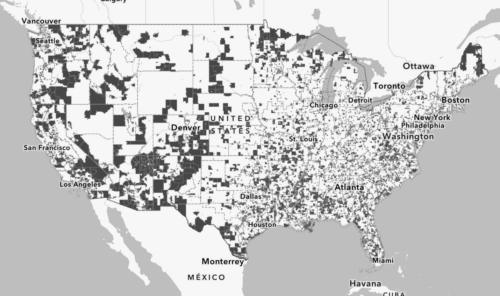
To demonstrate how corporate concentration has reshaped food access in the U.S., ILSR's interactive map shows food deserts alongside the location of grocery stores.
How Corporate Consolidation Broke America’s Grocery System
ILSR's brief explains how corporate consolidation fueled high food prices, and the critical role independent grocers play in building resilient local food systems.
This virtual event examined ways dominant retailers exert their power, how communities are fighting back, and how leaders can restore fairness in our food system.…...
###
About the Institute for Local Self-Reliance
The Institute for Local Self-Reliance (ILSR) is a national nonprofit research and educational organization founded in 1974. ILSR has a vision of thriving, diverse, equitable communities. To reach this vision, we dismantle concentrated power and equip changemakers to build communities with locally accountable power. We believe that democracy can only thrive when economic and political power is widely dispersed. In recent years, ILSR has researched and advocated for programs and policies that address problems caused by price discrimination and unfair competition in the grocery sector.