Simpler Solar Permitting Is a Key to Affordable Electricity
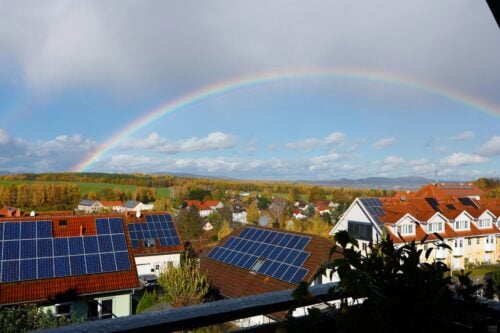
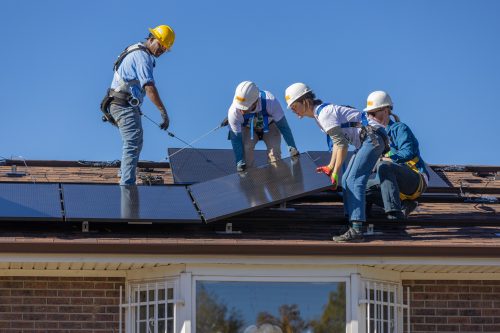
Solar is the cheapest source of electricity in the world, saves residents money on their monthly electric bills, generates no pollution, and can be installed in as little as one day. Peer countries like Australia and Germany have seen massive growth in solar uptake in just the past several years, with panels added to house and apartment balconies, roofs, and farms.
Meanwhile, power rates in the U.S. are skyrocketing, federal tax credits have been slashed, AI and electrification are driving huge increases in demand for electricity, and 1 in 7 households is in energy poverty. So why hasn’t the U.S. seen a solar revolution similar to those in peer countries?
Even with the recently-cut federal tax credits, American customers have been paying tens of thousands more for rooftop solar and batteries – and waiting months longer for installation – than their counterparts elsewhere. Complicated and expensive permitting requirements imposed by local governments account for most of those costs.
Simplifying the nation’s patchwork of local permitting processes is the key to making local solar affordable. In 2025, we teamed up with Permit Power to examine how the local permitting process affects solar costs in Minnesota. Our study revealed that the problem is not a permitting process, but the variety of permitting processes.
Solar installers that operate in multiple cities take on the major cost of handling each municipality’s unique permitting process. One installer might track permitting requirements in a spreadsheet. Another might have to call every city for each project to confirm that the published permitting process is accurate. This obligation to track hundreds of bespoke permitting rules is a major driver of the high cost of U.S. solar installation. The keys to making permitting less expensive include simplifying procedures and lowering fees, but a comprehensive solution also needs to be a spreadsheet slayer.
Solar permitting needs to be easy and fast. Too many U.S. solar projects are delayed weeks or months while cities process, approve, and conduct project inspections for permit applications. Meanwhile, Australia’s municipal solar permits are issued in 24 hours or less, a major contributor to solar adoption by owners of 1 in 3 Australian homes.
Instant permitting software is already available in the U.S., but cities have to individually decide to adopt it — ultimately, the software’s value will be limited by how many cities keep their distinct (and slower) permitting processes.
Some local governments’ first impulse might be to resist permit simplification in an attempt to preserve their authority. Fortunately, the most developed software — SolarAPP+ — was designed by the federal government with input from city officials. Several municipalities piloted the free app in real-world processes. A 2023 survey of cities using the app (which numbered 160 at the time) found that it dramatically cut permit turnaround times and significantly saved staff time, benefiting both solar customers and municipal budgets.
Streamlining these processes at the state level would, of course, be simplest — and there’s plenty of room to bake in some city leadership and choice along the way. States could allow the first two or three cities that act to use the instant permitting platform of their choice, but restrict all subsequent municipalities to one of those few options, as long as permit approval wait times remain fast.
Alternatively, cities could emulate the Australian strategy by prioritizing installer training, minimal upfront permitting, and random installation audits. Solar projects could be exempted from a local permit requirement as long as they hired a certified, trained installer. Random audits would identify problems, and companies or individuals with repeat errors would face fines or other penalties. This kind of approach could help raise wages for rooftop solar workers, by directing some of the savings from simplified permitting to reward certified installers.
Simplifying permitting is a worthy investment, even for the affordability and climate benefits alone. If local and state governments take the lead in simplifying our complicated permitting landscape, the U.S. can join our peer countries in enjoying cheaper rooftop solar.
How Cities Can Simplify Rooftop Solar — Episode 218 of Local Energy Rules
Toyah Callahan and Zach Greene discuss how the SolSmart technical assistance platform supports local governments as they streamline their solar permitting, inspection, and zoning processes,...