This prestigious recognition celebrates Farrell’s extraordinary contributions to solar energy adoption, particularly through rooftop and community solar programs.
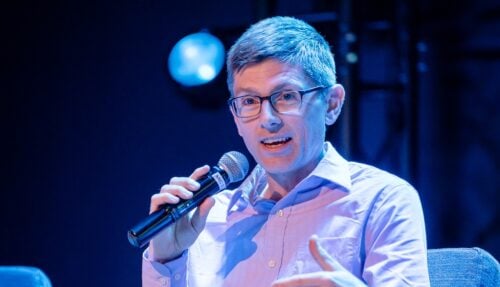
Minneapolis (October 07, 2025) — The Institute for Local Self-Reliance (ILSR) is proud to announce that John Farrell, ILSR’s co-director and director of the Energy Democracy Initiative, will be honored with the Minnesota Solar Energy Industries Association’s Melissa Hortman Lifetime Achievement Award on October 8, 2025, during day two of the organization’s annual Gateway to Solar Conference. The award was renamed this year in honor of Minnesota state legislator and former House Speaker Melissa Hortman, a tireless clean energy champion who was tragically assassinated in June 2025.
John worked closely with Representative Hortman during the pivotal 2013 legislative session, when she chaired the House Energy Policy Committee and shepherded passage of groundbreaking legislation that established Minnesota’s solar energy standard and launched one of the country’s first community solar programs. John recalls answering her detailed questions about community solar’s benefits and trade-offs as she prepared to defend the bill and build bipartisan support. “She wasn’t going to tell them something untrue,” John told Canary Media’s Frank Jossi following her murder in June. “She was going to seek reasons why this policy might be something that they would care about or that it might align with their values.” That legislation helped make Minnesota a solar energy leader in the Midwest and widely shared the benefits of going solar among Minnesota electric customers.
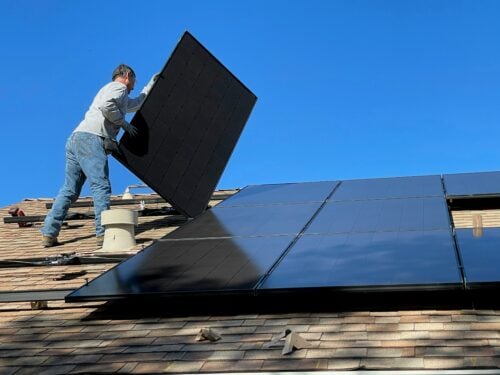
This prestigious recognition celebrates John’s extraordinary contributions to solar energy adoption, particularly his tireless advocacy for distributed solar through rooftop and community solar programs. A respected thought leader on issues of distributed energy, John has spent his career demonstrating that the path to a clean energy future must prioritize not just what powers our communities but also who owns and controls that power.
Championing Community-Owned Clean Energy
Throughout his career, John has been a leading voice for energy democracy — the principle that clean energy systems should be owned and controlled by the communities they serve, not by distant utility monopolies. His research and advocacy have illuminated the economic, environmental, and democratic benefits of local ownership of decentralized renewable energy, showing how distributed solar keeps money and decision-making authority in local economies while accelerating the transition away from fossil fuels.
As host of ILSR’s Local Energy Rules podcast and a prolific author, John has shared powerful stories of successful local renewable energy projects while exposing the barriers that monopoly utilities place in the way of community solar and rooftop installations. His landmark 2024 report Upcharge: Hidden Costs of Electric Utility Monopoly Power exposes investor-owned utilities as an abusive monopoly harming our communities, climate, and democracy. The report details how these utilities account for 32% of U.S. energy-related carbon emissions, cause 171,000 pollution-linked deaths annually, and use their monopoly power to obstruct clean energy competitors while gouging customers with record-high electricity prices.
Providing Pathways to Solutions
John’s impact extends far beyond identifying the problems with monopoly utilities — he has provided communities with concrete tools and evidence to take action. His groundbreaking report, Energy Self-Reliant States — a state-by-state atlas highlighted in The New York Times — provided data-driven ammunition for advocates of decentralized energy systems by demonstrating that as of 2020, nearly every state could meet 100% of its electricity needs using only in-state renewable resources. This work challenged the utility industry’s preference for large, centralized generation facilities they could own and control, and exemplified John’s approach: using rigorous analysis to show that community-scale, locally owned renewable energy isn’t just idealistic — it’s practical, economical, and achievable.
Through ILSR’s Community Power Scorecard, John and his team have created an annual evaluation of state policies that help or hinder local clean energy action, grading all 50 states on their support for energy democracy and utility accountability. This scorecard provides advocates with clear targets for policy reform and reveals which states are leading the way.
Similarly with the interactive Community Power Toolkit, John’s team has demonstrated how communities across the country have successfully worked with their cities and utilities to increase local clean energy, reduce energy use, and fight climate change. Rather than asking communities to reinvent the wheel, the Toolkit provides over 20 tried and tested strategies, complete with case studies, sample ordinance language, and stories of local success that other communities can replicate.
Following in the Footsteps of a Visionary
John’s approach to clean energy has been profoundly shaped by Institute for Local Self-Reliance co-founder David Morris, who passed away earlier this year. In a recent Building Local Power podcast episode, John reflected on one of the most important lessons he learned from David — the idea of clean energy itself isn’t enough. In addition to the climate, we must also think about who owns energy and the systems that provide it.
When David published his report, The Dawning of Solar Cells, in 1975 — when nearly the only people using solar power were in NASA’s Apollo program — he envisioned a future of community control and local ownership. Nearly five decades later, John notes, “the world is still catching up with things David Morris wrote 50 years ago.” David’s vision was clear: if clean energy systems remain controlled by monopolies, communities still find themselves at their mercy. A true energy revolution requires community-owned clean energy — the path David charted and John continues to follow.
Building a More Democratic Energy Future
John’s work has influenced policy and practice across the country, from advancing community solar programs that allow renters and low-income households to benefit from solar energy to supporting cities in their efforts to achieve 100% renewable energy goals. His advocacy has consistently challenged the century-old monopoly model of electricity delivery, asking whether it still makes sense in a 21st-century distributed energy landscape.
MnSEIA’s Melissa Hortman Lifetime Achievement Award recognizes not just John’s decades of leadership but also his unwavering commitment to ensuring that the clean energy transition creates a more equitable and democratic energy system — one that puts power, both literally and figuratively, in the hands of communities.
“It’s been a joy to see how John has grown ILSR’s energy democracy and climate solutions work over the 20 years we’ve worked together,” says John Bailey, the development director at ILSR. “I’m heartened by how his leadership and perspectives on the best way to implement a clean energy transition are increasingly gaining momentum. This award is truly deserving.”
The Institute for Local Self-Reliance congratulates John on this well-deserved honor and looks forward to continuing the work of building local power through energy democracy.
Recent Highlights from John Farrell and the Energy Democracy Team
A Farewell to Clean Energy Champion Rep. Melissa Hortman
Energy Democracy Initiative Director John Farrell writes a farewell to Minnesota clean energy champion Rep. Melissa Hortman, who was assassinated in June 2025