Public Housing Project Creates Jobs, Supports Gardens, and Reduces Rat Problems
This case study was originally published in Keep Compost Local, a report offering survey data, case studies, and policy recommendations to equip governments to collaborate with local composters and foster community prosperity.
Municipality and Interviewees: New York City Housing Authority, Juliette Spertus, Associate Urban Designer, and Louisa Denison, Programs and Policy Advisor (both in NYCHA’s Sustainability Department)
Community Composter: Compost Power (Domingo Morales, CEO, Founder)
Public-Private Partnerships (PPPs)
The New York City Housing Authority (NYCHA) manages 335 properties with a total of 2,212 resident buildings and about 361,000 residents in all five boroughs of New York City. The average income of NYCHA residents is $25,605, according to the Authority. In 2021, NYCHA published a Sustainability Agenda that included the collection and processing of organics in partnership with several urban farms on its properties, increasing residents’ access to organics collection, adopting a design for circularity, and improving gardens and soils with compost generated on site.
To fund its work related to organics recycling — specifically on-site composting of residents’ food scraps and leaves and yard trimmings from NYCHA building grounds — the Authority applied for and received two grants, one from the New York State Department of Environmental Conservation (NYS DEC) for $195,000, and the other from the U.S. Department of Agriculture’s (USDA) Composting and Food Waste Reduction’s (CFWR) cooperative agreement program for $398,904. Both grants include a public-private partnership with Green City Force (GCF), a green workforce development nonprofit, and Compost Power, an incubated organization of GCF solely focused on composting in environmental justice communities. GCF created and manages six EcoHubs (urban farms) on NYCHA grounds, and Compost Power does the composting, food scraps collection, and outreach and education.
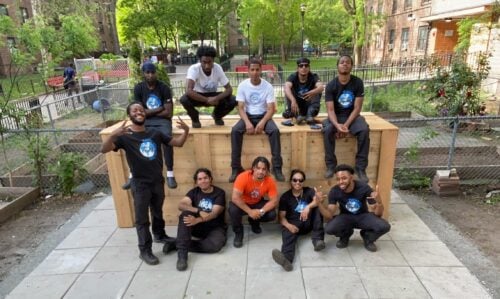
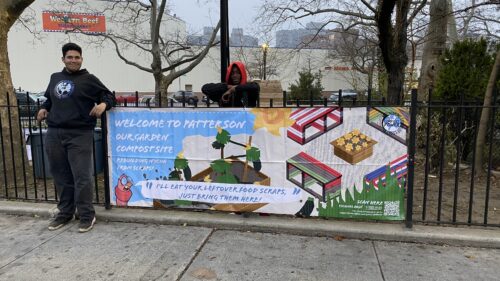
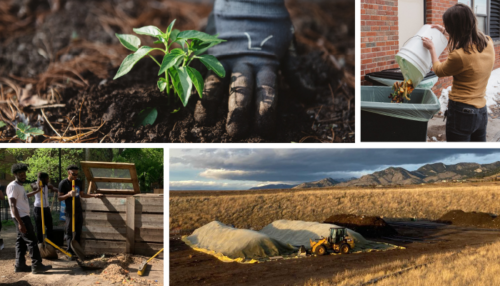
Crew members with garden compost site sign. Credit: Compost Power
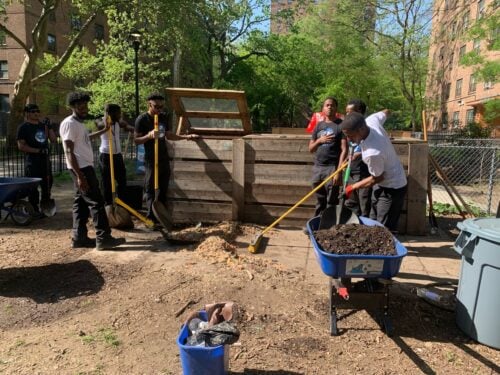
Crew engaging in composting process. Credit: Compost Power
Municipal Motivation
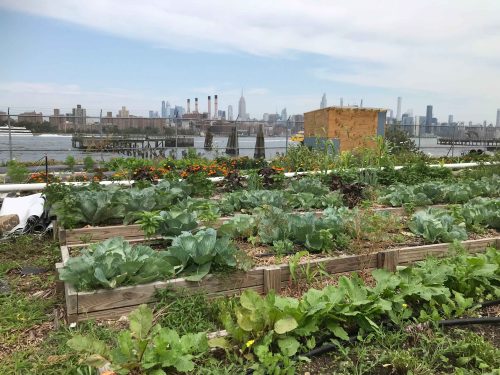
According to NYCHA, about 600 tons per day of waste are generated across its campuses, of which an estimated 200 tons per day are organics. The Authority has one to two grounds staff per campus, which makes it a challenge to add the responsibility to manage an on-site composting system. However, many of its residential properties have land available for community gardens and urban farms, where on-site composting of food scraps, leaves, and wood chips can be done, creating a source of nutrients and organic matter for the farms and gardens. Rodent habitats in the gardens are an ongoing challenge for residents.
NYCHA’s successful relationship with GCF to establish the Eco-Hubs laid the groundwork to help create composting capacity at some building campuses, utilizing Compost Power as the “boots on the ground” for food scraps collection and composting. There are six composting sites partnered with GCF’s Eco-Hubs, along with two operating independently on NYCHA campuses.
Grant-Funded Programs
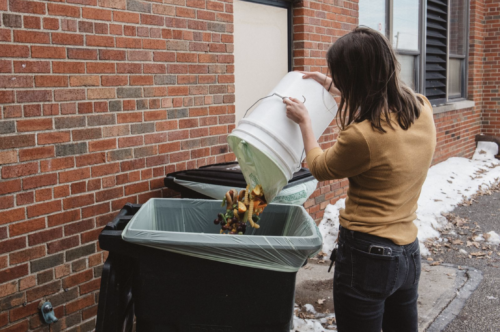
NYS DEC: The NYS DEC grant was awarded to NYCHA in 2022 to fund a two-year pilot to collect and process food scraps at two NYCHA developments — the Polo Grounds in Upper Manhattan and the Patterson Houses in the South Bronx. The goal was to provide convenient food scraps collection to more than 8,000 residents, pilot a new model for 3-bin composting not located at an Eco-Hub, generate compost for residents and the building grounds, and reduce the rodent population at pilot sites. Funds covered Compost Power’s staff time for collection and composting, as well as expanding the drop-off schedule from three-hour windows weekly with staff to 24 hours, seven days a week (staffed during some windows), helping maintain a consistent flow of materials.
Approvals with each building’s Property Management and tenant association leaders were obtained. Materials for the 3-bin system cost about $11,000 per site, and included pavers and mesh for rodent proofing and totes for food scraps collection. Five young adults were trained on how to build a 3-bin system using hand and power tools.
Food scraps pile. Credit: Compost Power
Compost Power collected data on food scraps captured using a ticker and a scale; the measured data includes temperature and the weights of both food scraps and finished compost. NYCHA and Compost Power teams met monthly to review the data and discuss any counteractions or ideas for improvement. For example, after extensive testing, Compost Power decided to accept meat and dairy. This matched what the Department of Sanitation’s drop-off “smart bins” were collecting, allowing the program to compete and facilitating participation. From January 2023 through December 2024, more than 47,000 pounds (>23.5 tons) were processed, or roughly 19,000 pounds per year. About 25,000 pounds of leaves were collected. Compost Power recorded over 2,800 resident interactions. More than 12,000 pounds of finished compost were distributed. Compost Power’s crew measured contamination. A total of 440 rat tunnels were collapsed.
Food scraps collection at Patterson Houses started slowly in 2023, e.g., 166 pounds in the first quarter, and increased during the summer and fall quarters (1,416 pounds and 2,378 pounds, respectively). “The team continued with determined engagement, even walking alongside passersby to let them know about the food scraps drop-off site,” notes Louisa Denison.
USDA/CFWR: The CFWR grant — which runs from March 2025 to February 2027 — builds on the infrastructure and outreach and education accomplished through the NYS DEC grant: continuing to expand access to food scraps dropoff to an estimated 11,400 NYCHA residents and providing additional NYCHA community gardeners and urban farmers with finished compost and technical assistance. Compost Power set up four additional satellite food scraps collection points near the Polo Grounds and Patterson Houses. It uses an electric tricycle to transport the food scraps back to the composting sites. Grant funds are also being used to procure leaf mulching equipment and a wood chipper to improve the efficiency of processing landscape materials, significantly boosting compost production. “A key focus is soil quality improvement and increased capacity to manage leaves and tree trimmings on-site,” says Louisa Denison.
As the grant progresses, the scope of work will be further enhanced by an additional position, a dedicated Compost Power Compost Liaison, who will coordinate the distribution of the finished compost processed at Compost Power to NYCHA community gardens and urban farms as well as NYCHA grounds, in order to reduce the use of fertilizers. Finally, this project will deepen the Authority’s research on the effects of compost and leaf mulching on soil fertility and stormwater management at NYCHA sites, assessing the benefits in terms of soil health and flood risk reduction.
Contract Agreements
Green City Force and NYCHA have a license agreement for use of the property for its Eco-Hubs and Compost Power’s composting sites, essentially a “barter” for use of the land in exchange for the services GCF and Compost Power provide. In 2021, NYCHA issued a Request for Proposals for stakeholder engagement services; contracts were awarded to several groups, including GCF for outreach and engagement initiatives. NYCHA is subject to five-year contract limits, so will need to issue a new RFP for services in 2026.
The public-private partnerships with GCF and Compost Power made it possible for NYCHA to apply for the USDA CFWR grant, explains Spertus. “Without our contract with GCF, as well as the licensing agreement, we would not have been qualified to apply,” she says. “Those cover all NYCHA sites and the broad list of activities conducted by GCF and Compost Power, and we were able to reflect that in the USDA application.”
Composting Activity
At both the Polo Grounds and Patterson NYCHA campuses, Compost Power installed a 16-foot by 16 foot “patio” or base for the 3-bin composting systems built with two-foot pavers. “That is the first step in rat proofing,” notes Domingo Morales. “We also created space for three 20-foot long by 6-foot wide windrows to process the leaves and brush coming from the campuses. Compost coming out of the bins can be added to these windrows to cure if it isn’t needed right away for the gardens.” Wood chips and other carbon sources are stored in corrals, which are more visually pleasing to residents passing by.
Morales’ advice when composting food scraps in public spaces (e.g., parks, housing campuses, urban farms) is to start by composting only leaves and residuals from the gardens. “Stick with those materials in the beginning to create the first batch of compost,” he says. “That keeps the microbes native to the ‘community.’ Then add food scraps. Key is to break down the high-carbon, really dry materials enough to mix in with the food scraps and cover them.”
Compost Power is able to compost a portion of the leaves that come down during the fall at its composting sites. The remainder are collected by the NYC Department of Sanitation. At the Polo Grounds, almost 80% of the leaves are composted on-site. The compost is being used to remediate a slope on the campus.
To enable composting of all food scraps, leaves, and yard trimmings generated on a NYCHA campus, a combination of human power and machines will be needed, adds Morales. “There are different campuses where a solar-powered in-vessel system could complement human-powered composting,” he says.
Outreach & Education
Through funding from the grants, Compost Power takes the lead on outreach and education to residents, the tenant associations, the building staff, and the grounds workers. “Don’t think about installing a composting site without connecting with the residents and the leaders of the tenant associations,” notes Morales. “They are the leaders of the community and approve of new gardens, where to place e-bike charging stations, and anything else that is public-facing on the campus. Their meetings are usually later at night. Attending is our first investment in the community, and we start by listening and then gauge how much we should say early on. We’ll bring fliers and explain what Compost Power does if asked. Because we and GCF hire NYCHA residents, that is an automatic plus. Our end goal is to be a problem solver, for example, help with eradicating rat tunnels. In some cases, we never get to building a composting site, but we can address the problem of rats in their gardens.”
If it gets a green light, “we will pour 100% into figuring out how to fund it, learn where management would like us to put the site, and then, most importantly, where the tenant association would like us to be,” he adds. “Even though our sites have similar layouts, each looks different because the residents get involved.” Once the process gets underway, Compost Power staff attend community events, hand out flyers, teach residents about composting, and involve them in deciding what the banner at the site should say and look like. When the site is ready to accept food scraps, Morales recommends staffing the drop-off for a few weeks — at a minimum, five days a week — and then switching to it being open 24/7 as many residents can’t come in the windows when it is staffed.
Morales emphasizes that success doesn’t mean processing a lot of organics, at least in the early days and months. “Be prepared to play the long game,” he says. “For some residents, it takes time before they are willing to participate.” Household participation at some sites is 15% to 20%; at two of its sites, Compost Power is getting close to 25% to 30% participation.
Compost Markets
The finished compost is used at the resident community gardens and the Eco-Hub farms. A portion is used on the grounds.
Costs & Benefits: NYCHA
Access to composting located on NYCHA’s campus is a significant benefit during the fall when the leaves are coming down. “The sites create the capacity to reduce hauling and make sure organic material stays on the campuses,” notes Denison. “This presents an opportunity for the property management, waste management, and sustainability departments to collaborate and promote the organics diversion programs on NYCHA campuses.”
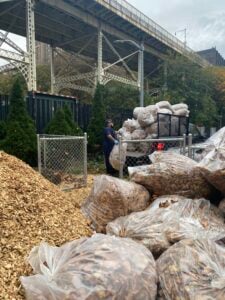
Crew member loading bags of carbon-rich materials. Credit: Compost Power
Another key benefit is that regular, repeated engagement builds the trust and visibility to scale up food scrap diversion. Residents get to know staff when they are at the site processing compost or picking up scraps by e-bike multiple times a week.
A template and lesson learned from the DEC grant — and which may be unique to NYCHA — is putting a composting site on a NYCHA campus that is in a cluster of NYCHA properties, adds Spertus. “Compost Power staff utilizes the cluster to collect food scraps from the nearby campus buildings,” she says. “One processing site can serve multiple campuses.”
The sites create the capacity to reduce hauling and make sure organic material stays on the campuses. This presents an opportunity for the property management, waste management, and sustainability departments to collaborate and promote the organics diversion programs on NYCHA campuses.
Louisa Denison, Program Associate, New York City Housing Authority Sustainability Department
Costs & Benefits: Compost Power
Morales concurs with Spertus’ perspective: “We don’t want to build a processing site on every campus. The key is how to efficiently serve many campuses and how to do that with as little budget as possible.”
With an on-site composting operation in an urban setting, Morales recommends “going extra on the patio in terms of thickness, and using cedar wood for the bins.” He adds that “it takes a lot” to work through all the red tape at NYCHA: “I’m getting used to it. As long as we are thorough and dot the ‘i’s’ and cross the ‘t’s,’ the red tape becomes easier to manage. We want to serve residents, create jobs, and reduce waste. This is a lot easier at NYCHA because of its 10-year sustainability agenda — and composting is on that agenda.”
When asked about how he calculates Compost Power’s cost per diverted ton, Morales points out that the calculation is a bit different for his organization because community impact has to be factored in. “These calculations need to incorporate how many residents you interact with, behavior changes, trainings, and overall support to ensure success happens,” he says.
PPP Lessons Learned
NYCHA: A key metric for a successful public-private partnership is factoring in how much time initiatives take to launch and create valuable learnings. “We ran a six-month organics recycling pilot with an in-vessel unit, and it wasn’t nearly enough time to get everything up and running and learn,” says Spertus. “That is why with the DEC grant, we were insistent on it being two years, and then we were able to extend it further with a funding match.”
Another lesson learned is creating meaningful partnerships with all the other internal stakeholders who are key to a project’s success. “In NYCHA’s case, that means engaging with the Property and Waste Management Departments,” explains Denison. “Our public-private partnership sits in the middle of that space, and brings together elements of each department’s areas of responsibility. For example, we aligned on the benefit of pest management, especially rats. And we collaborated on finding unique ways to spread the word and increase resident participation.”
Compost Power: The public-private partnership creates the foundation for GCF and Compost Power to do what they do best, emphasizes Morales: “GCF does the farming and Compost Power does the composting. We use these two programs to train young adults and feed residents.”
His advice to other community composters is to identify institutions that have a sustainability agenda as well as existing capacity — in NYCHA’s case, land — and research how to integrate composting services into that agenda. “Network and talk to people to identify how to plug into helping the institution achieve its goals,” says Morales. “Be in tune with what is going on and how to tailor solutions. Bounce ideas off each other and create a strong and sustainable relationship. Once the partnership is underway, only ask for help when it is completely necessary. The municipal partners need to see that you can get things done without bugging them too much.”
He adds that in NYCHA’s case, it has been important for Compost Power to work in step with the Authority’s unionized labor force. “We invested time and effort to figure out how to do our work without stepping on their toes,” explains Morales. “For example, with the Supervisor of Grounds, we ask if it is okay to cut the grass around the gardens. If they say no, we walk away. We’ve learned how to help without being viewed as a threat to union jobs.”
We want to serve residents, create jobs, and reduce waste. This is a lot easier at NYCHA because of its 10-year sustainability agenda — and composting is on that agenda.
Keep Compost Local: A Roadmap for Local Governments to Build Community Prosperity with Composting
A report providing guidance for municipalities to support and partner with local composting initiatives, meeting their composting targets while fostering myriad economic and cross-sectoral benefits.
17 Case Studies Model Local Government Programs and Partnerships with Community Composters
Partnerships between local governments and community composters have the power to transform a city’s capacity to embrace more sustainable alternatives of waste management. These 17...