Trump’s New SBA Size Standards Call Big Business “Small” — And Main Street Will Pay
Note: Public comments on the proposal are due Nov. 20, 2026. Scroll to the bottom for instructions.
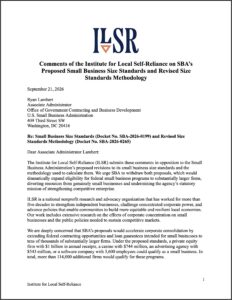
A private equity firm with $1 billion in annual revenue, a casino with $744 million, an advertising agency with $543 million, a software company with 3,600 employees — all would qualify as small businesses under proposed SBA size standards put forward by the Trump administration.
The Small Business Administration (SBA) is proposing to radically overhaul the standards the federal government uses to decide which companies count as small. The change would immediately bring more than 114,000 additional firms under that designation, making them eligible for federal loan guarantees, contract set-asides, and other support earmarked for small businesses.
It’s easy to see the absurdity of calling a billion-dollar investment company small. But the more consequential problem is what will happen to actual small businesses if the government does this. Scholars who studied previous increases in the SBA’s size thresholds found that, when larger firms in a particular industry became eligible for government contracts and loans, small businesses were crowded out. Their revenue dropped. They filed fewer patents. They cut payroll. And they closed in greater numbers. Young, highly productive firms suffered the most.
The SBA’s proposal would take this experiment to a vastly larger scale. The earlier increases researchers studied were much smaller and limited to particular industries. The Trump administration’s approach would sharply raise the thresholds across virtually every industry. If adopted, it threatens to accelerate the very consolidation the SBA was created to counter.
A New Way to Define “Small” That Only Gets Bigger
The SBA has long maintained size standards. They vary by industry and are generally based on the number of employees a business has or its annual revenue. These thresholds not only determine eligibility for federal programs; they also determine which firms are exempt from regulations that do not apply to small businesses. Many state laws and programs are also pegged to the SBA’s definitions.
The current standards are already too expansive. Depending on the industry, businesses with as many as 1,500 employees or $47 million in annual revenue can qualify as small, though the actual cutoffs are considerably lower in most industries. 1
The Trump administration is proposing something more fundamental than a routine update. It wants to overhaul the methodology the SBA uses to set the thresholds, making them much larger and driving them even higher over time. In doing so, the agency appears to be departing from the statutory criteria Congress laid out for determining what constitutes a small business.
Before turning to the methodology, consider some of the companies that would now count as small: citrus farms with up to 3,500 employees; poultry processing plants with up to 2,000; movie theater chains with up to 2,700; graphic design firms with $158 million in annual revenue; engineering firms with $252 million; management consultants with $295 million; internet service providers with $402 million; banks with $5 billion in assets; and private equity, venture capital, and investment-management firms with as much as $1 billion in annual receipts.
The SBA’s current approach involves examining the structure of each industry, including the distribution of revenue across different sized firms, the level of concentration, and average assets per firm (a proxy for the costs of launching a business). The aim is to determine what constitutes a relatively small business within the context of each industry.
The proposed methodology abandons this granular approach. Instead, it focuses on the overall size of each market and sets the threshold to exclude dominant companies. The larger the market, the larger a business can be and still count as small because, the agency notes, “a greater level of scale is required for a firm to be dominant.” In effect, the agency is replacing a measure of smallness with a measure of non-dominance.
The methodology then dramatically enlarges the markets used in this calculation. Current size standards cover nearly 1,000 distinct industries. The new approach lumps many of these together into 338 broad industry groups. It also adds net imports in measuring an industry’s size. Both changes expand the markets against which firms are measured. This allows larger companies to qualify as small.
Using broader industry groupings can also obscure the very dominance the methodology claims to measure. A $200 million IT vendor might be a powerhouse in the relatively small “Computer Facilities Management” subsector, for example, but barely register when folded into the far larger “Computer Systems Design and Related Services” industry group.
Another change would cause the thresholds to rise much faster over time. The SBA already adjusts them periodically for inflation. It now proposes to add productivity growth. To illustrate the effect, the agency points to a $1 million benchmark it used in 1954. That would be $9.7 million today if adjusted only for inflation. Adjusted for productivity too, it rises to $30.6 million.
The administration justifies its methodology by pointing to the Small Business Act, which created the SBA in 1953 and says that a small business is “one which is independently owned and operated and which is not dominant in its field of operation.”
But the statute does not say that non-dominance alone defines a small business. It expressly authorizes the SBA to establish additional criteria for determining whether a business is small. And while the proposed methodology centers on dominance, it barely considers the other half of Congress’s baseline criteria: what it means to be “independently owned and operated.”
The overall result is a profoundly warped definition of small business. The bigger and more concentrated an industry becomes, the larger a company can grow and still count as “small.”
“The Trump administration’s approach would sharply raise the thresholds across virtually every industry. If adopted, it threatens to accelerate the very consolidation the SBA was created to counter.”
Stacy Mitchell
How Bigger Size Standards Harm Small Businesses
There is a deep irony in the SBA couching its proposal in the antimonopoly language of “dominance”: past increases in the thresholds have fueled greater market concentration.
When the SBA raised the size standards in the past, government contracts and loans shifted toward newly qualifying larger firms, crowding out genuinely small businesses. That matters because the federal government steers more than $200 billion a year in contracts and loan guarantees to small businesses. Changing who qualifies can alter the structure of an industry.
A 2026 study by J. David Brown, Matthew Denes, Ran Duchin, and John Hackney found that in industries affected by size increases “revenues decline for the smallest firms, particularly those that are younger, more productive, and financially constrained.” And the effects extended beyond revenue: “firm exits increase, wages decline, and patenting falls.”
Following an increase in an industry’s size standard, the number of small firms exiting that market rose by more than 9 percent on average, according to the study. The losses were “most severe for younger and more productive small firms — precisely the firms that prior research identifies as disproportionately important for economic growth and innovation.”
These findings are alarming given the scale of the Trump administration’s proposal. The increases the researchers studied were far more modest.
For most of SBA’s history, the agency did not expand eligibility. Its initial size standards, adopted in 1957, were already generous. For federal contracting set-asides, businesses generally qualified if they had fewer than 500 employees. For loans and other SBA support, the thresholds were lower. For decades, the SBA’s size standards remained largely unchanged, despite pressure from larger companies to raise them.
In 1980, the SBA even proposed lowering the standards in several industries, which would have reclassified about 225,000 firms as too large. After protests from affected companies and intervention by Congress, the agency backed off. In 1984, it shifted direction, lifting the thresholds in several industries and allowing 39,000 additional businesses to qualify as small.
After 2010, the SBA began to more systematically ratchet up its size standards. A law passed that year required the agency to review all size standards every five years. In the first review, the agency’s methodology called for increasing the thresholds in 621 industries and lowering them in 177. It adopted the increases but made only three of the decreases. In each of those cases, not doing so would have allowed a firm dominant in its industry to count as small.
The pattern continued in the Biden administration. It increased the size standards in 436 industries. Its analysis concluded that the thresholds should be lowered in 492 industries, but it declined to do so, citing the economic impacts of the Covid pandemic.
Now the Trump administration is proposing increases that are vastly larger than those previous rounds. Even under the SBA’s extraordinarily expansive new methodology, its analysis recommends lower thresholds in 45 of its 338 industry groups. But the administration has declined to lower them, citing the “difficult conditions small businesses faced during 2021–2024.”
At the SBA, across administrations, the size thresholds may go up, but never come down.
Who Benefits from the SBA’s Proposal
If actual small businesses stand to lose, who stands to gain?
One set of winners are established federal contractors. Of the more than 114,000 companies that would newly qualify as small, there are 37,000 that already hold $71 billion in federal contracts. These incumbent government vendors would now be eligible for contracts reserved for small businesses.
Federal agencies have also pushed for higher thresholds. Agencies are required by law to direct 23 percent of their contracting dollars to small businesses. Larger size standards make that easier to meet by allowing them to count more of their spending with larger, established companies as small business contracting.
Private equity firms engaged in “roll-up” strategies see opportunity too. Attorneys who advise the industry are touting the “expanded universe” of acquisition targets, including companies that previously exceeded the size standards but would now qualify as small. The much higher thresholds would give private equity firms more room to roll up small businesses before their combined holdings exceed the SBA’s limits. (Businesses affiliated through common ownership are counted together by the agency.)
All of this turns the SBA’s mission on its head. Congress created the agency to “aid the interests of small-business concerns in order to preserve free competitive enterprise… and strengthen the overall economy of the Nation.” The proposed rules would instead divert programs intended to strengthen small businesses to larger companies, accelerating the consolidation the SBA was created to counter.
How to Comment:
Government agencies disproportionately hear from large, well-resourced interests. Big businesses have lobbyists and lawyers who comment on nearly every rule like this. Small business owners and community members’ voices are critical. They have real-world experience and a real stake in the outcome of this rule. This is exactly the perspective regulators can’t get anywhere else.
If you’re a concerned community member or small business owner, here’s how you submit a comment:
Draft your comment: Write a response sharing your perspective. Whether you’re a small business owner or a concerned community member, share why you care and what it will mean to you, your community, and/or business.
Submit your comment online: The easiest way to submit your comment is online through regulations.gov on Docket No. SBA-2026-0199 (see the green button “Submit a Public Comment”). You can write your response directly in the fields or upload a document.
Your comment will be public: SBA posts all comments online, so do not include anything you don’t want made public. You can submit your comment on behalf of yourself, an organization, or anonymously.
Deadline: November 20, 2026.
There are alternative ways to submit a comment. You can mail or hand-deliver your comment to: Ryan Lambert, Associate Administrator, Office of Government Contracting and Business Development, 409 Third Street SW, Mail Code 6530, Washington, DC 20416.
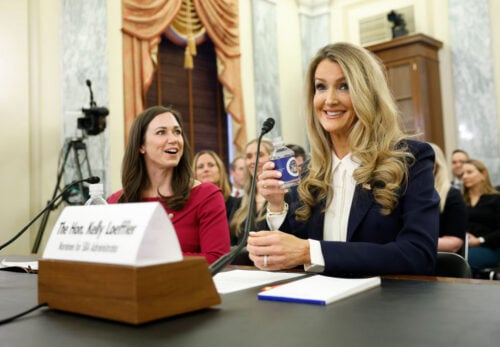
Photo: WASHINGTON, DC – JANUARY 29: U.S. Sen. Katie Britt (R-AL) (L) introduces Kelly Loeffler, Administrator of the Small Business Administration, during her Senate Small Business and Entrepreneurship Committee confirmation hearing (Photo by Kevin Dietsch/Getty Images)
In The Nation, the Left Should Fight for Small Business
Stacy Mitchell and Susan R. Holmberg argue that the left should embrace small business again; it is crucial to reversing inequality and rescuing democracy.
Boxed Out: How Big Retailers are Flexing Their Supply Chain Power to Kill Off Small Businesses
Powerful retailers are dominating supply chains. Our report argues it’s time to revive the Robinson-Patman Act to restore antitrust enforcement against predatory buying.