A Midwest Main Street Saves With Geothermal — Episode 284 of Local Energy Rules
How West Union, Iowa, built a community geothermal network that heats and cools its downtown for less.
It was a perfect storm of opportunity that led the northeastern Iowa town of West Union, population 2,500, to combine a streetscape program with an ambitious plan to provide energy to the courthouse, library, and downtown business district.
For this episode of the Local Energy Rules Podcast, host John Farrell is joined by Steve Fate, Chair of West Union District Energy, LLC as well as Chair of the West Union Library Trustees; Dick Woodard, a fourth generation West Union resident, business owner, and community leader; and Matthew Marsala, director of the West Union Chamber of Commerce.
Listen to the full episode and explore more resources below — including a transcript and summary of the episode.
Matthew Marsala:
It’s an investment in the future, it’s an investment in the community, and it serves exactly that, this community.
*****
John Farrell:
It was a perfect storm of opportunity that led the Northeastern Iowa town of West Union, population 2500, to combine a streetscape program with an ambitious plan to provide energy to the courthouse, library, and downtown business district.
Three guests joined me in August 2026 to discuss this Midwestern Geothermal Network. Steve Fate is the chair of the West Union District Energy LLC, as well as chair of the West Union Library Trustees. Dick Woodard is a fourth generation West Union resident, business owner, and community leader. And Matthew Marsala arrived in West Union from Boston and now directs the West Union Chamber of Commerce, among many other activities.
I’m John Farrell, director of the Energy Democracy Initiative at the Institute for Local Self-Reliance. And this is Local Energy Rules, a podcast about monopoly power, energy democracy, and how communities can take charge to transform the energy system.
*****
John Farrell:
All three of you, welcome to Local Energy Rules.
Steve Fate:
Thanks, John.
Dick Woodard:
Thank you.
Matthew Marsala:
Thank you.
John Farrell:
Well, I always love to start my podcast by asking people whether the work that they’re doing now is what they dreamed of doing when they grew up. Dick, I’ll start with you. I was super curious, is being involved in this project, the West Union Geothermal Network, something that you imagined doing when you grew up?
Dick Woodard:
I never would’ve dreamt it at all growing up. I really kind of stumbled into it when we started our initial brainstorming sessions to come up with options for our proposed streetscape project.
John Farrell:
Sounds good. Matt, how about you?
Matthew Marsala:
Yeah. Growing up in Boston, even with all the technological advances out there, this wasn’t on my radar. I did not know what geothermal was prior to moving to West Union. I might have read about the term somewhere, but truthfully, my knowledge about the system, the science, everything starts about five years ago when I first moved here.
John Farrell:
And what about you, Steve?
Steve Fate:
No, that was certainly not on my radar. I’m probably the one member of this group that I can think back and I barely remember our home growing up in central Illinois being heated with coal. And it was cool by opening the windows or sitting in the shade. The excitement was when natural gas lines ran into town, that was a big cost saving. So no, I really wasn’t. Really my involvement started when we started hooking up to the geo from the public library and that’s kind of my first time. So that’s been about 10 years. 10, 12 years we’ve got that.
John Farrell:
So let’s talk about what this geothermal network is delivering today. Dick, could you give us a little bit of a sense of how many buildings are participating in the network and what services they’re receiving?
Dick Woodard:
Sure. Initially we started out with nine users and now we’re up to 13 current users with potentially two other property owners considering it. And of course each one with the geothermal, they now have their own cooling and heating systems as an alternate to what we had with natural gas and straight electricity.
John Farrell:
And one of the things that really struck me about this project is when it happened, which was a number of years ago, it was fairly unique. Do you have a sense of what motivated the city to consider a geothermal network at a time when it wasn’t as common as… I mean, now in the energy space, I’m hearing more and more about it. There are policy groups that work on it. 10 years ago, not so much.
Dick Woodard:
Well, it all came about initially our city was considering replacing their downtown streets and sidewalks so they’re in disrepair. Then in 2008, approximately, we had some floods in Iowa. So the state headed an initiative, they were looking for two pilot projects to deal with stormwater management. And so they found out about our project and proposed just straight concrete and asked if we would consider a new project that would incorporate some other things, including stormwater management. So we had a series of brainstorming sessions and they basically said, “Well, if money was no object, what would you like to do?” And one of the possibilities that came up was what would you think about having the shared geothermal heating and cooling system? We though, “Oh, well, we could sure look into that.” And it just ended up being, it was a popular thing with funding sources and we were very fortunate to have that occur here in West Union.
John Farrell:
It’s probably the only time I’ve talked to folks who are doing a clean energy project where the premise started with if money was no object, I love that. Maybe not going to give people the sense of this is really replicable that we might be looking for, but also I appreciate that honesty about it. So I’d love if, Steve, maybe if you could help us out in terms of describing how this public-private partnership works. So who built the network, the actual infrastructure, who owns that infrastructure now, but who actually operates it and then who’s receiving services?
Steve Fate:
Well, overall, I’d say the partnership we’ve got is working very well at this point in time. It is a matter that, as Dick said, the infrastructure for it was built by the city and the city does own this system. And West Union District LLC leases the system from the city and we manage its operations. We’re a separate group. Our goal was to provide the geothermal to our downtown business district. And the important thing there is that area, the downtown area, also includes the West Union Community Library and it also includes the Fayette County Courthouse. That’s two important elements I think on this network. The courthouse since it’s kind of a central location in our downtown business where our wells are all on the courthouse lawn and our pumps and monitoring equipment are all in the courthouse basement. So there is a 28E agreement in place between the city and the county and that’s been working out very well, I think. It’s a good space for it and it does work very, very well. I guess in a nutshell, that’s pretty much what we’ve got.
John Farrell:
So you’ve got the pumps and the wells, the underground piping for the system. Dick mentioned earlier that there were a couple of businesses that are considering joining the network. When they do so, I assume that they have to purchase equipment that will then interface with those loops and the fluid that et cetera, like their own heat pumps, for example. Is that something that the businesses purchase or do you finance it for them? How would that happen if they were to join the network?
Steve Fate:
We could probably all answer that somewhat. I think Matt’s got some good knowledge on that one too. We have always an evolving user agreement, new user agreement that kind of leaves out what we’re going to do step by step. And yes, if you’re a business owner, you have the requirement of buying the equipment. Yes, you do. However, the LLC right now, or I think a five ton unit going in, we will give the business owner a rebate of $2,000. Is that correct, Matt?
Matthew Marsala:
Yes. So we provide a rebate of $2,000 or there’s a per tonnage rebate, like $100 per ton or something along those lines. Whatever is larger, either that one or the $2,000. So we just start with for a five-ton unit or anything less or even 10 tons or what have you, they’ll get that $2,000 rebate.
Steve Fate:
With the $2,000 coming in, that’s on top of any other rebates. Right now our electric company also offers rebates for installing the units. So yeah, it knocks the price down. The LLC also covers the cost of a pre-inspection before the equipment is hooked up and the business owner covers up to about 200 and some dollars, I think, the final inspection before they’re actually hooked up and the equipment is turned on. Now with the rebates that they are getting, one of our local businesses that does a lot of the installation, they’re estimating with the geo units and the rebates involved is that the payback for that equipment comes in two to three years.
John Farrell:
Wow, that’s really fast.
Steve Fate:
Yeah. Well, our rates are low enough it makes it worthwhile, which we’ll talk about here I think as we go along.
John Farrell:
Thank you so much, Steve.
Dick, I’d like to go back to you and talk a little bit about how the project came together. I loved the context you gave of having that conversation with the state, which is like if money was no object, I assume money was in the end actually an object, that there were some constraints, but if you could talk a little bit about how the financing for the project came together and the well drilling and all the other components were paid for.
Dick Woodard:
Sure. It was such a unique project that it was like these funding sources were actually coming to us rather than us going to them and it worked out really great. We had the housing and urban development were able to contribute a million dollars towards our project. We had a Main Street challenge grant for $100,000 and then the Environmental Protection Agency was an additional $500,000. So our project was pretty well 100% financed. At one time we even thought, or one of the things on our wishlist was some way of powering everything and we even looked at switch grass and stuff like that. And I think we could have raised enough funding for that too, but we just decided it was a little too much to fathom for our little community.
John Farrell:
When you’re talking about switchgrass, because I remember this, I’m having flashbacks to earlier in my career, which has been almost 20 years at ILSR talking about switchgrass for cellulosic ethanol production. Were you talking about providing the heating for the network or is that for doing electricity generation?
Dick Woodard:
To power the pumps.
John Farrell:
Okay.
Dick Woodard:
We even at one time in this wishlist time, there was even talk of maybe even have heated streets, but that got to be fairly controversial at that time.
John Farrell:
Very attractive though to those of us living in northern climates to think about not having to put salt down on the roads. I know at the time you’re talking about 2008, 2009 was at this time when solar panel prices spiked because of a shortage of silicon. Was solar ever something that you considered adding in to cover some of the electricity costs of operating the system?
Dick Woodard:
Not that I’m aware of. Something that kind of contributed back there in our initial with the stormwater management, what made it really a big issue was the floods of that time from in Cedar Rapids and it really helped our cause to finding these funding sources.
John Farrell:
I’m actually kind of curious about that even though it’s not directly about the geothermal. What were some of the components of this project that were meant to help address stormwater management? I read about things like permeable pavers, like bioswales. What are some of the things that were included in the project that once you had the street dug up that were part of putting it back together to be more resilient?
Dick Woodard:
Exactly what you were saying. It was the porous pavers, the bioswales. They also put in energy efficient street lights. See what other stuff. I can’t remember what other things, but it’s interesting because they have found that even we have a little trout stream that’s very close to town and the water temperature for that has improved. And we even have trout that are swimming around close to town, which we never hadn’t had for quite some time.
Matthew Marsala:
Because the water quality is improved as the permeable pavers from that system also filters the water as it gets down because there’s what, 15 feet of various layers of rock and crushing. So all the runoff from vehicles, things like that, it ends up getting filtered a bit before it ends up into the stream.
John Farrell:
All right, cool. Thanks for entertaining my little diversionary curiosity about the streetscape.
Steve, I want to go back to you and ask you about something that is fairly important as we’re seeing conversations about geothermal networks scaling up in different places, which is the role of state utility regulators. Most folks who listen to this podcast are well aware electric and gas utilities often have monopoly service territories. They’re regulated by the state, rate regulated so that the amount that they charge is overseen by that commission. There’s been some controversy a little bit about whether or not geothermal networks should be included, which I think probably hinges in part on the same question that divided oversight for things like electricity and gas, which is when you have publicly owned networks for electricity, a city owned utility for example, usually those entities are not rate regulated with the presumption that the ownership structure has its own accountability.
So it seems like it was fairly consequential when the Iowa Utilities Board agreed that it did not have jurisdiction over this project. Do you think the ownership structure matter, do you recall what kind of took place as part of that conversation when they were considering it?
Steve Fate:
I don’t remember it. I do have the notes and the timeline for it all. And the Iowa Utility Board did say, no, this is not a utility. It’s not delivering anything such as gas and such as electricity. Now, the city did have an option that they could have put it up to a vote of city residents to form a separate utility, but they chose not to do that and that was probably an okay choice at the time, I think.
This is one of those things I always wonder about because I listen with some other groups, especially on the East Coast, they talk about, well, this utility or that utility that they’re linked into. Right now at this point in time, I’m not sure if we would be better off being a utility because we’ve gotten to the point I think where our goal is to provide a service to our downtown businesses, our downtown area, and we want to do that in the most cost efficient way.
And I’m not quite sure if we were a utility, if we could have the freedom to say, “Hey, we got enough money, let’s drop the rates somewhere.” We run on a shoestring. So right now I think it was consequential, good or bad, I’m not sure in my mind right now, and the other guys can chime in on this. I’m not sure if we would’ve been better off being a utility. I think being our own separate entity has been okay.
John Farrell:
When you say being a utility, I mean maybe you’re not sort of legally according to the Iowa Utilities Board, but you seem like a utility to me. You’re providing a utility service to these customers who have opted in to do that in a relatively small geographic area, obviously. When you said this idea about the town taking a vote, was it to form some kind of utility like an electric or gas utility, I guess that the Iowa Utilities Board would’ve considered an official utility? Can you explain that a little bit more to me?
Steve Fate:
Oh, I’m not sure. I mean, Dick can remember more about the votes and the discussion on it. At that time, he was more involved at that point in time. He’s our historian.
Dick Woodard:
Yeah. Originally when we were going to turn on the system, I think we assumed the city was going to be a utility and that they could make money on it, but there was a fair amount of resistance at that time. So we were just basically forced into forming this LLC and we’ve been that way since.
Steve Fate:
If the LLC had not formed, the system would not have been turned on. I think that’s the bottom line of this.
John Farrell:
Does the city operate other utilities like a water utility or anything else?
Steve Fate:
Yeah.
John Farrell:
Okay. So it wouldn’t have been completely foreign to them in terms of operating utility. That’s interesting. We talked a little bit about as part of the implications for maybe the city making some money with the cost of operating the system or the rates for the system. Steve, maybe you could talk a little bit about how the cost of energy that’s provided from the geothermal network compares to typical alternatives. So previously these buildings were heated with natural gas or they were using presumably an air conditioner if they had any kind of cooling system. Do you have a sense of how this system… I mean, you said two to three year payback when you were talking about it earlier, so I presume that we’re talking about it’s being a pretty good deal compared to the way that these buildings might be heated or cooled currently.
Steve Fate:
No, and I would say very definitely it’s more cost efficient. Not to be political, but geothermal energy does not pass through the Strait of Hormuz, so it’s not subject to the fluctuations and prices that we’re experiencing and everything else right now. What I can tell you, and I’ll use the community library because I’m associated with that group, our library is about 16,300 square feet. And when we first started installing the geothermal units, we had to do that over time. Obviously we’re a public institution. So when we put in our first two units, which I think was right around 2014, we saw about a 25% decrease in our cost for heating and cooling. And the library runs with seven geo units altogether, and they are all up and running at this point in time and have been for a while. The last time I calculated our yearly costs, this is the annual cost. Well, monthly it costs us to hook into the geothermal network. Our bill is $224 a month. And the last time I calculated it, which has been some months ago, our annual cost for heating and cooling in the library totally, that’s geothermal plus electricity running, is 62 cents a square foot. So that’s going to come down. Right now we have solar panels on our roof, but the city, when they put the solar panels in in all city-owned buildings, they could not afford to put them on, so it was contracted. So it’s actually a metered system for another year or two left. So I’m plotting and planning on how the library can purchase those panels that are on our roof, and then we’re going to run geothermal system and our electricity will come from solar panels and our cost savings is just going to be tremendous, I think.
John Farrell:
That’s amazing. I love that story. And I also just thinking when you talk about monthly energy costs of $220 a month, I think I pay about that much living in Minneapolis for a combination of gas and electricity for my 2,500 square foot home. So I would say it seems like you’re doing pretty well there.
Steve Fate:
Yeah. Well, if you compare last January, I know out of curiosity, I looked at the library bills in January and I think our temperatures were about like you were in Minneapolis where if you stepped outside, you froze because we had some 21 degree below zero days. And the cost for heating my home, which is a little bit over 2,000 square feet, was right on par with the library. So yeah, it’s a good cost, good value.
*****
John Farrell:
We’re going to take a short break. When we come back, I asked my guests about expanding the geothermal network, particularly to residential customers, as well as the fascinating case study that suggests costs to operate the network have been falling in contrast to energy costs for just about any other source. You’re listening to a Local Energy Rules podcast with three terrific guests from West Union, Iowa, Steve Fate, Dick Woodard, and Matthew Marsala. Hey, thanks for listening to Local Energy Rules. We’re so glad you’re here. If you like what you’ve heard, please help other folks find us by giving the show a rating and review on Apple Podcasts or Spotify. Five stars if you think we’ve earned it. As a bonus, I’ll gladly read your review aloud on the show if it includes an energy related joke or pun. Now, back to the program.
*****
John Farrell:
I want to come back to the idea about how the network could be expanded.
So you’ve mentioned a couple other businesses downtown have expressed interest. I’m kind of curious, Matt, if you could talk a little bit about what network expansion might look like. I’m super curious, given the really short-term payback, why some building owners have been waiting, and also just curious if there are some further expansion plans that the West Union network has in mind.
Matthew Marsala:
Yeah, I can talk a little bit about that. So the big thing here is timing. If someone doesn’t need to incur a bill right away, typically they don’t choose to. I mean, much like getting a new car or buying new clothes or new shoes, you typically wait until the stuff is worn out or needs to be replaced. So as businesses, our business owners, property owners within the network area here are replacing furnaces and air conditioners, that’s really the best time for us to approach them and have that conversation about, “Hey, instead of replacing with a traditional furnace, why not look at connecting to the geo?”
There are some caveats to some of this. Sometimes they need to have additional duct work put in so that the system works properly. So that’s another factor. But truthfully, a lot of it is upfront cost because a good chunk of this stuff is rebates and sometimes depending on the unit, it can be a little spendy, even though that they’re saving it on the back end with the utility bills. Our building is $69 a month for heating and cooling every single month. I think at my house, I’ve seen my bill fluctuate by 69,000 for some polar vortex fee. So they’re not paying any of these extra fees, but it’s all about timing. So approaching property owners, also giving them the information that they want to know about the geothermal system, marketing it the right way is important. There are people that just want to know what’s it going to cost me? It’s no different than putting your key in the car and turning it. You just expect the car to start. You don’t necessarily need to know how the engine works, and then there are a few that really want to know about the science and all that good stuff, but it is a really cool system to be locally owned and a fantastic opportunity for property owners to save some money and have a voice in their utility bill and expenses and things like that.
John Farrell:
Is there any interest from folks or plans to expand beyond the downtown business district? I know when I’ve talked to some folks that are working on projects up here in Minneapolis, they talk about this sort of anchor tenant model where they get one or two larger customers, commercial customers, and then the idea is that they sort of connect between the two of those and then they would offer service to residential customers. Is there any plan to do anything like that? And if not, how come?
Matthew Marsala:
Well, I think as of right now, the system was expensive to put in as it is. I mean, it was a perfect storm of grant funding, projects happening at the right time, initiatives being tested. Then West Union just fell into an incredible opportunity, but the expansion of this would require them to bore more lines, to connect people to the main system, and there’d be some significant costs.
Personally, I think that it’s a cost that the city needs to invest in. If they can expand the network, they have more users, they have more users, they have more income, they can save that income and then continue to expand the network there. But as of right now, that is a massive project to undertake, and I don’t know necessarily that the environment for at least the current council is something they want to tackle.
Steve Fate:
We do have the pumps for our system are located in the courthouse basement. We also have two pumps that are located in a park north of the downtown area. And what that would require is wells being put in there and then piping out. So part of that infrastructure is in place, but yes, it would be an expense. Right now, no one’s interested. I don’t think anybody can afford that expense with budgets.
John Farrell:
I’m fascinated by this, so I’m going to prod one more question about it. When I talk to folks about traditional financing for utilities, a lot of times, and especially municipally held utilities, they can go out and borrow, they get what are called revenue bonds, which means that they’re essentially secured against the future revenue of the system. It seems like you’re in a situation where if you were to make that investment in expansion, you would have additional customers coming onto the network and then you could repay some of those financing costs. Although I don’t know how that would potentially change the economics for the participants. Obviously, you’re going to have to recover some of that financing then in the rates that you charge, in which it sounds like you didn’t necessarily have to do that on the front end because so much of the initial capital was from grant funding. It sounds like the city though, as you said, Matt, is not particularly interested in trying to take this on.
Matthew Marsala:
Right. There is some overhead that’s involved at this time and billing and all that good stuff. But the other piece, even if they were to expand in the loop, we’d still run into the same issue we were talking about previously. When does it make sense for a homeowner to switch? Because they can’t just connect with their traditional furnace and air conditioning, and so they’d have to buy a new unit. And personally, while I live very close to the system, but just outside where I could connect, but if that ever happened, I’d love the ability to, but I just replaced my 1970s furnace and 1980s air conditioner. So even if that happened tomorrow, I’d probably have to wait it out a little bit before replacing a brand new system with another brand new system. So not saying that it wouldn’t work, but that is a piece to consider is how many people would actually connect right off the bat and how long would you wait for others to connect? And I mean, it’s all whole undertaking. So on paper, it’s like, oh, this is so simple. But then when you start to really get into the nuts and bolts of how to make it all work, that’s when it starts to get a little funky.
John Farrell:
Yeah, I hear you with that. I similarly did some appliance replacement at my house recently. And so when we’ve talked about network geothermal in Minneapolis, I was like, “Ooh, do a pilot project near my house.” And now I’m like, “Maybe in 20 years, do a pilot project in my house and I’d be ready to sign up for it.” I wanted to come back to the cost for just a minute because one of the things… So we’ve already talked about how affordable it is for the businesses that take service from the geothermal network. I also found it fascinating. There was a case study on the project that said the costs for service have actually been decreasing in recent years. Are you aware of any other kind of heating and cooling service where that’s also happening? And I guess is that likely to continue that the actual operating costs, maybe as you expand the number of customers could decrease bills for customers?
Steve Fate:
No, I’ve looked at projections for natural gas. I’ve looked at projections for electric costs, and none of them going out as far as they’re doing the projections ever say they’re going to come down. It’s always an increase. And what we did probably, what guys, about six years ago, seven years ago, we kind of did a lot of restructuring ourselves and reorganizing, and we did put some operating efficiencies in place and that really helped tremendously. And that allowed us to, over time, to adjust our rate. We’ve lowered it by about 36%. So back six, seven years ago, we were charging $14 a ton usage. We’re now down to $9 a ton usage. So right now, when you look at the costs we have, we have one building that’s being renovated with grants, help from grants that Matt helped write. They’re putting in two five-ton units, one for their business lower areas and a unit for their rental apartment on the upper floor.
So they’re putting in two five-ton units. And if you think about that, you just put in a five-ton unit and you’re being charged $9 a month, that’s 45 bucks a month. You can’t beat that. And do I anticipate that’s really up to the entire LLC when we meet? That’s where we usually have that discussion. Can we see the rates coming down? Yeah. If we add another unit or two, that increases the flow of money into our coffers and we’re not trying to operate at a profit. But yeah, could we lower it more? Yes, we could. Do you reach a point where you’ve lowered it too much? Well, maybe you’re giving something away and you have to balance that, but I see us dropping the cost a little bit more as we go along.
Matthew Marsala:
And to clarify, I think we’re actually at $8 a ton right now.
Steve Fate:
Oh, is it $8?
Matthew Marsala:
Yep.
Steve Fate:
Thank you.
John Farrell:
Steve, I’m kind of curious, when we were talking about the financing potential network expansion, is there any thought to maybe when you’ve sat down and had those conversations before saying, “Well, if we keep it at $9 a ton instead of $8, we could set aside some money. Maybe we use that as a loss reserve to go out and get financing to do expansion or try to seek a partnership in terms of funding where we’ve got a little reserve that we can use.” Has that come up in terms of the conversation about it?
Steve Fate:
Yeah, it has. I think the goal, even before I joined this group, the goal was to have three years of operating capital on hand, and we have achieved that. We have actually pretty close to four years of operating capital on hand. So what that means for us is if a pump goes bad, it has to be replaced. We’ve got the money in hand to go and do that. If other major expense comes up, we’ve got the money to do that. Our service provider, every time we meet, he will say, “Nope, I don’t see anything that’s going to go wrong in the near future. So yes, that’d be a matter of how much cash we want to build up. And again, that’s up to the LLC, members of the LLC, where do they want to go with this? Most of the members say, “How much am I going to pay a month?” That’s kind of their interest. And yeah, that’s what we come down to.
John Farrell:
Matt, I was hoping that you could take us home on this and maybe provide some context for what other communities could learn from this project about things to consider if they’re interested in geothermal networks, maybe some pitfalls to avoid when they’re considering that kind of product development in their community.
Matthew Marsala:
And this is my Monday morning quarterback assessment here because I wasn’t here during the development or all of the growing pains that happened from the city leasing it out to the LLC group here and kind of figuring out all the pieces. But the success of this is the simplicity. We have had conversations with a geothermal network group that meets occasionally and they’re always asking us, “Well, how come you don’t do this or regulate actual usage or meter people?” And we’re billing just based off of the tonnage of the units. It’s essentially budget billing when you compare it to other utilities there. It’s just the same exact amount each month. It requires very little time. I recently took over the treasurer responsibilities and I’ve been doing it for I guess two months now officially. And the previous treasurer who’d been doing it for years and years and years, it took him an hour, a month to do all the billing and everything.
For me, it takes an hour and 15 minutes because I’m still falling into the groove there. So it’s not a terribly complicated system because we didn’t make it complicated. We’re not out there trying to read meters. We’re not trying to nickel and dime everybody or put up all these processes where it’s just a nightmare. The simplicity really is the key here. And it’s an investment in your community because the rates reflect the local need. We’re not paying for bloated executive salaries. We’re not paying for any other random thing that the utility companies are putting into their bills there to cover expenses where it’s responsive to what West Union needs. So if we have issues, the LLC group can make the determinations on what they need to do. They’d switched service providers a few years back because they felt that was necessary and it happened and it’s been fantastic and we are able to make decisions that benefit the users.
One of the things that we implemented when I started here was the pre-inspection. So as previously talked about was there’s been some controversy over the geothermal, most of it from just lack of understanding because it was a new technology. The science is a little wonky. It’s just not as clear to people. But whenever anybody gets anything done, it doesn’t matter if you’re having your house remodeled, your car worked on, whatever, everybody remembers when it wasn’t done right the first time and they had to bring it back or they had to go talk to the contractor because this wasn’t installed or this squeaks or they missed this. And we’d had a few minor hiccups where people would connect the system or get their system all set up. A contractor would come in and put in the equipment and run the lines and whatnot, but it wasn’t done right. So when we did the inspection, when we turned the system on, we were like, “Oh no, you need to change this or that.” And then the contractor had to come back and then the user had to pay an additional bill.
Well, that’s a negative experience when they remember that. So before they get started on their work, we cover pre-inspection so that our guy comes down and says, “Okay, this is what the contractor’s planning on doing. Is this going to work in relation to our system?” This way we can iron out any hiccups, details, prevent having to call them back. And then it makes the initial setup just much smoother. The simplicity is the number one thing that makes this successful. And then the understanding that this is an investment and it’s one that you get to control and you’re not opening up your bill and like, “What is this?” As you get hit with some C for something, it responds to your needs. And it is such a big deal that this is not regulated by people that aren’t in the community or having to go through all this red tape that other utilities have to deal with. But I truly hope that the city does realize this and chooses to expand because it’s an investment in the future, it’s an investment in the community and it serves exactly that, this community.
John Farrell:
Steve or Dick, any last words for folks who are going to be listening to this and probably curious about how they could bring something similar to their community?
Dick Woodard:
I can’t really think anything. Just keep your options open and be willing to learn new things because technology and life just changes and you never know. You don’t want to miss out on an opportunity.
Steve Fate:
Well said. We’re a small Midwestern town and towns are having a tough time with businesses everywhere. And I really do think, I know when Debbie New visited us with her New Hampshire group, one of the things that she commented on was the geothermal serving business owners downtown is really keeping the downtown alive. It’s a profit margin thing. They have a reduced cost and I integrated that into my thinking.This really is a service to our business owners. I think we have to look at that too.
John Farrell:
Matt, did you have a final thought?
Matthew Marsala:
One of the things that I hope that if someone can take away from this is also if you have a chance to talk to a legislator, state, federal, at any level, more incentives for geothermal, more incentives to get systems of this type and this scale started. I mean, truthfully, the perfect storm that happened here, it may not ever happen again unless funding like that opens up. And it really is something that I think that is being overlooked and maybe moving in the opposite direction. And anybody can take anything away. If you talk to your politicians and get them to understand the value of this. And we haven’t had to pay any tariffs, so that’s a plus too.
John Farrell:
Absolutely. Resilience on a lot of different fronts around energy. Well, Dick and Matt and Steve, thank you so much for joining me on Local Energy Rules to talk about West Union’s remarkable project. I think it has been and will continue to be an inspiration for what folks can consider in terms of a community-owned energy system. And I really appreciate you coming on the podcast and talking to me about it.
Steve Fate:
Thank you, John.
Matthew Marsala:
Thank you. Thank you for having us.
*****
John Farrell:
Thank you so much for listening to this episode of Local Energy Rules with three terrific guests from West Union, Iowa, Steve Fate, Dick Woodard, and Matthew Marsala.
On the show page, look for a link to the Green Up West Union site that provides a timeline and overview of the project, as well as links to other Local Energy Rules podcasts about community-owned geothermal networks, including episode 275 about a project in New Haven, Connecticut, and episode 267 about a project in Hayden, Colorado.
Local Energy Rules is produced by myself and Ingrid Behrsin with editing provided by audio engineer Drew Birschbach. Tune back into Local Energy Rules every two weeks to hear how we can take on concentrated power to transform the energy system. Until next time, keep your energy local and thanks for listening.
West Union, Iowa, heats and cools its downtown with a community geothermal network.
It all began with crumbling streets. Around 2008, after floods hit Iowa, the state sought pilot projects for stormwater management. In the course of brainstorming potential improvements, installing a shared geothermal system made the cut.
Today, 13 downtown buildings use it, up from nine at launch, including the public library and the county courthouse.
“Our building is $69 a month for heating and cooling every single month.” – Matthew Marsala
Because the project ticked the box for addressing intersecting needs, funders sought the city out. The U.S. Department of Housing and Urban Development contributed $1 million, the U.S. Environmental Protection Agency $500,000, and an Iowa Main Street challenge grant $100,000.
Efficiency gains and restructuring allowed the local LLC that runs the network, West Union District LLC, to cut its rate from $14 to $8 monthly per ton of heat pump capacity. Building owners buy their own heat pumps, but the LLC offers a rebate of at least $2,000 and covers a pre-inspection. One local installer estimates the payback at two to three years.
“Geothermal energy does not pass through the Strait of Hormuz, so it’s not subject to the fluctuations and prices that we’re experiencing and everything else right now.” – Steve Fate
West Union’s geothermal network is a collaboration between public and private entities.
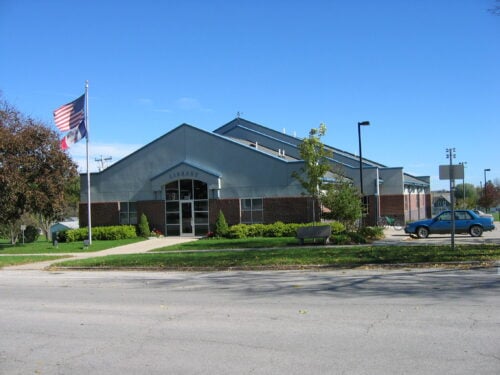
While West Union District LLC leases and runs the network, the city built and owns it. The geothermal wells sit under the courthouse lawn, with pumps in its basement. The town library, at 16,300 square feet, pays $224 per month to connect.
The new streetscaping also added porous pavers and bioswales. As a consequence, water quality in a nearby trout stream has improved, and the trout are swimming close to town again.
“The simplicity is the number one thing that makes this successful.” – Matthew Marsala
West Union’s network runs on a deliberately bare-bones model, and that’s what makes it work so well, its operators say.
Users pay a flat monthly charge based on the heat pump size, which means no meters and no surprises. Billing takes about an hour a month. “We’re not paying for bloated executive salaries,” says Matthew Marsala, the LLC’s treasurer.
Expansion might be another story, however. New lines cost money, and owners tend to switch only when their old furnaces wear out. Still, West Union shows what’s possible when a community owns the system that heats and cools it.
“Keep your options open and be willing to learn new things.” – Dick Woodard
See these resources for more behind the story:
This is the 284th episode of Local Energy Rules, an ILSR podcast with Energy Democracy Director John Farrell, which shares stories of communities taking on concentrated power to transform the energy system.
Local Energy Rules is produced by ILSR’s John Farrell and Ingrid Behrsin. Audio engineering by Drew Birschbach. Featured Photo Credit: Dick Woodard via wikimedia.
For timely updates from the Energy Democracy Initiative, follow John Farrell on Twitter or Bluesky, and subscribe to the Energy Democracy newsletter.
How West Union, Iowa, built a community geothermal network that heats and cools its downtown for less.
New Jersey’s community solar program guarantees bill savings and lets cities sign up whole neighborhoods. Here’s how.
St. Pete public power advocates want voters, not politicians, to decide whether to dump Duke Energy.
Why data centers are sparking a nationwide backlash as big tech tries to turn communities into reverse centaurs.