A Coal Town Digs Deep for Municipal Clean Heat — Episode 267 of Local Energy Rules
How did this coal town ditch gas lines, win grants, and make municipal networked geothermal the cheapest heating option?
Editor’s note: On August 6, 2025 Tucson’s city council voted to nix the proposed Amazon data center, Project Blue, referenced in this episode.
Electric bills as high as $1000 in a summer month and thirty percent rate increases in five years? Surely there’s a better way, say public power advocates in Tucson, Arizona.
For this episode of the Local Energy Rules Podcast, host John Farrell is joined by Lee Ziesche, co-chair of the Tucson DSA.
Listen to the full episode and explore more resources below — including a transcript and summary of the episode.
Apple Podcasts Spotify YouTube
Podcast (localenergyrules): Play in new window | Download
Lee Ziesche:
I think all of these things combined have really exposed that TEP is mostly focused on their own profits and not community.
******
John Farrell:
Electric bills as high as $1,000 in a summer month, 30% rate increases in five years, and a new data center that could consume as much electricity as in the entire residential population of Tucson. Surely there’s a better way, say Public Power advocates in Tucson, Arizona. Joining me in July, 2025, Lee Ziesche co-chair of the Tucson DSA, explained how affordability and clean energy are driving a campaign to take the for-profit utility Tucson Electric Power public, and how it could mean cleaner and more affordable energy for the city’s residents and businesses. I’m John Farrell, director of the Energy Democracy Initiative at the Institute for Local Self-Reliance, and this is Local Energy Rules, a podcast about monopoly power, energy democracy, and how communities can take charge to transform the energy system.
******
John Farrell:
Lee, welcome so much to Local Energy Rules.
Lee Ziesche:
Thank you so much for having me.
John Farrell:
So I love to start off my interviews by just asking people what their history is. How did you end up advocating for Public Power Tucson? Is this part of your professional life? Is this a hobby on the side? How did you get here?
Lee Ziesche:
Yeah, I’d say my professional and personal organizing is very blurred. It’s a bit of both, but I kind of got into the climate justice organizing space in 2013. I was hired to be the grassroots coordinator for the Gasland films, so I traveled all over the country for several years setting up film screenings and working with communities that were fighting fracking and fracked gas infrastructure, so a lot of power plants and big pipelines. And then I worked for a pretty small scrappy grassroots group called Sane Energy Project. This was all in New York. And yeah, we were fighting a very big pipeline called the Williams NESE Pipeline and National Grid was actually the main customer, a gas utility in New York. The two main utilities are Con Edison and National Grid and someone’s like, yeah, you guys should all get involved in rate hike cases. So we were involved in Con Edison’s case and then our really big first case was National Grid — trying to stop another smaller pipeline they were building within Brooklyn.
I think I was a little bit radicalized by being involved in the rate case experience, just really seeing that we were not going to be winning enough when it comes to affordability in these cases as well as seeing enough climate progress.
I also became a member of DSA in 2018 in New York City and Sane Energy Project also became a part of the Public Power New York coalition to fight for the Build Public Renewables Act. So yeah, those kind of dual experiences of being a part of the rate case process and just seeing how flawed our current system is really made me a huge believer in public power. And then, yeah, almost three years ago now, I moved to Tucson. My partner is from here. He really wanted to move back, so I fortunately still got to work a bit with the Public Power New York coalition.
Once I moved here in 2023, I was helping out doing some of the press work around Build Public Renewables. Got to tell that amazing story of how we won that bill and found out pretty much once moving here that the city of Tucson was going to be doing a feasibility study looking at a public power utility as part of its climate plan. And Tucson DSA was a pretty small chapter, especially compared to New York City DSA, it was pretty hard hit by COVID and was kind of in this rebuilding era. And we were like, well, we really need a campaign to organize around. And I was like, well, I heard the city’s doing a feasibility study around public power. I think it’s a really amazing thing to organize around — would people want to organize around public power? And now we’re here two years later taken on TEP.
John Farrell:
I love it. And I should have mentioned for folks who are interested in the New York public renewable success that I did do an interview on local energy rules with Patrick Robbins a number of months ago about that success story, one of a few about public power that are real achievements. So it’s impressive to hear that you were part of that, which I think is kind of a landmark for a lot of other people who are organizing around state policy to look at, if they think public power is important.
Well, let’s pivot this and talk then about your work in Tucson. So I was looking over some of the news stories. There were some letters to the editor about Tucson Electric Power and one of those letters to the editor noted that Tucson Electric Power was threatening to increase rates by 30% over four years, which seems incredibly high. First of all, this was a letter to the editor. So I just have to ask, is that true? Does that actually match up with what is happening, and is that the primary reason that you and others who are with DSA and others that are part of this campaign want to see a publicly owned utility instead of having the privately owned or the for-profit Tucson Electric Power?
Lee Ziesche:
Yeah, so TEP just filed a rate hike about a month ago and we’re still kind of sorting through it, so I’m not exactly sure where the 30% comes from. They have filed for a 14% rate hike right now, which would be about $200 more per year. And this comes on the heels of them getting a rate hike approved just a few years ago in the fall of 2023, that was a 10% rate hike. I believe their rate hike in 2020 was 8%. So those numbers are kind of close to 30% happening over the last five years alone if they get this 14% rate hike approved. And we do have this feasibility study now that has been conducted by GDS Associates and that just shows pretty much that TEP’s revenues are going to be on this steady increase for years to come. Their study just shows their rates and TEP’s profits just going up, up, up over the years.
And TEP bills are very, very high. And it is absolutely one of the reasons and probably the main reason that Tucson DSA launched this campaign. We really started it in the fall of 2023 right after TEP got their last rate hike approved. We had heard that this city was doing this feasibility study looking at replacing TEP with a public power utility, but we had heard from some city council members, they’re like, oh yeah, the study’s happening, but we’re never going to take over TEP. It’s going to be way too expensive. And we’re like, okay, then why are you doing this $300,000 study? So at that point we launched a petition to our mayor and council asking them to take this feasibility study seriously. And we started in the fall of 2023 right after this rate hike had been approved, right after people had seen a really brutal summer of high TEP bills and started talking to people about it.
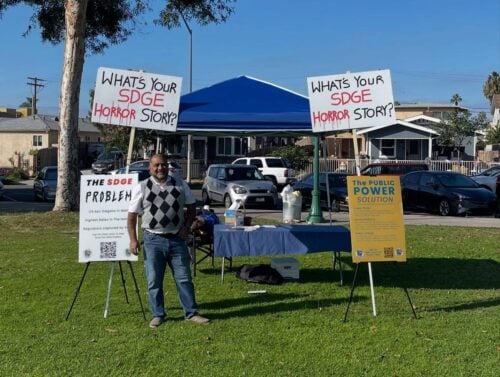
We have a very popular street called 4th Avenue, and on the weekends we were out there whenever there was a big festival or street fair, we were out talking to people at this stage too. We were kind of in the early stages of our campaign and saying like, okay, is this something that people want? And we heard again and again, especially in the summer, that people are really struggling to pay their TEP bills. I heard average of like, yes, in the summer my bills get up to 300, $400. I heard that again and again. But we also heard horror stories of people where their bills were like $800 a month in the summer had somebody come to a town hall and told us their bill was a thousand dollars a month in the summer. So we’re getting into the territory where like people’s TEP bills are almost a second rent. The unaffordability of it has definitely been, I think, the main driver of our campaign and the main thing that we’re talking to people about because it is just such a problem here, especially in the summer where it’s 110 degrees, 115 degrees, people really need their AC and right now under TEP, they can’t afford it.
John Farrell:
I’m glad you mentioned this study because we’ll come back to that. I’m interested in asking you more about the city’s feasibility study, but I also want to get a little bit into this broader conversation. So around the time that you and others were having a public rally for the public power effort in April, the Tucson mayor did mention that they wanted a franchise agreement, which is the agreement between the city and the utility that matches the city aim of “creating climate goals and adapting to climate.” Do you feel like that’s a shared aim of you and others that are working on the publicly owned utility and has TEP as the incumbent utility made significant commitments in terms of renewable energy and reducing emissions?
Lee Ziesche:
Absolutely. I think affordability is maybe our top line messaging, but climate is right there. We’re living in the Sonoran desert. Temperatures are climbing every single summer. This is my third summer in Tucson, and you can’t go out in the middle of the day if it’s 115 degrees. You just can’t. So we really see a public power utility being able to address these two main crises that we are facing, an affordability crisis and a climate crisis. So the city had a bunch of energy town halls around the franchise agreement. Ultimately we were asking the city to kind of delay and not put a franchise agreement before voters this November because we just had gotten these great feasibility study results and luckily they have delayed this conversation, but when we showed up to these town halls, we absolutely talked about making sure that TEP is helping the city reach its climate goals.
Our other main ask within those kind of negotiations were we don’t want to be paying the franchise fee anymore. Right now, residents are paying that on their bill, and we think that’s absolutely something that shareholders who are profiting off of our energy grid should be paying for, as well as these investments to help Tucson meet its climate goals. And as far as TEP’s climate goals, of course, they go out there and say that they’re doing all of this work. They do a lot of community washing within Tucson. They do a lot of greenwashing as well. So within their climate plan, their goals, they’re hoping to get carbon neutrality by 2050. That’s a little bit slower than Tucson’s goals. The city wants to get city operations, city buildings, things like that, carbon neutral by 2030 and citywide by 2045. So TEP’s timeline’s a little bit longer than the city’s.
TEP also wants to reduce carbon emissions by 80% by 2035. They still have two very large coal-fired power plants that create a lot of the power within their distribution network that they plan to retire by 2032. And unfortunately as part of their claim that they’re reducing emissions, they’re saying, well, we’re adding gas as part of that mix, they want to add 400 megawatts of frack gas power. They’re also talking with one of the other utilities in Arizona, APS and the Salt River Project about maybe doing nuclear as well, which they have a lot of concerns about how expensive that would be, and ultimately they’re kind of slow on solar. And all of this is really coming into question right now with TEP because there’s been a huge, huge data center proposed within Pima County and TEP is very much in support of it, and that data center would become their largest customer.
Some people who are experts on this think that if it actually ran at full capacity, this data center, that the energy use could actually be more than all of the homes and their other customers combined. It would be that great. And so we really question if they’re adding all this capacity to serve a data center, will they even be able to meet these kinds of inadequate goals that they already have. A draft development about the data center came out recently with the city, and it shows that, yeah, the city of Tucson might have to adjust its climate plan to serve this data center, which TEP is very much in support of doing. Yeah, I think TEP is really not on the same level with the city. I think the city of Tucson does have really great climate goals and we can’t meet them if we’re following TEP’s path.
We are still kind of figuring out how much of this current rate hike that they’re asking for. They obviously don’t mention this data project by name, Project Blue, but there is some information in their most recent rate filing that shows they’re building a lot of infrastructure that we’re going to pay for as rate payers to serve this corporate data center, which we don’t even know the end company behind. There’s a lot of crazy things about this data center, but we actually don’t even know what company is going to be running it. Is it Jeff Bezos’s Amazon? Is it Elon Musk’s XI? We have no idea, but that’s kind of the thing that it seems like TEP supports: a big corporation over making sure that the people and our businesses and our hospitals and schools, that’s what should be getting renewable energy if we’re adding it to the grid, not some big data center.
John Farrell:
It’s really interesting because when I looked at the city’s feasibility study, which we’ll link to in the show notes, it’s called the Energy Sourcing Study. And speaking of climate goals in contrast to TEP, it suggests that a city-owned utility would first of all save people potentially hundreds of dollars per year on their electric bills with the asterisk that that depends on the purchase price to buy out the utility company, which is always a fairly hotly contested issue, and that would reach the net zero carbon emissions that the city goal has for by 2045, but it also said that it would only be marginally more expensive to meet that same emissions goal by 2035, a full 10 years earlier. Do you feel like the study was accurate? I know sometimes that there have been sometimes even competing studies between a city and the utility company. Do you think it was ambitious enough? What’s your take on what that energy sourcing study had to say?
Lee Ziesche:
We were extremely happy to see the results of the feasibility study. It said within five years that people could be saving $241 a year and in the long term, because TEP just has that steady, steady rate of increasing profit long-term within 16 to 20 years could save people $1,077 per year. That’s huge savings for somebody, especially if you’re struggling to pay your electric bill when it’s 115 degrees outside in the Tucson summer. So yeah, we think that GDS did a really fair assessment. They have worked with a lot of utilities all across the country, and as soon as these results came out, TEP kind of came out swinging. They really tried to undermine the credibility of the study, and part of their argument was like, well, we’re going to make this really difficult for you. We might drag this out in court, which I think was really a mask-off moment.
They claim to be such a great community partner, but I think that was really revealing this Canadian corporation behind TEP that owns TEP, Fortis, and their interest. But yeah, I think GDS really understands the benefits of what happens in a community when you take out that profit incentive. And they also did a pretty good job of defending themselves against TEP and these claims that these weren’t accurate results. And one thing that we are really interested in, I think the only argument that maybe TEP has some legitimacy is right now it’s only looking at within city limits. TEP service territory expands out into Pima County. They did say it’d be very expensive to separate the grid. I think GDS looked at that. It’s all included in the numbers, but ultimately, yeah, we would actually really like to take over the whole service territory. We’ve talked to people who live right outside of city limits. That’s something we’re definitely interested in looking at that the study didn’t include. But I think overall it was fair. And of course TEP doesn’t like it. It’s threatening their business model. It pretty much says it would be better for the people of Tucson if you didn’t exist. So yeah, they’re not happy with it.
John Farrell:
I love that you put it so bluntly there, and I appreciate you kind of talking through the different components of the feasibility study. I’m curious if you could, on that one issue you just mentioned about taking over the entire utility versus just the portion that is served in Tucson. I seem to recall that in Colorado when Boulder was considering their public power takeover, they were prevented under state law from taking over something that was beyond their service territory or there was some major complicating factor. Have you had a chance to do more analysis of whether or not that’s possible or is that kind of on your to-do list?
Lee Ziesche:
Yeah, I think that it’s a little bit on our to-do list — that and figuring out the bonding and would the county have more bonding capacity? The city of Tucson does have a water utility that is publicly owned now, and that does extend beyond city limits. The city has made a decision not to serve people beyond city limits anymore without annexing them and bringing them in. So I don’t know if it has the same legality, but yeah, so that is one of the things on our to-do list as well as talking to the county and our county supervisors and trying to get them on board with the idea.
John Farrell:
One thing I was really curious about when I heard about the public power campaign was that I had the privilege of coming to visit Tucson back in 2014 in the winter, which was very nice for someone from Minnesota, and I really felt that there was a strong undercurrent of interest from the folks who invited me down there from folks in city government in investing in more solar and renewable energy. I’m just kind of curious if you have a sense of what kind of progress has been made over recent years or even before you came to Tucson. I guess part of my question here is if people were interested in this 10 years ago and TEP says that it wants to give the community what it would like or to be in service to the community, I’m wondering if it has sort of lived up to that promise given that it was so long ago that I was traveling there at the behest of the community to talk about the opportunities from investing in renewable energy.
Lee Ziesche:
Yeah, I think it’s been slow, especially compared to the potential here. It’s incredibly, incredibly sunny here. We are just absolutely drenched in this resource of renewable energy that we can be taking advantage of. And when you’re driving around Tucson, I don’t think you see all that much solar. Definitely not on people’s homes, and if you look at what percentage of TEP’s current portfolio is solar, it’s still pretty low. I think if you drive around places like California, you see a lot more solar than you do here in southern Arizona than where we should be. Part of that is kind of TEP’s fault. In addition to not really building it fast enough at the utility scale, they have advocated for and received through the Arizona Corporations Commission a 10% reduction year after year on the credits that people can get when they have rooftop solar. It’s already very often that only wealthy folks can afford rooftop solar and TEP is advocating to make it more and more so.
I do think the city of Tucson itself is making some progress as part of the energy town halls that they had on the franchise agreement, they did present that they are putting solar on a lot of different city buildings. They’re more on track to try to meet that goal by 2035 of having city operations being carbon neutral. But overall, I think we are nowhere near what the potential is. There are still so many people in Tucson that want this. We’re a place where we’re very, very aware of the climate crisis and the limitations of certain resources, but the abundance of sun is here. There’s a movement as well kind of parallel to the public power movement of folks who are fighting for community choice aggregation. They’re Arizonans for, they call it community choice energy, but unfortunately legislation has to change on a state level for that to happen. No law needs to change, this was part of the feasibility study, for us to take over TEP and make it a public utility, but unfortunately, a state law does need to change for CCA to be legal in Arizona. So I think if that happened, we would probably see a lot more energy development and that’s something we would love to see. The perfect situation is community-owned generation and also the public owns the distribution system as well. I think it’s slow, and that’s really sad.
John Farrell:
It’s really remarkable coming from a place that is so much less sunny than Arizona to think about. Minnesota for example, has almost 900 megawatts, or a little over 900 megawatts of community solar, a kind of program that Arizona doesn’t have at all, and has a fair amount of rooftop solar as well. It’s just such an interesting lesson, how much the policy and the politics matter in these decisions. And also interesting to what you said about the progress of the city of Tucson. One of the things I have found fascinating over the past decade where I’ve been sitting on an advisory committee to the city of Minneapolis and its clean energy partnership with Xcel Energy, which is the electric utility here, is it’s really clear that when the city has goals around climate change that are within their power, that they achieve them. Similar to Tucson, the city of Minneapolis had goals for getting city operations onto renewable energy, I think by a hundred percent by 2030, if I’m not mistaken, and they’re well on their way. It looks like they’re going to hit that target, but the goals that they had set for the broader utility service territory or for the state are lagging behind because those are the ones that the utility controls. So I think it is a very important lesson in terms of when communities have that decision-making power, they really can make a difference.
Lee Ziesche:
Yeah, yeah, definitely. The city of Tucson, especially under Mayor Regina Romero, has been taking climate pretty seriously and has gotten even some recognition from the Biden administration, which I think is worthy. I think they’ve been a little slow to recognize that TEP is not this great community partner, but I think things are starting to change a little bit here around that and their relationship with TEP.
John Farrell:
I want to come back to that, but I wanted to ask you first, the feasibility study was very clear that both in terms of affordability and in terms of climate, that having a publicly owned utility could be a big benefit. I didn’t have a chance to look through in great detail to see if the feasibility study looked at this at all, but do you have a sense whether public power can help address the disproportionate health and financial risks of indigenous communities or communities of color, low income folks? Do you have folks from those communities that are involved in the broader public power campaign?
Lee Ziesche:
Yeah, and it’s not really something that was specifically addressed in the feasibility study, but TEP has a pretty poor record when it comes to their treatment of indigenous communities. Most of their power plants are located in indigenous communities and have been polluting these communities, primarily the Navajo Nation for decades and decades. And actually one of the very first things that kind of put TEP on my radar when I moved here, Sierra Club, as part of the 2023 rate hike was trying to fight for just transition funds for these communities because not only have they been polluted for decades, a lot of their economy was dependent on these power plants, and TEP has absolutely fought that. They do not believe that shareholders should be paying for any kinds of just transition funds. Navajo Nation is also dealing with TEP transmission lines, and they are fighting for just funding there as well.
They have these massive, massive transmission lines, and apparently they’ve been getting the Navajo Nation a very raw deal, barely getting any money from TEP for the decades that these major transmission lines have been on their land, on their homelands. The gas generation that I mentioned that TEP wants to add to its mix that would be happening in South Tucson, which is of the city folks who tend to be low income communities of color, Tucson has, that’s where people live. That’s definitely an environmental justice issue of where they’re wanting to be putting their fossil fuel generation. And I think we’re trying to think of the best ways that we can address this with a public power utility, right? Because we’re not taking over that generation, but we would hope that the city could then focus on making sure that it is buying energy that is not being produced in places where it is hurting environmental justice communities.
Another thing that the feasibility study found is that essentially the public power utility would not be regulated by the Arizona Corporations Commission. So we’re very interested in looking at could the city have a more just rate structure to address some of these issues, making sure that people can afford their electricity. We also know that a lot of these communities in South Tucson tend to be hotter because they don’t have trees the same way wealthier parts of Tucson do. So that’s definitely something that we’re looking into and we want to make sure as we are pursuing this public utility that we’re not in any way making it harder for somebody like the Navajo Nation to get justice from TEP and Fortis. So it’s a little bit of a tricky issue. It’s not as clear cut, but it’s definitely something we’re thinking about. Right now a lot of this work is being led by Tucson DSA, but there are plenty of people from all different communities, including the Tohono O’odham Nation, which is also in this area. That’s whose indigenous land we’re living on, who support our work, and yeah, we’re trying to be more in coalition as we move forward and this becomes more of a reality that we can actually win.
******
John Farrell:
We are going to take a short break. When we come back, I ask Lee to share about the opposition, to share about what other issues are impacting the campaign and to share what advice she has for public power campaigners and other places. You are listening to a Local Energy Rules podcast with Lee Ziesche, co-chair of the Tucson DSA.
Hey, thanks for listening to Local Energy Rules. We’re so glad you’re here. If you like what you’ve heard, please help other folks find us by giving the show a rating and review on Apple Podcasts or Spotify, five stars if you think we’ve earned it. As a bonus, I’ll gladly read your review aloud on the show if it includes an energy-related joke or pun. Now, back to the program.
******
John Farrell:
It’s always the case that public power campaigns like this are facing opposition, usually from the incumbent utility. So you’ve already talked about how TEP was trying to undercut the feasibility study, suggesting that switching to public ownership would be a benefit. Are there other folks that have been creating opposition to this? I’m kind of curious what issues are coming up as this campaign grows in terms of what people are saying are potential drawbacks, whether that’s true or not.
Lee Ziesche:
So I’d say opposition-wise, really publicly so far it has only been TEP. We expect that if this moves forward, one thing that the feasibility study did find is that the people of Tucson will have to vote on this. They can either vote whether to say yes, just do it, or specifically on the bond that the city would be doing to buy out the utility. We kind of expect that the Tucson Metro Chamber will probably be against us. TEP is on their board. They tend to kind of side with the bigger corporations. We’re seeing a lot of these, the Chamber of Commerce coming out for Project Blue, which is the data center, and we aren’t necessarily expecting the local IBEW, which has linemen that are represented that work for TEP. When GDS Associates were presenting the draft feasibility study, their questions almost seemed like they were coming from TEP, but we’re hoping to work with them and maybe bring them on board.
I think a lot of utilities, we don’t have very strong union protections here in Arizona. We’re a right to work state. There’s always a lot of concerns with utilities. It’s sometimes kind of easier just to accept the devil you know versus the one you don’t and when it comes to becoming city employees, but they have not publicly come out against it yet. And yeah, we’re really hoping to work with them and other unions, like the union that represents city employees AFSCME, to kind of let them know that, making sure that any kind of contracts we would want to make sure that is honored if it was taken over by the city and hopefully unionize more employees. Right now, it’s really only the linemen within TEP that are union, so we do believe if it became a public utility, there could be a good opportunity to increase union membership. But yeah, so we’ll see. We haven’t heard a direct no from them yet, but it’s how it’s been a lot of places. Yeah.
John Farrell:
Yeah. I wonder if in a way, because of being a right to work state and having fewer protections for workplace organizing if that in some ways makes your job slightly easier. One of the things I remember about the Our Power campaign in Maine was that the switch from being a private sector union to a public sector one as the result of the Supreme Court’s Janus decision would actually decrease the sort of power of the unions in that case. It sounds like, I mean, not that you would choose to be a right to work state, but at least the switch from private to public might actually have less of an impact on the power of those unions to organize the workplace if you make that transition. Does that sound right? And I don’t know if you’ve really thought much about that, but it seems like that might actually work in your favor.
Lee Ziesche:
Yeah, I mean it’s definitely something we’re still wanting to do a little bit more research, but yeah, I mean that was a huge issue in New York as well, with the Build Public Renewables Act, some concern about becoming public sector union employees. But yeah, I think it’s definitely something we want to think about. And like I said, we want to, I think one of the potentials is that there could be a lot more union employees. Right now it is only their linemen that are unionized within TEP. Most of their workers are not union.
John Farrell:
Yeah. I want to talk a little bit about, you mentioned already the Project Blue, the data center that’s being proposed. It could be a very significant electricity user, and I saw some of the news stories too, talking about the water use. Are there other big factors like that playing into this campaign and this conversation, other big users of electricity? I assume water use is always an issue when you’re in the Sonoran Desert. What else is playing a role in the conversations about public power?
Lee Ziesche:
Yeah, I mean, I think this new data center has put TEP as kind of a villain in this too, right? They are supporting the data center. I think it’s exposed to a lot of people that they are not good community partners within Tucson.
The other thing that’s come up recently too is TEP supporting potentially more nuclear development. There are a lot of anti-nuclear peace activists who are against nuclear, both in a generation sense, but also in its relationship to the war economy, which also has a pretty strong foothold here in Tucson. So I think TEP tiptoeing and looking into nuclear has also gotten a lot of people up in arms.
And then we’ve also been having these franchise agreement talks, and TEP did not come to the table really for those, and that really upset our mayor and council. Last month was a pretty bad day for TEP, the same day that they were testifying before our county that this data center wouldn’t impact rates negatively at all they filed their rate hike, on the very same day, and they did not come to the city council meeting around the franchise agreement. So I think all of these things combined have really exposed that TEP is mostly focused on their own profits and not community, and it’s just building up to them. When you add on the fact that people keep getting that higher and higher bill every month, they’re pretty unpopular right now. I haven’t really met anyone who’s like, yes, I like TEP and they’re doing a great job.
John Farrell:
Even with that, one of the tough lessons that I’ve learned over my time doing these conversations with folks in cities doing public power is that most of the ones in the past decade have not ended with a public power takeover, even against utilities with a terrible record of high bills and poor service. In Maine with Central Maine Power, they were, I think the worst rated by JD Power and Associates for customer service had some of the highest rates in the country. It sounds like in Tucson, some public officials like the mayor’s comment was more oriented around the negotiation of that franchise agreement, which would potentially still leave TEP in charge as opposed to doing a public power takeover. So what gives you hope that Tucson can succeed? You’ve kind of alluded to this already. Nobody seems to really like that incumbent utility. What else do you have going in your favor? What gives you hope that this public power project could be successful?
Lee Ziesche:
There’s a few things. I mean, I think the number one thing is that I just really believe that things cannot go on the way that they are as our position being so vulnerable to climate change, it’s just really too hot right now, and TEP bills are too high. Something has to break, and I hope it doesn’t get to the point where we see an incredibly popular movement spring out of this because somebody dies because they’re too afraid to turn on their AC in the summer. The fact that TEP bills are so high, I think it’s an issue that affects people on a very wide political spectrum. One of my favorite places to actually canvas outside is there’s this weed dispensary where you have to walk on a public sidewalk to get in. And so I canvas out there a lot, and I’m definitely talking to people that are not Democrats and are definitely not Democratic socialists.
They’re like pulling up in some really big trucks, but they support this because bills are just so high and people are really afraid. I think we are seeing a lot of movement on the city council for that reason. We have over 3,800 people that have signed our petition now. There’s actually two people running for Tucson City Council that Tucson DSA has endorsed and that are very strong advocates for public power. We’re starting to see some movement with our city council, people who very much were like the franchise agreement is the best we can do. I think our recognizing that this is a popular issue because it is such a dire situation. Another thing that gives me a lot of hope is we actually have a sister fight. Central Hudson in New York is owned by Fortis as well. I had the amazing opportunity to organize with Sarahana and a lot of the other people in the Mid-Hudson Valley DSA, and I know what an amazing fighter they are.
So I think now Fortis is going to be facing what I hope to say is formidable fights now on two sides of the country, and I think overall more and more of these fights are springing up everywhere. And ultimately what we’re trying to do is change this larger structure. So I think it’s going to be getting harder and harder for utilities in general to kind of keep operating the way they are. And I think the last thing that gives me a lot of hope is I just have a lot of faith in Tucson. When I moved here three years ago, I was like, oh man, we’re moving to this place. That kind of seemed like, I don’t know, the suburbs to me a little bit after living in New York City, and it’s like, oh, I’m moving to the desert. But there is so much community here in Tucson, but it is a little bit spread out. This is a place that really cares a lot about its people and the opposition we’ve seen to this data center has sprung up incredibly quickly because it was moved very fast, very secret, but people have been fighting for conservation of water and energy here for decades because we live it every day.
We understand the value of our resources. So I just think there is so much potential here in Tucson and people are willing too to take on bigger fights here. I think just the makeup of Tucson gives me a lot of hope that we can be powerful enough to take on TEP and Fortis.
John Farrell:
I should mention that if people are interested in that Central Hudson story, I didn’t know that they were also owned by Fortis when I did the podcast with Representative Shrestha from New York. And so if folks want to listen to that and hear more about that story and kind of its parallels, that’s fascinating and I think it is really encouraging. In the same way too, I can see a parallel… I was inspired and worked with folks in Minneapolis, Minnesota on a public power campaign and then ultimately the Clean Energy Partnership that I previously mentioned. And I think one of the reasons that we had some success is that we and Boulder, Colorado are both served by Xcel Energy and you had two of these large cities in that utility service area, in that utility’s company portfolio, both saying the same things. And Xcel, maybe neither of our cities have a public utility now, which is true, but we have seen Xcel have some of the most ambitious commitments of a for-profit utility to clean energy. And so that also gives me hope that there is, even in losing some of those campaigns as we have in the past, at least we’ve laid the groundwork for some future success. Speaking of that, I’m kind of curious, as you’re in this fight, what advice might you give to other folks that are campaigning for public power?
Lee Ziesche:
First of all, I would say do it. One of the biggest challenges is overcoming that initial pushback. So many people are going to tell you it’s impossible that we can’t take on these giant corporations. I mean, so many people told us that when we first started our campaign, and I think a lot of that Ursula Le Guin quote, she said, “we live in capitalism. Its power seem inescapable, so did the divine rights of kings. Any human power can be resisted and changed by human beings,” and I think any corporate power can ultimately be changed as well. And one of those initial hurdles is just all those people that are going to tell you that it’s not possible. It will definitely not be easy. You’re going to have to do a ton of work, and that involves just getting out there and talking to your community. I think that’s another big thing is this is not something that can be done just through social media campaigns and a little bit of lobbying of your governments, you’re actually going to need to get out there, talk to your community, and build a base of people that are willing to fight for this.
I’d also really recommend connecting with other groups, kind of like what we mentioned with having this sister fight in Central Hudson and more and more of these fights popping up. I think a lot of this is us going to just be challenging the notion for these private utilities that these are safe, easy investments and they can just keep chugging along as things are making money. It’s going to be like, no, it’s actually going to be hard for you to operate in this environment with all these people coming together. And I think my other advice is just, I think focusing on affordability is the issue these days. We saw that in the presidential race in 2024. I mean, when Donald Trump actually came to Tucson and he brought up high electric bills, it was kind of ironic. He said something about “comrade Kamala.” I can’t even remember exactly what he said, but it was somehow her fault.
And it was like, well, actually, the solution to this is kind of what you’re making fun of. It is a public utility, but when we talk to people, they’re really struggling to pay their bills. And I think we also saw affordability be such a huge issue in the Democratic primary in New York City as well, and it wasn’t one of his main issues, but through my work with Sane Energy Project, we asked Zoran to become an intervener in the ConEd rate case, and he did. He was a huge fighter for public power in the Build Public Renewables Act in New York. Climate is obviously such an important issue, but really people’s utility bills right now is often their most direct connection to the climate crisis. If you don’t have the power plant in your backyard, you might experience a wave of climate disaster here and there, but your most direct connection to the climate crisis is your utility bill right now. So I think focusing on affordability is going to be key in any fight to actually winning.
John Farrell:
Well, Lee, thank you so much for joining me to talk about the great work that you’re doing in Tucson. I think it’s already clear that it is bearing fruit in terms of the upswing in interest. Like you said, the really rapid and significant opposition to the data center, the very clear benefits that could be offered by a public utility. So I really do hope that you have a lot of success talking to people about this and showing them that there is an alternative to what they have in place right now. Where can people learn more if they happen to be in Tucson or if they’re just interested in showing some solidarity with your public power efforts?
Lee Ziesche:
Right now, following Tucson DSA on Instagram is probably the easiest way to find out what we’re doing and get involved. We also do have a petition that folks can sign if they want to, and then they’ll, once they sign it, they’ll be added to our email list. It’s bit.ly/TEPpetition. The TEP is capital, and then petition is lowercase. And so yeah, if you sign our petition, you’ll get on our email list and we’ll let you know whether it’s a canvas we’re doing for one of our city council candidates who support public power or showing up to fight the data center. We’re out there and we need a lot more people involved because ultimately it’s going to take a very mass movement and we’re subtly growing, and I think we can do it.
John Farrell:
That’s wonderful. We’ll have links on the show page for folks who didn’t catch them as Lee was mentioning them, to find out where to connect with Tucson DSA and to sign that petition. But thank you again, Lee, for all the work that you’re doing and for joining me on Local Energy Rules.
Lee Ziesche:
Yeah, thanks so much for having me and doing the work to connect all these fights. It’s so important.
******
John Farrell:
Thank you so much for listening to this episode of Local Energy Rules with Lee Ziesche, co-chair of the Tucson DSA about the Public Power Campaign in Tucson, Arizona. On the show page, look for a link to several news stories about the campaign and the city’s municipalization feasibility study. We’ll also link to ILSR’s newly released Public Power Handbook, a collection of crowdsourced wisdom for public power advocacy campaigns, as well as our deep dive six-part podcast series called The Promise and Peril of Publicly Owned Power, which starts with episode 163. We’ll also have that interview with Representative Sarahana Shrestha about the initiative to take over the Hudson Valley Utility, episode 220, and a few other episodes with Public Power Campaigners, episode 229, 223, and 207. And if you’re also a public power campaigner yourself, we invite you to contact us about joining a monthly call connecting city and state public power campaigns across the country.
Local Energy Rules is produced by myself and Ingrid Behrsin with editing provided by audio engineer Drew Birschbach. Tune back into Local Energy Rules every two weeks to hear how we can take on concentrated power to transform the energy system. Until next time, keep your energy local and thanks for listening.
“Especially in the summer where it’s 110 degrees, 115 degrees, people really need their AC. And right now, under TEP, they can’t afford it.”
Tucson Electric Power (TEP) recently filed for a 14% rate hike, adding about $200 per year to household electric bills. This follows a 10% rate hike approved in fall 2023 and an 8% increase in 2020, collectively approaching a 30% rise over the past five years. These escalating costs, with summer bills getting up to $1,000 monthly, make electricity almost a “second rent” for many Tucson residents.
“It’s just really too hot right now, and TEP bills are too high.”
TEP’s unaffordable bills are the primary drivers behind Tucson’s public power campaign. The campaign, led by Tucson DSA, launched in fall 2023 after TEP’s latest rate hike. Organizers quickly gathered over 3,800 petition signatures, and urged the mayor and council to take a feasibility study on a municipal takeover of TEP seriously.
“The city of Tucson does have really great climate goals and we can’t meet them if we’re following TEP’s path.”
Tucson faces both an affordability and a climate crisis, and TEP’s actions are making it worse. The city aims for carbon neutrality in its operations by 2030 and citywide by 2045. But TEP has set a slower goal of carbon neutrality by 2050, while also planning to add 400 megawatts of fracked gas power and exploring expensive nuclear power. The utility is also impeding solar adoption by advocating for reduced rooftop solar credits.
“It’s incredibly, incredibly sunny here. We are just absolutely drenched in this resource of renewable energy that we can be taking advantage of.”
To make matters worse, TEP strongly supports a new data center, Project Blue, which could consume more energy than all of Tucson’s residential customers combined. Ziesche explains that this data center’s energy needs would shift infrastructure costs to ratepayers and may force the city to lower its climate ambitions.
“The people and our businesses and our hospitals and schools, that’s what should be getting renewable energy [to] if we’re adding it to the grid, not some big data center.”
Ziesche was heartened when a feasibility study by GDS Associates found significant benefits in overhauling TEP to be a publicly owned utility.
The study projects that people could save $241 per year within five years, and over $1,077 annually in the long term (16-20 years). Tucson’s public power campaigners were encouraged by the findings’ emphasis on the huge savings potential for residents struggling with high electric bills.
“Of course TEP doesn’t like it. It’s threatening their business model. It pretty much says it would be better for the people of Tucson if you didn’t exist.”
TEP, owned by Canadian corporation Fortis, immediately attacked the study’s credibility, and implicitly threatened legal challenges. GDS Associates, which has experience across the country, effectively defended its findings, and confirmed the benefits of removing profit incentives from utility operations.
While the study focused on municipalization within city limits, Ziesche and other public power advocates are interested in expanding public ownership to the entire TEP service territory, including surrounding Pima County.
“I haven’t really met anyone who’s like, yes, I like TEP and they’re doing a great job.”
“We want to make sure as we are pursuing this public utility that we’re not in any way making it harder for somebody like the Navajo Nation to get justice from TEP and Fortis.”
Tucson’s public power advocates are hopeful that a municipal takeover could improve affordability and health impacts for the area’s indigenous and environmental justice communities. TEP currently holds a poor record with indigenous communities. Ziesche explains how the utility has polluted the Navajo Nation for decades and has offered the Navajo Nation a “raw deal” for transmission lines on their land. It is also fighting against just transition funds.
And in south Tucson, a primarily low-income community of color, TEP is proposing a new gas-fired power plant. The community is already more vulnerable to climate change, given its relatively low tree cover compared to wealthier areas of the city. The new gas plant would exacerbate climate impacts in the area.
In contrast, public power could allow Tucson to create a more just rate structure and prioritize energy that avoids harming environmental justice communities.
“The makeup of Tucson gives me a lot of hope that we can be powerful enough to take on TEP and Fortis.”
Ziesche believes that Tucson’s dire exposure to extreme heat and unaffordable bills make changes to the utility structure inevitable. Residents across the political spectrum are united by the high cost of electricity, and the city has a long-standing commitment to water and energy conservation.
Another cause for hope is that there is a “sister” public power fight against Fortis, TEP’s parent company, in Central Hudson, New York. This two-pronged effort represents a broader public power movement, and may stretch the utility’s resources to the benefit of both efforts.
“Fortis is going to be facing what I hope to say is formidable fights now on two sides of the country, and I think overall more and more of these fights are springing up everywhere.”
Ultimately, Ziesche advises that focusing on affordability and being willing to do face-to-face, boots-on-the-ground, campaigning are key to waging public power campaigns. For Ziesche, utility bills often offer people their most direct connection to the climate crisis.
“You’re actually going to need to get out there, talk to your community, and build a base of people that are willing to fight for this.”
See these resources for more behind the story:
For concrete examples of how towns and cities can take action toward gaining more control over their clean energy future, explore ILSR’s Community Power Toolkit.
Explore local and state policies and programs that help advance clean energy goals across the country using ILSR’s interactive Community Power Map.
This is the 242nd episode of Local Energy Rules, an ILSR podcast with Energy Democracy Director John Farrell, which shares stories of communities taking on concentrated power to transform the energy system.
Local Energy Rules is produced by ILSR’s John Farrell and Ingrid Behrsin. Audio engineering by Drew Birschbach. Featured Photo Credit: Cameron Capara.
For timely updates from the Energy Democracy Initiative, follow John Farrell on Twitter or Bluesky, and subscribe to the Energy Democracy weekly update.
How did this coal town ditch gas lines, win grants, and make municipal networked geothermal the cheapest heating option?
Learn how public power can tackle the affordability crisis.
How can state legislatures pave the way for cities to advance clean energy and equitably address climate change?
Slayton's public power takeover aims to improve reliability and safety.