A Coal Town Digs Deep for Municipal Clean Heat — Episode 267 of Local Energy Rules
How did this coal town ditch gas lines, win grants, and make municipal networked geothermal the cheapest heating option?
Studies show public power could save San Diego residents billions of dollars. So what’s standing in the way?
For this episode of the Local Energy Rules Podcast, host John Farrell is joined by Bill Powers, Mark Hughes, and Isaiah Glasoe from Public Power San Diego.
Listen to the full episode and explore more resources below — including a transcript and summary of the episode.
Apple Podcasts Spotify YouTube
Podcast (localenergyrules): Play in new window | Download
Bill Powers:
The core push now by us for public power is we have got to get local control of electricity supply. It can’t be public power light. It can’t only be community choice aggregation.
*****
John Farrell:
It seems obvious that electricity would be cheaper by cutting out the profits in the transition from private to public ownership. So when studies suggest otherwise, be suspicious. That’s the lesson from San Diego where three separate studies have been done to evaluate the benefits of public power with widely varying results. Joining me in November, 2025, Bill Powers, Mark Hughes and Isaiah Glasoe from Public Power San Diego helped me take a deep dive into the mechanics of feasibility studies and emphasize the crucial importance of public oversight.
I’m John Farrell, director of the Energy Democracy Initiative at the Institute for Local Self-Reliance, and this is Local Energy Rules, a podcast about monopoly power, energy democracy, and how communities can take charge to transform the energy system.
*****
John Farrell:
Bill Powers, Mark Hughes, Isaiah Glasoe, welcome to Local Energy Rules.
Bill Powers:
Thank you, John. Happy to be here.
Mark Hughes:
Thank you. Yeah.
John Farrell:
I want to just start off as a question that I like to ask everybody when they come onto the podcast, which is just how did you get into this work of public power advocacy? Maybe just very briefly touching on what were the interests that drew you into this or what have you done previously that feels related.
Bill Powers:
Thank you, John. I’m a consulting engineer by trade, power systems specifically, and it was the California energy crisis in 2000, 2001 that really inspired me to get engaged as an energy activist. In addition to doing the engineering, I retooled my consulting practice to work primarily with nonprofits pushing back against fossil plant expansion, became an advocate for rooftop solar and battery storage as the most cost effective lowest impact tool to meet the climate challenge and help form and lead nonprofits serving as investor and utility watchdogs. And really that’s what ultimately has led me to public power is the best solution to this Gordian Knot.
John Farrell:
Thanks, Bill. Mark, how about you?
Mark Hughes:
So I spent my entire career in the power generation industry, and that included working for an investor owned utility at one point. I was in the power plants. I wasn’t in administration in that sense. I’m also a big advocate of renewable energy. And so that got me started a few years ago with Community Choice Energy here in San Diego. And so I took part in that campaign and we got that done, which was good to see. And then this is the obvious next step. And so that’s how I’ve gotten involved.
John Farrell:
Isaiah?
Isaiah Glasoe:
I got started about two and a half years ago. I was working as a property manager and I saw just the stratification of landlords, developers, homeowners, renters, all of them hate SDG&E. And I had this question of why is this not solved? And yeah, one month I got a high bill and I was out of town for that month and I started ranting on Reddit and started a payment strike against SDG&E. And from there I started working with the Power San Diego campaign, which was the ballot initiative to municipal SDG&E. And I’ve also experimented with some debt organizing and debt forgiveness as a means to organize people around this issue as well. And now I’m working for Public Power San Diego.
John Farrell:
I love the varied backgrounds that you bring to this, but all kind of rooted in some element of either being as an electric consumer or being involved in the electricity industry. Just to start off by asking what’s at stake in your public power campaign?
Isaiah Glasoe:
What’s at stake right now is San Diego is paying some of the highest rates in the nation. One in four people are in debt to SDG&E and they’re making nearly a billion dollars in profit every year off us. In our educational campaign where we’re at right now, affordability is top of mind, but I think we’re trying to tackle a deeper issue which is it is completely immoral to have a regulated for-profit monopoly. We are living in that experiment right now and in my opinion has totally failed. So what’s at stake is reclaiming our democracy from these corporations which have influenced our politics and our politicians, and lower rates. I think that’s sort of the context.
John Farrell:
Is there anything more that anyone would add about what do you see as being able to be improved if you’re successful? What happens if you get a publicly owned utility?
Mark Hughes:
To me, this all comes down to motivation. And by that I mean that if you’re the CEO of an investor owned utility, your customers are your investors and that’s your motivation to serve them. And you do that whatever it takes, including political influence, influencing the public utility commission all the way down, various strategic charity donations.
On the other hand, if you are the director of a municipal utility, your customers are the rate payers. So all of your decisions are made with them in mind and that completely changes the results. And so some of the other things that we would expect to have happen is, for example, the investors in utilities here are quite opposed to rooftop solar because they make a lot of money off of building transmission lines. We could run San Diego off the solar energy that’s available to us, but the motivation is in the wrong direction right now. We would also, if we were putting in less transmission lines, we’d have less impact on the back country, which is where the transmission lines are run through and they’ve been known to cause fires. So that’s the way I put everything in a nutshell that we’re going to talk about.
John Farrell:
One of the things I find really interesting about San Diego is that there have been multiple efforts over the years to get San Diego’s energy system to tap the abundant local solar resource that you have to create more local benefits. I was hoping you give folks who are listening and who are probably not familiar, a bit of a background on what else has been tried over the years. I first encountered, actually, I think through your work, Bill, kind of documenting how local solar could be an alternative to big transmission lines. There was the work on community choice aggregation, which sounds like it’s been successful. Am I missing anything? Are there other elements that have been building up to this?
Bill Powers:
Thank you John for that question. And I think in terms of talking about what else has been tried, I might flesh out what has been tried and what has worked, but what still needs to be done. And California has led the nation by far in rooftop solar installations, which is a real success story. And that ironically happened under a Republican governor, Arnold Schwarzenegger, the million solar roofs program. And despite relentless utility pushback, relentless utility attempts to undermine that program, it thrived. And even here in California, more than 20% of the customers have rooftop solar. We put in, the biggest year for us was 2023, we put in over 300 megawatts of rooftop solar in relatively small investor owned utility territory. And in some ways the very first thing we did could have largely addressed the issue, which is just let rooftop solar and storage keep booming and seamlessly take care of the switch.
But a couple of years ago, the utilities with allies in the assembly and state level were successful in pushing through a pretty draconian change in our net nearing tariff that has resulted in a pretty precipitous drop in installations. It also resulted in a lawsuit here in California and both Mark and myself were on the board of the Protect our Communities Foundation. That was one of three nonprofits with Center for Biological Diversity and the Environmental Working Group that sued the Public Utilities Commission. And we actually miraculously won the first round in the Supreme Court in August, and we’re now going back to the appellate court to try it on the merits and hopefully out of this will come a much more equitable tariff than what we were handed by the commission a couple of years ago. So that net metering approach as a major card in the solution may come back with a little bit more force in a couple of years depending on how this shakes out.
So number one is we had a program that historically has been working great to get us low / no impact, solar and storage where we use it. Mark mentioned community choice aggregation. Earlier I mentioned the Enron crisis, the California energy crisis. What came out of that was community choice aggregation law in 2002, didn’t really get going until 2010 in California. It’s pretty much swept the state. And I would say on paper it’s been a success in that most customers now get their power from energy choice aggregators. In reality, it hasn’t moved the ball forward much. And what do I mean by that, which is the community choice aggregators have largely been following a procurement track that is very similar to what the investor owned utilities were doing anyway, let’s build a multi square mile solar array in the Nevada and create a situation where we have to have more transmission if we keep building in remote areas and let’s try and shave a couple of pennies per kilowatt hour off the price.
That is not what we envisioned for community choice aggregation. Those of us that were very active in this 10 years ago wanted that to be essentially public power light meaning instead of having to buy the lines, we just control the power supply and we’ll put it in the cities and the suburbs and we’ll use it and we’ll eliminate any justification for a build out of transmission and rates going up because of all that expense. That has not happened yet. It may happen still because the community choice aggregators are under at least nominal public political control, but it hasn’t happened yet. And so what that has led me to after being in this space for almost 25 years is the investor owned utilities, and you’ve touched on this many times, John, have tremendous political power. In fact, that is their power. It isn’t the product, it isn’t the price. It’s that political gift of a private monopoly and then the ability to control public utility commissions where you’re located. And so the core push now by us for public power is we have got to get local control of electricity supply. It can’t be public power light. It can’t only be community choice aggregation. It’s got to be we own and operate those wires and we define what flows on those wires. And when it comes to community choice aggregation is, look community choice aggregator, this is the product we want: we want rooftop solar, parking lot solar. You need to keep the price low, bundle a hundred rooftops, a hundred parking lots into a single RFP, whatever it takes, but give us what we envision as the best, most cost effective, least damaging road to clean energy.
John Farrell:
I want to ask you one quick follow up about community choice. I followed it for quite a long time, really since as you mentioned, after all of the lawsuits were settled and additional legislation was passed California to actually enable it in 2010. And one of the things I find really interesting about, and disappointing, as you mentioned, about the procurement model, is that it has largely followed the idea of essentially like, well, we’ll just change who buying the power from in some cases, but we’re going to buy it in the same fashion. And I’ve come to wonder if that problem is that by being public power light by not buying the poles and wires, we sort of created a situation in which the publicly controlled entity does have the decision-making power, but they don’t control the part of the grid, the distribution system, where a lot of the benefits are to be found of building local renewables.
So if you are going to build a lot of stuff on rooftops, you mentioned, I think that really intriguing idea of like let’s find and bundle together a hundred different rooftop solar projects. One of the arguments out there is this is going to reduce the cost of supplying power of maintaining the grid system in that particular area. Well, a CCA is not necessarily going to see that benefit because they’re only procuring the electricity. They’re not the ones managing the grid system and paying for the distribution system that gets it. That’s like a pass through to their customers. I’m curious just for you to maybe riff on this for a second of the way in which maybe community choice didn’t go far enough or didn’t properly align the incentives in terms of localizing our energy system.
Bill Powers:
John, we need you do to help change the bow of the boat on CCAF here in California because you just nailed all of the problems with the CCA program, which is they bifurcated the power supply from the transport transmission and distribution such that the CCAs that they choose to which they have can just basically put on blinders and say, Hey, the power contracts that we have are slightly lower cost than the power contracts that the investor utility would have. Without acknowledging it, by signing contracts with power in remote areas, you’re fueling the need for the utility to put in applications for more transmission and beefing up the transmission and distribution system. In that sense, it’s a bad model because it allows the power supplier and the CCA to basically ignore the implications of those contracts on the other side of the bill, which they’re not responsible for, which is the investor-owned utility.
And so I do think that having said all that, and having been an expert witness in the proceeding about exit fees where the utility said, Hey, these customers leave our bundle service and they go to this CCA, we were procuring a lot of renewable energy and backup power supplies for them and now they’re gone and we’re basically going to be putting this burden on the customers that remain, therefore we have to impose an exit fee on the customers that leave. And without going into a lot of excruciating detail on that proceeding, a very unjustly high exit fee was imposed on customers, which has really constrained the wiggle room of the CCAs to do anything but look for the absolute cheapest power out in the market and buy it, try and show some benefit relative to the IOU. And so the IOUs and their friends at the state level really ran the table on constraining the CCAs’ ability to do what we wanted them to do, which is saturate these cities with, it’s fine with me, it was mostly commercial rooftops and parking lots, but that it would be here, it would be on the distribution grid and it would do exactly what you said, John, is that if we’re putting it here where we’re using it, we are removing the justification for all of this build out, all the transmission build out and then beefing up the distribution system to take power because it’s mostly coming from outside exported in.
And that’s the problem all over the country, but especially here because geographically we are a densely populated coastal strip with a relatively unpopulated desert only 70 miles to our east. And so it’s an easy pitch which resonates with people who know very little about this to say, well, the cheap power is right over there. It’s something a hundred miles away in the desert. We just have to build a couple of billion dollars worth of transmission to get it, even though the same solar panel that would go on your roof is what they’re putting out in the fallowed field or open country to the east.
John Farrell:
Thanks for entertaining me with that little diversion, but I’ve just been kind of curious about that limitation of community choice. I should add, by the way, you mentioned the victory at the California Supreme Court around that metering. It hasn’t been published today when we’re doing this interview at the beginning of November, but should be out by the time this podcast is released, that I did an interview with Roger Lin about that court decision and the implications of it. So if folks are interested in learning more, just scroll back in the podcast feed and you should be able to find that.
I want to get back to our core topic here about public power and to this issue in the campaign of the feasibility study. So folks who are familiar with public power probably already know this, but folks who aren’t may not, that generally speaking, anytime a community looks to do a public power campaign, there is this step involved in doing a feasibility study, which is evaluating the cost effectiveness of transitioning to a publicly owned utility. If you want to learn about all these steps, ILSR has what’s called a public power handbook. You can check it out online. It runs through all of the big pieces of these campaigns. But about these feasibility studies, almost all of them that are conducted by independent consultants usually representing the city themselves or the Campaign for Public Power show really big benefits, which is not surprising in the context that most in general, on average publicly owned utilities have better reliability and lower rates. So you would think that would be the outcome.
Yet, in contrast, almost universally, the studies that are funded by the incumbent for-profit utilities do not show benefits. So I’m really kind of interested what happened with the city-funded, although utility-leaning study in San Diego. Did you have competing studies? Was there just one study? How did that study process turn out and how has it impacted the campaign?
Bill Powers:
We probably have one of the more complex public power feasibility study histories of any community in the country. To begin, almost a decade ago, energy activists in the community, including myself, could see that our 50 year franchise agreement with the investor-owned utility was going to be up in late 2020, early 2021. And it was an opportunity, we’d been watching the City of Boulder, we could see all the publicity about their pursuit of public power negotiations on terms. And so we wanted to be ready when that franchise agreement expired to have at least a state-of-the-art franchise agreement with easy off ramps to public power. It’s the right time to do it. I was part of a group that we cobbled together the funds through a nonprofit in town to pay for one of Boulder’s consultants who they recommended to us to do the feasibility study.
We spent a total of about $55,000 on that study. It was actually a pretty good study and it was a public interest group that funded it. And as you were saying that public interest group funding and my ability to serve as kind of oversight for it, the assumptions are good, everything’s good. It was a winner. Electric distribution utility definitely go in that direction. We worked with our city council, we met with all of them to prep them. Most of the council members had no clue about the franchise agreement or what the implications were. And so the city also felt compelled to do a feasibility study in preparation for those franchise agreement negotiations. They hired New Gen Strategies, New Gen Strategies in the politics of that moment where we had a Republican administration, it wasn’t necessarily in the pocket of the electric utility, and the study was reasonably good, that New Gen did.
It definitely showed, with other consultants assisting, it definitely showed that public power would be a net benefit to the city. The primary consultant on those franchise negotiations said, look, if San Diego Gas and Electric does not agree to your franchise terms, your bid sheet as written, go straight to public power. Interest rates are low and it’s the time to do it. And then we just got balled up in the politics of the city where they didn’t accept any part of the bid document and yet they still ended up getting challenged and then actually precipitated multiple lawsuits, two lawsuits specifically over SDGE getting special treatment. There was no level playing field for the franchise. So at that point we had two franchise agreement studies. We had the Power Services out of North Carolina recommended by Boulder. We had New Gen Strategies working for the city, in both cases saying public power is the way it go.
And then one of the bones that was thrown to the community and what essentially was a debacle of a franchise agreement negotiation, at least for the citizens of San Diego, one of the bones thrown to the community was yet another municipalization study, very well-funded municipalization study. And we were like, whoa. And I had recommended New Gen Strategies for this, but at the same time I was like, wait a second. We got a pretty comprehensive multi hundreds of thousands of dollars of study from them and it’s good. I’m not sure why we need another study. More detail can be useful, but it’s also an opportunity to muddy the water, to make other assumptions. So understanding this, several of us petitioned the city council to form a citizen’s oversight task force of this municipalization study. We have an administration right now at the city that is sympathetic to the utility and just concerned we might end up with something not that helpful to the community. We got that through the council, but it died in the mayor’s office.
And so no citizens task force was formed. And then fast forward two years and just this study has dropped on the community as a final document with zero citizen input or oversight. And keep in mind, this was done by New Gen Strategies. They own this. And so we’ll talk about this for a moment, is I immediately read that document the week after it was put on the table, then see some truck size holes in it, and you petitioned the council to stop any forward movement on that study until they fixed the problems. The fixes wouldn’t have taken long. I mean, for example, they only looked at a transmission and distribution structure, when the prior studies had identified distribution only as the way to go for a couple of reasons, both administrative and cost. Anyway, about the same time I had helped launch the Power San Diego ballot initiative to municipalize.
And so this study started being used as a bit of a club to slow us down, say, wait a second, we just did this study. And what does the study show? It shows under absolute best case circumstances, it’s probably beneficial to pursue it. You would save some fairly substantial money, but if the asset valuation is higher, significantly higher, it might be basically a draw, might not be worth pursuing. So just kind of the earlier studies are saying good to go. Now we get this study, which is damning municipalization, in my view, with frank price. A lot of effort or maybe not that much payback. So I wanted to see the financial model that NewGen had put together. I wanted to see the inputs because the narrative in the document was saying, Hey, SDG&E’S revenue is growing at eight, 10% per year has been for years. We project it will be for years. And by the way, we’re going to assume that the investor-owned utilities growth rate and the model is 3% per year. But wait a second, if they’re growing at eight and they haven’t grown at eight and they’re projected to grow at eight, why are we assuming rate of inflation growth through the IOU and why are we also assuming rate of inflation growth for the public utility, which is reasonable, but not for the IOU. So these are just some of the problems that were immediately identifiable in the study. And so I requested through public records act requested of the city, please provide the model, I’d like to review at least the inputs to the model, not necessarily the model. The city said, can’t find it, don’t have it, not available. Okay. So we pushed some more polite, polite, polite. Finally, three months later, we file a lawsuit.
Now we start to get some action, but it’s still like the typical initial responses to Public Records Act requests that an entity doesn’t want to give you the records. They drop a 400 page report on you and say, somewhere in this report is one of the assumptions that we think you might be looking for. And finally I went look, I’m looking for a one pager, I’m looking for a one pager with 10 or 12 inputs and you tell me what they are. And back and forth for another six months. And finally it was the city says guilty, I will settle with you. Mr. Powers we’ll award you $15,000. Here are the inputs. And by the way, here’s the model. Okay, well I actually wasn’t looking for the model, but they gave us the model. We said, well, now that we have the model, why don’t we use it to run scenarios?
Let’s look at different revenue growth rates, different non bypassable charges, different ways of structuring the revenue bonds. Let’s look at everything to see how we might do this and optimize this. And so we did. And that’s a report that Mark and I put together, which is basically just looking at what NewGen did and then looking at, okay, let’s look at realistic or optimized inputs. And what we found was best case with the model when they ran it transmission to distribution, book value, we would save $15 billion over 30 years. Not bad. That’s assuming 3% revenue growth through utility. So what if we assume 7% something a little more conservative than what they’re actually doing, but still in the ballpark. 7%, we’d save over $90 billion over 30. Well, that takes municipal power from is it really worth the effort maybe to an absolute no brainer. So in some ways that’s where we’re at today is we just issued that report at the beginning of October and we’re working with our city council members keeping this ball alive.
Because the interesting thing about this, John, is because of Mark’s excellent work and skills with Xcel, we’re able to do this, it is fascinating to go, okay, 7% revenue growth. So we say 90 billion, what about 6%? Well that’s 70 billion. Lemme see what about 5%? That’s 50 billion. What about 4%? That’s 30 billion. And the conclusion I came to is, if they run this model and we pay about the highest rates in the nation, if they run this model assuming anything more than rate of inflation growth for the investor-owned utility, it’s a no-brainer. And so in some ways, I wonder if they even felt they had a choice to do anything but assume rate of inflation growth because anything beyond that, it’s just such a benefit to the community that it would be hard to push back on it.
John Farrell:
That’s really astounding. I can only imagine what it would look like in other communities if you similarly were able to rerun some of these utility funded studies with assumptions that actually match the real world. I’m reminded in Iowa of the feasibility study that was published by the utility to undercut the vote for a public power utility in 2018, said that their utility’s rates wouldn’t grow by more than 1% per year. And the year after that ballot initiative failed by three votes they put in for a 24% rate increase. And I’ll just say this, the thing about it that continues to baffle me is that they had a second vote last year or maybe earlier this year, and they lost even worse trying to get a public power utility. So I keep wondering what happened that the utility lied so dramatically about what was going to happen and that members of the community were still inclined to not make a change. I dunno, there’s some fascinating, no doubt, sidelights about the psychology of decision-making on how people make those votes.
*****
John Farrell:
We are going to take a short break when we come back, I ask my guests about the key assumptions that undermined the accuracy of the new gen study, how utilities consistently find consultants to give them study results favorable to their own point of view, and what policies or practices could help avoid gamesmanship with public power feasibility studies. You’re listening to a local Energy Rules podcast with Bill Powers, Mark Hughes and Isaiah Glasso of Public Power San Diego. Hey, thanks for listening to Local Energy Rules. We’re so glad you’re here. If you like what you’ve heard, please help other folks find us by giving the show a rating and review on Apple Podcasts or Spotify, five stars. If you think we’ve earned it. As a bonus, I’ll gladly read your review aloud on the show if it includes an energy related joke or pun now back to the program.
*****
John Farrell:
But okay, I want to come back to this though because you actually got the numbers. You got a chance to look at it. Mark, is there anything that you wanted to add about as you dove into the financial model, some of the switches that you flipped that you saw that were really problematic? And then Isaiah, I’m interested to hear from you about what implications you think this might have for the advocacy campaign around public power.
Mark Hughes:
Sure. So I’ll jump in here. The most sensitive factor to the financial results was, as Bill said, what you assume for the rate of increase of the utility’s charges. And what’s interesting that in the model there was a sheet that the engineer New Gen Strategies put in there that showed they did their homework. They went through and put together a table of all of the utility’s rates for all rate classes going back from 2017 to 2023, and then they averaged those. So they got an average annual rate of increase for that time period for all those five different rate classes. And that number came out to be 8.33%. And then as Bill mentioned, what do they use in the model after having done some very good research and clearly documenting what could be used as a reasonable rate of annual increase, and they used 3% instead. So that was pretty impressive to us, but it was neat that that sheet was in there at all. So the next thing, the next biggest piece to this are what are called non-bypassable charges. This would be wildfire funds, nuclear decommissioning, transportation. Some of these other various odds and ends, and in their own study, in their report they said 5% is typical and in the proforma they used 10.
John Farrell:
Wow.
Mark Hughes:
So they doubled it just right out of that. And after that there were things regarding around the debt structure, how are you going to handle that? Is it going to be debt versus some percentage cash? We also made some adjustments to how do you pay for this in terms of is it levelized, is it decreasing over years? Is it increasing over years? That sort of thing. But the other thing we also did is we actually increased the asset value. They had assumed a 1.0 multiplier on original cost less depreciation. We bumped that up to 1.35 because we don’t believe that we would ever manage to get SDG&E to sell it at what it was actually estimated to be worth. And so that actually put a damper on our results. And then on, there’s a thing called debt service coverage ratio that we increased. Again, this makes people feel good, lenders in particular, about your trustworthiness and paying it back. But again, it actually decreased our results, but we still ended up, of course, as Bill said, with way more than what the original study had predicted.
John Farrell:
Mark, I really appreciate you diving into this because one of the things that I worry about and that likely happens here is the way that this then can influence the work on public power of course, is that you have the city council will be the first people to read this other city staff, and then there’s probably going to be a news story about it, right? Because this is a big enough deal, this conversation about municipalization. And the problem is that most of the people who are going to read it, who are either a decision maker or who have a job to inform the public about it, don’t have the level of sophistication to understand these kinds of components and the importance that they have in those choices. So they’re going to just take the top line result of the study, whatever it is, and say this is what they found.
And so it’s so disappointing to realize that utilities or whoever was making the decisions about that assumptions, maybe it was some utility aligned folks within the city. Maybe it was the utility pushing and just saying, this is the number you need to pick because it’s true and people were just taking their word for it. But that danger in not having that kind of understanding of those numbers and then allowing these studies to come out and really impact the public campaigns is just really striking. So Isaiah, I’m hoping you can talk a little bit about both what that study means and what it means for the fact that you were able to get ahold of it, get ahold of the assumptions, do your own analysis, and any other thoughts you have about where you’re at with the feasibility study and its impact on Public Power San Diego.
Isaiah Glasoe:
It’s funny, John, you mentioned earlier, I forget where exactly, but they had lost the vote twice even though there was such damning evidence that public power is cheaper for whatever city it was
John Farrell:
Decorah, Iowa. Yeah.
Isaiah Glasoe:
And I guess to me, what interests me about this issue, public power, is the people movement aspects of it. I think we have a really high view of people being logical decision-making people, but it’s actually much more emotional. There’s a lot of trust involved. And so when you ask about the implications of this study, we have been preaching to people in San Diego that you will reduce your rates by 20% on day one, and now we have a solid logical Excel spreadsheet that proves that. That’s great. I think that the fundamental thing for me is when we look around the nation and we see all these feasibility studies coming out that are done, it’s like studying is water wet. It’s like taking profit costs out of a utility will reduce rates. That should be, anybody can get that. So it’s good to have this financial backing, but I think that what it kind of also shows is that across the nation, these public power movements, we need to be doing deep canvassing, educational work, organizing, building the trust in our community that this is a real thing and is tangible. And we will see this through. We know the timeline. This is not an overnight switch.
Our goal is to make an awesome public utility in San Diego, and we’re committed to that goal and we know what that means and we understand that there’s a time and there’s a sacrifice of years of our lives into this. And then I think from a national perspective too, I recently got back from the Public Grids public power convening from Portland, and I’ve joined a couple national calls related to utility justice, and I became sort of concerned about this new concept of attacking the cost of equity. When we look at the cost of equity argument, there’s this rationale that maybe the utilities won’t fight us as hard and therefore it’d be easier to achieve reducing the cost of equity than to go straight to public power. And the benefits of that would be that you’d reduce the cost of the grid and therefore these feasibility studies would show that it’s obviously more profitable for people to switch to publicly owned utilities.
And I feel like this study in particular is incredibly damning. These studies are playing into the investor owned utilities game and we’re beating them at their own game, which is great, but I feel like cost of equity is sort of like a distraction to our end game goal, which should be public ownership, removing the profit costs of these grids. And yeah, that’s sort of what I think on the national scale of what are the implications of this.
I also want to mention John too, at that Public Grids convening, other people had done feasibility studies. And I brought this article that we had at the ut and I brought this report to this study and I was telling people, I was like, you guys got to look at this. They’re doing this 3%. They’re acting like they’re a publicly owned utility to show that they’re competitive with publicly owned utilities as far as cost. And people said they knew about that. They were like, oh yeah, they did the same thing in Florida. And I was like, did you guys use the real numbers though? And they’re like, well, it already showed that there were savings over 30 years. What’s the point? I’m like, well, the point is that water is wet, public utilities are cheaper, and it’s an astronomical amount.
John Farrell:
It’s really interesting what you say about the national implications here in terms of your lesson learned was essentially you can show dramatically bigger benefits if you are using reasonable numbers in the studies. And to hear that the implication of it that public power is still cheaper is enough, and we’re not really interested in showing the dramatic difference that it could make by being able to input our own assumptions. Even if that’s an option though, of course, maybe they don’t have the appetite for the lawsuit or the process of actually getting access to the model. I just want to ask you one quick follow-up question on the cost of equity. This is actually an issue that ILSR has worked a lot on, and I think of it more as a key political strategy that the cost of equity is so high that it really in my mind highlights the problematic design of the energy system that we have with for-profit monopolies.
It’s interesting that you’re relaying that you have heard from people that they’re thinking of this as a better strategy than public power, maybe in the same way that people who thought community choice aggregation was going to be easier. I guess the lesson I feel like is anytime you fight the utility for any reason that involves its profits, it’s going to fight tooth and nail and use all of its resources against you. There is no easy way to do it. So I think that’s fascinating that people would see that somehow a lighter lift than public power.
Isaiah Glasoe:
I’ve heard that it’s an intermediary step. I think a lot of people see public power as such a heavy lift that it’s like, I’ve heard this many times from people that are close allies and in this world and are on the same page as fighting these utility companies and they say it’s politically unfeasible. And I think the term politically unfeasible to me is sort of like, well, I just don’t think it’s possible. Let’s just leave it at that.
And John, I want to say one more thing about these studies is it’s like even with the bad assumptions in San Diego, they still showed $15 to $30 billion in savings over 30 years. And with right assumptions, you’re showing more savings. But the insanity of this argument is we’re not arguing anymore is public power cheaper, we’re just arguing about how much cheaper. I think that is a truly strong talking point that’s found a lot of success here in San Diego as well.
John Farrell:
Bill, I wanted to ask you about, there is one of the things that I think is really interesting here is that so many of the studies that we end up seeing on public power are the ones that are funded by the utility are often just using the same consulting firms. So the utility hired a different consulting firm, Concentric Energy Advisors, which has done inflated asset value studies for other utilities. This is something Mark you talked about of trying to get an appropriate price for the grid assets. I won’t get too much into it here, but just say that we’ve had other conversations on this podcast about this idea of what price you have to pay and how ridiculous it is that there’s not a number that is just coming out of an accounting book as opposed to a really litigious argument about how much is this power pole worth. But that being said, can you talk a little bit about what we’ve learned about how utilities try to defend their turf and whether or not the studies that we are seeing about public power, especially related to this topic of asset value or other things that you’re seeing where the numbers seem to be really inflated?
Bill Powers:
Sure. And one thing we have definitely learned in this process is don’t necessarily assume that any consulting house that has a resume of doing municipalization studies should be allowed to simply go off on its own and knock out the study. Because NewGen strategies is case in point. I recommended them to the city because of their past work. They accepted some pretty, what I felt were pretty erroneous assumptions that they put into the model and slapped it on the table as a final document. So as a professional consultant, my name is on it, I own it. And NewGen Strategies owns this. And I think that it’s important for the community nationally to know that you need to have someone on your side who is watching like a hawk. What is going on at the city? I’m just leaving aside that IOU-funded studies for the moment, just you don’t really know what’s happening in city politics and that type of thing. You have to have someone on it.
So getting back to these guns for hire like Concentric Energy Advisors where, just stepping back for a moment to Edison Electric Institute’s how to defeat municipalization playbook, which we have bootleg copy of, and this is how you do it. You muddy the water, you hire a consulting firm that ostensibly has some special capability that you’re unaware of that enables them to do these types of studies. But from the utility side, it’s get that hired gun to do something that inflates the price three or four times. And don’t worry about the numbers, don’t worry about the citation. Just three or four times whatever the community study is going to show and just, this happened in Iowa, is just create confusion. That’s the whole point. And in this case in San Diego, it was interesting because up until the moment our investor-owned utility, San Diego Gas and Electric, hired the gun and Concentric Energy advisors to do this back of the envelope seven page long nothing sketch, they had been supporting the city’s multimillion dollar municipalization study.
Because the point of that study was just to slow down and and effect a rapidly gaining momentum ballot initiative. I mean, that wasn’t the original point, but that’s how it was being used. It’s just, wait, this is phase one, we’ll have a phase two, just calm down.
But interestingly enough, and this is good for communities to know, the investor-owned utility knows the one variable they don’t control is the community. So if you can get the community to catch fire on the idea of public power, that might actually happen. It’s a big lift, but it might actually happen. Whereas they know they generally control the state level government utilities commissions, they’ve got that locked down, but they don’t necessarily have people locked down if the people get fired up. And so what was interesting in our case is we start this campaign and we are gaining some momentum.
Our volunteers are all over the city and they’re getting signatures. And so out of the blue, the utility hires Concentric Energy Advisors, they slap down a price that’s three or four times greater than what the municipalization study said. And it does create confusion, which was the intent. The press just reported it, blah, no analysis, no reference to the city study that we just paid a couple of millions of dollars for and had very different numbers just reported as news. And so the important point here, and we did not have an opportunity to really research Concentric until this was put on the table, but Concentric is one of the expert witness entities that our utility uses to push for the highest possible return on equity. And so I wish we had known that when that study hit the street because we would’ve immediately pointed that out. But their bread and butter is working as expert witnesses and doing studies for the investor-owned utilities to maintain their sky high return on equity for the capital structures that they build. And so that’s just an offering that this particular company puts on the table.
But one other point I’d like to make, John, is that one of the closest analogs to San Diego that NewGen Strategies has done municipalization feasibility study for is Chicago. And we looked at the Chicago study and they were called the Chicago study, where in Chicago the determination was it would be much more expensive to do municipalization and therefore you needed to stick with the IOU. But in that particular case, and I’m getting back to needing to watch your consultants regardless of their reputation. In that case, the city government was clearly sympathetic to ComEd and they allowed ComEd to feed the consultant NewGen Strategies one of the important costs in determining how much of it would take, and in this case the term severance where you have to rearrange the wires to keep all of the people in your community on the system.
And for example, geographically San Diego is bigger than Chicago in terms of square miles. We have half the population, but we’re bigger geographically. NewGen Strategies estimates for severance cost in our case, $250 million. Estimate in Chicago’s case, $5 billion. And you’re going, well, that’s impossible. You’re right, it’s impossible. But what was allowed to happen in Chicago and Chicago allowed ComEd, the investor-owned utility, to feed into the municipalization study a poison pill, which is a crazy high severance cost, and that is Concentric Energy Advisor’s bread and butter. In our case, what happened is Concentric is a smart enough consultant to put in footnotes that said, Hey, the investor-owned utility fed us this number, we don’t know where it came from. And so that’s what they did in this case. And so severance cost went from $250 million NewGen Strategies who actually did an analysis, to $4 billion based on just an entirely concocted concept of severance for the city.
But ultimately the point, the end objective was achieved — confusion. The press didn’t check out what they did. It’s now on the table. So when I have debates with stand-ins for the utility, which utility doesn’t show up. It’s always stand-ins for the utility. And the numbers they always use are the Concentric numbers. And so I have to spend a few minutes and basically do what I’m doing here is saying, timeout, let’s talk about Concentric. And so we have to do that. But again, when you have almost unlimited resources and you can throw this type of bad information into the discussion, it is effective. It does work.
John Farrell:
Yeah, it’s not too expensive when you make a billion dollars a year to throw tens of thousands of dollars at a bunk study just so that you could cite it once it’s been erroneously reported.
Isaiah, I’m hoping you wrap us up with talking about if there are policies or practices that cities or states could adopt, do you think it could help address this issue that seems to arise so often in public power campaigns of competing and often very misleading feasibility studies?
Isaiah Glasoe:
Yeah, great question, John. I want to point back to earlier in the podcast when Bill was mentioning that they had pursued a citizens oversight committee for this feasibility study that was sort of like the bone that was thrown after the city basically signed up for a terrible franchise agreement.
And to quote Bill when we were talking about this question, he was like, that bone was subsequently used to hit us over the head. And I feel like that is something that is incredibly frustrating. So as far as policies that a city or state could do, citizens independent oversight, transparency, transparency, transparency, giving us access to the model, the fact that Bill had to sue the city to get the model is just a major red flag. And I guess I want to maybe also ask a question back to the audience is what does it really mean when you ask city what can city or states do? It’s like they could municipalize the grid too. They could do that. Why won’t they? And that’s a scary question. I think it’s like they represent corporations more than they do people these days.
John Farrell:
Well, thank you so much, all three of you, for taking time to really dive into what happened in San Diego and help people who are advocating for public power understand what is going on behind a lot of these studies.
I especially appreciate, Isaiah, the way that you put it of people just know these studies are showing that water is wet, that public power is cheaper. It really does pass the common sense smell test that if you take the profits out, it will cost less. And it’s funny that we end up spending so much time into the weeds in city after city, after city over and over again. The consultants are doing very well here, that’s for sure. But we haven’t yet got a lot of the outcomes that we want in terms of public power. So I think your advice here and your experience will be really helpful, I hope, to other public power advocates in terms of understanding where does the fight need to be taken and to what degree should these feasibility studies play a role. So thank you again for your work and thanks for joining me on Local Energy Rules.
Mark Hughes:
One last thing I would say, John, is we designed that spreadsheet. When we modified the spreadsheet, we put a front end on it and it’s very easy to go and turn on and turn off the various changes that we made to the model. And you can see immediately what it does to the return over 20 years and over 30 years. And you can therefore see the sensitivity. And as Isaiah said, it’s transparent, it’s absolutely transparent to go through and do this. So I urge your listeners to go to our website and download this. It’s available for anybody to download and you can see exactly how this all worked.
John Farrell:
Thanks so much, Mark.
Bill Powers:
Only final point I wanted to make. John is we’re happy to be a resource for any other community in the country that is having to deal with this because I think we’ve seen most of the tricks and we would be happy to assist any community in the country guiding them through this procedure to make sure they get the best study that they can.
John Farrell:
Thanks, Bill. I’ll definitely be passing along that offer of support and we’ll make sure that there’s a link to the spreadsheet that you mentioned, Mark on the show page for the podcast. Thank you all again, really appreciate talking to you.
Isaiah Glasoe:
Thank you, John.
*****
John Farrell:
Thank you so much for listening to this episode of Local Energy Rules with three leaders of Public Power San Diego, Bill Powers, Mark Hughes, and Isaiah Glasoe. On the show page, look for a link to the Public Power San Diego Resources page, which includes the spreadsheet where you can manipulate the assumptions behind the city-sponsored feasibility study and see how they change the results. We’ll also have links to two podcasts about the close vote over public power Decorah, Iowa, as well as our six part series on public power called The Promise and Peril of Publicly Owned Power. Local Energy Rules is produced by myself and Ingrid Behrsin with editing provided by audio engineer Drew Birschbach. Tune back into Local Energy Rules every two weeks to hear how we can take on concentrated power to transform the energy system. Until next time, keep your energy local and thanks for listening.
“It is completely immoral to have a regulated for-profit monopoly. We are living in that experiment right now and in my opinion it has totally failed.” – Mark Hughes
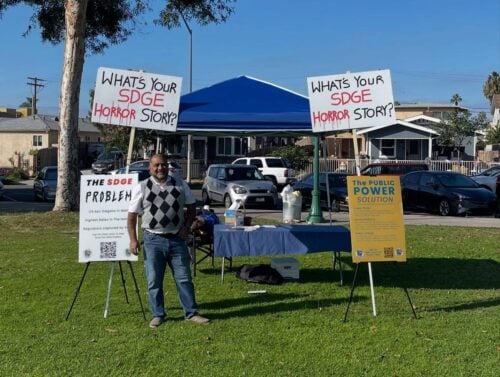
San Diegans are battling soaring energy costs, currently paying some of the highest electricity rates in the nation. The incumbent investor-owned utility, San Diego Gas & Electric (SDG&E) makes nearly a billion dollars in profit every year. In the meantime, 25% of the monopoly’s service territory residents are in debt to the utility.
Public Power San Diego came together to call attention to the core issue – the immorality of the regulated for-profit monopoly model – and to propose something different. The public power campaign aims to save money for residents, localize energy generation, and reclaim democracy from a monopoly utility with outsized political influence.
“If you’re the CEO of an investor owned utility, your customers are your investors and that’s your motivation, to serve them. And you do whatever it takes, including political influence.” – Mark Hughes
Conversely, a municipal utility serves the ratepayers, ensuring all decisions are made with customers in mind. Taking public ownership of SDG&E would, for instance, eliminate opposition to local renewables like rooftop solar. Investor-owned utilities oppose distributed solar because their revenue models depend on building transmission lines. A publicly owned utility could better utilize available local solar energy and reduce the environmental impact and fire risks associated with large transmission lines.
“We could run San Diego off the solar energy that’s available to us, but the motivation is in the wrong direction right now.” – Mark Hughes
Previous efforts to localize San Diego’s energy and make it more affordable have hit roadblocks. While California’s rooftop solar sector thrived initially, a draconian change in the state’s net metering tariff, pushed by utilities and their political allies, has caused a steep drop in installations.
Community Choice Aggregation (CCA), intended as “public power light,” was intended to support communities with sourcing local energy without having to own transmission and distribution. But because CCAs control electricity procurement rather than distribution, they have largely followed the IOUs’ approach, electing instead to procure power from remote areas. This in turn reinforces the IOUs’ financial model of relying on transmission build out for revenue.
“In reality, it hasn’t moved the ball forward much.” – Bill Powers
“If they’re growing at eight and they haven’t grown at eight and they’re projected to grow at eight, why are we assuming a rate of inflation growth?” – Bill Powers
San Diego’s fight for public power has been mired in multiple rounds of feasibility studies. Although earlier studies showed public power would be a net benefit, a utility-sympathetic counter-study leaned on a highly problematic assumption to seed misinformation and slow the campaign.
Specifically, it erroneously assumed the IOU’s revenue would grow at only 3% per year, despite the utility’s actual average annual rate increase for the preceding years being documented at 8.33%. Public power campaigners had to sue the city under the Public Records Act to gain access to the financial model and inputs. In the process they uncovered other issues, including a doubling of assumed non-bypassable charges compared to typical rates.
“We’re not arguing anymore is public power cheaper. We’re just arguing about how much cheaper.” – Isaiah Glasoe
Even with the original flawed assumptions, the study still indicated savings of $15 billion over 30 years. But by gaining access to the model, San Diego’s public power champions were able to adjust the inputs to reflect realistic revenue growth rates. Even when assuming a 7% growth rate in for-profit utility revenue (less than the historic average), the re-analyzed data showed that public power would save residents over $90 billion across 30 years. If the model assumes anything more than the rate of inflation growth for the IOU, municipalization becomes an “absolute no brainer.”
To counter IOUs that deploy “guns for hire” consultants to inflate costs and sow confusion, public power advocates must focus on deep community organizing, and demand citizen independent oversight and complete transparency for all future feasibility studies.
See these resources for more behind the story:
This is the 260th episode of Local Energy Rules, an ILSR podcast with Energy Democracy Director John Farrell, which shares stories of communities taking on concentrated power to transform the energy system.
Local Energy Rules is produced by ILSR’s John Farrell and Ingrid Behrsin. Audio engineering by Drew Birschbach. Featured Photo Credit: Public Power San Diego via Instagram.
For timely updates from the Energy Democracy Initiative, follow John Farrell on Twitter or Bluesky, and subscribe to the Energy Democracy newsletter.
How did this coal town ditch gas lines, win grants, and make municipal networked geothermal the cheapest heating option?
Who should pay for upgrades to the high voltage transmission network?
San Diego may be the only city to have secured upfront funding from utility shareholders to make clean energy cheaper.
Oregon tries to tie utility profits to climate, cost, and reliability targets through performance-based regulation.