A Coal Town Digs Deep for Municipal Clean Heat — Episode 267 of Local Energy Rules
How did this coal town ditch gas lines, win grants, and make municipal networked geothermal the cheapest heating option?
The solar tax credit landscape is changing. Third-party ownership could be one way to cut losses.
For this episode of the Local Energy Rules Podcast, host John Farrell is joined by Jeremy Kalin, an attorney at Avisen Legal.
Listen to the full episode and explore more resources below — including a transcript and summary of the episode.
Apple Podcasts Spotify YouTube
Podcast (localenergyrules): Play in new window | Download
Jeremy Kalin:
The third party model is going to be critical for the next four years of development.
*****
John Farrell:
Hey, you’ve stumbled on some bonus content from my two-day nine interview podcast recording marathon at the Gateway to Solar Conference in October, 2025. Consider donating to ILSR to keep conversations like this flowing. Now here’s my conversation with Jeremy Kalin, where we talk about third party ownership of clean energy projects and federal tax credits and how standard financing could cut solar costs.
*****
John Farrell:
Jeremy, it’s so nice to have you back on Local Energy Rules here at the Gateway to Solar Conference, you’re podcast number eight, which is quite a run for me.
Jeremy Kalin:
Yeah, that’s great. You must be tired.
John Farrell:
I’m doing pretty well actually, lifetime achievers and all that.
Jeremy Kalin:
I mean, I’m really worried about your longevity now. Not over the years, but just is it nap time yet?
John Farrell:
This is usually a good time for a nap.
Jeremy Kalin:
And I’m older than you, so here I am tossing shade at you for being old, but that’s okay.
John Farrell:
What I wanted to talk to you about is, so you were on a panel about third party ownership, and this has always been an interesting intellectual issue for me around solar. So specifically we’re talking about people getting solar on their rooftop. Could be a business, could be a homeowner, but they don’t own the panels themselves. They are leasing them from somebody, they’re maybe purchasing the electricity. There are many reasons for this. We can get into that. I’ve always been conflicted because the Institute for Local Self-Reliance loves ownership. We like people to own things, but as I have been doing this now for 20 years, I did analysis a while back and it looked like, man, every state that has a robust rooftop solar market has third party ownership. So it seems to be there’s a little magic in that policy sauce. It also seems to be really helpful because if you don’t have it and you don’t have access to good credit, you also probably can’t get solar at all because it’s super expensive. We’re talking 25, $30,000 to put panels on. Let’s just start with the policy itself. What does it mean when we have a policy in a state that says you can have third party ownership of solar panels?
Jeremy Kalin:
First, let’s say, what are the ranges of policy? Really quick top line. Some are very explicit. Some states that you can have third party ownership, some are very explicit that you cannot. Minnesota is actually in the middle gray zone because there are pathways to third party residential solar and certainly more robust pathways, or I should say at least in an economic scale for commercial, and I include nonprofits and public buildings in that same commercial description, commercial scale, not utility scale, but commercial scale, third party ownership. So we’re kind of in the middle. I certainly have done, as a lawyer, hundreds and hundreds and hundreds of third party-owned solar.
John Farrell:
Lawyers install solar panels?
Jeremy Kalin:
Yeah, exactly. I have worked on the installations. Yeah, do not. I can install a racking. I can probably install a module. Could I hook up a string inverter to another string inverter and then… No, no, not at all. I’ve been involved as the lawyer in structuring hundreds if not more than a thousand rooftop third party owned projects in Minnesota, and I’ve always been an advocate of if the host can purchase and own the solar, they should, whether that’s the residential host or a multifamily property or a commercial or nonprofit church, whatever for the exact reasons that you described. In fact, I was very critical of the national not to be named major third party ownership groups that were backed by Wall Street tax equity finance. I was critical because they were actually turning credit-worthy homeowners from owning their own systems into third party ownership.
They were basically plucking low hanging fruit and stripping all this value and shoving it to remote investors that they were not doing the but for analysis. And when you and I might’ve talked about this, I actually did reverse engineer at my consultancy before I was lawyering and realized that the effective interest rate if they had offered loans was 15 to 22, 24%. So predatory behavior, we’re just less concerned about pretty sophisticated folks with FICO scores in the eight hundreds. And so I think you get easy penetration because zero down cashflow positive, someone’s going to take care of it all, going to own it, operate it, deal with all the permitting, deal with everything, and I don’t have to take out a loan, I don’t have to all those. There’s little friction to a third party ownership, particularly let’s focus on the residential side, and so it’s been really attractive, but where we’ve had things like a residential solar loan that’s a second or third mortgage maybe that recognizes more and more of the different value.
So maybe you’re not just doing FICO underwriting but doing FICO plus or other ways to underwrite. So you’re getting further and further down market. That’s been really successful, but what’s going to happen on December 31st, the residential tax credit, if a project is not fully installed and substantially complete by that date, it doesn’t have to be energized, but has to be installation complete. January one, if you wake up and your installation is not complete, you’re not going to be able to access, be able to claim the 30% federal tax credit. The other thing is that tax credit’s always been non-refundable in the residential market, which means if I, after earned income tax credit and other write-offs deductions, if I only pay a thousand dollars a year in federal taxes and it’s a $30,000 project, it’s going to take me nine years to be able to carry forward.
In some cases there’s been limits on that. So the ability to get the tax credit has always been limited as well to those that are, I mean, tax credits generally make wealthy people wealthier except for 6417 direct pay, which you and I have now done two episodes on, and so huge fan on that front. What I’d love to see is a third party owned nonprofit direct pay model, which I have clients that are doing this because they’re getting a hundred percent of the value to just recycle basically and do more installations. But third party solar will be so critical to the residential solar market from 2026 and beyond. It has to be done with consumer protection. It has to be done thoughtfully and can’t be done in a way that is predatory. But because no residential homeowner putting solar in 2026 will be able to directly take a credit as a residential installation, the third party model is going to be critical for the next four years of development.
John Farrell:
Yeah, so let me pull that out a little bit.
Jeremy Kalin:
Please do.
John Farrell:
The key here is that I wasn’t actually thinking about the tax credit when I asked you this question, but I think it’s really important. So there’s sort of two components here. One is just how do you come up with the money to build the solar array? And if you directly own it yourself and you’re sort of responsible as the homeowner, just to use the home example for figuring out where that money comes from, maybe you’re one of the lucky people who has a bunch of savings. Maybe you have access to a home equity loan, some other line of credit. I think you were referring that there are these other now tools out there that might help people finance it, but it’s complicated. There’s not a huge amount of experience with it. But the secondary piece perhaps even more important as we go into next year is now you can’t get the tax credit as the owner, but third party projects still have a little bit of runway with the tax credit as we discussed on our previous podcast interview. So third party ownership becomes even more important now for the economics of rooftop solar projects in the next couple of years when it is still available. And then beyond that, maybe we don’t need to go there today, but I’m sort of fascinated a little bit about what’s going to happen in the long tail here when there’s sort of no tax credit because there has been that availability of tax credit, of course that drew in Wall Street and other investors in the first place and added a lot of complexity here.
Jeremy Kalin:
From the lands of Institute for Local Self-Reliance and the mission of this podcast and of course of my priorities as well as a practicing lawyer, the tax credit does make wealthy people wealthier unless it’s, well, so the residential tax credit’s always been interesting because it can be taken by the post owner and then direct pay with the nonprofit side of a hundred percent of that value just being claimed by that tax exempt entity is also keeping dollars local. In fact, it’s bringing federal money in, which is what I want to point out. Every time we get a tax credit in Minnesota for solar, we are bringing federal climate dollars home to Minnesota, and I’m never one that says that the tail should wag the dog. So if we were to have no new policymaking and no updates of the tax code from here forward, that means by 2030, 2031, we will lose the investment tax credit for solar entirely, not for batteries, but for solar.
And so we will have no more access to federal funding for solar projects. That’s why I want to take advantage of every dollar we have now. We’re in the sprint to begin construction to be able to have that 2030 timeline, and we’re not going to go through too much of those. I think we talked about them, those deadlines before. And so what I know about with my creative background in the crafts as a potter and a maker that while we’re working on the urgent case, those questions are starting to really bounce around in my brain and starting to really, I’m excited to think about what comes in ’29, ’30, ’31. I don’t have any answers there yet, but it’s certainly like I can feel the potency of opportunity and of new solutions driving down soft costs. And you’ve talked about these a lot with other guests, that’s going to have to be part of the solution. But for now, I want every single dollar that we can possibly get from the federal government to take climate action and have it be locally owned and locally benefiting. And that’s why I actually think as much as I’ve been skeptical of third party ownership models, I think doing it right can achieve those goals.
John Farrell:
One of the other concerns that I’d had years ago when we first started working on this was that third party ownership, adopting it early in a state’s market development would mean that you’d get a lot of national players coming in and then dominating the market. You wouldn’t have a lot of homegrown solar companies because they didn’t have the sophistication, the connections to do third party ownership models. What do you think of that? Do you think that was a wise concern? Do you think that was overblown that the locals would’ve figured out how to do it, find partners, et cetera?
Jeremy Kalin:
No, I think your concern is very well founded in not only data in this market, but I think we can look at all the data that you’ve compiled on community solar, and I remember reading some of the 2013 Solar Energy Jobs Act that our friend of blessed memory, Melissa Hortman, championed. I remember the year or two after some of those strongest advocates at the capitol and MNSEIA champions complaining that there was all this, that they were getting pushed out. And I said, well, that was a really predictable outcome of this bill. I wanted to help stem the tide against it. But that happened in the community solar space for sure. I think we needed to build an ecosystem, and did, and I think some of the achievements around the revamped program on the community solar side are strengthening those even more so that both benefits and the maker, the developers and contractors, are as local to the extent possible.
And I think frankly, the cap on the program ended up actually keeping folks out on the community solar side. I had lots of outside parties or like, gosh, I don’t know how much we’re going to be able to build if we don’t have an unlimited scale. And I think the same on what you observed. I’m not going to name them as well, but the third party residential providers certainly exhibited that same behavior you just described and just coming in and just harvesting every possible project without any real screen and really dominating. And so I think that it’s got to be a but-for case because otherwise you’re just stripping equity and opportunity away from locals as we talked about already. So yeah, I think your concern was well-founded and I’m less concerned about it now, particularly in these gray area states like Minnesota. There’s opportunity, but not so much that I think you’re going to see predatory billion dollar players come in and try to just harvest everything.
John Farrell:
I imagine know that on your panel discussion, some people were saying, let’s move Minnesota from a gray area to a sort of green light third party ownership state. And I’m kind of curious then it sounds to me like you’re saying be cautious about that approach.
Jeremy Kalin:
I would say that that approach, my longtime colleague Mike Bull, now the deputy secretary at the Public Utility Commission said on a panel earlier that he would prefer that this below the radar kind of bubbling up, simmering, third party ownership model with some uncertainty, have greater clarity through a stakeholder process including consumer protection attorney general’s office, et cetera, and then brought to the commission before there’s a complaint brought about by a utility that we might potentially be violating the exclusive service territory, et cetera. And I agree with Mike that I think that’s probably what needs to happen, is that we don’t necessarily need the full open the gates and release the hounds with legislation or with any. But I think just continuing to work within the limitations we have and get clarity. And sometimes, John, you and I have known each other for 22 years, we’re just confirming, and I have been that aggressive bulldog early in my career and now I recognize that sometimes you don’t want to blow the gates open entirely that sometimes needing to do things thoughtfully, carefully and sort of crawl, walk, run. We’re in between the crawl and walk phase here on third party ownership in Minnesota. And I think that if we went from running to sprinting, you’re going to tear a hamstring at our age and everyone else else is too. So let’s keep taking this incremental approach. And yeah, there’s enough barriers so that the outside world’s not going to come in and dominate and do stupid things from a consumer protection standpoint, but enough clarity or enough learned knowledge that there are pathways right now.
John Farrell:
It’s interesting the way that you put that because I think about we have from a climate perspective, a desire to sprint and get lots of solar deployed, but I think about some of the news coverage in the past year about some of those bad actors and the experiences that consumers have had. And it doesn’t take a lot of that for consumers to be like, oh, I was really interested in going solar, but now I’ve heard about this and I want to be more cautious. So I think being able to have an industry that gives people confidence that it’s worthwhile to invest in, that it’s safe, that there’s someone looking out for them, feels like it’s definitely really important.
One of the other things I wanted to ask you about is having done a lot of the financing arrangements, worked on them, one of the pieces that I keep coming across, this is a little more in community solar, but I could imagine it applies to residential or commercial individual projects, is that it seems like the financing deals are so often you build your own.
And I just think about the process of when you want to buy a house, there are these forms, there’s a lot of forms to fill out, but they’re very standard. Every house you buy, you fill out the same damn thing. I mean whatever state that you’re in, right? Largely the same kind of thing. Buying solar though seems to be not standard, like each company is going to have its own forms, its own process. Have you been thinking about in providing these services to folks around doing the financing for projects, how we could streamline that? Because when we talk about the cost of solar these days, so little of it is in the hardware, so much of it is in other pieces, permitting, interconnection, and financing. What do you think about in terms of what we could improve?
Jeremy Kalin:
Well, I experience this every day from wasted time to actual paid time accountants and lawyers. The meter ticks when we work on projects. I was just having a conversation with A EPC, so a contractor builder of projects that’s building for a third party ownership client of mine. And I was getting frustrated. I said to your point, just tell me the vanilla, the portfolio of 30 to 50 commercial projects that are going to — commercialish — projects that are come in front of you. So a flat roof in good shape, what’s your base? And then in what parameters would you need to put on adders? And those adders could be hourly time, it could be just it’s going to take 20 hours or more engineering time. It could be, I know that if I have access challenges, I’m going to give you a flat number and that number is going to be the lift rate.
And so if it’s going to be one day lift or two day lift rentals, that’s fine. I don’t really care how you get there. I just want really simple and then just adders. Well, it’s just not that simple. It’s like, yeah, I’ve been around this block long enough. Just tell me what your, and set your margin at a reasonable margin. And for that flat rate for a standard, let’s say a hundred kilowatt flat roof with easy access, all the pieces, and then just build on top of that. And I said, well, here’s where the frustration’s coming in from my client of it should be this simple and you should be able to give up something in exchange for the efficient process or build in the inefficient process with a slightly higher cost. Just we can’t be going back and forth and back and forth, especially when we have this deadline to begin construction and get things locked in.
And so I think that’s just a great example of where every piece of this process can be simpler even on lawyering. People are surprised that I’m willing to be a tax credit lawyer that spends all this time in the code and has a special expertise and my rate’s low for a tax credit lawyer. And I say, yeah, because everything’s templated to the extent it can be templated. So if you want me to keep your project costs low, let’s just work with what we got because everyone’s a unique butterfly, but it’s not that complicated. We’re working around six or eight big legal principles and that’s kind of it. And so I think that’s big reason we have standard residential purchase agreements and real estate contracts is because they’ve been driven by the heavily subsidized mortgage world that’s federally subsidized, that is then one national insurance product for mortgage insurance, one national underwriting of mortgage standards that then is easily replicated into the state products.
I think we want to be, it’s that balance between the local reality of utilities that are, I mean, I don’t know how many utilities there are in the, you probably do know this off the top of your head, but there are thousands, maybe tens of thousands. I don’t know. There are definitely thousands. And each one is its own special butterfly and we have to navigate each of those. So I don’t know that we’ll ever get to that same standardized document, but the standardized approach and then tweaking things just a little bit. I’m doing lots of work in Washington state right now on behalf of the State Department of Commerce, really, really fun portfolio of projects. And there it’s really easy to know. I know what the Washington State clean energy grant agreements look like, right? Because it’s wash rinse repeat repeat. I know what Puget Sound Energy’s net metering policy. I mean the same in Xcel, right? And so I think the less we think of ourselves as needing to reinvent wheels or do something more beautiful than the next, not to destroy innovation, but gosh, if we just want solar up and we want it to just say, Hey, there’s 5, 6, 7 types, where do I fit in there?
John Farrell:
I love this idea of what are the potential variances. I was actually, when I got solar on my house, I went through Solar United Neighbors caveat, I’m on the board, so I’m a believer and a customer. And it was interesting. So they do these negotiations and they have this kind of participatory process where you as a participant can help vet and pick the installers. But that was one of the things I thought was really clever is they did have a standardized price, but they had a couple of caveats of if the city needs to come do a structural inspection, it’s this flat rate. If this other, there was something about the conduit running on the outside of the house. If we have to do it in this certain way, it’s this flat rate. So it was very understandable and you as a homeowner knew like, okay, my cost is likely to be this, and at the most it’s going to be this.
And like you said, there’s this trade-off for the installer. Hopefully none of the projects goes outside of those bounds, but most of them will not. And the benefit is they have lower costs to go out and find a bunch of customers, or in the case of your commercial projects, lower cost to serve 60 different sites because it’s all very standardized. There’s less time spent negotiating over, but we needed a ladder here or we needed a lift or we needed whatever. So is there a policy approach that would be helpful here? I mean, it sounds like you’re already thinking about this as a provider, as someone who does this work, is there a network of people like you who are like, let’s figure out how to simplify this. Is there sort of from an industry standard approach or is there, how could this go the next level?
Jeremy Kalin:
Yeah, I mean, I think as one good example, my standard residential solar lease or PPA very similar products is from the NREL, National Renewable Energy Lab, standardized documents that were developed with lawyers and then released. I hated the format. It was the least consumer friendly format, but the substance was great. And over a week, I just fiddled with it, not with any specific client, but knowing I was going to need to get a better version of my own and probably spent 30 to 50 hours of my time. But I had the beginning starting point that was publicly available. And I think the more that we, so I just want to recognize that that process happened to some degree, and I think that we can reinvigorate that process and figure out who are the stakeholders that need to make it happen next. I’m involved in this really awesome project that the Milken Institute is leading with Amalgamated Bank and philanthropy and the National Bankers Association to try to deploy a billion dollars of additional capital before the begin construction deadline for the investment tax credit.
And we’re doing something very similar where we’re working from similar term sheets and saying, Hey, you don’t have to use these term sheets, but here’s the starting point of a begin construction loan or an ITC bridge loan. And I think that it’s that stakeholder process, informed by practitioners, that really matter and can advance it. So I think we don’t need to reinvent more stakeholder processes, but I think it’s time to start simmering that. And you need policymakers at the table because there’s some policy lenses and you need some good quasi-academic or public intellectual, which is the role that I see you playing. And then you need doers and you need folks who will pound the table to say, I want contractors to get their margin. I want you to be healthy. I want you to be able to take six weeks, eight weeks vacation over the course of a year, like a good successful person who can catch your breath. I don’t want to squeeze you, but there are ways that we can achieve this at the same time. So tell me when I’m wrong and tell me, gosh, I think maybe there is something that we could do in this area or that area.
John Farrell:
Right. Jeremy, thanks so much for joining me yet again to talk about third party ownership and financing. And just really appreciate your deep insights from working in the trenches on this with so many folks.
Jeremy Kalin:
Well, I’m starting to think of you as Lorne Michaels is to SNL, John Farrell is to local ownership of renewable energy and podcasting. So if this is my third appearance, I believe you get a jacket when you’re the five time guest on SNL. So I don’t know what the jacket is, but it’s got to be something interesting.
John Farrell:
I hear that I have to be very careful about inviting you back is what I hear.
Jeremy Kalin:
See this is the strategic thinking that comes from a public intellectual, whereas I’m just a dogged deal guy trying to get things done without looking over the horizon. So I do want to point out one example, because we started with, do lawyers actually put up solar, and when I got my solar put in on our garage, we had to dig the trench to lay the conduit to go back to the main meter that’s on the house. And I did dig the trench by hand myself because we had to run power out to the garage for other reasons too. So I do get dirty.
John Farrell:
Excellent. So an accomplished delegator and someone who has been in the trenches, in the financials and in the ground.
Jeremy Kalin:
That’s exactly right. There you go. Well done. See, this is why you get Lifetime Achievement awards and the rest of us just strive to get there someday.
John Farrell:
Yeah. Thanks so much, Jeremy. Appreciate it.
Jeremy Kalin:
Thanks, John.
*****
John Farrell:
Thank you for listening to one of my nine mini podcasts from the 2025 Gateway to Solar Conference with Jeremy Kalin from Verizon Legal. We’ll have links on the show page to my other two interviews at Jeremy episode 213, which provided a deep dive on how direct pay would make federal tax incentives more accessible to community-based solar projects, and the more recent episode 244 and how the opportunity isn’t over yet.
Even these mini versions of Local Energy Rules are produced by myself and Ingrid Behrsin, with editing provided by audio engineer Drew Birschbach. And as always, we’re talking about taking on concentrated power to transform the energy system. Until next time, keep your energy local and thanks for listening.
“Because no residential homeowner putting in solar in 2026 will be able to directly take a credit as a residential installation, the third party model is going to be critical for the next four years of development.”
When installing rooftop solar, property owners face a choice: buy the panels outright or opt for third party ownership. Third party ownership (TPO) means leasing the panels or purchasing the electricity generated without owning the system itself. While ownership has its benefits, TPO has helped unlock growth in the solar market because it offers low upfront costs for people without access to good credit to go solar, which can cost $25,000 to $30,000.
TPO is set to become even more critical for residential solar starting in 2026. After 2025, residential homeowners will no longer be able to claim the federal credits directly but will only be able to access credits via a third party owned system. TPO models will be vital for project economics, enabling the capture of federal climate dollars for local communities. Fortunately, nonprofits like cities and houses of worship will be able to maintain direct ownership with the Direct Pay option of the commercial tax credit, at least for now.
Despite its benefits (zero down, easy penetration), TPO must be done thoughtfully with strong consumer protection to avoid predatory behavior. Early in the market, for example, some major national TPO groups prioritized “plucking low hanging fruit,” stripping value away from homeowners by converting credit-worthy customers into third-party agreements, in ways that sometimes translated to 15% to 24% interest rates.
A major roadblock to faster rooftop solar deployment is the high cost associated with non-hardware elements, known as “soft costs,” including financing and permitting. Unlike buying a house with standardized forms, solar financing deals often require building a new deal structure every time. A more standardized approach, using templates (like those from the National Renewable Energy Lab) and simple adders for variances, can streamline the process, and make solar deployment more affordable and efficient.
See these resources for more behind the story:
This is the 259th episode of Local Energy Rules, an ILSR podcast with Energy Democracy Director John Farrell, which shares stories of communities taking on concentrated power to transform the energy system.
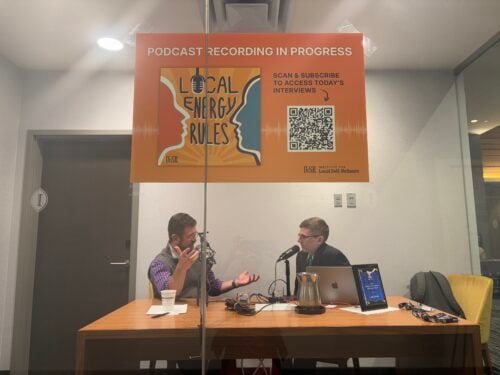
Local Energy Rules is produced by ILSR’s John Farrell and Ingrid Behrsin. Audio engineering by Drew Birschbach. Featured Photo Credit: Ingrid Behrsin.
For timely updates from the Energy Democracy Initiative, follow John Farrell on Twitter or Bluesky, and subscribe to the Energy Democracy newsletter.
How did this coal town ditch gas lines, win grants, and make municipal networked geothermal the cheapest heating option?
Who should pay for upgrades to the high voltage transmission network?
San Diego may be the only city to have secured upfront funding from utility shareholders to make clean energy cheaper.
Oregon tries to tie utility profits to climate, cost, and reliability targets through performance-based regulation.