Reducing Red Tape to Slash Rooftop Solar Costs — Episode 272 of Local Energy Rules
States can slash rooftop solar costs with instant permits and remote visits.
Doing a solar and storage project on a laundromat on the Pine Ridge Reservation means figuring out unique challenges like electricity capacity and water pressure, in addition to factors that challenge projects in urban areas, from permitting to interconnection.
For this episode of the Local Energy Rules Podcast, host John Farrell is joined by Jeri Baker, executive director of One Spirit.
Listen to the full episode and explore more resources below — including a transcript and summary of the episode.
Jeri Baker:
More and more things now are coming up, whether it’s wind or solar or whatever, that we know that we need to have this. There’s room on our planet for all us, and we need to recognize that.
*****
John Farrell:
Doing a solar and storage project on a laundromat on the Pine Ridge Reservation means figuring out unique challenges like electricity, capacity, and water pressure, in addition to factors that challenge projects in urban areas from permitting to interconnection. Joining me in April 2026, Jeri Baker, executive director of One Spirit, shared how her organization has partnered with the Lakota people to do several projects with solar and batteries, including a buffalo house, a youth center, and now the first on- reservation laundromat.
I’m John Farrell, director of the Energy Democracy Initiative at the Institute for Local Self-Reliance, and this is Local Energy Rules, a podcast about monopoly power, energy democracy, and how communities can take charge to transform the energy system.
*****
John Farrell:
Jeri, welcome to Local Energy Rules. It’s great to have you on.
Jeri Baker:
Oh, thank you very much. I am honored to be here and I’m honored to talk about something that’s very important to us and to the natives and to the country.
John Farrell:
I just have to start by asking you because I read your bio about how you worked for many, many years in human services. You have retired, if that’s an appropriate word, although it seems like retirement might be generous. And so I was curious what motivated you to found One Spirit and to be doing this work to improve the lives of native people on the Pine Ridge Reservation.
Jeri Baker:
Yes. I grew up, as you know, from reading the bio in the Appalachian Mountains in an area that was very poor and coal mining area with a lot of problems there, conflicts, et cetera, if you know the history. In fact, I have a shirt that says Bloody Harlan County, Kentucky. And that refers back to the conflict between the coal operators and the people. But I grew up there and I also graduated from Berea College who has a mantra or a motto, if you will, of God is made of one blood, all the peoples of the earth. And I think that given where I was in my background that I was working with … My background is in human services and I worked for 30 years in children’s mental health and child protective services and foster care and mental health for children and families, and did a lot of research along the way.
So that was my passion and my background my whole life. When I was working with a medicine man on the Mattaponi Reservation in Virginia, he told me about Pine Ridge. And to my amazement, John, I’d never heard of Pine Ridge Reservation. I went to college. I had a master’s degree and I never heard of Pine Ridge Reservation. And I certainly did not know it was the poorest place in the Western hemisphere outside of Haiti. Nothing about it. But I went to the reservation, came to the reservation, and when I stepped on to the reservation or drove onto the reservation, I must have left the United States. Could not be in the same country where this was part of that country. It was unbelievable. With that and with what I know I was raised to do was that if you see something that needs to be done, you better do it.
Then there’s no need of waiting. Let’s just see what we could do about it. And my background was in human services. So we started One Spirit in 2005, and we’ve been working with the Lakota ever since. We have had wonderful, wonderful people from around the world. Well, okay, that’s exaggerating a little bit. We’ve had wonderful people from … It could be from around the world, but the people who knew us and worked with us have been from Europe and from all over the United States. And amazingly, the people in Europe know a lot about … They probably know more about the Native Americans than I do, at least than I did before I started this organization. But they are very generous, and so are the people here. We have more than 5,000 people who support us, who have the same thing that we want, which is let the Natives have a better life.
But I had something else, John. I worked for 30 years in human services and bureaucracy, if you will, and I didn’t like it. I didn’t like what was there. I liked the people. I liked the people I worked with, but I did not think bureaucracy was the way to go. I didn’t like the attitude toward clients. I thought the fact that people who worked with the clients seemed to think they were better than the clients in some way. There was not any camaraderie there. Also, there was nothing that said to the clients, “You can do this yourself. Let us know how we can help you do it.”
And so when I started this organization, my goal was to do it in a different way. First of all, to talk to the people here and say, “What do you need? And what can we help you with?” And they told me. And so since then, in the 20 years since, we have built a buffalo house because that was the food processing, that was the meat processing. There wasn’t one on the reservation. So we built a meat processing facility. We started out small with that in a very small facility that could process maybe three animals, three or four animals a week, and a low employment, like four or five people who were employed. And we now would quickly reach maximum capacity. And now we are trying to expand that buffalo house and we’ve got most of it up. We’re probably $250,000 short of getting it fully completed. And when we do, then it will be USDA inspected. And that will be a huge thing for the people here on the reservation because they can sell meat off the reservation and they can sell it on the market rather than just being able to feed their people.
So that adds a lot to the economy, and that’s what we want to do is to provide jobs at economy so that the people here want to be self-sufficient and we want to help them reach that goal. So that was how it started. We’ve gotten the Buffalo House. We knew that the youth were in trouble. There’s a lot of alcohol and drugs on the reservation. And that’s not to say anything bad about them. It’s just if you go to any poverty stricken area, you will find that. And they want to do something about it. They want to take care of their youth. They want to be sure that they have the education and the healthcare that they need and the parental and care and community support that they need. So we want to give them the ability to do that. So we built a youth center in one area.
And it’s a large reservation. It’s about as large as the state of Connecticut. So you could build one youth center, but you need to be sure. And they’re working too. It’s not just One Spirit, but they’re working too. And so we built a youth center, we put in programs there. We started feeding the kids every day. We had a full kitchen and giving them something to eat. And then Phil Jackson from the basketball coach gave us the money to build a basketball court for them there. And we have a food pantry for the community. So the big thing is to provide food, but also to bring them to where they are self-sustaining with food. So we’re providing gardens and areas for gardens and equipment so they can cultivate their gardens and harvest them. And you are always working toward self-sufficiency for whatever we’re doing. And that would bring us to that solar stuff.
John Farrell:
Exactly. I would love to hear more about that project. What really struck me about this project in the context of the other work that One Spirit has been doing with the Lakota people is that a building that has solar and battery storage for most people that listen to this podcast or that work on energy, it’s a cool thing, right? It’s like, oh, great, you can lower your electric bill. Or maybe in those rare times when the grid goes down, you have power. My sense that this means a little bit more for folks on the Pine Ridge Reservation than just some of those simple things that we normally think of when we talk about solar and battery storage.
Jeri Baker:
Well, it certainly does. The lights here, of course, go out, but they go out here frequently. It’s the grid, the homes, the wiring is not stable. It was very, very helpful. And enlightening, if you will, that’s kind of a strong word in this situation, but enlightning, they call me up from the youth center where there is solar and they say, guess what? The lights are out all over the reservation and we’re the only one with power here in the community. So everybody’s coming in so they can keep warm. They could do what they … They could cook meals, they could eat, they could do what they … So power was off for 24 hours or so. It means a lot to have just forward thinking. It’s not only the power, as you said, the electrical and the backup, but using something that protects the environment, that you’re not continuing… The Lakota people are all about protecting Mother Earth and knowing that they live with Mother Earth. And so the fact that they have solar power, that they can have battery backup, they can have their power means a lot in those terms as well.
John Farrell:
And can you talk a little bit about why is this a laundromat? What was the importance of that as a facility to meet the community’s needs?
Jeri Baker:
Boy, can I ever … A few years ago, one of the elders here, but he’s an elder, but not in our sense, I guess, because he’s a very active person. I was with him talking to him. He’s the person I’ve worked with for the years I’ve been here. And he says to me, ” I’ve got to go because I’ve got to go take my clothes to get em washed. “And I said,” Well, where are you going? “He says,” Well, no, it’s about a hundred miles away, but we go to the laundromat over there when we can.” And my eyes popped up because I’d been here all these years and it never hit me, but there’s not a laundromat on this reservation and that people don’t have a way of washing their clothes. And then I was talking with a social worker here and she said, “Well, we have people who come that we see that they’re having problems with bedbugs and they want to get rid of them, but they don’t have a laundromat.They don’t have the heat and the things to keep their place clean and to do that.”
Then we also had, we did a survey, so the community did a survey with the school kids and asked them what did they want in their community? And every one of them said “We want clean clothes. We want to wear clean clothes. We don’t want to go to school with dirty clothes anymore.” That was amazing. That was totally amazing. And so we put two sets of machines in the Allen Youth Center several years ago and they have been used continuously seven days a week. They are used all day. Everybody comes there to do their clothes, but Allen is on the far side of this very large reservation. So for a lot of people who are on the other side, it would still mean driving a hundred miles to be able to wash your clothes and two sets of machines is not going to do it.
So we started looking to find a way of doing two or three more laundromats. We were really fortunate. We had one of our wonderful supporters that I talked about in the beginning who bought us 30 sets of commercial washers and dryers.
John Farrell:
That’s amazing.
Jeri Baker:
Yeah. So the first laundromat is about to open on Saturday morning because we had planned to do three across the reservation. And the first one will open Saturday morning at 11:00 AM and we’ve had it open on a sort of a soft opening, if you will, for the last week, and people have been coming in every day, all day to wash their clothes. It’s an important thing. It’s a health issue. We talk about food being a health issue, and it is, but talk about the need for having a laundromat, having basic needs bet that you can wash your clothes. I’ve been out here now 10 days, and I’m looking at the clothes I brought and going, “Oh my goodness, I need to find a laundromat somewhere.” But we know that and we know that the health issues that ensue when you’re not able to keep your linens and your household items and your clothes in the condition that they need to be in.
It’s that kind of thing. We’ve started the first one. People all over the reservation are talking about it, how much they need this laundromat, and they come to the one that’s opening, they’re coming not just from the surrounding area, but they’re coming from a few miles away too, because they can wash their clothes. We are making it again because we want it to be self-sufficient. We are making it so that people do pay to wash and dry their clothes. It’s $2 for to wash and $2 to dry, but they don’t have to drive anywhere. The interesting thing, we talked about their feeling about the earth and the environment, right? And so some of the washing products now that are also concerned about this are giving us the strips. You may know some of the laundry strips that are environmentally friendly and don’t contribute to the landfills and this kind of thing.
They are true earth and clean people, those … Well, true earth has given us several boxes of their laundry strips, and we are giving those out to the people and they’re happy to use them. They’re happy to use them. They know about … In fact, I’m so surprised because people here say, “Yeah, we use those. They got your clothes clean too.” So it’s really good that you don’t have anything adding to the landfill, but you’re using something that’s also kind to the earth and you’re getting your clothes clean. It’s a win-win all around.
John Farrell:
Yeah. One of the things I was struck by is that this doesn’t look like it’s the first project that One Spirit has done on the Pine Ridge Reservation that also involves renewable energy. Could you just talk about what motivated you to start looking at doing solar and batteries as part of these projects?
Jeri Baker:
Yes. I guess you could go back to a very basic thing, which is that people often don’t have electricity. Look, electricity is high. This is a very cold climate with many times during the winter way below zero and people live often without heat. And if you’re going to have a place where people can go, if we can’t get it on every house and we can’t get it community-wide right now, we can at least make places where people can be. And so from the beginning, we have wanted to conserve the environment. We’ve wanted to be sure that people have a place to go to just like the people who called us and said, “We’re the only place that with lights on the res.” We want to be sure that they have someplace that’s safe and that it meets all of the values of the Dakota people as well as ours, really.
I mean, these values are not just the Lakota people, they are all over. We have these values. We believe in the earth, we believe in an environment, we believe in climate control. Well, most of us do, but we believe that we have to protect the planet we live on. And so I think with that, we certainly want to join with the Lakota in their desire to protect the earth too.
John Farrell:
When you’re doing these projects, I was curious if there are sort of job opportunities too. Who’s building the solar projects or even the laundromat? Is this an opportunity, like a pathway for the youth, for tribal members to get involved in these kinds of construction projects?
Jeri Baker:
I’m so glad you asked that John. I am so glad. One of the goals that One Spirit has had from the beginning has been to provide jobs on the reservation. If you’ve read anything on the internet, you know that the unemployment rate here is anywhere from 60 to 85%, right? And so people here do not have jobs and people here don’t like that. They don’t like to be unemployed. They do not want to be dependent on handouts and charity. So we have from the beginning made it our business to whatever we’re doing to … First of all, we only employ the natives and people who work with us who are not on the reservation, the non-natives, if you will, are … We get no salary even. We never have taken a salary. And all of them are very happy to contribute their expertise and their time and their energy to making these things work for the natives.
So employment has been a big thing. And from the beginning, whether it was distributing food as it was before we had food pantries, just going door to door to distribute food, whether it was building the Buffalo House or building the youth center, only the Lakota were employed. And we gave jobs here. So right now, our payroll stands at about 30, 30 some people who are on the payroll. All Lakota, half of the board is Lakota. Our One Spirit board is now Lakota, but they are the ones who get paid. And that’s why there’s always a struggle, a struggle to meet this payroll. But what people should know, John, is that this payroll is met by the donations, by the people who care about the Native Americans. It is they who make this happen and who employ the natives and give them a way to take care of their family in a good way using their own strength, which is never done before.
This was not something that the government said, “We’ll put you on here and we’ll give you jobs.” And this kind of thing as we do outside, it was more, “We’ll take care of you and we’ll give all your stuff, but there won’t be any jobs.” It’s still, there needs to be better healthcare here. There needs to be more money into education. We are now planting gardens all over the reservation. We planted an orchard that’s now in its third year. Particularly, we have also the LEG group, and that LEG stands for Lakota Empowerment Group. And they are building houses. The housing here was very, very poor. And often this year alone, I think there’s been at least 10 house structure fires, right? Houses burn down here because they don’t have the wiring, they don’t have the heat. They try to keep warm in the cold winters and consequently fires erupt.
So you read recently that the Okiti market burned down. This was the market where we had the food pantry for people on dialysis. We had a market where things came that coming into the reservation for the people came there. So all the camping supplies for the kids came there. And one of the things that we do for the kids here is send them to camp at the YMCA Native American Camp on Cheyenne River, but they don’t have to pay a fee, but they do have to have supplies. So people have been shipping in those supplies for them and they burned. Things that were coming for the laundromat, they burned. So yeah, it’s been quite a tragedy in that respect too. I want to go back and try to remember now your question.
John Farrell:
Broadly, I was just interested in, like you said, in the employment opportunities. So you’ve actually covered it really well in terms of how you’re only employing Lakota people as part of the projects, giving them jobs to do the work.
Jeri Baker:
And training.
John Farrell:
I assume building skills and doing this work. Yeah.
Jeri Baker:
Yeah. Not only are the Lakota Empowerment Group, there are about 15 guys there who are learning the building trades and who are working the building trades every day, but it’s a double thing because they’re not only learning the building trades, they’re repairing houses, the housing that is so badly needed. So they’re learning their skills by repairing the houses. How good is that? And they’re being paid for it at the same time. In addition to that, we sent three young men to Ohio this week to learn how to repair and maintain laundry facilities, right? Laundry machines. Amazingly, on the reservation, if somebody happens to have laundry machines in their home, and if they need repair, they have two choices about that. They can put them in the dump or they can put them on a truck if they could find one, if they have the gas, if they have the money to pay somebody, and take them to Rapids City, over a hundred miles away to get them repaired.
And then they can pay for the repair if they have the money for this, which they don’t have. Most, a lot of them don’t have. So we wanted to put those skills here on the reservation, not only the building trades to repair homes, but also the skills to repair and maintain the machines, the skills. If you go to a dump here, you will see a lot of appliances piled up at the dump because that’s all people could do with them, right? But it’s the kind of thing we want now to train people in HVAC, heating and air conditioning and have those skills here on the reservation. How in this area, as large as the state of Connecticut, how can you not have services like this where you can call somebody to help? How can you not have that? What other community would put up with that for a minute?
So we need to send these young adults who want to learn and have a business here. So yeah, that’s employment too, and that’s putting the services out here, double things.
*****
John Farrell:
We are going to take a short break. When we come back, I ask Jeri about the unique challenges of doing solar projects or even laundromats on the Pine Ridge Reservation, and I also ask what advice she has for others who are working to build self-reliance in other tribal communities. You’re listening to a Local Energy Rules podcast with Jeri Baker, executive director of One Spirit. Hey, thanks for listening to Local Energy Rules. We’re so glad you’re here. If you like what you’ve heard, please help other folks find us by giving the show a rating and review on Apple Podcasts or Spotify, five stars if you think we’ve earned it. As a bonus, I’ll gladly read your review aloud on the show if it includes an energy related joke or pun. Now back to the program.
*****
John Farrell:
One of the things I wanted to ask you about, it was sort of specific to solar. My work has been for, I mean, over a decade looking at solar energy and solar policy. And one of the things that I’ve seen time and time again is that getting solar access to native communities has often been very challenging. You need the money to buy the panels. You might have utility companies that aren’t particularly cooperative about it. There have been rules that prevented tribal members from getting federal tax incentives. How have you overcome so many challenges to make this work and more than once, not just for this laundromat project, but for others?
Jeri Baker:
Well, we did put solar on the Allen Youth Center. We put solar on the Buffalo House, the meat processing facility. We had a partner who helped us with this. It’s called Everybody Solar. It’s an organization and they helped raise money and we put solar on these buildings. We tried, you’re right, John, we tried very hard to get solar in the community. And at one point we had somebody who was willing to fund that, to put up solar panels. And no, you’re right, that did not happen. The power companies weren’t ready for that. Yeah. So we weren’t able to make it happen.
I think more and more things now are coming up, whether it’s wind or solar or whatever, that we know that we need to have this. And that doesn’t mean that there’s no need for oil or gas or anything else, but there’s room on our planet for all us and we need to recognize that it has its place. And if we can do that here on the reservation, that’s great.
John Farrell:
Do you feel like the success with the projects that you’ve done makes it easier to do more of them, to do solar and batteries and other things on other projects?
Jeri Baker:
Well, easier in this way. They’re more acceptable. People here are eager to have all this stuff. They are so excited about everything about the Buffalo House. They love the fact that the Youth Center is there. They’re trying to get it all over now. All of the projects, and the empowerment group, that’s their favorite group of all. They love empowerment group. So in respect to here, yeah, we are trusted by the tribe. We’ve been here 20 years. They know who we are and what we are and what we’re about. And so we have their trust and we have the trust of the people. Is it easier? Right now, the economy is down, stock market is down, the food prices are up, gas prices are up, and people are being cautious because they don’t know what’s going to happen. So what makes it harder is the need. We can’t do this without money.
We know that. It’s the way the world works and we have to have money to make it happen. And so it’s probably the lowest point I’ve seen in 20 years as far as being able to raise the revenue or have the revenue that you need in order to have the projects happen. We have the machines to go into two more laundromats, but we need a building. We need to retrofit that building and we need to make it happen and the infrastructure. When you look here on this place on the reservation, the electrical current, the water source, the power of the water is not great enough to handle the laundromat. So we have to upgrade that. You’ve got to upgrade the electrical current coming into the building. You’ve got to upgrade the water supply. You need to put in a larger drain fill and a larger way of handling the water.
So it’s a bit expensive, but that’s the only way you can get laundromats in. And people are eager. I mean, that’s why they come to the laundromat as soon as it’s open. But yeah, those are the challenges you face.
John Farrell:
Out of curiosity, is there one single utility, electric utility that serves the reservation or is it more than one? Do you have relationships with them?
Jeri Baker:
There are two that serve it. The largest one on the reservation is Lacreek Electric, and they’re the ones we work mostly with, right? There is a small area that is under Nebraska entity, and we work a lot less with them, but mostly Lacreek.
John Farrell:
I’m just kind of curious about this because I remember talking to a fellow who worked in Highland Park, Michigan. It’s a small suburb outside of Detroit. And he said one of the barriers there was that the for- profit utility company that served that area, when they had built the distribution system in an area that was primarily Black Americans, it wasn’t as robust as the grid that they built in other wealthier areas, whiter areas. You were just kind of describing here, at least for the laundromat, it sounds like you might need an electric system upgrade in order to support that. Is that also what got in the way of some of the solar projects you might have put on people’s homes?
Jeri Baker:
Of course, of course. And the one where we wanted to do a whole community, put out solar panels to power a whole community, it gets in the way. You have to have the infrastructure there to do it with. Me being very naive when I say, “Oh, you need laundromats. Well, let’s put it a laundromat.” I come from a white community. I don’t have to worry about any of that. And so it doesn’t occur to me. Oh, you better check to see if the power is going to support it or if the water supply is going to support this. In our world, John, in yours and mine, well, of course it does. No problem. But out here, it’s a different story. The companies do work with us, but they also, it’s costly to get this upgraded.
John Farrell:
I was going to ask you about batteries. Is cost the major reason that you wouldn’t be able to put batteries on projects or are there any other reasons like the electric grid or other issues that have kept you from putting batteries on where you’ve had the solar projects?
Jeri Baker:
We have batteries on them, but thanks to everybody’s solar who raised the money for this and to our own donors, we raised the money for the batteries and we put batteries on them and we have to do the same here. We have to have the batteries to really have because the electricity does go out.
John Farrell:
You’ve mentioned that you’ve got the machines to do two more laundromats, so it sounds like you’ve already got that in the pipeline. Are there other projects that you have? I guess you also mentioned that you’re looking to expand the buffalo house. What else is in the pipeline for you and for the community?
Jeri Baker:
The housing, the construction crew here for the housing, the gardens, growing food and the orchard throughout, so that there can be … We need the equipment to be able to grow food. The people who are building houses need the equipment to build houses, right? We have one donor who bought a truck for them so they’d have something to haul their tools in. He also put out here, there’s often a drought, John, and right now right now going on is a drought. And so we had another one of our donors who gave the $30,000 it cost to put in a 350 foot well, because that’s how far you had to go to get water for the buffalo on the buffalo field. So we have to look at every garden that we plant, we have to look at where’s the water coming from for that? Rural Water’s here and they’re very good at working with us, but we have to be sure that there’s enough water coming in that we can access it for gardens and for orchards and for the things that are being planted.
John Farrell:
Have you found that folks in other native communities have reached out about the work that you’re doing? And I was kind of curious what advice you would have for people who are hoping to replicate the kinds of projects that you’ve done on Pine Ridge in their own communities?
Jeri Baker:
Yes, they have reached out. And unfortunately, we have not had the resources, either the financial or human resources to do this. If you have everybody who’s working for free raising funds and doing this, you have to limit what your resources can fill. So we haven’t been able to expand ourselves and people have reached out and said, “Can you come and do what you’re doing over here on this reservation?” We can’t right now because we don’t have the ability to do that financially. We’d have to invent a way to do it. We do work with them about how to do some of the things. We certainly have people come here and look at the Buffalo House and see how it’s built and see how these things are doing because that was built by the people here too. So we’re very willing to open up and give any information that they need that we can provide, of course, and to help them start whatever they’re doing. And they are. They’re starting some things. Some of them are the reservations. They’re doing well to start these, but they have needs too.
John Farrell:
Do you have any specific advice that you would give folks who might hear of your work first time through this podcast about how they might get started or maybe some of the lessons that you’ve learned from doing this now for 20 years?
Jeri Baker:
John, probably nobody would want to follow what I did and I wouldn’t advise them to follow exactly what I did. I did this out of a lot of adrenaline and a lot of anger, if you will, at seeing a situation that did not need to exist in this country. And that propelled me to start this. And I was very fortunate that so many people saw it the same way and were very concerned about the Native Americans and how they were being forced to live in situations that none of us would be happy in. So I think that if you’re going to do it, do it. Don’t let roadblocks rise up that keep you from even considering getting started. It’s kind of like I was brought up that if you see something needs doing, do it. And if you need help, look at the hands at the end of your own arms and get started. And people will join you. There are many, many good people in this world who feel and are compassionate, who want to help. They may not be able to spend 20 hours a day or 16 hours a day as I do working to get these programs going, but they are there to help and they’re willing to give what they can do to help. So believe in that and do it.
John Farrell:
It sounds like so much of the work that you’ve done benefits from people who are … Well, we’ll give some money basically to help these projects happen. People want to do that after listening to this. How should they go about doing that? Is it a spot for them to do that on their website to learn more about the work that you’re doing? Where should they go to learn more?
Jeri Baker:
They should go to the website, first of all, onespiritlakota.org. If you can put that in a way that people are going to say it’s all lowercase, one and spelled out words, so onespiritlakota.org. All of our information is on there. All the programs are on there. You can certainly donate. Please join us. Together we can do this together. We can see that the Lakota people, the Native Americans have the kind of life that we want to have, that they can work, they can support their family, they can have houses that are warm, that are not open to the rain and the coast. Yeah. And don’t burn down every time you turn around, houses burning down. We can do this. We can do this together.
John Farrell:
Well, Jeri, thank you so much for taking the time out of your very, very busy days to share about the work that you’re doing and the work that you’re doing with the Lakota members on the Pine Ridge Reservation. It’s really inspiring what you’ve been able to accomplish. And I hope other people also feel inspired to join you.
Jeri Baker:
And I thank you, John. And I do want to say one last word for people around here. A couple of things. And I know you’ve gotten a long podcast here. First of all, the Lakota people, often I’ve heard people who say, “Well, Lakota people just don’t want to work.” Negative things, right? No. No, they don’t. That’s not true. They are up every morning. They go to work in all the jobs that we have. They are out there trying to make things right for their people.
I also want to mention that it’s interesting. If you think about the surrounding area, and I guess a negative thing has been people mostly talk about the bias, the prejudice that is between people on the reservation and people off the reservation in the area. The burning of the Okini market and the dialysis clinic and even before then, what I saw, what I have seen is people who care.
They are in the Rapids City area. They are in nearby Nebraska. They are surrounding this reservation. There are people who care and they step up to give. They step up to help. They may not be able to give enough to create all the housing and all the things that we want, but they step up and they’re there. A lot of people have reached out and it’s been very gratifying that people in the local area have offered to help. And that’s a beautiful thing to eliminate prejudice and bias.
John Farrell:
It’s wonderful to hear that people nearby have been paying enough attention and willing to step up in those moments of crisis.
Jeri Baker:
Yes, it is.
John Farrell:
Well, Jeri, thank you again. I really appreciate you taking the time. We will have a link to your website and more information about the projects on the show page.
Jeri Baker:
Thank you.
John Farrell:
But yeah, thank you again for joining me for the podcast.
Jeri Baker:
Thank you, John, for this opportunity. I appreciate you.
*****
John Farrell:
Thank you so much for listening to this episode of Local Energy Rules with Jeri Baker, executive director of One Spirit, about its work with the Lakota community to bring community services with clean energy to the Pine Ridge Reservation. On the show page, look for a link to One Spirit where you can learn more about their projects and donate to support development. We’ll also link to Local Energy Rules podcast episode 189 with Alex Hill, discussing the underinvestment in the Highland Park Electric Distribution Grid, and my recent interview with Reverend Dr. Ambrose Carroll about the projects putting solar and storage and building self-reliance on several black churches in the San Francisco Bay Area. Local Energy Rules is produced by myself and Ingrid Behrsin with editing provided by audio engineer Drew Birschbach. Tune back into Local Energy Rules every two weeks to hear how we can take on concentrated power to transform the energy system. Until next time, keep your energy local and thanks for listening.
Hey, hold on a sec. I know that’s usually our sign-off, but you are still here and that means we share an interest in great research and storytelling to advance energy democracy. So keep in mind that you can support this work at ilsr.org/donate. Nice. Now, I wonder what we’ll start auto playing next.
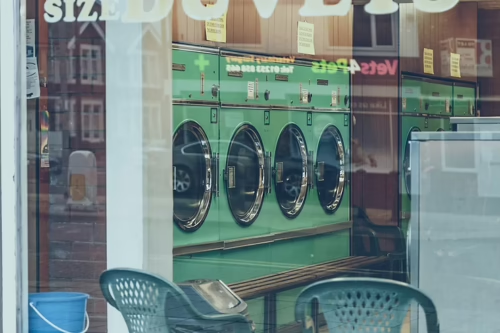
For years, residents on the Pine Ridge Reservation drove a hundred miles to wash their clothes. So when Jeri Baker and One Spirit surveyed local youth about what amenities they wanted most in their community, they gave the same answer: clean clothes. With the support of donor funds, the organization just opened its first laundromat on Pine Ridge, powered by solar panels and battery backup.
The grid here also fails regularly. When it does, the Allen Youth Center — already equipped with solar and battery backup — becomes one of the only lit buildings on the reservation. Residents come in to cook and stay warm. The new laundromat is built on the same model.
“The fact that they have solar power, that they can have battery backup, they can have their power means a lot.”
Before the laundromat could open, One Spirit had to upgrade the electrical supply, water pressure, and drainage. These were lessons learned after a community-wide solar project stalled years earlier when the power company’s grid wouldn’t support it. Like other disinvested communities, the infrastructure many wealthier communities take for granted was never built here to the same standard.
“The lights here, of course, go out, but they go out here frequently.”
Every worker on every One Spirit project is Lakota. The organization is building a meat processing facility – the buffalo house – that employs Lakota workers and will sell USDA-inspected culturally significant meat on the open market. They have also planted an orchard and gardens across the reservation to move the community toward food self-sufficiency.
The organization carries a payroll of about 30 people, funded entirely by donations. For example, crews learn construction trades by repairing the reservation’s housing stock or train as laundry machine technicians. Historically, on a reservation the size of Connecticut, broken appliances go straight to the dump. Future jobs initiatives include training residents in HVAC installation and repair.
“How in this area, as large as the state of Connecticut, how can you not have services like this where you can call somebody to help?”
Baker rejects any characterization of One Spirit’s work as enabling dependency. The laundromat charges $2 to wash, $2 to dry. Jobs, gardens, solar power, building trades — One Spirit facilitates access to the tools that let the Lakota people do it themselves.
“[We] are always working toward self-sufficiency for whatever we’re doing.”
See these resources for more behind the story:
This is the 271st episode of Local Energy Rules, an ILSR podcast with Energy Democracy Director John Farrell, which shares stories of communities taking on concentrated power to transform the energy system.
Local Energy Rules is produced by ILSR’s John Farrell and Ingrid Behrsin. Audio engineering by Drew Birschbach. Featured Photo Credit: One Spirit.
For timely updates from the Energy Democracy Initiative, follow John Farrell on Twitter or Bluesky, and subscribe to the Energy Democracy newsletter.
States can slash rooftop solar costs with instant permits and remote visits.
A solar-powered laundromat is changing daily life on the Pine Ridge reservation.
In some states, 30 cents of every dollar a customer pays to their electric utility goes to the utility’s shareholders’ profits. How widespread is this...
What can we expect from a new utility-owned distributed storage program that made headlines when it was announced over 18 months ago?