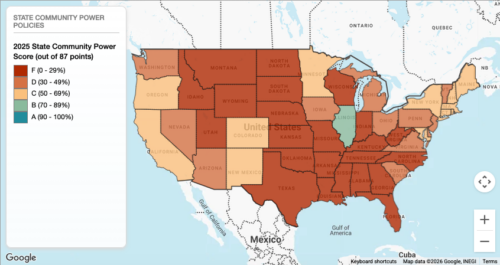
Most U.S. states could do far more to provide their residents with affordable, reliable, clean energy and to capture its economic windfall. In the 2025 Community Power Scorecard from the Institute for Local Self-Reliance — evaluating state policies to expand energy democracy and to hold utilities accountable — poor state scores suggest lawmakers must take immediate action to improve. Of the 50 states and D.C., only one state scraped an above average grade (a B), 13 hit the C average, 14 received Ds, and 23 states received a failing F grade.
How could your state earn an A? Our full scoring methodology explains the policies we track, and model policies you can advocate for today. You can also read a summary of 2024’s community power wins and losses and about how to boost your state’s score with these four shortcuts.
This annual scorecard focuses on laws that let communities capture the largest local benefits, shifting from the status quo to an equitable, democratically-accountable energy system. The states that score the highest support locally owned clean energy and competitive access to the grid, empower communities to be more self-reliant, and ensure that everyone benefits from clean energy. High scoring states also hold utilities accountable, protecting consumers and competitors from inflated costs and other abuses of monopoly power.
ILSR’s Community Power Scorecard evaluates state policies as they are written, not their implementation. The work of advancing energy democracy requires continued advocacy, vigilance, and effort. The 18 policies evaluated in the scorecard are worth a maximum of 87 points. Scores can be viewed below — scroll to the right within the table to see all columns.
With over 100 U.S. cities pledging to reach 100 percent renewable energy, ILSR’s Community Power Scorecard matters more than ever, grading states whether their energy...