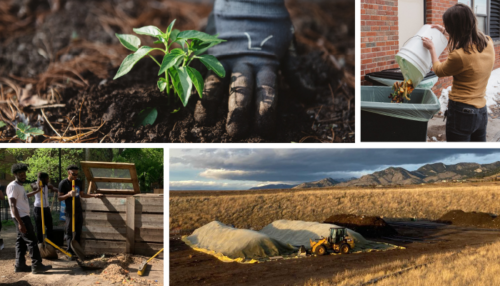
A participatory event on how to advocate for local ordinances to support distributed composting featuring real-life examples.
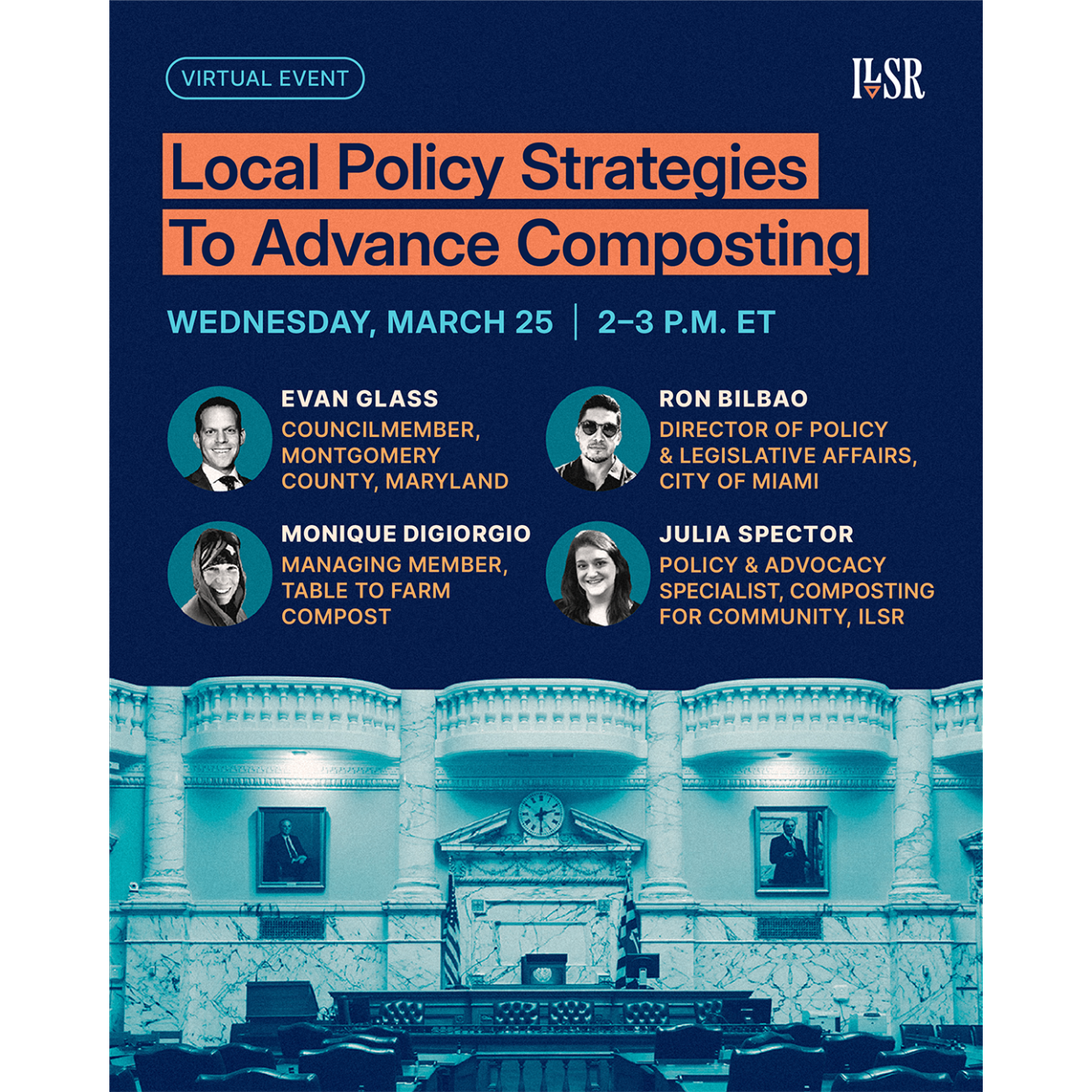
This event will introduce advocates and local policymakers to a range of policies that local governments can implement to support farmers, healthy soils, economic development, and trash reduction via local composting. From setting procurement requirements, to ensuring that composting is legally codified, to mandating food scrap diversion, there are many ways to get policies for composting in your community moved forward.
This live event will take place on: Wednesday, March 25th, 2026 2 – 3 p.m. ET
As detailed in ILSR’s latest report, Keep Compost Local, local governments are uniquely positioned to foster composting, and local composters have the tools to enable municipal and county governments to begin offering food scraps collection access to their residents. Local policies are a key mechanism for making progress.
Three featured speakers who have played key roles in successful local ordinances to advance composting will offer brief remarks about what it takes for local policies to succeed. Following their remarks, they will be available to answer questions and participate in discussion directly with participants.
Attendees should come ready to engage in Q&A with the featured speakers, participate in breakout groups, and network.
Note: AI companions (including notetakers and assistants) are not permitted at this event. We ask that you disable your AI companions before joining the live meeting.
Registration Details
The fee to register is $20.
Free access is available for government affiliates, farmers, members of tribal communities, educators, and members of the Community Composter Coalition (CCC). Government affiliates should use the discount code GOV, farmers should use FARMER, K-12 educators and schools should use EDU, tribal community members should use TRIBE, and CCC members should use CCC at checkout for free registration.
This webinar complements ILSR’s previous series, Government Support for Community Composting, which focuses on the role of policy and public resources in advancing local composting efforts.
Together with our library of composting-related webinar recordings, these resources support the growth of a distributed and diverse composting infrastructure that includes community-scale and on-farm systems.
Featured Speakers
Councilmember Evan Glass, Maryland Councilmember At-Large – Montgomery County
Evan Glass is an At-Large member of the Montgomery County Council. He is the first openly LGBTQ+ individual to serve on the Council and chairs the Transportation & Environment Committee. Since his election to the County Council in 2018, Councilmember Glass has passed the Montgomery County Pay Equity Act, the Housing Justice Act and the Safe Streets Act. As an environmental and social justice leader, he successfully led the initiative to make public buses free for everyone 18 and expanded food composting for residents. Prior to joining the Council, Evan spent 12 years as a CNN journalist. Evan and his husband Jason live in Silver Spring, Maryland with their two rescue beagles, Daisy and Poppy.
Ron Bilbao, Senior Advisor to the Mayor and Director of Policy and Legislative Affairs – City of Miami
Ron Bilbao brings two decades of experience shaping and advancing policy that strengthens opportunity, resilience, and quality of life. His work spans local, state, and federal arenas, with expertise across voting rights, healthcare, education, transit, and climate and sustainability policy. In this role, Bilbao will lead the Mayor’s policy and legislative agenda, manage relationships across local, state, and federal government, and help turn the Mayor’s policy priorities into real, on-the-ground results for Miami residents.
Monique DiGiorgio, Managing Member – Table to Farm Compost
Monique brings her love of nature and the environment to climate activism in La Plata County, Colorado through Table to Farm Compost’s mission to recycle food waste into compost and save the planet. Monique began her career as a field ornithologist and then moved into the non-profit world and found she had a proclivity for building small organizations from the ground up. Her career has involved myriad environmental initiatives from wildlife crossings to private lands conservation. Most recently, she also made significant contributions in the fields of healthcare and affordable housing through her work with the Local First Foundation. Monique holds a B.S. in Biology from the University of Notre Dame and brings a science-based perspective to her work. She recently completed Dr. Elaine Ingham’s Soil Food Web course to become proficient in identifying the microorganisms that make compost a living, breathing world of action under our feet with the goal of making compost that builds soil health and sequesters carbon.
Julia Spector, Policy and Advocacy Specialist – Composting for Community, ILSR
Julia Spector is the Policy & Advocacy Specialist for the Composting for Community Initiative. She works to amplify the team’s policy and advocacy efforts to advance community composting from the local to the federal level. Julia has dedicated her career to promoting social and racial justice, working at organizations focused on democracy, economic, and youth issues. She received her M.P.A. from New York University and her B.A. in Political Science and Environmental Advocacy from Syracuse University.
Facilitator
Sophia Jones, Associate Director for Policy and Advocacy – Composting for Community, ILSR
As Associate Director for Policy & Advocacy, Sophia works to advance policies that center local, decentralized composting to build community self-reliance. Her work focuses on analyzing policies, identifying barriers and solutions, and creating tools for local governments, policymakers, and advocates. She also leads the team’s project management processes. Sophia received her degree in Environment and Development Studies from McGill University.
Government Support for Community Composting Webinar Series
Are you a local government interested in reducing and recycling wasted food and curious to learn how you can help spur community-scale composting? Or perhaps...
Keep Compost Local: A Roadmap for Local Governments to Build Community Prosperity with Composting
A report providing guidance for municipalities to support and partner with local composting initiatives, meeting their composting targets while fostering myriad economic and cross-sectoral benefits.
Diverse, Impactful, Growing, Resilient: 2024 Community Composter Mini-Census Findings
A snapshot of the operations, diversion, community impacts, finances, government partnerships, and contamination rates of this distinct and often underrepresented slice of the composting sector.

 Councilmember Evan Glass, Maryland Councilmember At-Large – Montgomery County
 Ron Bilbao, Senior Advisor to the Mayor and Director of Policy and Legislative Affairs – City of Miami
 Monique DiGiorgio, Managing Member – Table to Farm Compost
 Julia Spector, Policy and Advocacy Specialist – Composting for Community, ILSR
 Sophia Jones, Associate Director for Policy and Advocacy – Composting for Community, ILSR