ILSR has conducted a sweeping investigation that reveals Amazon has quietly become a major force in how cities, counties, and school districts purchase basic supplies — and that its tightening grip is driving up costs, eroding competition, and harming local economies.
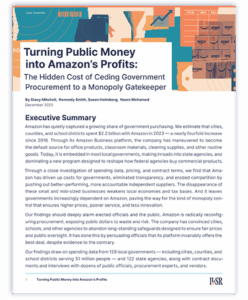
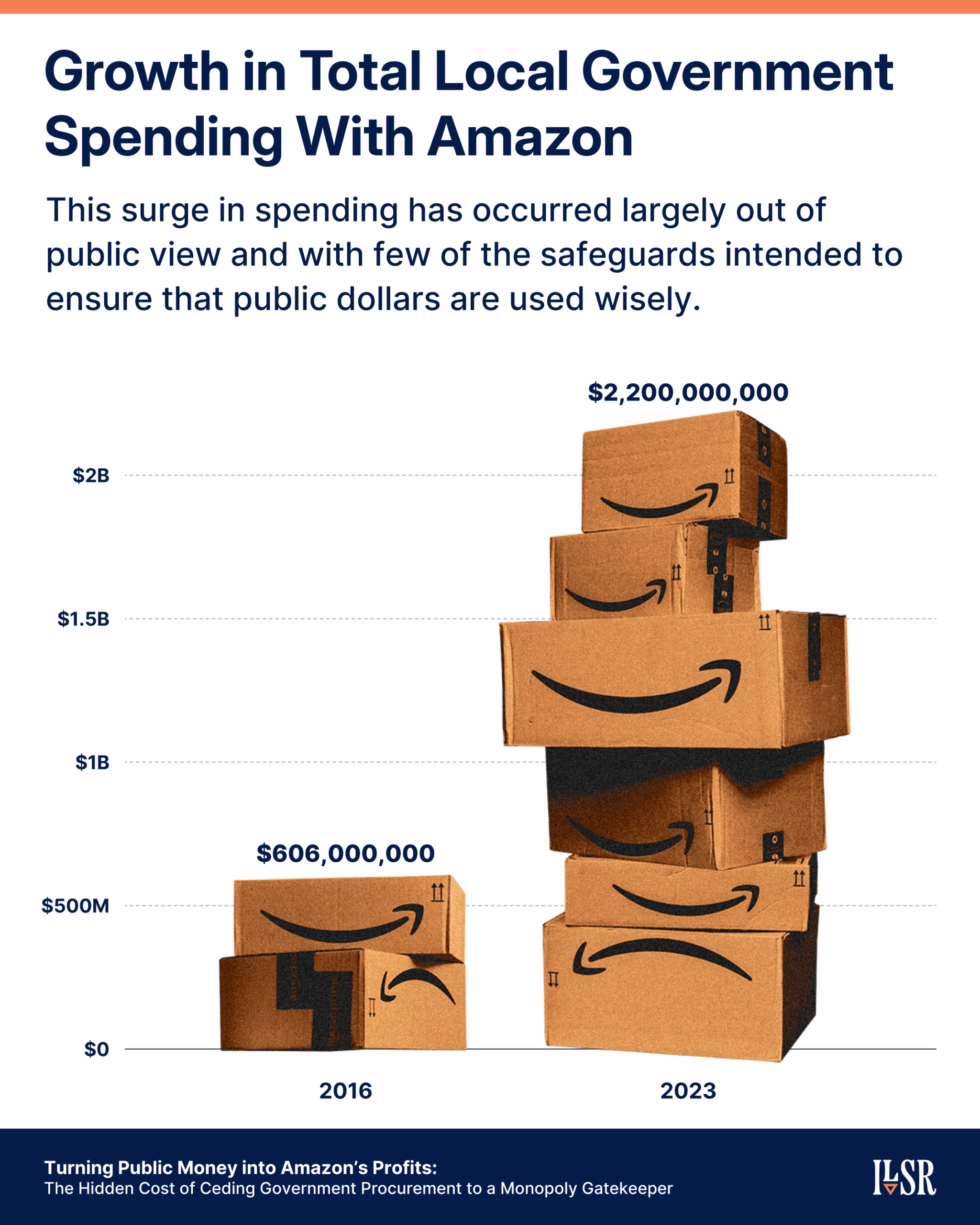
Amazon has quietly captured a growing share of government purchasing. We estimate that cities, counties, and school districts spent $2.2 billion with Amazon in 2023 — a nearly fourfold increase since 2016. Through its Amazon Business platform, the company has maneuvered to become the default source for office products, classroom materials, cleaning supplies, and other routine goods. Today, it is embedded in most local governments, making inroads into state agencies, and dominating a new program designed to reshape how federal agencies buy commercial products.
Through a close investigation of spending data, pricing, and contract terms, we find that Amazon has driven up costs for governments, eliminated transparency, and eroded competition by pushing out better-performing, more accountable independent suppliers. The disappearance of these small and mid-sized businesses weakens local economies and tax bases. And it leaves governments increasingly dependent on Amazon, paving the way for the kind of monopoly control that ensures higher prices, poorer service, and less innovation.
Our findings should deeply alarm elected officials and the public. Amazon is radically reconfiguring procurement, exposing public dollars to waste and risk. The company has convinced cities, schools, and other agencies to abandon long-standing safeguards designed to ensure fair prices and public oversight. It has done this by persuading officials that its platform invariably offers the best deal, despite strong evidence to the contrary.
Our findings draw on spending data from 128 local governments — including cities, counties, and school districts serving 51 million people — and 122 state agencies, along with contract documents and interviews with dozens of public officials, procurement experts, and vendors.
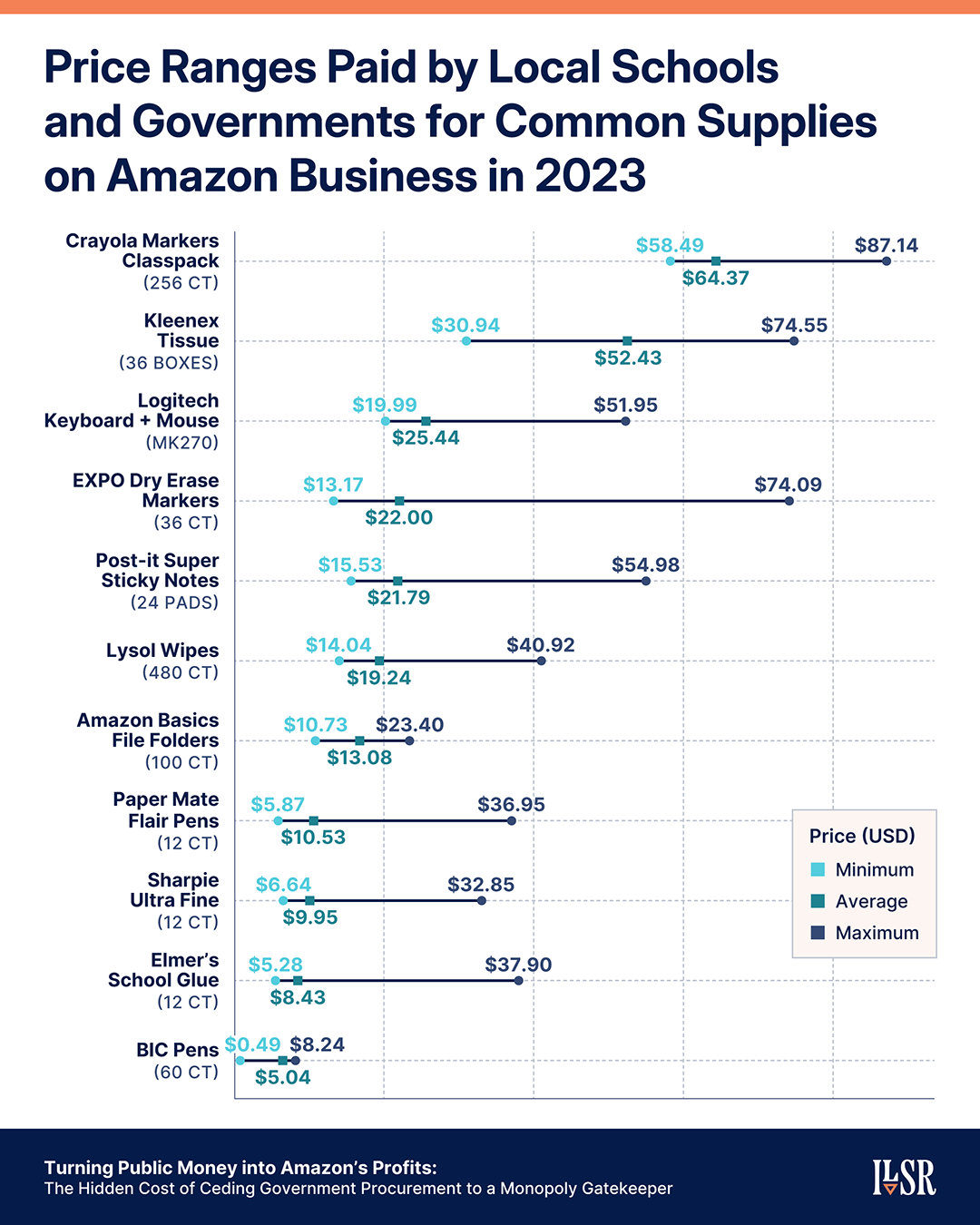
Amazon’s “dynamic pricing” lets it covertly raise prices and inflate costs for governments.
Unlike standard public contracts that lock in fixed prices, Amazon uses algorithm-driven pricing to continuously adjust what governments pay. The result is dramatic price variation: one city bought a 12-pack of Sharpie markers for $8.99, while a nearby school district paid $28.63 for the identical pack that same day. Our data contain thousands of similar examples, with some agencies paying double or even triple what others paid for the same items.
It’s impossible to know exactly how much Amazon’s algorithms overcharge governments, but across 2,500 frequently purchased products, we found that one school district could have saved 17 percent had it consistently received Amazon’s lowest prices. Taken together, the evidence shows that schools, cities, and counties are routinely paying more than they should.
Amazon is driving out independent suppliers that offer lower prices and better service.
In a price comparison of 628 frequently purchased school supply items, an independent office supply dealer beat Amazon on more than 68 percent of them. Overall, its prices were 4 percent lower — and, unlike Amazon, it provided consistent next-day delivery and personalized service. These results align with previous studies and make sense in light of the dynamics of this market: in a sector where competitive bidding is a fundamental principle, independent suppliers have had to operate with exceptional efficiency and performance to survive.
Amazon’s expanding reach is draining local economies and stifling competition.
Small and mid-sized businesses that supply schools, cities, and other public institutions are disappearing, taking with them local jobs and tax revenue. Over the last decade, the number of independent suppliers of office products, furniture, and janitorial goods, for example, has dropped from about 1,300 to 900.
Amazon tells governments that these local suppliers can keep selling to them by joining its platform, but its steep fees, which average 45 percent of each sale, make that nearly impossible. In Berkeley County, W.Va., for example, the school district spent $1.3 million with Amazon Business. Yet only $142 went to sellers based in the state; most of the money flowed to Amazon itself or to overseas vendors. As small suppliers disappear, governments lose reliable local partners, competition wanes, and Amazon gains even more power to dictate prices and terms.
Amazon’s platform is prone to misuse and fraud.
Amazon’s marketplace model, with millions of unvetted sellers and an ever-changing catalog, has made government purchasing more vulnerable to fraud and abuse. Numerous investigations have found that its platform is flooded with fake or mislabeled products, including hazardous items. Independent dealers, by contrast, source from trusted wholesalers and manufacturers, ensuring authenticity and safety. Amazon’s lax oversight also makes it easy for public employees to make improper purchases. Our investigation uncovered hundreds of questionable transactions that appeared to be for personal use, including for makeup, clothing, and even sex toys.
Amazon’s contracts create a false sense of oversight and expose public dollars to risk.
By claiming its marketplace provides built-in competition, Amazon has persuaded officials to abandon competitive bidding and fixed-price contracts. Through group purchasing deals — most notably through OMNIA Partners, a large group purchasing organization — the company has secured highly irregular contracts. They appear to provide vetting and accountability, but in reality, create only the illusion of oversight while giving Amazon access to thousands of local governments at once. Buying under one of these contracts is no different from simply shopping on the Amazon Business site. Yet the strategy has worked for Amazon: school districts using these contracts spent twice as much per student with the company as those that did not.
Amazon is making inroads with state and federal agencies.
Amazon first focused on local governments but has now extended its reach into state and federal purchasing. We estimate that states collectively spent at least $250 million with Amazon Business in 2023 — though weak tracking systems likely make this an understatement. At the federal level, Amazon dominates the General Services Administration’s Commercial Platforms Program, a new system for agencies to make purchases below $15,000 that do not require competitive bids. During the first two years of the program’s pilot phase, Amazon captured 96 percent of sales.
Our findings draw on spending data from 128 local governments — including cities, counties, and school districts serving 51 million people — and 122 state agencies, along with contract documents and interviews with dozens of public officials, procurement experts, and vendors.
A Better Path
A handful of cities and counties have recognized the risks of relying on Amazon and taken steps to restore transparency and keep public dollars local. Tempe, Ariz., rejected an Amazon group-purchasing contract after hearing concerns from a local business owner. Between 2017 and 2023, the city cut its Amazon spending by 84 percent while increasing purchases from local suppliers. Phoenix likewise prioritizes local bids and has spent almost nothing with Amazon over the last decade.
Public dollars should serve the public good. The following reforms can help state and local governments ensure that procurement systems are fair, open, and accountable:
Ban dynamic pricing in public procurement contracts: States should require all contracts signed by local governments and state agencies to specify fixed prices.
Restore competition and prioritize local suppliers: Set local purchasing targets; audit spending to identify products that can be bought locally; and train employees on the benefits of buying from local businesses.
Strengthen oversight and ensure transparency: Publish open, searchable, and complete payment records with standardized vendor data so that spending is visible and accountable.
Develop better marketplaces: Seek out neutral, transparent e-procurement platforms that are open and affordable to small suppliers and that foster real competition.
We urge federal policymakers to:
Reform the Commercial PlatformsProgram: Cap seller fees, disqualify platforms with conflicts of interest, and set targets to diversify spending across competing platforms.
Stop agencies from counting Amazon purchases toward small business goals: Only purchases made directly from small businesses — not those mediated through Amazon — should count toward the federal 23-percent small business purchasing mandate.
Invest in public platforms: Upgrade the GSA Advantage platform and put it into expanded use as a platform governed by public interest, not private monopoly.
Public purchasing is one of the most powerful tools local, state, and federal governments have to shape the economy and serve their constituents. Whether those dollars reinforce monopoly power or foster vibrant local communities depends on the rules we set. By reclaiming control of public procurement, governments can safeguard dollars, strengthen local businesses, and ensure that the goods that sustain our schools and public services are supplied through systems that are transparent, competitive, and democratic.
In this report, we outline serious concerns with Amazon's move into procurement spending. The move could leave local governments at risk of being ripped off.
How Amazon uses its monopoly power to extract extreme and rapidly growing fees from businesses on their site that have little choice to reach customers.