1. How to Find Out Whether, and How Much, Your Local Government or School District is Buying from Amazon
You can find out how much your local government or school district is spending with Amazon by filing public information requests for records of their Amazon purchases. All tax-supported organizations are required to provide access to most public records, including spending records. Call your city, county, and school board and ask how to submit a public records request (or check their websites; many local government entities include online portals for records requests).
There are three places where you might find information about Amazon purchases:
General purchases by departments
Credit card statements for the credit cards issued to public employees for work-related purchases (called P-cards)
Employee reimbursement requests
Your request should request records from all three datasets. You can find more information about how to submit public records requests here.
We would love to hear your experiences with Amazon’s role in public purchasing in your community.
2. How to Assess and Share the Information You Get Back
If you find that your local government and/or school district are not buying from Amazon, thank them! Write to each of the board and council members, thank them for patronizing independent suppliers, and encourage them to continue doing so.
If, however, you find that they are buying from Amazon, let them know that doing so hurts independent businesses and undercuts the local economy.
Call or email local governing boards — city or county council, and/or the board of education — and procurement staff and ask them to prioritize local businesses over Amazon.
Go to a city or county council or school board meeting and explain why buying from Amazon hurts the community. Share our reporton Amazon’s expansion into public purchasing with council and board members.
Talk to other local and regional organizations that might share your concerns and encourage them to speak out as well. These could include business groups, workers’ rights organizations, environmental groups, and economic justice organizations.
3. How to Propose and Advocate for Change
Ask your city, county, and school board officials not to adopt a group purchasing contract with Amazon— or, if they already have, ask them to stop using it.
Hundreds of local governments and school boards have piggybacked on to group buying contracts with Amazon through group purchasing organizations like OMNIA Partners, Choice Partners, and PEPPM. These contracts seem to offer a simplified way for public employees to buy supplies, equipment, books, and other relatively small dollar-value items, but the hidden costs to the community are extensive.
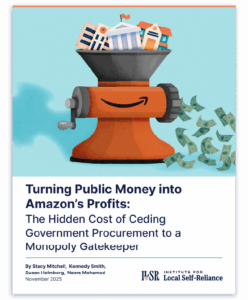
Contact your local government and school board officials and explain that an Amazon contract that lacks fixed, competitive pricing is a bad deal for your community and its taxpayers. Send them a copy of our report, Turning Public Money into Amazon‘s Profits. If they haven’t yet piggybacked on to a group purchasing contract with Amazon, ask them not to. If they have, ask them to stop using it — or to cut back on Amazon purchases and instead find opportunities to buy from local and regional businesses. Point out to them that, even if they have already piggybacked on to a group buying contract with Amazon, they are not obligated to use it.
Insist that your local government and school district prioritize spending through existing contracts with local and regional suppliers.
Through the Amazon Business administrator dashboard, a government entity can block specific items or entire categories that it does not want its employees to buy from Amazon.
Contact news media.
News media will almost certainly be very interested in your findings about your local government’s and school district’s spending with Amazon. Amazon is frequently in the news, which offers a good opportunity to bring an international mega-corporation into local and regional news and explain why it is bad for local economies. Suggest that media representatives speak with both public officials and also with local businesses negatively impacted by Amazon, such as bookstores, office supply stores, and sporting goods stores.
Be prepared to refute Amazon’s rote, misleading arguments.
Amazon routinely makes a number of misleading or outright false claims about how its platform benefits communities. Chief among them:
MISLEADING —Public entities can support local businesses by shopping with them on Amazon’s platform. Amazon claims that locally owned businesses can join its marketplace platform as third-party sellers and that, once they do, governments can continue to buy from them there, which is technically true. But Amazon fails to mention that the fees it charges businesses to sell products on its platform are crippling, cutting deeply into small businesses’ revenues and putting them at risk of failure. In 2023, Amazon’s various fees for third-party sellers hit an astounding 45 percent, up from 35 percent in 2020 and 19 percent in 2014.In 2018, Amazon approached Sandy Grodin, the owner of El Paso Office Products, at the request of one of his largest customers, a school district, and asked him to become a “distribution point” between Amazon and the district. Grodin realized that “distribution point” was a euphemism for becoming a third-party seller on Amazon’s marketplace, so that the school district could buy products from him there. But Grodin knew that Amazon’s fees would completely wipe out his profit margin. He opened his books to the school board and showed them the problem. The board got it and recommended that it only buy products from Amazon that it could not buy from El Paso Office Products.
FALSE — Amazon’s dynamic pricing means state and local governments and education districts’ customers get the best deals. Amazon claims that, because of competition on its marketplace, government entities almost always get the best possible prices there, but its dynamic pricing model means prices fluctuate all the time and that governments often pay more than they would if they were buying the same products from independent suppliers within the region.We found, for example, that Iowa City Schools paid Amazon $56.49 for a case of Kleenex on January 17, 2023, but Amazon charged the Denver School District $36.91 for the same product. In early November, Clark County, Wash., paid $53.98 for two cartons of Lysol disinfectant wipes; Savannah, Ga., paid only $37.98. Montgomery County, Pa., bought a case of Elmer’s Liquid School Glue from Amazon on February 27, 2023, for $37.90, while the Denver School District paid only $11.29 for the same product that same day.
FALSE — Amazon Business’s platform saves government workers significant time, versus getting bids or approvals for everyday purchases, and saving time means saving taxpayer dollars.An online platform with vetted suppliers and clear purchasing guidelines might save workers a bit of time. But there are two problems with this argument. First, the potential time savings are far less than the negative impact on the local economy of not shopping from local suppliers. Second, there are online marketplace solutions that can and do support locally owned businesses better than Amazon Business’s platform, as the two marketplace platforms recently added to the Commercial Platforms Program — ePS and G-Commerce — demonstrate. They charge vendors significantly lower fees and work almost exclusively with locally owned, independent businesses.
Ask your local government and school board to adopt policies that support local, independent businesses and that discourage employees from buying supplies from Amazon.
Here are a few ideas:
Adopt a local first policy. A growing number of cities, counties, and school districts are adopting policies that explicitly direct public workers to make their work-related purchases from locally owned businesses whenever possible. Hemet, Calif.’s local first policy is actually embedded in its city code. It offers qualified local vendors a five percent reduction in price on bids requiring the lowest bid and a five percent boost for those requiring the best value for the city.It isn’t enough to prioritize local and regional businesses; it is also important to consciously direct government spending to them. In some instances, that means restricting purchases from Amazon and other big businesses with no physical presence in the community. Purchasing regulations for Gadsden, N.M.’s school district include Amazon in its list of non-allowable procurement card purchases (the list also includes alcohol, cash advances, and items for personal use). That doesn’t mean the school district doesn’t buy things from Amazon, but it removes the temptation for employees to simply default to Amazon when they need supplies.
Identify products that government workers are currently buying from Amazon but could buy locally. In 2018, Tempe, Ariz.’s Internal Services Director, Renie Broderick, noticed that the city had spent over $8,500 on toys in the first half of the year. She then suggested that the city consider issuing a Request for Proposals for toys and soliciting bids from local toy stores rather than continuing to buy toys from Amazon.
Ask your local officials to buy gift cards from locally owned businesses or from credit card companies, not from Amazon. Rather than offering Amazon gift cards as prizes for completing surveys, winning contests, or other activities, encourage your local government and school district to buy a gift card from a local business or from a credit card company. This way, a recipient can choose to support a locally owned business or to shop on Amazon, if they prefer. But it gives them a choice, rather than blindly driving more sales to Amazon.
Ask your local officials to consider adopting one of the U.S. General Services Administration’s Commercial Platforms Program’s two non-Amazon marketplaces. In 2024, the General Services Administration added two new marketplace platforms to its Commercial Platforms Program, through which federal employees make many of their supply purchases. This program is open to local governments and school districts as well. Its two non-Amazon marketplaces, eProcurement Services and G-Commerce, focus primarily on helping public workers buy from independent businesses. Public workers can easily identify businesses with specific certifications, such as veteran-owned, HUBZone, and AbilityOne businesses. G-Commerce has a strong commitment to local economies and actively encourages locally owned businesses to join its platform, enabling local governments to support businesses in their communities through a convenient marketplace and for locally owned businesses to find customers in other communities. And the fees it charges its vendors are a fraction of those that Amazon Business charges, making them a much more affordable option for small businesses.
Ask your local officials to ensure that purchase card purchases include details. Information about the specific items purchased is not included in credit card statements. Ask your local officials to require employees to provide this information.
“… A democracy cannot function unless the people are permitted to know what their government is up to.”
Supreme Court Justice William O. Douglas, 1973
How to Request Public Records for Amazon Purchases
All government entities in the U.S. are required to make records available to the public, helping hold government agencies accountable for their actions, including how they spend public dollars. You can find out how much your city, county, school district, or state has bought from Amazon by filing a public records request.
Generally speaking, a public record is information that exists in some retrievable format (on paper, on film, as an electronic record, etc.) and that is related to government business. Public records include documents like correspondence, meeting agendas and minutes, invoices, credit card statements, budgets, court decisions, and research reports.
Submitting a public records request
Many local governments post instructions online for submitting public records requests. Some school districts do as well. For those who do, simply follow the instructions for submitting a request. For those who don’t, send an email with your public records request to the entity’s public information or finance department.
Here are a few general suggestions for submitting your request for public records:
Include the statutory citation. State that you are submitting your request in accordance with the state’s public records law. You can find a list of state statutes here.
Ask only for existing records. Your request must be for existing records. Government agencies are not required to create new records in response to a public records request. They are also not required to answer questions; they simply provide existing records. So, for example, you can ask for “records of all widgets your agency purchased from Amazon.com in 2024” and expect the agency to provide you with receipts and/or a summary of purchases. But if you ask, “Did your agency purchase any widgets from Amazon.com last year?” your request is likely to be turned down.
Be as specific as possible. Your request should be as specific as possible about the information you are requesting, the time period for which you are requesting records, and the format in which you would like to receive the records. This will help the record’s custodian find the information faster. You do not need to explain why you are requesting the information — but, if you are doing so as a representative of a merchants’ association, a civic group, or another organization, it might help clarify the scope of your request and make it easier for the custodian to retrieve the correct information. If the records are likely to be available in multiple formats, specify which format you prefer. With records of a government entity’s Amazon purchases, records might be available in the form of individual receipts or in the form of a spreadsheet, and a spreadsheet will make it much easier for you to add up the purchases.
Include your contact information. Provide your name, email address, and phone number. If the jurisdiction from which you are requesting information provides information only to residents, include your physical address as well.
Document your request. Almost all government public records statutes require a public entity to respond to a records request within a certain period of time. Keep a record of when you send your request, what the required response date is, and when you receive information from the entity from which you have requested information. In the event that a public entity does not respond to your request, responds late, or provides you with incomplete or misleading records, your activity log could be invaluable for resubmitting or appealing your request.
Some tips
In some instances, a simple public records request might provide information on all purchases a government entity has made from Amazon in a given time frame. But, in many instances, it might take a little more digging — and more than one public records request — to learn how much the government entity has spent with Amazon.
Request and examine credit card statements. Some cities, counties, and school districts include details of all government purchases in their purchase records, even those made with government-issued credit cards (called a purchasing card, or P-card). This is usually the case when purchasing is centralized, with purchases made on behalf of employees by a single purchasing office or a small handful of designated procurement staff. But, in many instances, Amazon purchases are buried in monthly credit card statements. If you request public records about Amazon purchases but find no or few records, ask for copies of the government entity’s credit card statements. Unfortunately, credit card records do not provide details on the specific items purchased or the reasons for their purchase, effectively hiding the purpose of these purchases from the public.
Request and examine group purchasing agreements. If the government agency has signed on to a purchasing contract with Amazon negotiated through a group purchasing organization, such as OMNIA Partners, then the agency has signed an agreement or passed a resolution to do so, and the agreement may specify the maximum amount the agency expects to buy from Amazon. In your public records request, ask for copies of all contracts and other correspondence with Amazon and/or group purchasing organizations through which the government entity might buy products and services.
Request and examine expense reports that contain Amazon purchases. Even in localities that have chosen to spend public dollars locally, government employees might buy products on Amazon with their personal accounts, then submit reimbursement requests to their employers.
Please accept this request for public records, in accordance with [state statute]:
Records of all purchases that [jurisdiction] made from Amazon.com in calendar year _____. I request that these records include all goods and services purchased from Amazon, including but not limited to those purchased through a direct contract, through a group purchasing contract that [jurisdiction] has adopted, or purchased through a purchasing card program or similar small purchases program. I request that the records contain:
The name or a brief description of each product purchased
The date of each purchase
The quantity of each item purchased
The ASIN number of each item purchased
The unit and total prices of the order
I request that this information be provided to me by email at [email address] as an attached, unlocked spreadsheet in .csv or .xlsx format.
Copies of employee expense reimbursement reports that contain purchases from Amazon
Records of all expenditures by [jurisdiction] with Amazon Web Services (AWS) during calendar year ______.
If [jurisdiction] has adopted a group purchasing contract with Amazon Business through OMNIA Partners or another group purchasing organization, I request a copy of [jurisdiction’s] contract.
INDEPENDENT BUSINESS INITIATIVE
Sign up for updates on the fight for a level playing field
In this report, we outline serious concerns with Amazon's move into procurement spending. The move could leave local governments at risk of being ripped off.
How Amazon uses its monopoly power to extract extreme and rapidly growing fees from businesses on their site that have little choice to reach customers.