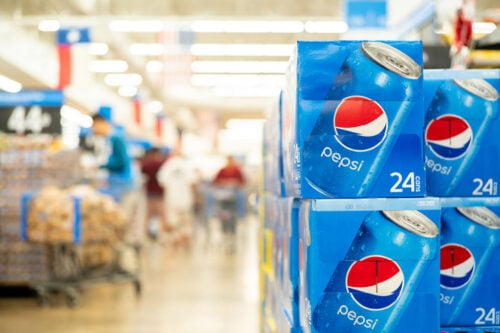
Newly unsealed FTC filing accuses PepsiCo of favoring Walmart while artificially inflating prices for local grocers and consumers
WASHINGTON, D.C. (December 12, 2025) — Judge Furman granted the Institute for Local Self-Reliance’s motion to unseal previously redacted details in the Federal Trade Commission’s (FTC) complaint against PepsiCo, which alleges the beverage giant violated the Robinson-Patman Act, engaging in illegal price discrimination that favored Walmart while raising prices for competing independent grocers and their customers.
Today, the public can finally see the unredacted complaint, revealing new details on the ways PepsiCo systematically violated the law by giving Walmart preferential treatment over competing retailers in ways that intentionally create an unfair competitive advantage in the resale of Pepsi soft drinks. The complaint demonstrates the real effect of price discrimination: to ensure higher prices at every retailer, except the one receiving the sweetheart deal. According to the FTC’s complaint, PepsiCo worked to meet Walmart’s demand that it have lower retail prices than its rivals through:
Tracking prices across the retail economy to ensure no retailer offered prices for Pepsi products as low or lower than Walmart’s price.
Raising wholesale prices for non-Walmart retailers and reducing their discounts in order to push their prices higher and drive customers to Walmart.
Funding Walmart’s promotional displays and price reductions while reducing promotional support to competing retailers
“This complaint pulls back the curtain on how corporate giants rig the market against independent businesses and local retailers. For years, PepsiCo has been systematically weaponizing its relationship with Walmart to crush competition — not through better service or efficiency, but through discriminatory dealing that the Robinson-Patman Act explicitly prohibits,” said Stacy Mitchell, Co-Executive Director of the Institute for Local Self-Reliance.
“When independent grocers tried to compete, PepsiCo cut their promotional support and raised their costs to protect Walmart’s ‘price gap.’ The real victims are local grocery stores and the communities they serve. This case demonstrates exactly why the FTC’s renewed Robinson-Patman enforcement is so critical — and why this law matters for both small businesses and consumers.”
“These newly unsealed allegations highlight the importance of transparency in our judicial system, particularly in cases like this one involving historic government investigations and conduct affecting small businesses’ bottom lines and millions of consumers’ pocketbooks,” said Katherine Van Dyck, attorney for ILSR. “It strengthens our courts’ and our agencies’ legitimacy by protecting the public’s First Amendment right to access judicial documents and assess the facts themselves.”
The implications of the FTC’s decision to abandon this case extend beyond PepsiCo. The Robinson-Patman Act was enacted to prevent large retailers from using their market power to secure unfair pricing advantages and drive small businesses out of the marketplace. The law has been largely ignored and unenforced by our antitrust agencies since the 1980s. During that period, independent grocers’ market share plummeted from over 50% to nearly 25%, contributing to the proliferation of food deserts in both rural and urban communities.
ILSR argues that, without enforcement of the Robinson-Patman Act, dominant retailers and suppliers can continue to engage in practices that eliminate competition and ultimately harm consumers through higher prices and reduced choice. Reactivating RPA promises to stop powerful retailers from using their size to bully suppliers and push independent businesses out of communities that depend on their existence. The FTC has an obligation to the law and local communities to use the full extent of its enforcement powers to ensure that independent retailers have a level playing field on which to compete.
INDEPENDENT BUSINESS INITIATIVE
Sign up for updates on the fight for a level playing field
99% Invisible talks Food Deserts with Stacy Mitchell
99% Invisible, with Stacy Mitchell's help, devotes an episode to the relationship between food deserts and the federal government's abandonment of Robison-Patman Act enforcement.
Boxed Out: How Big Retailers are Flexing Their Supply Chain Power to Kill Off Small Businesses
Powerful retailers are dominating supply chains. Our report argues it’s time to revive the Robinson-Patman Act to restore antitrust enforcement against predatory buying.