Motion seeks to reveal details of complaint alleging PepsiCo gave preferential pricing to a big-box retailer while harming independent grocers and consumers
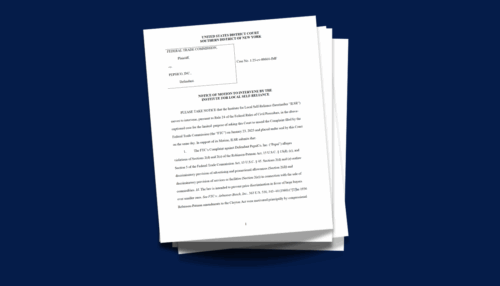
WASHINGTON, D.C. (August 05, 2025) — The Institute for Local Self-Reliance (ILSR) has filed a motion in federal court to unseal the Federal Trade Commission’s (FTC) antitrust complaint against PepsiCo, which alleges the beverage giant engaged in illegal price discrimination by providing preferential pricing to a major big-box retailer while raising prices for competing independent grocers and their customers.
The case represented a significant test of antitrust enforcement under the Robinson-Patman Act and underscores the growing debate over the FTC’s direction under new leadership. The complaint, filed in January under former Chair Lina Khan, was dropped by the agency in May under current Chairman Andrew Ferguson, leaving crucial details hidden from public view.
The heavily redacted complaint obscures key information, including the identity of the favored retailer, the specific nature of the alleged price discrimination scheme, and its impact on grocery prices and local communities. This lack of transparency comes at a time when grocery prices and food access remain pressing concerns for consumers nationwide.
“The FTC’s complaint, which was filed after a two-year investigation, describes a scheme that may have harmed independent grocers and raised prices for millions of people. But nearly all of it remains under seal,”said Stacy Mitchell of ILSR.“We’re asking the court to lift the redactions because the public has a substantial interest in seeing the evidence and understanding the details of the alleged scheme, knowing which big-box retailer benefited and which retailers were harmed, and the impact on grocery prices and communities.”
Chairman Ferguson called the complaint “weak,” while former Chair Khan characterized PepsiCo’s alleged conduct as a “patently illegal scheme.” The divergence of these statements makes it all the more important that the public be allowed to review the complaint in full.
When initially filed, the FTC stated it would “swiftly seek to lift the redactions.” There is a strong “presumption in favor of public access to judicial documents,” the judge noted, and ordered PepsiCo to justify the redactions. However, the agency dropped the case before PepsiCo’s deadline, effectively preventing the court from ruling on the issue.
“ILSR is exercising its right to access documents, a right that courts have long recognized is critical to an open and democratic judicial system,” said Katherine Van Dyck, attorney for ILSR. “When these documents are hidden behind black boxes, it becomes impossible for the public to judge the fairness and integrity of court proceedings for themselves.”
The implications of the case extend beyond PepsiCo. The Robinson-Patman Act, enacted in 1936 to prevent large retailers from using their market power to secure unfair pricing advantages, has been largely dormant since the 1980s. During that period of non-enforcement, independent grocers’ market share has plummeted from over 50% to approximately 25%, contributing to the proliferation of food deserts in both rural and urban communities.
ILSR argues that without enforcement of the Robinson-Patman Act, dominant retailers and suppliers can continue to engage in practices that eliminate competition and ultimately harm consumers through higher prices and reduced choice.
Dollar stores are not merely byproducts of economic distress; they are a cause of it. Through predatory tactics, chain dollar stores are killing off grocery...