States Can Stop Utilities From Strangling Local Solar — Episode 273 of Local Energy Rules
Solar is ready. Thanks to utilities, the rules to connect it to the grid aren't.
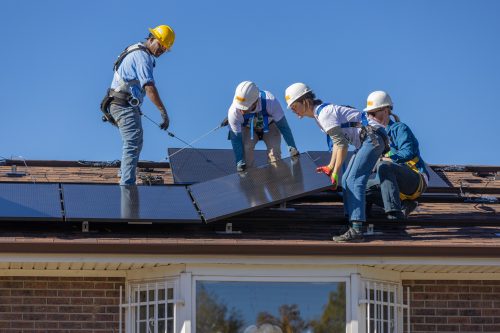
A laborious permitting and inspection process can add one-fifth to one-third to the cost of putting solar panels on your home or business. Addressing this fragmented system of differing municipal policies could significantly lower local solar costs and increase adoption.
For this episode of the Local Energy Rules Podcast, host John Farrell is joined by Elizabeth Ridlington, Associate Director and Senior Policy Analyst with Frontier Group.
Listen to the full episode and explore more resources below — including a transcript and summary of the episode.
Elizabeth Ridlington:
Solar maybe is a little bit different because the problems that need to be solved here are not just local.
*****
John Farrell:
A laborious permitting and inspection process can add one fifth to one third to the cost of putting solar panels in your home or business. Addressing this fragmented system of differing municipal policies could significantly lower solar costs and increase adoption. To tell me how associate director and senior policy analyst Elizabeth Ridlington from Frontier Group joined me in April 2026 to talk about their new research on state rules for solar permitting. From a lot of failing grades, they found a few examples for states to follow. I’m John Farrell, director of the Energy Democracy Initiative at the Institute for Local Self-Reliance, and this is Local Energy Rules, a podcast about monopoly power, energy democracy, and how communities can take charge to transform the energy system.
*****
John Farrell:
Elizabeth, welcome to Local Energy Rules.
Elizabeth Ridlington:
Thank you for having me.
John Farrell:
So I always like to ask my guests a little bit about their background. When you imagined what you’d be when you grew up, was researching the challenges of solar permitting anywhere on that list?
Elizabeth Ridlington:
Short answer, no. But had I known and had somebody said to me, “Oh, I can see what you might do in the future, I think it could have fit.” So I knew starting in fifth grade, I wanted to do something related to government or public policy. Although at that time, I still thought maybe I would become a classical violinist and I didn’t actually rule out the violin thing until early in high school. But one of my favorite activities in middle school was to read the voter guide from front to back.
John Farrell:
Impressive.
Elizabeth Ridlington:
This is meaningful because I grew up in Oregon, which has a very active and lively initiative system where citizens can place measures on the ballot. And sometimes there are so many initiatives that the voter guide, it came out in two volumes and anybody who had paid, I think it was $25 or $50 could get their view of a ballot measure published. And I loved reading that from start to finish to understand the pro and the con of each ballot measure. And then I would tell my parents how they should vote. And then on election night, I would sit there in front of the television and watch the election returns. So did I think I would research solar permitting? No, but does that probably fit with where I started out? Yeah, it might.
John Farrell:
I think that’s a pretty accurate characterization and that’s probably one of my favorite descriptions of somebody who had an early inkling that they wanted to do public policy or government work. I have a similar story from my background, but it wasn’t until high school. So fifth grade is definitely, I think, being an early riser, if you will, into this area.
Elizabeth Ridlington:
And I give a lot of credit actually to the Oregon’s ballot initiative process of making it obvious that citizens should be involved in government and should think about the future of their community and how it should be governed and function and that they are welcome to and need to have a role in what that future looks like and to shape it.
John Farrell:
Well, thanks for sharing about your background. I want to ask you about solar permitting. So you were an author on a recently released report about the state of solar permitting in the US. What was the motivation to do this report and what might it mean for Americans who are interested in solar if states made permitting simple and what could it do for the grid?
Elizabeth Ridlington:
So the motivation for working on the report is that we need more solar power. It seems that it has a lot of upsides and not that many downsides that I’m able to identify. And one of the obstacles though is that permitting right now in the US is cumbersome and expensive. We know that it adds thousands of dollars to the cost of a project, potentially increasing the expense by one fifth to one third of the total cost. So that’s one reason that there’s a good thing and there’s an obvious roadblock, so let’s try to fix it. The benefits to me of solar are it’s clean, it doesn’t create air pollution, it doesn’t add to climate pollution. It avoids strain on the grid because if I am generating power on my roof, then there’s no need for me to have a long distance transmission line feeding my community.
If the solar is installed with a battery, then it helps smooth out demand on the grid. And that battery also helps ad resilience in states that experience extreme weather or even planned power outages. So I’m in Northern California. My community has had its share of wildfires and planned power shutoffs. Even when everything is going great here in the winter months, we still are reliant on natural gas fired power plants down in Los Angeles area. Los Angeles does not need any more air pollution and I here in Sonoma County should be doing my best not to make their problem worse. So solar seems like such an obvious path forward on that. And then we’ve had our share, as I mentioned, of wildfire related incidents, including some public safety power shutoffs to de-energize the power lines during periods of extreme weather when there’s high fire danger.
And the first time that happened, I went on a walk around my neighborhood and took video or photos of all the generators that were running at people’s homes but also at the grocery stores and even I think Home Depot might’ve had one going out back and it’s just a horrifying amount of local air pollution that’s generated by those diesel generators. But if those facilities had had batteries, instead they wouldn’t have needed to be running the generators. Recently, the power went out in my neighborhood for some unrelated reason and one of my other neighbors said, “Yeah, well, I just learned that Alice has a battery because her house was the only house that still had lights on when all the rest of us were in the dark.” And I thought, “Exactly, that is what solar and a battery can do for you. So Alice had lights, I on the other hand, had to reset the clocks on all of my appliances.
So small example there, but batteries can keep things running and solar makes people’s lives better and makes the air cleaner. So that’s why we need more of it and that’s then why I’ve been working on a variety of projects to streamline solar permitting.
John Farrell:
So this phrase came to mind when I was reading the report and also having followed this issue for a while. Do you think it’s accurate to describe the current solar permitting environment in the US as a hot mess?
Elizabeth Ridlington:
Yeah, I think that’s fair. So before the current solar permitting scorecard that got released in March, I wrote a report about a year ago on the problems of red tape in solar permitting in Texas. I just wanted to understand the problem more and document it, put it out there for public consumption so that we could tell more stories about how bureaucratic regulations actually affected people trying to put solar on their rooftops. So I called up a number of solar installers and talked to about a dozen of them and said, “I want to know more about your frustrations, your problems, your challenges in this solar permitting and inspection process, and boy, oh boy, did I get an earful.” So they were happy to tell me all sorts of things. And from that report, Red Tape In Residential Solar Permitting in Texas, I have a bunch of examples of how this is a hot mess in a way that you wouldn’t necessarily think about it upfront.
So I learned about unpredictable timelines, by which I mean most solar projects when you go seek a permit from the local regulatory authority, which might be the county, might be the city, most projects get approved pretty quickly. In Mesquite, Texas, for example, the median approval time is three business days. That doesn’t sound bad at all, but 10% of permits there take five weeks or longer. So which category are you going to fall into? If you’re a homeowner and you want solar on your rooftop, are you going to have your permit in three days or are you going to end up waiting five weeks? So the unpredictable timeline is one thing that they told me about. They also told me about how complicated it all is. So in Dallas, for example, keep in mind this is a year ago and maybe it’s better. Installers who want to apply for a permit have to work their way through two different online portals that aren’t connected to each other at all.
And then it’s just additional staff time on the part of the solar installer to get that permit. In another town, for example, the complication comes from how the homeowner’s association is involved with the solar permitting process. Depending on your HOA, you might need to go to the HOA before or after you get your permit from the city. The city even admitted that it was complicated and it was unnecessarily so, but that’s how it is. So the solar installer was just very frustrated because he wanted to apply for a permit, but he needed instead to first go to the HOA. The HOA had up to 30 days to get back to him to let him know if the project was acceptable or not.
Which leads me to another problem that’s part of the hot mess, which is slow permitting. In city after city, there were all sorts of weird complications. In the era where we email each other, we Zoom chat, we do all sorts of things with instant messaging, solar installers told me about how they still sometimes had to go in person to submit their application for a permit, which in a state the size of Texas is a significant challenge because sometimes they would bid on projects that were two hours away from their home office. So that added delay, they needed to find time for a staff person to go apply for the permit.
Or another complication that added to the slowness was installers would apply for a permit via email. Great, don’t have to send a staf person, but then that was their only point of contact. And so if that staff person was busy or backlogged or on vacation, they couldn’t get an answer about the status of their permit. There was no way for them to find out were they going to be a three-day approval or were they going to be a five-week approval kind of process.
In other cities, I heard stories of how multiple staff review the permit. So there’s the building folks who review it and then maybe some fire people and then maybe it needs flood review and that happens sequentially, which just adds the delay in getting the permit for the project.
I heard about problems with inconsistency. So Texas has a statewide building code. Local variations in code are allowed, but even beyond that, code officials in different cities interpret the code in different ways, even though the language they’re looking at is identical. And so as a result, the solar installers have to navigate this different set of requirements in every single city. And then in the most extreme case, somebody told me about how there could be variation even within a single department. So the installer said, I couldn’t get this permit approved. The reviewer rejected it. I got frustrated. I called up and I complained to the supervisor and then the supervisor approved it. I don’t know. Same city, same set of rules on paper, but one person approved it and one person didn’t.
The result is that solar ends up being more expensive and fewer people want to install it. So we had turned up data, not our research, but some preexisting information, that 25% of planned solar projects in Texas were canceled in the time between when solar installers submitted the permit application and when they received their permit. So if we can streamline the permitting process, we can get more solar if you can just get fewer of those projects getting canceled along the way.
I talked to one solar installer who said he was trying to get a really big project permitted and it was meaningfully large for his relatively small firm, but the customer was getting so frustrated. At one point he got fed up with this installer, thought the installer was incompetent because he couldn’t get the permit and he threatened to pull out of the project entirely. So when that happens, in this case the customer didn’t, but when customers do in that 25% of cases that the permit where the project gets canceled before the permit is issued, installers end up eating a couple thousand dollars in costs. They can’t recover that on that project. They have to build it into the costs that they charge for other projects. So installers do have a bunch of ways of dealing with this hot mess, but we end up paying for it as consumers because projects are more expensive and we end up paying for it just as fellow citizens in the community where there’s less solar installed. So that means more air pollution, that means more need for grid infrastructure investments.
The solar installers, back to the scheme of how this costs all of us, how this costs customers at least three companies in Texas told me that they keep detailed proprietary manuals of how to navigate the permitting process in every city where they work. In some cities, they flat out won’t do projects or they’re super selective, which means if you’re a customer in one of those cities, there’s fewer installers you can even get bids from so that process is less competitive. And then they also deal with it by raising their prices. So there’s survey data from a national set of solar installers that found that of installers who respond to these permitting nightmares by increasing their prices, they increase their prices on average of 10%. So it’s just an expensive process when they’re having to deal with the hot mess, as you put it, of solar permitting.
And then to be clear, the hot mess is not limited to permitting. It also applies to inspection because when I first called up those installers in Texas and asked them for their bad experiences with permitting, half the stories that they told me were about the inspection part of the process. They had their permit in hand, they had built the project, put it up on the roof, everything was installed, it was ready to start producing clean energy for that homeowner and start saving them money, but they struggled with the inspection process. The kinds of problems that they told me about were, even if everything’s going to go perfectly, you call up the building department and you schedule your inspection and then it gets scheduled maybe for a four-hour window, but somebody needs to be on site to meet the inspector, show them key parts of the equipment and so forth, which means that the solar company has to have an experienced skilled technician sitting on site doing nothing for multiple hours and the only way you cover the cost of paying that person’s salary is you have to charge more for the rest of the project. So just scheduling even done well for that inspection adds to costs.
Installers told me about multiple inspections that they faced. So there was one city in fact that even required an inspection before the permit was issued to see what the impact would be on neighboring homes of the solar inspection on a roof in that neighborhood. But then more common were inspections required at the rough-in stage, so when the project is halfway completed, in addition to an inspection at the final stage. So in each case though, you potentially have to deal with this scheduling and having a technician sitting on site just waiting for the inspector to show up. Another common story that people told me of the problems with inspections were that they needed to have multiple inspections, a building inspection for example, and an electrical inspection and ideally that would be conducted by just one inspector, but in some cities the inspectors weren’t skilled enough or hadn’t been trained and so it required multiple inspections.So now we’ve got the technician sitting on site waiting to meet the building inspector and then again, waiting on site to meet the electrical inspector.
And then I also had an installer tell me a story about the inspector showed up and said,” Oh, I know this is permitted, but I don’t understand this equipment. I need more information. “And in that case, the installer was actually able to call the manufacturer and get the spec sheets and give the inspector the information that they needed right on the spot. But if that hadn’t happened, then they would’ve been back to this business of, ” Okay, we’ve got to reschedule the inspection for later.” And in a number of these cities, if you can’t do the inspection when the inspector shows up, then you have to pay another inspection fee. So it drives up their costs, not merely with staff time, but also because they actually have to pay more to the city.
So those were the kinds of nightmares that people told me about when I was doing that research in Texas. I know it’s not limited to Texas and I don’t in any way mean to imply that Texas is worse than other states because I had a colleague at Frontier Group, James Horox, who did a similar report in Illinois and was able to tell a lot of the same stories. And I think you’ve written one, John, for Minnesota that encountered a lot of the same issues. I know that there’s similar stories in a lot of states around the solar permitting and inspection process
John Farrell:
Indeed. One of the things I found really interesting, my colleague Katie Kienbaum and I did research in Minnesota on the permitting process and I remember thinking as I was going into it, my hypothesis was, okay, this process is bad and the real limiting factor is going to be cities make this very complicated. And a lot of the ways that you just described actually finding we found that as well. But the thing that really surprised me was that, and this actually goes back to one specific thing you mentioned about the proprietary database of city permitting processes, that the problem is not just laborious processes of pulling a permit, but it was the fact that the rules are basically different in every single city. And so with your research, what were some of the criteria that you were using to evaluate whether a state has good or bad permitting rules?
Elizabeth Ridlington:
Yeah. And our research was very much informed by our understanding of what the problems were that solar installers encountered, which we know trickled that down then to consumers having to pay more, families not being able to put solar on their rooftops. Basically, the currently permitting and inspection are complex, uncertain and slow processes. So we looked for criteria and for policies that make inspection and permitting simple, predictable, and fast without compromising health or safety. Because yes, that local variation was one of the most frustrating things that the solar installers expressed to me and a lot of the variation had to do with how different people were interpreting safety codes or building codes, but in ways that I didn’t understand actually had any benefit for health or safety. So we looked for what’s simple, predictable and fast, can we just get these permits out? Because millions of houses in the US have rooftop solar and hundreds of thousands have batteries and they’ve done it safely.
So this isn’t something where we need to still be tailoring solutions in each community necessarily. This is something that we know how to do and know how to do safely. So the question is, how can you do that at scale quickly, get all these processed? So we asked a bunch of different questions about what makes for streamlined solar permitting. The first one actually solves a whole bunch of these problems and that is, does the state make it possible for installers to apply for a solar energy or a battery permit using instant permitting software? This is software that is developed either by the Department of Energy and now is operated, I think by a separate organization called SolarApp, or there’s private software out there from the company Symbium that automatically reviews an application for a solar permit. Does it comply with code? Are the correct plans uploaded? Are all the bits and pieces of the details about the equipment that are required? Is that all in the system? And if that material is there, then the permit is instantly issued.
If the material’s not there, then it tells the solar installer right away, no need to go check with which staff person has it and is it lost somewhere in the depths of City Hall? The solar installer immediately knows what the problem is, can correct the problem and then get the permit. So permitting times drop from unpredictable to very predictable and it’s in the control of the solar installer. So that was the first thing we looked for was, does the state make it possible to use instant permitting on pretty much every project, solar and battery project?
Then we look for other policies that the state might’ve adopted to speed permitting. So that included things like funding for jurisdictions because there is a little bit of a transition cost as cities adopt those instant permitting platforms, just one of them, for matching their local building codes and whatever their requirements are.
We also look to see in some cases the state is the one who issues the permits. That’s the case in Colorado. So has state adopted instant permitting if it has jurisdiction? We look to see whether the state has written a guidebook that says to local jurisdictions, “Here’s how you can make the whole process faster and simpler and standardize it and here are the best practices.” We look to see if the state encourages the adoption of or encourages jurisdictions to participate in SolSmart, which is a designation you can be any number of bronze, gold, silver levels, but it indicates a commitment to having streamlined and solar permitting and inspections and doing other things to support solar in the community. And then we also looked to see if the state had a uniform permit so that a solar installer would know exactly what they needed to fill out one community to the next.
The next category we looked at was building codes. Are the building codes standardized as much as possible across the state or are they allowed to vary by jurisdiction? The issue here, and this is sort of what came up with the solar installers in Texas and they could say, “Well, it’s the same building code pretty much with just a little bit of a few tweaks and then a bunch of layers of interpretation on top of that. And to the extent that that can be streamlined, the whole process goes much faster. And truth be told, this applies not just to solar permitting, but also to all kinds of building activity. I in fact found an article from 2021 that was a bit of a review article about the impacts of building codes and it concluded that uneven building codes between state and local jurisdictions may actually matter more and do more to drive up costs than the kind of code. Whether you have a stringent code or a lax code might matter less than how much variation builders encounter from one community to the next. So we look to see, does the state have a statewide building code or is it a statewide building code with some amount of local variation and amendments allowed or is it a free for all?
Then we looked at what the state says about the role of homeowners associations. Should they have the right to block or restrict solar energy projects or should they not have as much say? Homeowners associations can affect the efficiency of projects and they can also affect costs. Some of the most common rules that we encountered when we looked into this were rules that said homeowners associations can control the placement on the rooftop, the visibility from the street.
So this might mean if you … Well, my house, for example, I don’t live in a neighborhood with an HOA, but my west facing roof is the most productive roof and that’s where my solar panels are. But if I lived in an area with an HOA that said they can’t be visible from the street, then those panels would need to be on the east side of the roof and my total production would be much lower. So I would get far less return on my investment in those panels and it might’ve changed my decision of whether to go solar or not. So does the HOA get to influence the placement and visibility of panels?
John Farrell:
I feel like, just as an aside that, HOAs are … There’s never been a time I’ve heard of them that is not some terrible way that they make life harder for people. So I don’t understand why we have them at all, frankly, but even just hearing about this in terms of solar, it’s just such a tragedy.
Elizabeth Ridlington:
It is such a tragedy. I feel like I have a lot of the same questions as you about HOAs and yet roughly, what, a quarter of Americans live in housing that’s controlled by an HOA. And so there must be some value to them. There must be some attraction. Maybe you need to get an HOA proponent on to tell you more of why HOAs are good and what good HOA governance looks like.
John Farrell:
There we go.
Elizabeth Ridlington:
But yes, I agree. I hear of HOA horror stories more than I hear of HOA praise.
John Farrell:
Anyway, sorry to interrupt. Just to summarize though, you’re talking about there’s the instant permitting software and the support for adopting that and the consistency of the rules across jurisdictions. Same thing for building codes. We just talked about HOAs. All right, let’s let you get back to the flow of what you’re evaluating in this study.
Elizabeth Ridlington:
Yeah. So let me tell you a little bit more about HOAs because HOAs were actually a curious beast. They can affect the efficiencies and how much the panels put out depending on the HOA rules, visibility from the street, things like that. But then other HOA rules can also affect cost. So the HOA might be able to set a rule that says, and we did see a lot of this, that the color of all the parts of the solar project need to match the rest of the home. Okay, that’s fine. You maybe just have to paint the conduit, but what if that color restriction aplies to the color of the panel? It can’t have a blue tint and needs to have a black tint or vice versa to the panel. Then all of a sudden this gets into questions of what equipment you have to buy and that might affect the cost of it.
So in the better states that with the better policies we saw were policies that said HOAs can’t affect the cost increasing it by more than 10% and they can’t affect efficiency by decreasing it more than 10%. And there were some states that were even stronger than that. They limited impacts to 5% on one or the other of those metrics, or they had an actual dollar cap. I think it was California says you can’t increase the cost by more than $1,000. So that was HOA policy, which had huge variation around the country and some places do really well and some places there’s no limit to what the HOA can do.
Then we looked at another question sort of similar to the HOA question, but affecting actual the permitting authority instead. Can they include factors other than health and safety in their permit review? Can essentially they apply some of the aesthetic criteria that HOAs might apply? And on that, there’s actually only one state, California, that has said that these aesthetic criteria can’t be included in permit review process. But I did see Maryland in the General Assembly has passed legislation that includes this provision as well. And if the governor approves that, then Maryland could be the second state that would eliminate that particular stumbling block in the solar permitting process.
So then we looked at some policies related to inspection, because as I mentioned in Texas, the inspection proces can be painful for the installers and frustrate homeowners. Worst case story that I encountered in Texas actually was the inspection wasn’t available on the day that the installer had thought it would be because of miscommunication with the jurisdiction and the homeowner did not have power for an entire weekend and had to stay in a hotel instead. So inspections can be frustrating. So we looked at what states have done to streamline the inspection process.
That includes limiting the number of inspectors. So you can have only one inspection, it’s the final inspection, it’s done at that point when the project is all up on the roof and it should be as streamlined as possible. We also look to see if states allow remote inspections because in this era where we’ve all got video recording equipment in our pocket and a nice microphone and can connect to the internet anywhere, it’s possible to do inspections where the inspector doesn’t actually have to drive hours through traffic to get to a project. This is especially useful in large metropolitan areas, but these can be done remotely with the installer on site, doing essentially a FaceTime call with the inspector, or it can be done with prerecorded video and lots of photo documentation that gets sent into the inspector, put into their queue, they work on it as soon as they have time.
And it saves this problem of needing to have a staff person on site from the solar installer spending hours waiting for the inspector to show up.
John Farrell:
Probably also worth mentioning that a lot of this stuff can save cities money in actually doing permit review, et cetera, because if you don’t have to actually send someone out and spend half their day driving around from property to property, they can process a lot more stuff.
Elizabeth Ridlington:
Yes. So I think this is actually why L.A. County has adopted remote inspections for a lot of their solar projects because that is a place that is actually very large and as we all know, famous for its traffic. And so if you can have your inspectors get to a lot more properties in a day by doing remote inspections as opposed to spending much of their time stuck driving, then yeah, it saves money for the jurisdiction.
And then we also, another way to solve this problem that we considered is allowing installers to hire a third party inspector. So there are licensed engineers out there, there are other qualified inspectors and some states allow installers to hire those third parties to do the inspection and then they put their stamp on it saying, yes, I’m staking my career license on this is an acceptable project. And so those third party inspections can also speed up the inspection process.
And then we looked at two final categories. We looked at fees related to getting a permit. So in the worst … Well, I should start with the best case scenario. Best case scenario, there’s just a hard cap on how much jurisdictions are allowed to charge for a solar permit. In more jurisdictions, we saw that there was some requirement that the cost of the permit be tied to the number of staff hours involved in actually reviewing it, but otherwise in worst case scenario, the permit fee is sometimes tied to the cost of the solar project, which might have no bearing on how much it’s actually costing the jurisdiction to review the permit and do the inspection.
And then the last category is we looked at the question of whether the state exempts third party ownership arrangements from regulation as utilities. So leases and power purchase agreements are a way for homeowners to get help with some of the upfront costs of putting a rooftop solar system up or putting a battery on their home. But in the regulatory world, this might then mean that the owner of that solar system, that third party that owns the lease or that has done the power purchase agreement might end up getting regulated as a utility and utility regulation is complicated and nobody wants to voluntarily step into that. So effectively, if the state hasn’t set up its rules to allow third party ownership arrangements, then nobody will do it because that utility regulation is just too onerous for them to deal with. And that was something we looked at all across the country and that was done really easily because we just used your research, John, of which states has set up good policies here and cribbed from that.
John Farrell:
Well, I’m glad to hear that that was useful in doing your research and I should add that I think the feeling’s going to be mutual because we’re going to be using some of your research in turn on our annual scorecard that has sort of a broad view of state energy democracy policies because we see this permitting rule being such an important piece of that.
Elizabeth Ridlington:
And then I should add with all of these policies that we looked at, we looked at statewide policy. We didn’t look at how well these are implemented at the local level. I don’t even know how a person would begin to evaluate that. That would be a much bigger project than this already was. So we were just looking at statewide policy and what’s on the books, not what’s actually in practice.
John Farrell:
Thank you for that clarification.
*****
John Farrell:
We are going to take a short break. When we come back, I ask Elizabeth whether there are any states that do solar permitting policy well. We talk about the link between good permitting rules and high solar adoption and whether she found any surprises in doing this research. You’re listening to a Local Ender Jewels podcast with Elizabeth Ridlington, associate director and senior policy analyst at Frontier Group.
Hey, thanks for listening to Local Energy Rules. We’re so glad you’re here. If you like what you’ve heard, please help other folks find us by giving the show a rating and review on Apple Podcasts or Spotify, five stars if you think we’ve earned it. As a bonus, I’ll gladly read your review aloud on the show if it includes an energy related joke or pun. Now back to the program.
*****
John Farrell:
I remember looking, giving a quick glance at the grades on the report of the different state permitting policies suggests that unfortunately it seems like most states are flunking pretty badly on all of these measures. Is there any state that is doing this well? What is it? What are some of the things maybe briefly that they are doing that other states should be emulating to get a better score?
Elizabeth Ridlington:
So it’s true. Most states did not do great. California and Texas were the top two states that got B’s. New Jersey and Colorado were the next two states they got Cs and all the other states got Ds and Fs. The things that California and Texas are doing that set them apart along with New Jersey in this case, but New Jersey doesn’t have all the other pieces, is that in California and Texas, it’s possible for most projects to be reviewed, sorry, to get their permit using instant permitting. So the solar installer can go to the local government authority in California and get the permit using automated permitting. In Texas, it’s a completely different approach. They could use a third party permit reviewer and that third party permit reviewer can use instant permitting. So there are lots of different ways to solve this problem of the red tape in solar permitting and California and Texas have both figured out a solution that works for their respective states.
But the key thing is, yeah, they’ve just eliminated a bunch of the delays in the costs in getting solar permits. Let’s see. Other things that they’ve done, they have similar deals with building codes, statewide building codes with some local amendments allowed. Both have some limits on what homeowners associations can do, probably better in California than in Texas, but still it’s not a complete open-endedness about what HOAs can do. California, they scored higher and they’ve got better policies on a few things in particular, including prohibiting jurisdictions from reviewing permits for reasons other than health or safety. Health and safety matters. We want to make sure that nobody’s injured or harmed either in the home or working on the lines or anything else, but it’s really not within the purview of the permit review process, whether it’s a pretty color on the roof or something like that.
Texas allows parties to do inspections as well. So Texas in some ways might have an edge in terms of reducing friction in the inspection process. California also has some restrictions on what can happen during the inspection process, but there’s a lot of loopholes and kinds of projects that aren’t covered by those inspection speed up measures. So there’s room for improvement there. And both of them allow third party ownership, both leases and power purchase agreements, so that’s helpful. Both have some limits on fees. Neither one is great. Both could be better. So anyway, we might do this report again in two years and I hope that more states get good scores and join California and Texas and that California and Texas move higher.
John Farrell:
I also think it’s quite telling that in these divided political times, you take two states that are often sort of cast as the opposite ends of the political spectrum and yet both can find a good way to make solar easier in a way that is in keeping with the other ways that they like to govern.
Elizabeth Ridlington:
Yes. That was really interesting to me as well that the California approach feels like a very California approach, if I may engage in stereotyping of lots of instruction from state government telling local governments what they can do. And in Texas, there’s a wide open approach, which is go hire a licensed third party permit reviewer and third party inspector and move your process along that way. But it works. It solves this problem.
John Farrell:
So just to play devil’s advocate for a moment. So a lot of these statewide policies, as you note, are telling cities how to permit solar, or maybe tell is a little too strong of a word, but setting limits on how the permitting process will work. When cities are often in control of permitting decisions about other things like say a gas furnace, why is it appropriate to do this around solar and how might that be different?
Elizabeth Ridlington:
We thought long and hard about this question because as an organization at Frontier Group and within the Public Interest Network, which is our parent organization, we do see the value of local control. We argue against federal preemption of state laws. In a lot of cases, states should be allowed to set the floor but not the ceiling for things. And in this case, then why shouldn’t that apply as well to solar and what states are telling their local jurisdictions to do? The local people are the people who know the problems most intimately and often are in the best position to solve things, but it feels like solar maybe is a little bit different because the problems that need to be solved here are not just local.
So as I referenced before, I live in Sonoma County. My electricity sometimes is generated at power plants in Los Angeles. So the decision that happens here to make solar easier or harder to install doesn’t just affect me here and my ability to put panels on my roof, but it potentially affects the quality of the air that people in Los Angeles breathe. And so I think that’s one reason why it’s probably appropriate for states to be telling local jurisdictions what they can do. And then as we talked about some of the other benefits of solar earlier on, such as improved grid resilience, less need for long distance transmission infrastructure, those are also broad benefits that are beyond the purview of just local governments. So I think that’s why it feels okay to me that the state is telling jurisdictions, here’s the minimum of what you need to do to streamline the solar permitting process.
John Farrell:
Thanks for engaging in that. I was just, as you might imagine from a group called the Institute for Local Self-Reliance, we’ve also had some conflicting thoughts about this. And for me, I think it was that idea that this is sort of a tragedy of the commons problem, that by letting cities each have their own bespoke policy for permitting, they’re all trying to accomplish something very similar. They’re all trying to make sure that health and safety are protected, but they’re largely trying to do the same exact thing, which is just make sure that these projects are installed okay. And that got me to a place of feeling like I think it is appropriate for states to step in here given, like you said, all of these ancillary benefits that one gets from having lots of solar installed.
Elizabeth Ridlington:
And when I did the Texas report about the problems that installers encountered, I also called up a lot of those permitting departments and talked to them about their perspective on the stories that the installers had told me and then wanted to hear their own challenges as well. And nobody said to me, “Oh, I don’t like solar and I want to make it harder to install.” They just said, “Well, I don’t know about that rule. It seems like in order to make sure that there’s not a fire risk here, we need to have these additional requirements in place.” Everybody seemed well intentioned or they would acknowledge that they had an inspection problem, but they’d said, “Yeah, our inspectors aren’t trained yet so that we can send a single inspector. Sometimes we have to send two inspectors and we understand that’s a challenge.” So it seems like there is an obvious way to streamline and streamline the process, address the concerns of the installers and the intentions of the local authorities in a way that could make everybody happier. So that’s maybe the other reason why this feels okay. The solution is a solution that should work for everyone. And we already talked as well about how this can save local governments money on their permitting and inspection process.
John Farrell:
It’s sort of funny because I feel like if you 10 years from now, presuming that states continue this move toward instant and automated permitting, I doubt anyone’s going to look in the rear view mirror in 2036 and be like, “Oh, it was terrible that we made solar permitting easier.” There’s not a lot of downside in taking these actions. It’s like it becomes cheaper, it becomes quicker, it takes less time from the city budget, time and money from the city budget. It’s really hard to see a downside in making solar permitting go easy.
Elizabeth Ridlington:
Right. As I’ve worked on these reports over the last couple of years, I look for data on the number of jurisdictions that have adopted instant permitting and frustrating in a good way, the number keeps changing, it keeps going up and I keep having to update the information in my reports or at least pre-publication because that number has increased. It’s not that jurisdictions tried it and said, “Ooh, that is not for us. Get us out of here.” It’s more, “Oh, where do we find the staff time to do the transition? Because clearly once we do that, that would be better for us on the permitting end.”
John Farrell:
One of the things I looked at when I was reviewing your report was I was just actually publishing ILSR’s annual, what we call our states of distributed solar report. We look at how much distributed solar rooftop community solar, has been built in different states and particularly we look at it per capita to get a sense of which states have created a good market environment for local solar, which ones have not. I thought it was interesting that California, Colorado, and New Jersey, the three of your four high scorers all have a relatively high saturation of distributed solar on that report, which to me suggests that there’s at least a correlation between streamlined permitting and getting more distributed solar. I was kind of curious what other evidence that you’ve seen of it leading to lower solar costs and more solar.
Elizabeth Ridlington:
Truth be told, I don’t have great data to refer to. I think the obvious thing is that once you make it easier to go solar, more people will just do it. That’s true of so many things in life. So we know that if we can get that cancellation rate down of projects that get canceled between when the permit application is submitted and before the permit is issued, you’re just going to end up with more rooftop solar. I also think that there’s a little bit of a virtuous cycle that might happen in some of these places where as more people start to go solar, there’s more feedback into, “Oh, here’s the friction points in the system that we should try to streamline.” And so then there’s more people to tell their good and their bad stories of, here’s why you should go solar. And the installer who says, “Yeah, but if only you could fix this one particular problem, here’s how it would even be so much faster to get this permitted.” Yeah, maybe there’ll be better data in the years to come, but right now I don’t think we can draw that clear line.
John Farrell:
If you keep doing this report, I think one of the things that’ll be very interesting to me is that there are databases of solar installation costs by state that NREL or the Lawrence Berkeley Labs put out. And it will be really interesting to see if there’s a correlation there between the states that are getting high scores and taking action and whether it drives down the cost. Because I mean, famously, installing rooftop solar in the US costs more than many other places around the world. Is that part of your report at all? Do you talk about Australia or some of the other places where it’s significantly cheaper?
Elizabeth Ridlington:
I didn’t talk about it in the report, but I definitely know it’s significantly cheaper in other places and more people who go solar in those other places as a result. So I was just looking at the data for Australia, for example, where a seven kilowatt system like the size you might put up on your rooftop is $4,000 I believe in Australia, whereas in the US, it would be about $28,000. And in Australia, a third of families have solar on their rooftops, but here in the US, only about a 10th of us do. So not a perfect correlation necessarily, but definitely cheaper solar, more people go solar.
John Farrell:
Last question for you. Was there anything surprising in developing this report, either states that unexpectedly scored well based on your preconceived notions or anything else that popped out as you were doing the research?
Elizabeth Ridlington:
I encountered fewer surprises in the course of the solar permitting scorecard perhaps than I did in writing the red tape in Texas scorecard. I mean, not scorecard, but just report and analysis. I mean, I knew that in theoretical terms, solar permitting is unnecessarily costly and complex, but then to actually hear the stories and just the little frustrations and all the little ways that a permit could get hung up is what really surprised me in part because I hadn’t thought that all the way through and also because there were so many more ways that things could go wrong than I had anticipated. So I think my biggest surprise happened in that initial red tape and Texas report.
But then there were a few surprises in the scorecard such as the number of states that allow third party inspections. So I believe in Delaware, pretty much all inspections happen by a third party. Florida and Georgia and Utah also allow third party inspections, which I wouldn’t have guessed necessarily, but it seems like a great solution. And we looked not just explicitly at what affected solar, but some of these laws affect all kinds of building projects.
And then the third party ownership data shows that there’s no particular pattern to it in terms of parts of the country that allow third party ownership or political leanings that allow third party ownership. That really seemed pretty random as well. And I don’t know. I mean, my best guess would be it comes to just the history of utility regulation in the state or something, but I didn’t go down that particular rabbit hole.
John Farrell:
I’ll just say for myself that I had never even heard of the idea of a third party inspection. I though all inspections for anything that cities were permitting were done by city staff. So when I first read this report, I was like, “Oh my gosh, there’s actually this other way to do it. Who knew?” So that was definitely a learning point for me about this research and about this possibility.
Elizabeth Ridlington:
Well, now you raise that. Actually, I might have had a similar response to the idea of a remote inspection because I always sort of assumed, okay, the inspector has to come to the property and climb up on the roof and look at all the bits and pieces, but really there’s no reason they have to do that. The photos suffice because when I’ve had work done under the house, the inspector doesn’t go under the house. The contractor provides photos of all the thing and then the inspector signs off on that. So that could apply to solar just as well.
John Farrell:
Yeah, absolutely. Well, Elizabeth, thank you so much for joining me and giving me an overview of this research. Thank you for doing this research to give people a sense of how much cheaper and easier we could make it to go solar while preserving health and safety. I think it seems like a win-win-win and I’m really excited to see how states and advocacy responds to your research.
Elizabeth Ridlington:
Yes, I hope to do this again in two years. I won’t say that it will be fun, but I will be excited to see the results and I do hope that there are lots of states scoring better because they will have improved their policies and made this fairly obvious thing simpler.
*****
John Farrell:
Thank you so much for listening to this episode of Local Energy Rules about Solar Permitting with Elizabeth Ridlington, associate director and senior policy analyst at Frontier Group. On the show page, look for a link to the Frontier Group’s solar permitting scorecard and their Texas solar permitting study. We’ll also have links to ILSRs Minnesota Solar Permitting Research, podcast episode 218 on the SolSmart program that provides technical assistance to cities looking to improve the solar permitting process, and a link to ILSR’s community power scorecard, which shows how states can pass policies to create a better environment for local solar.
Local Energy Rules is produced by myself and Ingrid Behrsin with editing provided by audio engineer Drew Birschbach. Tune back into local energy rules every two weeks to hear how we can take on concentrated power to transform the energy system. Until next time, keep your energy local and thanks for listening.
Throughout the United States, rooftop permitting processes are a “hot mess.” Inefficiencies and bloated bureaucratic requirements add thousands of dollars to residential projects. In many cases, this red tape inflates total costs by one-fifth to one-third. This paperwork headache is a direct roadblock to not only lower bills, but also clean air and a more stable grid.
In most jurisdictions, solar installers are forced to navigate a gauntlet of unpredictable timelines and redundant requirements. While one project’s permit might clear in three days, an identical project in the same town could drag on for five weeks. Contractors often juggle disconnected online portals or drive hours to submit applications in person. Detours like these can kill 25% of initiated solar projects.
“I think it’s fair to describe the current solar permitting environment in the US as a ‘hot mess.'”
Frontier Group’s new Solar Permitting Scorecard awards credit to states that have endeavored to address these hurdles by adopting simple, predictable, and efficient permitting processes. For example, it rewards states that promote instant permitting software which can slash wait times from weeks to minutes. The scorecard also pushes for uniform building codes and permit forms, and advocates for limits on Home Owners Associations’ authority to let aesthetics tank efficiency and grid resilience efforts. The criteria also champion inspections via remote video or third-party licensed professionals, and capping permit application fees.
“There are lots of different ways to solve this problem of the red tape in solar permitting.”
While no states in the new scorecard earned an A, California and Texas currently lead the charge by leaning on two distinct but effective approaches. California mandates automated instant permitting and strictly prohibits local officials from blocking projects for non-safety reasons, such as aesthetics. Meanwhile, Texas champions a market-based approach, letting licensed third-party professionals handle both permit reviews and inspections and thereby bypass municipal backlogs.
“We need more solar power. It seems that it has a lot of upsides and not that many downsides.”
Streamlining rooftop solar permitting creates a win-win-win:
“Once you make it easier to go solar, more people will just do it.”
See these resources for more behind the story:
This is the 272nd episode of Local Energy Rules, an ILSR podcast with Energy Democracy Director John Farrell, which shares stories of communities taking on concentrated power to transform the energy system.
Local Energy Rules is produced by ILSR’s John Farrell and Ingrid Behrsin. Audio engineering by Drew Birschbach. Featured Photo Credit: US Department of Energy.
For timely updates from the Energy Democracy Initiative, follow John Farrell on Twitter or Bluesky, and subscribe to the Energy Democracy newsletter.
Solar is ready. Thanks to utilities, the rules to connect it to the grid aren't.
States can slash rooftop solar costs with instant permits and remote visits.
A solar-powered laundromat is changing daily life on the Pine Ridge reservation.
In some states, 30 cents of every dollar a customer pays to their electric utility goes to the utility’s shareholders’ profits. How widespread is this...