Queremos Sol: Seeking Solar Power for All Puerto Rican Homes — Episode 138 of Local Energy Rules
For this episode of the Local Energy Rules Podcast, host John Farrell and guest Ingrid Vila discuss why rooftop solar should power every home in...
It’s been eight years since Hurricane Maria struck Puerto Rico, causing one of the longest power outages in U.S. history and leaving behind a fragile electric grid. But Puerto Ricans have taken their future into their own hands, and thousands of locals have invested in solar panels and batteries to keep the lights on for themselves and for everyone.
For this episode of the Local Energy Rules Podcast, host John Farrell is joined by Javier Rúa-Jovet, Chief Policy Officer of the Solar and Energy Storage Association of Puerto Rico.
Listen to the full episode and explore more resources below — including a transcript and summary of the episode.
Apple Podcasts Spotify YouTube
Podcast (localenergyrules): Play in new window | Download
Javier Rúa-Jovet:
We advocate for a certain world and a certain worldview, and we’re not going to advocate against us. So we’re game to sit at any table, but we will definitely protect tooth and nails of policies that save lives and save the planet with solar and batteries.
*****
John Farrell:
It’s been eight years since Hurricane Maria struck Puerto Rico, causing one of the longest power outages in U.S. history and leaving behind a fragile electric grid. But Puerto Ricans have taken their future into their own hands, and thousands of locals have invested in solar panels and batteries to keep the lights on for themselves and for everyone. Joining me in September 2025, Chief Policy Officer Javier Rúa-Jovet of CESA, the Solar and Energy Storage Association of Puerto Rico, explained how residents have networked together to keep the grid running.
I’m John Farrell, director of the Energy Democracy Initiative at the Institute for Local Self-Reliance and this is Local Energy Rules, a podcast about monopoly power, energy democracy, and how communities can take charge to transform the energy system.
*****
John Farrell:
Javier, welcome to Local Energy Rules.
Javier Rúa-Jovet:
Thanks for your invite, pleasure and honor to be with you and your audience.
John Farrell:
I love to start off just by asking people kind of how they got to where they are today. Could you talk a little bit about how you ended up on this career path where you’re helping to cultivate virtual power plants in a beautiful place?
Javier Rúa-Jovet:
Well, there’s a short story and a long version of the story, but the short version is, is that my prior job is I used to be Puerto Rico’s policy person for Sunrun.
Sunrun came down to Puerto Rico after Hurricane Maria to initially to help out to do philanthropic work. And then they just saw the market and they were looking for a policy person and they hired me. And I remember 2018, I did a presentation on virtual power plants in front of the Puerto Rico’s regulator, that Puerto Rico Energy Bureau, because Sunrun was already doing that work or starting to do that work in New England. They had won a capacity auction there. And I still didn’t quite understand it fully what I was talking about, but I was talking about it in the regulator and it’s incredible that we’ve gone from, that was 2018 and now we’re here.
But the long version of the story is more I’ve been a public official most of my life. Initially I was Puerto Rico’s deputy secretary for natural resources, which is kind of like the local Fish and Wildlife Agency. And then for a little while I was chairman of the Environmental Quality Board, which is kind of like the Puerto Rico EPA I would say. And then in the stints where I’m not in government, I’m an attorney and I’ve had clients in energy. But then in my last tour of government in Puerto Rico, I was chairman of the telecoms regulator, the Puerto Rico Telecommunications Regulatory Board. And then [Hurricane] Maria came and then I was at Sunrun. So I like to joke that my life, I mean, I never plan anything that much, but if you marry natural resources, protection and policy and then you marry it with telecoms regulation, something like renewable stuff is born, you have the wonkiness of telecoms interconnection stuff, and then you have the public interest and environmental aspects of renewables. So it looks like a journey, but it’s really a bunch of accidents that seem to work out.
John Farrell:
That’s a really good point though that the telecom part is a crucial piece here because we’re talking about all these different systems communicating with one another.
Javier Rúa-Jovet:
For sure, for sure, for sure. And on that, I always say that distributed networks or distributed things are good, whether you’re talking about not putting all your eggs in one basket in your investments, you like to distribute things around or genetic diversity, you don’t want to be like frozen. So yeah, the internet is the distributed network of networks that is so resilient because it’s distributed and now where that narrative is clearly in this energy space with DPPs, the distributed power plants.
John Farrell:
So I’d love you to give kind of an overview for people to understand the impact and the benefit of coordinating many local solar arrays and batteries into a distributed power plant. How does it make the grid better and what does it do for utility customers to set things up in this distributed way?
Javier Rúa-Jovet:
Yeah. Before diving into that, just quickly to remind your audience, a VPP and or a distributed power power plant or a virtual power plant, it is really, I mean, all these batteries, powerwall like batteries and others are born out of the factory connected to the internet. So all these batteries, you can see them via the internet, you can coordinate them via the internet, and you can use them as fleets because of the internet, because you can aggregate them.
So in Puerto Rico, when Hurricane Maria hit in 2017, there were 9,000 people with solar. I was one of them. And none of us had batteries. After Hurricane Maria from 2018 on, but really it started really quickly in late 2019 and 2020, everybody started installing with batteries or retrofitting their systems with batteries. So we went from 9,000 systems, none with batteries, to over 170,000 systems today, residential, all with at least one battery, some with two, some with three. So it’s something like 1.3 batteries per system. So we went from nothing to a lot quickly.
And all these batteries were installed in Puerto Rico because people are just looking to save their lives. People want to avoid the blackout because after Hurricane Maria, literally over 3,000 people died, not because of the hurricane hit, but because of lack of basic power and lack of basic power to run a little fridge for the medicine or lack of basic power to not slip and fall because you can’t see. So everybody installed, including me, batteries to solar with solar after Maria, but those batteries mostly were universally set in just a backup mode there, waiting for the blackout, which is really an incredible use case in Puerto Rico because there’s blackouts all the time. But that’s not the, in many ways, the total or maximum or optimal use of batteries because batteries can do a bunch of things. Batteries can save you up from the blackout, but batteries can do a lot of great things.
So what are these batteries doing in Puerto Rico right now? So Luma, which is a local operator for the grid, has a program called CBES or Customer Battery Energy Sharing or CBES plus now. But anyways, customer battery energy sharing, which is a VPP or a virtual power plant or a distributed power plant. There’s over 70,000 households that are enrolled in this program. That’s at least 70,000 batteries, but it’s more. The vast majority of these batteries are Tesla power wells because that’s the battery that has installed really, really quickly in Puerto Rico. And they are managed not by the utility, these batteries, but they are managed by so-called aggregators that is the entities that have visibility and can control these fleets. So for example, in Puerto Rico, some people that have Tesla power wells that are owned by that customer, they are in the Tesla direct aggregator model.
But most systems in Puerto Rico are leased or under PPA, but basically leased. So that means that many were installed or financed by either Sonova or Sunrun. So in my case, my battery, my Tesla retrofit in 2018 was a Sonova loan for that. So Sonova is my aggregator, or now it’s going to be some successor of Sonova, but it’s still working. I just got paid recently.
So when I talked for the first time about VPPs in 2018, as I mentioned before, the bureau, I was talking, I was just saying given the presentation and saying the talking points, but it was just in many ways, and I must admit in my own mind, kind of like vaporware, it was like, what am I talking about? But it’s incredible to see from that policy engagement to actual things happening, which are helping everyone. It’s amazing.
So what’s happening? So there’s at least 70,000 batteries, and these batteries have certifiably helped avoid blackout for everyone in Puerto Rico at night. So Puerto Rico’s nighttime demand peak or high loads, when people get back home from work, it’s mostly from 7:00 PM to 11:00 PM. Basically the utility, the grid operator, Luma, makes a call at that time to the aggregators, which is a message, any type of message, and it doesn’t have to be anything high tech. It could be very simple, but it could be a push notification, it could be an email, it could be whatever. But they give a call to the aggregators for the aggregators to discharge these batteries as per customer-accepted parameters. So these customer-accepted parameters, in Puerto Rico, are really, really conservative. So by conservative what I mean is that they are set initially to settings that will protect, maximally, the customer’s resilience. In the case there is a blackout, so they are not discharging at their peak capacity or anything like that. So the vast majority of people are sharing about 20% of their battery.
Even though these batteries can discharge at a peak of seven kilowatts and a sustained peak of five kilowatts, they are, to stretch out the event, they’re not discharging over three kilowatts each. So that’s to expand the length of the event from seven to 11 and get more benefits.
But what that means in the real world is that it’s a predictable resource that the utility has of at least 50 megawatts for that period of time of 7:00 to 11:00 PM It could be way more. If 70,000 batteries were discharged in unison at their maximum capacity that is sustainable, which is five kilowatts, we’re talking about over 350 megawatts. But that would drain the batteries in two hours or maybe a bit more. But the way it’s set up is these fleets activate kind of like one after the other, not at the same time. And then the settings are conservative. But already the proof of concept is there. It is been so successful that Tesla’s public site, realtime monitoring of this Puerto Rico, VPP and how it helps, it’s amazing.
John Farrell:
I’m fascinated by what you said before about there are still threats from blackouts, but the network of these batteries can actually help prevent that. So you have this customer sited resource now that is actually helping to support the larger grid, if I understand that correctly.
Javier Rúa-Jovet:
Yeah. And in Puerto Rico, the story is even more amazing because it’s not shocking to most. And I guess it’s not shocking to most in your sophisticated audience that batteries can help a lot. But in Puerto Rico, even if without batteries, since Puerto Rico has a central generation deficit, the utilities’ power plants are old and there’s always a few offline. Puerto Rico is always has very low reserves, sometimes negative reserves. So during the daytime, forget about the batteries. During the daytime we’ve installed, as I mentioned, companies have installed over 170,000 systems, solar and batteries, but just the solar there is 1.2 gigawatts of solar that has been installed, distributed solar on people’s roofs, 1.2 gigawatts that if you were to throw a blanket over that in the middle of the day, you would cause a blackout. And the other way around is that these systems, the solar are helping avoid blackout for everyone during the day, or at least helping Puerto Rico have better reserves during the day. So residential solar is helping keep the lights on for everyone during the day and during the night, during the night now with batteries.
John Farrell:
And if I remember correctly from some of the digging that I was doing in 2018 about Puerto Rico’s power system, there’s also a couple other things. One would be most of those utility-owned power plants are using imported fossil fuels. So they’re expensive to run, so you’re saving money for the grid this way. But also there was, if I recall correctly, you’ve got your major population centers kind of on the northern side of the island, the large power plants on the south side. So you have some liability, I guess, of these transmission lines going through mountainous terrain, having to move that power. So having the solar where people use it seems like it would also actually be really great for the grid.
Javier Rúa-Jovet:
Yeah, it’s a win-win. It’s super economical to do these VPPs for all those reasons. Puerto Rico is not only highly dependent on imported fossil fuels, highly dependent on bunker sea fossil, which is kind of like the super dirty, bad quality oil, and coal. So also the environmental benefits are amazing of avoided emissions. But yeah, I mean the avoided losses just from the distance from generation to consumption to distribution and consumption, just the avoided losses of the distance compared to locally generated and consumed power is great.
So I mentioned that there’s a study by Gable and Associates for Puerto Rico. Gable is an expert on this, and Puerto Rico has net metering, and usually you have all the people that are opposed to net metering for supposed cost shifts, et cetera. In Puerto Rico, not only we have the normal arguments of avoided infrastructure and avoided fuels. As I mentioned in Puerto Rico, solar during the day is helping avoid blackout for everyone. So we’re helping the utility stay on and keep billing during the day. So the value in Puerto Rico of solar is huge. So the retail cost of power in Puerto Rico is 24 cents per kilowatt hour, and that’s the subjective value of an net metered customer in Puerto Rico for that policy. Super, super, super conservatively, what the Gable study shows is that that the value for everyone else is 33 cents in the grid. So the cost shift is happening from the prosumer to the rest of society in Puerto Rico, which is amazing.
John Farrell:
That’s remarkable. And actually it’s funny because obviously a lot of those narratives about how solar is a cost or benefit are often driven by utilities which have their own interests. We actually just saw, and I had a great podcast interview with Richard McCann, a utility economist who talked about how California’s is a net benefit despite what many people might’ve heard before. So I just think that’s terrific to see that folks are really recognizing it there and also recognizing that really concrete benefit.
I wanted to ask you one other thing. I thought it was really fascinating how you talked about how the batteries are being operated really conservatively right now, because of course the grid has been fragile in Puerto Rico. People want the backup available in case there is an outage. Do you think that might change over time? If the growth of the virtual power plants, the distributed power plants, actually makes the grid more reliable, will people become more willing to share more of their energy? They’re getting paid for that in a way that then actually has positive feedback loop of, oh, I give a little more power now the grid becomes more reliable now I don’t need as much as a backup so I can give a little bit more. It seems like there would be an opportunity there for that to continue to grow.
Javier Rúa-Jovet:
That sounds logical, but it’s hard to predict. It’s hard for me to see it even midterm because the grid is in really bad shape, and Puerto Rico’s grid reconstruction is fully predicated upon the flow of FEMA funds, which are the slowest funds in the universe. I say jokingly or kind of seriously that when the federal government wants something to not happen, they do it through FEMA. So it’s going to be a slow recuperation or a slow recovery here. And then there’s also a lot of trust issues. People don’t trust what the utility tells them. So customers prosumers are naturally conservative, and I get it. And as you mentioned, even though the benefits are so clear, we still have people that are pushing other narratives here and taking advantage of their positions to push narratives that are counter these things, even though the facts are evidently proving that they help. So in this world of post-truth, facts matter little, so we have to keep fighting for what we believe in, even though some things should make sense, like what you say it, it’s hard to predict, honestly.
John Farrell:
Do you have any favorite stories of a home or a business owner or even an entire community that’s been helped by having solar and batteries?
Javier Rúa-Jovet:
Well, I kind of mentioned it. It is just the idea that solar just by itself during the day is helping everyone out in Puerto Rico, and not just the subjective customer and batteries at that, but one story there, actually, this is pretty egotistical, but it’s me. The first eureka moment for me on this was when, it must’ve been 2018 that I heard all my neighbor’s generators. It was noisy in my neighborhood, and so there was evidently a blackout happening, but I had power my house, but it wasn’t noisy in my house, so what the hell’s going? So it was just a eureka moment of, oh, oh, that’s the power wall. So I didn’t even notice the blackout happening because it was such an automatic transaction of not losing power, but then opening my front door and just the noise of all generators and not in my house. And that story in Puerto Rico in my neighborhood has evolved to the point that now there’s a blackout and I open my front door and I hear some generators, generators far away, but not all my neighbors have solar and storage. So everybody has their own generator there, but it’s off. So that’s true in Puerto Rico all over the place, across the board, and it’s going to be truer and truer and keeps going.
John Farrell:
I love that story. I think that’s wonderful. Just the idea of you not noticing that there is a blackout other than the fact that you were hearing other people’s generators going.
Javier Rúa-Jovet:
And I remember just after the hurricane hit, just the middle of the blackout, everybody running generators, and you could actually see if you were driving down the highway or some road, you could see in the horizon, just like the distortion of fumes, the atmosphere would look distorted because of all the gases that were happening all over the place. I mean, you can talk in an abstract way about environmental stuff, but we’re talking about super palpable noise and actual fumes that are not happening. I mean, it’s not about climate change, it’s not about some, it’s about really, really, really palpable things. And then also the bigger climate benefits are there, but it’s so palpable and such a personal experience that it’s really, it’s hard to convey unless you live it, honestly.
John Farrell:
Yeah, I find that I would find it very difficult to imagine. I wanted to ask you a little bit about, obviously the events of Hurricane Maria were really strong motivations for people in terms of thinking about how do we have backup for the electricity system. Were there any particular policies, we’ve talked a little bit about net metering very briefly that have led to more residents and business buying solar and batteries, I guess particularly the batteries. And are there particular policies that are helping folks who might have low incomes or have particularly high bills so that they can also participate?
Javier Rúa-Jovet:
Well in Puerto Rico? Yeah, net metering is critical. In Puerto Rico, we have net metering up to five megawatts, which is really good. But even within that, we have a very, very, very fast interconnection for systems that are small. So systems that are from zero to 25 kilowatts. It’s basically a self-certified process that’s by law, which by which, for example, you call your solar company, the solar company installs, they have a certified engineer or a certified electrician. That person puts their title on the line on a piece of paper, they checks some boxes about compliance with several things. They send that little paper over to the utility, and you’re legal on day one. You only have to wait for 30 days to get net metering. I mean, you’ll be exporting on day one, but you won’t get credited until you get net metering activated. So that policy of 30 days net metering is being complied with generally. So that policy has been critical, just very, very, very expedited interconnection for these small systems.
And then on top of that, just the Puerto Rico facts of very expensive grid power that is crappy, bad quality. In terms of income levels in Puerto Rico, we did a study, and you can see it in our website, www.sesapr.org. Everyone that pays a power bill and has a single family home install solar that goes from low income people to not low income people because it’s basically a bill swap including the battery. So 58.8%, almost 60% of people that install in Puerto Rico are from low to moderate incomes because Puerto Rico in general is a poor society. So most people are that. So net metering plus multiple financing options. By multiple financing options I mean, if you install in Puerto Rico and you finance via Sunrun, for example, or you have a long-term contract there and your monthly payment will be basically the same that you used to pay the utility, but now you have a battery also, and now you can also participate in a VPP. So it ends up being not only economical, it ends up being an no-brainer.
So yeah, I mean there’s been some other programs trying to target very, very low income people because there are some pockets of people that are harder to finance, have no credit, et cetera. But those have not been stable, and it’s hard to scientifically say they’ve been successful. There’s been a lot of good intent, especially during the years of democratic control in Congress and in the White House. But federal programs are wonky and they flow slowly and sometimes hard to comply with. So there were also some programs by HUD, by the Housing and Urban Development Administration. It’s hard to say. I mean some systems have been financed like that, but it’s hard to say they’ve been additive really. Or if they have been people that would’ve installed anyways but then waited to get some free money to then install.
Because naturally a rational person, if there’s a potential or a promise of free money somewhere, they’ll hold out to try and get that free money. But at what cost? Sometimes, sometimes at the cost of waiting or at the cost of it not happening. We’ve seen how some of these programs have been just simply erased by the new administration just erased even though they were granted and legally binding. But people don’t want to, don’t want to go to court. It is hard to pay for that. So it’s complex.
So I can tell you the actual stable policies that have made a difference in Puerto Rico are net metering, fast interconnection for small systems, and I would add, given I mentioned entities like Sunrun financing entities, is that those entities like Sunrun is the only way in Puerto Rico in which you can at least indirectly tap onto the investment tax credit.
In territories, in US territories, including Puerto Rico, we don’t pay federal taxes. So normally we don’t have tax, federal tax liability. There’s nothing to get a tax break on individually. We also don’t vote. So I guess that’s the trade off. And that’s something interesting because yeah, it’s no taxation and no representation. I think in many ways DC is even more colonial than Puerto Rico because they get taxed and they get no representation either.
John Farrell:
I think there are many people who would agree with you. Yes.
Javier Rúa-Jovet:
So entities like third party owners like Sunrun that are federal taxpayers and finance a project in Puerto Rico, they are able to leverage the ITC. And that policy was protected for a while, at least two years after the big ugly bill. So that’s there. That’s at least 30% off of Sunrun’s price, but that trickles down into Puerto Rico prices, which is good as well as battery, battery ITC that will be there for a long time. So yeah, those are the policies that matter. Grants or other programs, unless there’s something super stable and predictable, they’re either washes at best or sometimes even harm because they slow things down.
John Farrell:
It’s really interesting. I’m absolutely fascinated by the interconnection process. It sounds like the sort of accounting for net metering, you said there’s 30 days until you are able to collect on net metering.
Javier Rúa-Jovet:
Look, we know it’s a unique policy, and I can tell you it was a reaction to after Hurricane Maria when there was this huge consensus across the board from right to left, left to right, west Greater and Puerto Rico that we had, we simply had to move away of the central generation paradigm based on fossil fuels. A critical law was written, it is called Law 17 of 2019, which is really, law 17 of 2019, the Puerto Rico Public Energy Public Policy law. It’s also the Puerto Rico RPS law, the Puerto Rico that tests Puerto Rico has to be a hundred percent renewables by 2050, but in a very important way, it was an exercise of creating policies that made historical utility shenanigans moot from the past. So I mean, our companies knew what the utility would do to kill you by process or to this and that.
And then in law 17, it was an aggressive policy, but it’s working. It’s working very well. And we also wrote something into that law, that larger systems, systems that are over 25 kilowatts have to be interconnected within 90 days. And if the utility doesn’t act within those 90 days, it will be understood to be interconnected. But that hasn’t been really, the regulator has not implemented that really, it’s there in this statute. But unlike the smaller interconnection, though, below 25 kilowatts or up to 25 kilowatts expedited interconnection, which has had a lot of follow up by the regulator, the Puerto Rico Energy Bureau, there’s hearings on how we’re doing, that has not been the case for larger things. And we want to focus on larger things because larger things are important too.
John Farrell:
It’s still amazing, even without having that larger expedited interconnection, just to think about how you can plug in the system to the grid faster than you can even get paid back, that’s almost the complete opposite of the way that we see in most other US states where that process is slow.
Javier Rúa-Jovet:
No, no. And it has adversaries, I can tell you that. But it’s working and it saves lives literally. So we are open to all conversations on the technical side, and we are actually having a great important conversation on smart and better settings and systems helping out with voltages for the whole grid because we know and we agree that energy is not telecoms. Telecoms won’t heat up anything, power will, and we all have a shared interest in things working, and we advocate for a certain world and a certain worldview, and we’re not going to advocate against us. So we’re game to sit at any table, but we will definitely protect tooth and nails of policies that save lives and save the planet with solar and batteries.
*****
John Farrell:
We are going to take a short break. When we come back, I ask Javier about the impact of federal policy changes and the size of the opportunity for distributed power on the island. You’re listening to a local Energy Rules podcast with Chief Policy Officer Javier Rua of SESA, the Solar and Energy Storage Association of Puerto Rico.
Hey, thanks for listening to Local Energy Rules. We’re so glad you’re here. If you like what you’ve heard, please help other folks find us by giving the show a rating and review on Apple Podcasts or Spotify — five stars if you think we’ve earned it. As a bonus, I’ll gladly read your review aloud on the show if it includes an energy related joke or pun. Now, back to the program.
*****
John Farrell:
You kind of alluded to this already, that there were mentioned the big ugly bill that was passed in Congress that’s ending a lot of the tax incentives, which as you also mentioned, were only accessible through third party ownership. I think you also mentioned too that there were these clawbacks of some of the Biden administration, the Inflation Reduction Act policies. Are there other things coming that are going to be problematic?
Javier Rúa-Jovet:
I mean, for sure on the nonprofit side, the hurt is bad. I mean, when they kill programs like Solar for All, that hurts Puerto Rico too. There was a lot of money granted there to local nonprofits to do these things, and it’s been erased. And other, there were some DOE funds. This is not the big ugly bill, but there were other funds that were canceled by other just by the change of the administration in the DOE. So yeah, there was a big push to get nonprofits to keep doing bigger and better things, but that’s going to slow down. I don’t think that we are, I mean, the commercial, the company side, and just to give, I’m the chief policy officer for SESA. SESA is a trade association. SESA is the companies that do business in Puerto Rico, in the solar and energy storage space from local companies to multinational companies. And we have installation companies and manufacturers and financiers. So the companies that are installing in Puerto Rico and financing in Puerto Rico, I think will be moving at a very similar pace that they have in the past, even despite the federal changes because the fundamentals have not changed. And I mentioned them: it’s expensive grid power that is bad quality, and net metering. And then metering is under attack, I must say. And there is an ITC that’s protected for leases, which is good for a while and for batteries for, but the local policies like net metering and just the Puerto Rico market truths of expensive power, that’s crappy. And the interconnection rules that are good for the small systems will be there for the long haul. So that, I don’t predict the slowdown on the commercial side of things, but yeah, the nonprofit side will see a slowdown because they were relying on these federal grants to do things and they were hit very, very hard.
John Farrell:
What do you see as the big opportunity going forward? How many folks that might already have solar or storage haven’t joined a virtual power plant or distributed power plant? And are there any limits? Will people continue to do solar and batteries and then join these virtual power plants and the capacity continue to grow?
Javier Rúa-Jovet:
I think the growth is happening. I think the big opportunity is to tap them all. I mean, we have 70,000 batteries enrolled at least, and they could be 165,000, so there’s work to be done there, but they’re going to keep growing. Puerto Rico solar and battery installations in the last few years since 2020, since 2022, have been 3,000-4,000 systems a month. So that’s at least 3000 batteries a month, but it’s really like 4,000 batteries a month. So the resource grows by itself, organically. It’s just convincing customers to join the VPP or as we call them now, DPPs, distributed power plants, because there’s nothing virtual about them. They are power plants. And I guess there’s some even longer term opportunities that might seem science fiction right now, but they’re really not. It’s just everywhere. We are seeing electric vehicle growth and bilateral charging growth. And there’s a point in the not far future that I can see this growing even exponentially because of EVs, because just the size of car batteries is conservatively four or five x of a home battery, but it’s the same battery, but just bigger and cheaper at scale.
So right now it’s just home batteries. There’s another opportunity. Is bigger front of meter bpps or commercial sized VPPs growing. This is a more real shorter term goal. The VPP right now, the CBES program by Luma is basically a residential program. So getting businesses also interested in batteries that are in businesses and bigger batteries, and not only behind the meter batteries, just batteries are great, period. Behind the meter, front of meter, large, small with wheels. They’re all great. So all these things are going to happen. I think they were going to happen faster with democratic administrations federally, but just the market is going to dictate, make them happen too naturally just because of the plunging costs of storage and just the easy deployability of it.
And some people have mentioned this, and I was saying it for a while, and then I saw someone else say it, and then I felt validated. In the telecom world, the killer app was really a mixture of the smartphone and the internet. All of a sudden, many, many business models were completely disrupted. I mean, all these companies that spend billions in telecom’s infrastructure, and now you can make a WhatsApp call. I think the killer app really in this sphere, in this world of ours is just EVs, EVs interconnected to your house, to the grid, to each other by the internet physically to the grid, but also virtually by the internet and controlling those transactions peer to peer or peer to grid. So V two X, the promise of that, that will be highly disruptive to centralized thinking. It will be the most distributed thinking possible. And I can imagine a tera-wide VPP or DPP just driving around your highways every day. So I don’t know how far that is. I think it’s within a, I think five years is not irrational, but I mean, I dunno, maybe it’s 10, maybe it’s three, maybe it’s five. I don’t know.
The shorter term thing for sure is just keep growing the DPP that grows organically — loop people in. I don’t think we’re going to see increased levels of incentives. We have in Puerto Rico, the level of incentive for the DPP to the customers, $1 per kilowatt hour. The adversaries of this are always messaging that this is a lot of money and it’s too rich and they don’t understand the cost of lost load in Puerto Rico or the value of avoiding blackouts. It’s billions of dollars cheaper of whatever subjective incentive that’s created. So I don’t think that level of incentive is going to grow, but if we were somehow able to grow it, it would incentivize more people to join the DPP for sure. But I don’t see that short term. I think we’re going to be at that $1 per kilowatt hour incentive, and we have to work for that and work with that.
And then just work with more education and more messaging and more, I say also gamification, just making it more fun and making people feel proud that they’re helping out and feel rewarded not only by money, just by kudos and just general societal gratitude.
Just one of your questions, which is a great story. I just got reminded of one, and this is also an important story to get people bought in and interested in this and really hyped and happy about, it’s that VPPs or DPPs or virtual power plants, distributed power plants, they are real, but they have been real, as far as I know, only in really advanced first world countries. Puerto Rico. I mean, so there’s DPPs in Australia, there’s DPPs in the us, there’s DPPs in Japan, Germany, other European locations. Puerto Rico has the first operational virtual power plant in Latin America and the Caribbean full stop. And that is amazing, and that is important, an important message because Puerto Ricans, you have to think of us as, I mean, we’re part of the United States and proud to be so, but we are really a Latin American jurisdiction and we see ourselves as Latin Americans, even though we are US citizens, which is great too. So we’re proud of that. And you can see that whenever there’s Olympics, we have our Olympic team and we love it,
And our basketball team beat the dream team once, and that was the best day for us and the worst day for the dream team. So this type of patriotic idea of being the first at something matters in Puerto Rico because it’s also, it’s an issue with also just your self-worth and your place in the world, particularly what’s moving fast and being great at stuff in the fifties, in the sixties, in the seventies, even the early eighties, and then everything went to crap. The whole society went bankrupt, and then just everything went downhill. And now we’re seeing hope and glimmers of hope and actual things that are amazing, like this world-class, amazing, like a virtual power plant of prosumers, helping everyone avoid blackouts. There’s one very basic human right aspect of it, of saving lives — your own life and other people’s lives, but it’s also on a sustainable economic development paradigm. It’s money that remains in the economy instead of Puerto Rico buys. And this is just a message on the ridiculousness of being addicted to fossil fuels. Puerto Rico buys about three to $4 billion in fuel every year. That’s money that is kicked out of our economy to other economies, sometimes enemy economies, forever. Whereas solar is free and stays here. And so as an economic development and a sustainable economic development, truth is also amazing. And even with all these things, we still have adversaries. We have to keep fighting even though they’re no brainers.
John Farrell:
Javier, thank you so much for joining me to talk about the success of distributed power plants in Puerto Rico. It really is a lovely story and really exciting to see how it is, like you said, serving so many of these different goals, environmental, sustainable development, reliable power, it’s just tremendous. Thank you again. I really appreciate it.
*****
John Farrell:
Thank you so much for listening to this episode of Local Energy Rules with Javier Rua, Chief Policy Officer the Solar + Energy Storage Association of Puerto Rico, about the remarkable growth of a distributed power plant supplied by rooftop solar and batteries. On the show page, look for links to other podcasts about Puerto Rico’s experience recovering from Hurricane Maria, and one about the enormous potential to meet the island’s energy needs with local power, episode 138. We’ll also share links to two other podcasts about distributed power plants, including episode 241 with Shannon Anderson and Episode 203 with Chris Rauscher.
Local Energy Rules is produced by myself and Ingrid Behrsin, with editing provided by audio engineer Drew Birschbach. Tune back into Local Energy Rules every two weeks to hear how we can take on concentrated power to transform the energy system. Until next time, keep your energy local, and thanks for listening.
Hey, just hold on a second. I know that’s usually our sign off, but you’re still here, and that means we share an interest in great research and storytelling to advance energy democracy. So keep in mind that you can support this work at ilsr.org/donate. Nice. Now I wonder what we’ll start auto playing next?
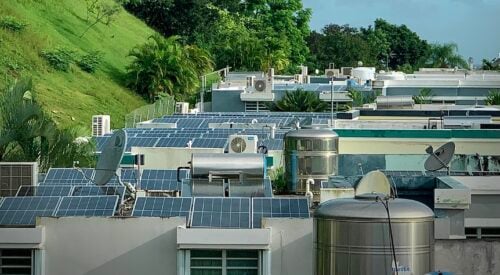
Puerto Rico’s rapid uptake of distributed power has helped it transition away from energy dependency and save lives in the process. Driven by necessity and smart policy, the island has pioneered the rapid deployment of residential solar and batteries, and made waves by establishing the first operational Distributed Power Plant (DPP) in Latin America.
“We went from 9,000 systems, none with batteries, to over 170,000 systems today.”
Puerto Rico is now home to the first operational Distributed Power Plant in Latin America and the Caribbean. The DPP functions by aggregating thousands of local, internet-connected solar arrays and batteries, coordinating them as managed fleets. Currently, over 70,000 households (or 5% of the island’s households) are enrolled in the grid operator’s Customer Battery Energy Sharing program. The batteries are managed by aggregators and create a predictable, powerful energy resource that steps in when Puerto Rico’s unreliable electric grid falters.
“People want to avoid the blackout because after Hurricane Maria, literally over 3,000 people died.
Before Hurricane Maria in 2017, only 9,000 solar systems were installed. None had batteries. But after the grid collapsed during the storm, more 3,000 people died due to lack of basic power. This catastrophe spurred residents to seek out self-reliant alternatives, and today over 170,000 residential solar systems are installed. All of them are equipped with at least one battery. While most batteries are set conservatively as a household safety net, even limited networking provides critical grid relief.
“Residential solar is helping keep the lights on for everyone during the day and during the night.”
Distributed energy systems stabilize the central grid by providing support around the clock. During daylight hours, the island’s 1.2 gigawatts of residential distributed solar help avoid system-wide blackouts by improving critically low reserves. At night, the enrolled DPP batteries prevent blackouts during the peak demand window (7:00 PM to 11:00 PM). These fleets provide the grid with a reliable resource of at least 50 megawatts when it needs it most. This localized power is highly economical, dramatically reduces reliance on expensive, imported, and exceptionally dirty fossil fuels, and minimizes transmission losses.
“Net metering is critical.”
Success hinges on key local policies. Net metering is fundamental, allowing customers to export power for credit. A study confirmed the objective value of solar to the grid (33 cents per kWh) is higher than the retail cost (24 cents per kWh), proving prosumers provide benefits to the rest of society. Furthermore, Law 17 of 2019 mandated lightning-fast interconnection for small systems (up to 25 kilowatts). Installers can self-certify compliance immediately, bypassing the otherwise slow bureaucratic processes. Finally, third-party financing entities like Sunrun leverage the federal Investment Tax Credit (ITC), allowing the 30% benefit to trickle down and making solar-plus-storage an economic “no-brainer”.
The distributed power capacity is expanding organically by 3,000 to 4,000 systems monthly. The immediate opportunity lies in enrolling the rest of the installed batteries — approximately 95,000 units — into the DPP program. Looking ahead, the rise of electric vehicles (EVs) is another source of optimism. EV batteries are four to five times larger than home units, and Vehicle-to-Grid (V2X) technology could lead to a massive, island-wide DPP. While increasing the current $1 per kWh customer incentive is unlikely, focusing on education, strong messaging, and “gamification” can encourage widespread participation and foster collective pride in supporting the shared grid.
See these resources for more behind the story:
This is the 251st episode of Local Energy Rules, an ILSR podcast with Energy Democracy Director John Farrell, which shares stories of communities taking on concentrated power to transform the energy system.
Local Energy Rules is produced by ILSR’s John Farrell and Ingrid Behrsin. Audio engineering by Drew Birschbach. Featured Photo Credit: Javier Rúa-Jovet.
For timely updates from the Energy Democracy Initiative, follow John Farrell on Twitter or Bluesky, and subscribe to the Energy Democracy newsletter.
For this episode of the Local Energy Rules Podcast, host John Farrell and guest Ingrid Vila discuss why rooftop solar should power every home in...
The cost of wind and solar energy keep falling, joined by batteries for energy storage. But while the technology of local grid power has become...
In this episode of Local Energy Rules, Energy Democracy Initiative director John Farrell speaks with Marcel Castro Sitiriche about the challenges Puerto Rico faces in...
Amid the wreckage lies an opportunity for Puerto Rico to rebuild stronger and smarter. … Read More