In December 2020, Washington, D.C., passed the Zero Waste Omnibus Amendment Act. This legislation is a crucial foundation for the District’s organics site management and recycling infrastructure. The Act covers overarching requirements such as a uniform recycling labeling scheme, source separation requirements, a requirement that waste collectors address contamination in recyclables and compostables, and requires the Mayor to impose a surcharge on recycling disposed of at District transfer stations when contamination exceeds a threshold. The legislation establishes standards for restaurants, mandating that the business use compostable and/or reusable food service ware and implement a reuse and donation program to reduce waste in landfills and incinerators. The district’s goal is to curb 80% of waste from landfills and incinerators by 2032.
The dates in the chart below reflect only the dates in the bill, outlined in sections 103 and 104, related to composting. Among those, there are several additional dates for establishing a producer responsibility collection and recycling program for primary and rechargeable batteries and recycling initiatives that can also be found within the bill:
Definitions
“Commercial food waste” means food waste produced by the production, consumption, and preparation of food at a commercial establishment.
“Back-of-house commercial food waste” means commercial food waste separated at the point of discard by employees of a commercial establishment. The term “back-of-house commercial food waste” does not include food waste discarded directly by customers of the establishment, but does include food waste discarded on behalf of customers by employees.
Source Separation Requirements
Beginning on January 1, 2024, multi-family dwellings, commercial buildings, and businesses or nonprofit organizations must submit an annual Source Separation Plan to the Department of Public Works (DPW). Additionally, each district agency must designate a person responsible for compliance and ensure that they are trained annually on source separation requirements. The DPW must collect information from each agency to ensure compliance and to create an annual report that conveys the data. The plans are due annually on April 1 and will be reviewed and verified through on-site inspection by DPW staff.1 Facilities within the district must adhere to such regulations:
- Separate waste in accordance with section 103 [language below] and provide adequate waste collection service in accordance with section 104 [language below]; and
- Maximize diversion of waste from landfill or incineration, including through promotion of reduction, reuse, repair, donation, recycling, and composting, including donating reusable goods to the maximum extent practicable.
Compost collectors must also follow updated guidelines. If a collector finds materials that aren’t designated for a container, they must notify the customer of the incorrect materials. Afterward, the collector must document the contamination in the collected solid waste. Additionally, upon arrival at the District’s transfer station for disposal, collectors must, upon DPW request, provide an accurate list of all customer locations from which solid waste was collected.
Commercial-Specific Requirements
There are two options for businesses for processing their food waste, as outlined in section 103:
(2) Source-separate all back-of-house commercial food waste generated at its premises and:
- Arrange for the separate collection and transport of the back-of-house commercial food waste to an organic waste processing facility or to processors for use as animal feed; provided, that such collection, transport, and disposal follow all applicable Federal, state, and local laws; or
- Process back-of-house commercial food waste using an on-site organic waste processing system
If processing on-site, businesses must adhere to the following guidelines:
- Any on-site composting shall be in-vessel composting or a processing system approved by DPW
- All equipment shall be properly sized to handle and process back-of-house commercial food waste generated at the premises in a safe and sanitary manner
- All equipment shall be installed in accordance with the applicable plumbing code and wastewater discharge regulations
Businesses must donate excess edible food consistent with the Good Faith Donor and Donee Act, which encourages food recovery by ensuring donors aren’t penalized if donated food inadvertently causes harm.
Bins are color-coded using the District’s guidelines: blue for recycling, green for organics (composting or anaerobic digestion), and black for trash. Containers for the waste must also be consistent with the District’s requirements:
Ensure proper storage for food waste on site, including a container with a secure lid, that will ensure that it is maintained separately from all other materials generated at the premises, is not commingled with recyclable material or trash, and does not create a public nuisance
Employees must be up to date on the regulations through training and signage posted throughout the workplace. To train employees, the business must: provide regular training to employees on the proper methods for separating and storing food waste; and post comprehensible, visible instructions in an accessible location, in multiple languages as appropriate. Signage must be posted clearly and legibly; include the trade or business name, address, and telephone number; and indicate that the entity which transports its own food waste or the entity provides on-site processing for food waste it generates on its premises.
Mayoral Authority and Districtwide Initiatives
The act grants the Mayor and City Council authority to conduct several outreach and education activities to community members in the District. These activities include:
- Technical support to colleges and universities, retail food stores, arenas or stadiums, hospitals and nursing homes, and private waste collection properties
- Conducting regular public education and outreach on the benefits of donating excess edible food and source-separating compostable materials
- Not prohibiting food service entities from composting or source separating compostable materials, as long as they provide adequate consumer-facing waste collection service
- Issue grants to universities, nonprofit institutions, and businesses to promote sustainable waste management and diversion practices, policies, and techniques, including solid waste research, collection, marketing, and other services2
Government Initiatives
The act mandates that DPW establish a grant program to provide financial support to businesses and nonprofits for leasing or purchasing an on-site organic processing system (e.g., an in-vessel composter or an aerobic digester). Grants are to be awarded on a competitive basis, and if awarded, the DPW has up to three years following the award to audit the grantee’s accounts.
Additionally, the Department of Energy and Environment (DOEE) shall establish a Donation and Reuse Program to reduce waste and increase diversion of reusable materials, including edible food, from landfills and incineration through donation or reuse. With support from D.C. organizations, the program will:
- Develop or promote public-facing technology platforms for direct donation coordination and to facilitate the exchange of used and surplus materials
- Perform public education and outreach on avoiding single-use products and encouraging reusable items
- Increase public awareness of and access to opportunities for reuse and donation;
- Support and expand the District’s reuse infrastructure, including through site donation drop-off, Fix-It clinics, and non-governmental donation facilities
- Prepare for and respond to emergency situations that result in surges of unsolicited donations in partnership with non-governmental donation facilities
Similar to the DPW’s Annual Solid Waste Diversion Progress Reports, the DOEE must also publish annual reports on the previous year’s findings, including whether regulations were met, the impact achieved, and recommendations for further increasing donation and reuse in the District.
The Office of the State Superintendent for Education may award grants to local educational institutions, schools, nonprofit organizations, or partnerships between schools and nonprofit organizations. These grants will help reduce food and food packaging waste at schools and expand food access for those in need. Grants will be awarded through a competitive process or formula. Examples of projects that may be funded include: the purchase or provision of reusable food service ware and food waste packaging reduction programs.
Residential Food Waste Collection Program
In January 2023, the Battery and Electronic Stewardship Amendment Act was signed into law. Composting legislation was also included in the bill. Upon completion of the pilot program, the DPW must provide information to the Council and the Mayor.
When planning the Fiscal Year 2023 budget, funding was allocated towards a curbside composting pilot program. After the pilot’s completion, the DPW provided the program’s total and broken-down costs, quarterly participation rates, and quarterly compost contamination rates to the City Council and Mayor.
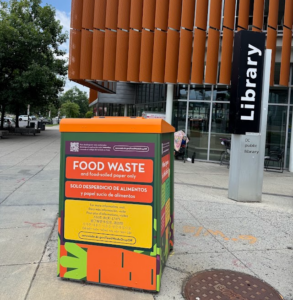
In August 2023, the DPW launched the Curbside Composting Pilot Program. After the 12-month pilot concluded, it transitioned into a permanent program called the Food Waste Collection Program. With the addition of residential collection, residents also have the option to drop off their food scraps at the newly installed Food Waste Smart Bins. These Smart Bins are available 24 hours a day and can be accessed using the MetroKEY app or a keypad access code. Additionally, food waste drop-off events are hosted at farmers’ markets and community sites on Saturdays and Sundays. In January 2026, the event days were updated to move away from seasonal events, and weekend food waste drop-off events are now year-round.
More Information
- Curbside Composting Pilot Program – Zero Waste DC
- “Washington, D.C. From Farmers’ Markets to Curbside Collection”, Case Studies for Keep Compost Local Report (p. 66-70) – ILSR
- Food Waste Drop-Off – Zero Waste DC
- Zero Waste Omnibus Amendment Act – Council of the District of Columbia
- Battery and Electronic Stewardship Amendment Act – Council of the District of Columbia