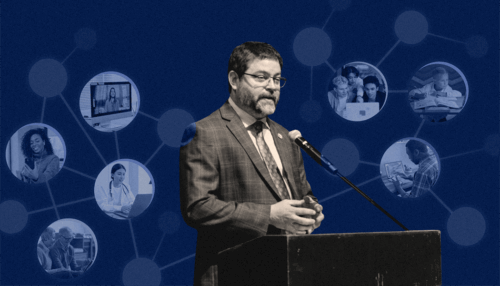
Christopher Mitchell Responds to Trump’s Abandonment of Digital Equity Act
The President’s actions “will result in much higher costs for slower, less reliable Internet access for millions of Americans,” says Christopher Mitchell.
Podcast (buildinglocalpower): Play in new window | Download
You’d think a company with as many resources, employees, and facilities as AT&T or Comcast would have good customer service. Surely, with all the billions of dollars flowing through these businesses, there’d be some resources devoted to creating a really good customer experience, right? If only that were the case. The thing is, these telecom monopolies are so big, with their power so entrenched, that it doesn’t matter if their customer service is good. When you control the market, you control the market whether customers are happy or not. Time and again, smaller, locally-controlled telecom companies and networks have better customer service and better products. Because they’re small and connected to their communities, these small companies have greater motivation to please their customers. Plus, since they’re competing against giants, they have a lot to prove to their customers. This is the crux of one of Christopher Mitchell’s arguments about why community broadband matters.
Christopher Mitchell“Talking about Internet access sometimes feels like you’re running a city and someone wants to talk to you about concrete. You’re like, ‘What do I care about concrete?’… I don’t know, it just underpins everything that you do.”
Christopher Mitchell, today’s guest on Building Local Power, is the head of ILSR’s Community Broadband Networks Initiative. Community broadband networks can take many forms, from municipal networks to co-ops and more. These networks are important, says Mitchell, not just because they’re better for consumers but because Internet access is essentially a human right in the contemporary world. Reliable and affordable Internet access isn’t just about social media and Netflix; everything from healthcare to education and beyond relies on a good Internet connection, all the more reason to leave broadband access in the hands of local communities. On today’s episode, Christopher explains all this, as well as sharing his thoughts on his friend, ILSR’s recently passed co-founder David Morris. It’s a compelling conversation with a passionate advocate. Have a listen.
Danny Caine
Telecom monopolies like Comcast or AT&T control how most Americans connect to the internet. I’m sure that’s scary enough to much of our audience, but it’s worth pausing to think about what exactly that means. For one thing, I can’t make this antimonopoly podcast without accessing the gatekeeper between me and the tools I need, a monopoly. By controlling our access to the internet, these monopolies have a hand in how millions of people communicate, entertain themselves, work, and even access healthcare. The problem is so huge and so complicated, it’s easy enough to just throw up your hands and say, it is what it is. There are people who refuse to do that though, and ILSR’s Christopher Mitchell is one of them.
He’s leading a team to dream up and advocate for telecom alternatives a community focus. Through ILSR’s Community Broadband Networks Initiative, Christopher and his comrades are working tirelessly to return broadband access to community control, searching for ways to make internet access more accessible, affordable, reliable, and human-centered. Christopher is today’s guest, and we covered a lot in our half hour together. Listen on for Christopher’s thoughts on the importance of broadband access, the challenges of funding his work in today’s political climate, and his remembrances of his friend, ILSR’s co-founder David Morris. Thank you for using a bit of your internet access to listen to our show.
Christopher Mitchell, thank you so much for joining us on Building Local Power.
Christopher Mitchell
Thank you. I’m glad to be back on the show.
Danny Caine
I want to start with a little bit of a story and it’s going to end in a question. So bear with me. I recently moved. I bought a house, which means it’s time to select an internet provider. In the area I moved to, it was between AT&T and Spectrum, I decided AT&T basically on a coin flip. As part of the installation process, they sent what they called something like a customer service specialist to my house. Allegedly to answer any questions I have about my new AT&T internet service, but it becomes very clear once this guy arrives that he’s trying to get me to sign up for AT&T cell phone service as well. And he, he’s got the big pitch. makes it like a theatrical production of like calling his manager to get the best rate for us. And like, weirdly he does save us a lot of money. And so I ended up saving 80 or a hundred bucks a month on this. So we do sign up and he drives off to the AT&T store, gets the phone, brings it back to our house and sits on the couch and sets up the phone while we eat dinner. But now, I’m pretty sure my cell phone service is worse and I don’t think my internet is nearly as fast as they promised it would be. Given your perch as a broadband access activist and an anti-monopolist, what’s wrong with that story?
Christopher Mitchell
Well, you know, it’s interesting because we have a beloved local provider here in Minneapolis. I’m in St. Paul and they’ve been expanding a little bit. And this is really relevant because they’ve just decided to sell out to T-Mobile, it looks like. And I’ve been going through Reddit and it’s a reminder of how great local service can be. So USI is this company and you just look on Reddit if you want to search for USI Minneapolis and look at what people are writing.
And people have all these amazing stories about how USI would solve their problems immediately, how it was great service. then you look at people’s reaction to becoming a T-Mobile customer, and they have all these horror stories to share of like waiting in line forever. Because if you’re a massive corporation that primarily extracts wealth through monopoly, it means that you don’t care how long Danny waits on the phone. in fact, the longer you wait, the better for them because it’s fewer resources that they’re spending. The more people will hang up and just say, I guess I’ll just deal with it. Whereas a local company, almost always local companies are coming in and competing because they’re the competitor, right? There’s a market where AT&T or charter is there already. The local company is a competitor. So they know they have to provide high quality service, reasonable pricing.
Danny Caine
Mm-hmm.
Christopher Mitchell
And they also know that they are rooted in the community. And so if they treat people poorly, those people will react to them when they see them. And so there’s a whole bunch of incentives for why local is better. But we have structured our telecom system to make it very hard for local services. All the incentives are for private companies to centralize. a lot of them that resist it eventually will succumb over time centralization, unfortunately.
Danny Caine
That idea of actual competition making service better. Like in theory, that’s how capitalism is supposed to work. as these telecom monopolies take over, we see less and less of that.
Christopher Mitchell
In capitalism, like, I tend to think of markets, and we want markets to have choices so that there’s a restraint on a tendency to do things poorly an incentive to be innovative and that sort of a thing. And it’s very clear that our version of capitalism is not resulting in markets that are structured well for outcomes that would be good for you and me. in telecom, it’s difficult because if you’re a bakery, we could have 10 bakeries within two miles of a person in a city.
It’s unlikely that we’re going to have 10 telecommunications companies because of the high cost to build it. It’s similar to electrical systems, as I’m sure you’ve discussed with folks on the energy team. And so it’s more difficult than to figure it out. And that’s why we focus on public ownership, because if we cannot have robust private sector competition, then we need structures that will be responsive to our needs. And that tends to be local government or some form of cooperative arrangement, which is much more common in rural areas for utilities it is in urban areas.
Danny Caine
That all leads me directly to my next question. So given all of you know, asking for a friend, say a person is frustrated with the between a rock and a hard place of the AT&T versus Spectrum choice, know, is interested in the idea of this public ownership or an alternative or a telecom company that is interested in my experience as a customer. What do I do? should a person do to kind of get the ball rolling?
Christopher Mitchell
You know, this is where you should go back and just insert Stacy’s answer to a previous question about talking to your neighbors and organizing locally, because it’s the exact same response that I would have. in a few cases, we know that there’s a place in Michigan where a person was fed up with Comcast and they built a network for their neighbors and themselves. It’s very rare. It’s very difficult to do that. And this is something where the internet seems mysterious. So I like to use an analogy of, of roads.
You know, imagine if you lived in an area where there are no paved roads. Well, you’re probably not going to try to figure out how to like build a construction company to pave it yourself. You’re going to demand your elected leaders meet your needs. And so the first thing is, Make sure your electeds are hearing from you because they hear every day from the lobbyists of the cable and telephone monopolies that everything’s great.
They need to hear that there’s problems. then you really do need to talk to neighbors, local You want to put together a group of people that has some broad representation to pressure your elected local leaders at the city council to look into options. And I’ll say that one of the things that some people will say back in response is, don’t even, I don’t know if I want my local government to get involved with this. Well,
One of the things that we’ve seen is that even when local governments start to think about making an investment to build their own network, that the existing companies suddenly will invest more, cut prices and do better. And a phrase about the mouse that roared. And so it can be helpful to go in that direction, even if you don’t necessarily intend to end up there.
Danny Caine
One person writing one review online is very different than an entire community beginning to organize and mobilize.
Christopher Mitchell
A two-star review for like a local provider is a big deal. And they may actually just like, you know, reach out to you proactively to talk to you about it. Whereas, you know, if you’re AT&T or a charter, you get two-star reviews all day long and you don’t much care. So yes, people need to be active. And that may mean starting talking to the neighbors, talking with local business owners and recognizing that there may need to be some public investments.
There’s a variety of ways that that could take and we’re not going to get into that because it could take all day. But cities don’t just have one model to choose from. They actually have a variety of options some would involve them offering services as the city and others would be where they would just make investments to allow other private companies to try to investments. And that can help in the short term. Although I think in the long term, we were going to need some kind of regulation.
And we’re probably going to be another five or 10 years before I think we really start to sort that out. So you’re going to be in pain for a little bit here, Danny, with the choices that you’ve made, but the way government structured things, you never had an option to make a good choice. So that is something that we need to change in the future.
Danny Caine
And you mentioned these different models. We don’t have time to go into detail, but I imagine the community broadband team has resources that we can point people towards to explain the details on that stuff if they’re interested.
Christopher Mitchell
We do have some resources. I do feel like this is such a complicated and big subject but there’s still so many issues that we work on that ⁓ I would love for people to say, hey, you’ve got great resources on this, but we need more resources on that. So people should check out communitynetworks.org, which is where we really focus a lot of our effort, as well as ilsr.org for the resources we put up there. On communitynetworks.org, you’ll find a lot of resources and we’re always interested in what would be helpful for folks that are working through this.
Danny Caine
Let’s take a step back. You know, ever since I’ve known you, you’ve been this advocate working so hard to advance these issues. I have no idea how you got started or interested in this. So can you tell us what piqued your interest in community broadband and how did it become your career?
Christopher Mitchell
Yeah, what piqued my interest is I wanted a job. So I was fortunate to grow up in a tech savvy family. My dad had actually gone back to school when I was young. And he got a degree, got into computers. ⁓ I was lucky enough to have a computer growing up. And so in the early 90s, I got on the internet earlier than most people.
I then started doing websites and building stuff. So I was a server administrator, web designer, and programmer ⁓ for a while. And I went to grad school ultimately. I was really interested in public policy, and I was particularly interested in foreign policy when I started. But I became more interested in information policy. Like how do people make decisions based on the information that they have? And that then led to me being more interested and utility policy oddly enough. I had an she got me very interested in utility type stuff and then as I’m getting ready to graduate grad school this job opportunity opens at the Institute for Local Self-Reliance and I was like this looks like a place that’s very aligned with my values of wanting to have decision making at the local level of distrusting centralized hierarchies and things like that. And I started and I hated it because like most of the listeners at that point, I didn’t know what a CLEC was. I didn’t know what an ILEC was. And I’m not going to tell you because it’s not really worth a lot of people’s time, but I didn’t know how telecom worked. I knew a lot about networks and computers and it was really hard.
And David Morris, who was here, really helped me. And I got advice from that same advisor who was like, don’t give up, know, like, stick it out, learn about this stuff. I found some great mentors. And then I found that this was a space that was really wide open and you could do whatever you wanted because there were so few people working in public interest, internet access type stuff. And so then we found some wonderful funders that have helped us to grow over the years. we’ve had these great teams.
I guess the last thing I would say about that is we would not be here today if not for Lisa Gonzalez, who was one of the first people that we work with me on this program. And she and I built it up to what it was, along with several other people who were in and out along the way, some of whom continue to work with us from time to time, and we have great relationships with. make a difference. And working with Lisa was just really terrific.
And she taught me a lot about how to manage and that sort of a thing. And so, know, I haven’t looked back. It’s exciting and we’re trying to figure out what the future will hold, but it’s very clear that we’re not about to solve this issue tomorrow. Right now we’re focused on public housing. There’s a lot of challenges with low income people in cities where they cannot get high quality internet access and that’s the next frontier. And I would love to imagine what we’re gonna do after that, but this is such a high hill to climb that I don’t know how long it’s going to take.
Danny Caine
Let’s bring it to the present day. A couple of weeks ago, we talked to your colleague, Sean, about the Digital Equity Act. for those who haven’t listened to that President Trump just kind of canceled that funding like he’s doing with so much else.
He’s like, the government’s not gonna pay for this congressionally approved funding anymore, kind of pulling out the rug from one of the more major government investments in telecom access ever. So now that we’re a couple months out from that decision, how have you seen community broadband folks responding? Has anyone been able to adapt to the new reality? And if so, what lessons can we learn ⁓ from them continuing their work despite the kind of political adversity and the withdrawal of funding?
Christopher Mitchell
It is very challenging. And so, like you said, the Digital Equity Act, it would have been the most significant investment we have on that issue that I was just raising regarding public housing. And it would have paid for a lot of people to get devices and training and paid for a lot of the work around that to make sure people could access the internet. So that was one aspect of it.
That’s been totally canceled, like you said, illegally, I think the courts will find. At the same time, we’re dealing with the access infrastructure investment. So there was $42.5 billion set aside for building networks out to primarily rural folks. That has been significantly changed in ways that we’re still trying to see what the results will be. But just so people are familiar, there’s been a change both to the program to build networks and then the program that was going to people to be able to use networks who have not had that sort of background and training before. the access program was changed and the for ⁓ equity to help people in more commonly in urban areas to use the networks with devices and training, that’s been totally removed. It’s been a real challenge.
What happened is that lot of nonprofit organizations, some companies, a lot of states and cities were all expecting that they were gonna have funds to do this important work. Important work not just to improve the lives of the low income folks who are primarily gonna benefit, but for all of us, right? Because if we make sure that people who are receiving Medicare and Medicaid, and this is…
This isn’t just people who might be disabled. This could be veterans who are trying to life. is all manner of people. If we’re able to make sure that they can access the internet, it means their healthcare costs will be lower. It means that they will be better able to improve their lives and not require public assistance as much moving forward. That’s all been gutted now. And so it means we’re not saving taxpayer dollars.
We have decided to pay more in taxpayer dollars in the future for people’s increased medical costs for their, for inefficient systems that rely on them having to go across town on a bus, wait in a line, and then talk to a human being face to face rather than solving the problem online at a much lower cost to taxpayers. it’s disastrous.
And I’ll just say that fortunately, the people that are trying to do this work, they’re doing everything they can. They’re like, I just suddenly thought of John McLean crawling over broken glass to try to figure out what they can do with the few dollars they still have available. And we’re hoping that the courts will reinstate this funding and that the states will be able use it effectively. But we don’t know what the future holds.
Danny Caine
It’s all overlapping. It’s not just like how fast I can watch a YouTube video. You recently contributed to reporting that discussed, for example, the connection between broadband access and reproductive care. So, you know, this idea of fast and reliable internet access really affects every corner of our lives.
It’s something for people to sit and reflect on, I think, especially those making these decisions about what to fund.
Christopher Mitchell
Yeah, no, I made a joke a few years ago that talking about internet access sometimes feels like if you’re running a city and someone wants to talk to you about concrete, you’re like, what do I care about concrete? And it’s like, I don’t know. It just underpins everything that you do. But at the same time, it’s not sexy. It’s not. Let me throw out to you an interesting thing, which was heard survey in North Carolina back before the pandemic. And it asked about a range of questions, including the state of the economy, education, what are the main problems that people wanted to see fixed? 70 out of 100 counties had replied that internet access was like one of the top priorities. And we were kind of surprised by that because that’s certainly not reflected in the priorities in the capital in we tried to make sense of it, we saw that it was true in other places too, because people recognize that they couldn’t fix education or the economy without resolving internet access.
Healthcare is only going to get worse for people who are losing their rural clinics and they don’t have telehealth as a viable option. And so people recognize that this is something that we’re not doing internet access for an internet access sake, right? This isn’t about Netflix. And sure, people will use Netflix once it’s available but it is fundamentally about education and economic opportunity, telehealth and things like that.
Danny Caine
And it’s this idea of making it sexy or kind of bringing people onto the bandwagon or finding compelling ways to talk about this. seems like this question of AI and large language models has really brought up questions about the capacity of our computing infrastructure got the data center question, the use of water, environmental impacts. It’s certainly driving some discourse. Do you think this AI discourse is a chance for the community broadband folks to find a new angle? To maybe kind of sell this to people who were apathetic before.
Christopher Mitchell
I think my answer is much like Dumb and Dumber, which is, you think there’s a one in a million chance? So you’re saying there’s a chance. I think there is a slim chance to turn this, the AI discussion a way that could benefit the things that we would like to see in terms of internet access. you know, what we’re focused on is how to improve internet access for people that are caught in a cycle of poverty. And the people who are talking about AI, they only want to talk about poverty. I mean, this is a broad brush. It doesn’t apply to everyone. But a lot of the people who are doing it, they’re trying to figure out how they can make a buck. people who make money off people in poverty. As we’ve heard many times, it is expensive to be poor. But I don’t think we’re going to see a lot of opportunities to really improve people’s lives. people might have heard about the fiber boom of the 1999 and 2000s and then the bust.
That was building fiber between cities. It wasn’t building it out to low income neighborhoods. And with the fiber that we’re seeing around AI, it’s similar, right? They’re trying to figure out how to get the data centers. They’re not going to be connecting public housing along the way, most likely. So I’m afraid I’m a little bit down on that possibility.
Danny Caine
That makes sense. Now I want to talk wins. I mean, we just spent a couple minutes really exploring some challenges and some perils of this work, but I’m sure throughout your long career you’ve had some big wins. So can you tell us about a community broadband success story?
Christopher Mitchell
Yeah, I was there before Chattanooga was building their network. I was brought in ⁓ to see what they were doing and to help write about it. We wrote a case study about it. It’s one of the best networks in the world. And this is not a win that I can take any credit for. It’s great folks there that have really organized. I Chattanooga is a real model of success and community decision making in a lot of ways. And it still has a way to go with poverty and other issues as well. they’re using their network to try to address that.
And it’s been exciting to have been there before it was started and to see it being developed now, what it’s come into, where this generated so many benefits for the community. We’ve been involved in documenting a number of really exciting networks that have been built, economic benefits for the community.
But the things that I think about are work we’re doing now with Tribal nations. ⁓ for the past four or five years now, I’ve worked with Matt and we’ve been doing the Tribal Broadband Bootcamps and seeing where here, again, a few individuals can really make a big difference where they’ve into the work, and they have taken every opportunity to educate themselves, and we’ve met them along the way.
We helped introduce them to people, and now they’ve received money from the federal government order to build that was ⁓ created under the IIJA or the previous, there’s several rounds of funding that were available to Tribal nations. It’s making a difference. It is building networks, networks that would not have been built otherwise because they are so expensive to build in these rural areas that have had so little economic investment in them.
And I’m excited to see what comes next as people then figure out how to take advantage of them for language preservation and ⁓ preserving culture and that sort of a thing. So those are the things that come to mind first. But then guess I would say one other thing, which is I have been around long enough to see some people where I knew them as they were coming out of school and now they’ve gone on to do really cool things and watching what they’re doing.
I learned from Sasha Meinrath, who founded the Open Technology Initiative, which became the Open Technology Institute at New America and has gone on to do important things. People are so core, and every chance we’ve had to bring in good people and try to nurture them and help inspire them, that’s where it’s exciting to watch what those people go on and do, because it’s people that make a difference, ultimately.
Danny Caine
Yeah, well, that’s building local power right there, right? You organize, you focus on people, you figure out what you can do in your community, and there’s great power in that.
Christopher Mitchell
Promising people don’t always know it, right? Like when you see someone that has a lot of potential, they don’t necessarily know it. And it can be really helpful to reinforce that for them and to help them to better see that they’re special and that they can, you know, where they can really make a difference. So people should reach out to each other and be sure to like, you know, just be good to each other and encourage people along the way. We don’t do that enough for each other.
Danny Caine
And again, all this talk of people power, of course brings up the philosophy and work of David Morris, who has inspired so many of us here at ILSR. I know you worked really closely with David before he passed away. Can you talk about how his legacy is shaping what you do and how you think about it today?
Christopher Mitchell
I’ll try. David was so important to me.
If I had something that was on my mind, I would go and talk to David. And if I didn’t have anything that was on my mind, I would go and talk to David. I would pop into his office regularly. I think I probably upset him more than anyone else with weird questions and refusing to agree with him on certain points that he thought were obvious. But he shaped the way I think and the way that I just see the world and in so many ways. And the thing that I think you’ve captured it well in talking to other people.
But I want to share that the thing that I think you didn’t understand about David is the joy that he brought to the work. He knew more about the ways in which humans have treated each other poorly than most people. And he didn’t let it stop him from trying to build a better world.
You could talk to David about really challenging things and still keep it light and recognize the, you know, some of the humor or the dark humor in things, I think. And so David was great to work for. He was so challenging. And it was hard because he could point out with a single question, you know, well, you didn’t recognize, you didn’t know about something. ⁓ And some people, I think, did not like that.
Some of us found it really challenging and ⁓ really sort of thrived under that, pressure. the thing was just that always that David had such a good heart and He worked so hard to use his gifts to make the world a better place. And ⁓ even though, you know, he, I think was at times really frustrated, he would never stop, he just did it with such joy, and he was so great to work with that ultimately that’s what I think about on the regular.
Danny Caine
That’s really lovely. And I think it’s important to hear that for many of us in a world like today’s. Mitchell, thank you so much for joining us and sharing your reflections and telling us about your amazing work.
Christopher Mitchell
Thank you. I’ve been really enjoying the shows.
Danny Caine
Check out the show notes for some links to the resources Christopher was talking about. There, you’ll find details about the Community Broadband team’s Tribal Nations work, as well as their podcast, Community Broadband Bits, which Christopher happens to host. On the subject of podcasts, I wanted to let you know that Building Local Power is gonna take a bit of a break to relaunch our show in an exciting new format. I’ll have more details to share in the coming weeks, but I can say that we’re gonna go deeper than we ever have on a variety of problems facing our communities and how communities are coming together to solve them. We’re excited to share it with you when it’s ready. In the meantime, stay tuned for some visits to the Building Local Power archive. episode of Building Local Power was produced by me, Danny Caine with the help of Reggie Rucker. I did the editing with help from Téa Noelle who also composed the music. Thank you so much for listening and see you soon.
The President’s actions “will result in much higher costs for slower, less reliable Internet access for millions of Americans,” says Christopher Mitchell.
Former BEAD Director Evan Feinman joins Christopher Mitchell & Sean Gonsalves on the Community Broadband Bits podcast to discuss the turmoil around the BEAD program.
The federal BEAD program should not repeat past policy mistakes and waste billions of dollars delivering subpar Internet access to households at higher prices.
This past summer, the Institute for Local Self Reliance in conjunction with Matt Rantanen and Internet Society convened the first ever Tribal Broadband Bootcamp in California.… Read...