Across the nation, families and individuals are struggling to keep up with skyrocketing electric bills. Electricity prices have soared in recent years, dramatically outpacing both inflation and wage growth. Low‑income households, especially Black and Native American families, bear a disproportionate share of high energy costs. More and more households are falling behind on their utility bills, or having life-sustaining power cut off due to nonpayment.
Excessive utility profit rates are a key driver of these problems. In exchange for a legal monopoly over the public good of electricity, for-profit utilities agree to have their prices set by state regulators. Regulators also set the rates of profit – also known as return on equity – utilities can pay their investors. These approved profit rates are too high, and are costing U.S. customers an extra $300 per household, or $50 billion per year.
Utilities overcharge customers to overpay their investors
State regulators are setting utility profit rates too high – allowing utilities to overcharge customers by billions in order to overpay their investors. Because utilities enjoy a government-backed monopoly over an essential service, their investors take on a very low risk of losing money. Customers can’t shop around for better prices or service, and they can’t go without electricity – so utility profits are practically guaranteed. The low risk premium associated with safe-bet investments means utility investors should expect low returns. Instead, utility risk premiums and returns on equity have been climbing since the mid 1980s.
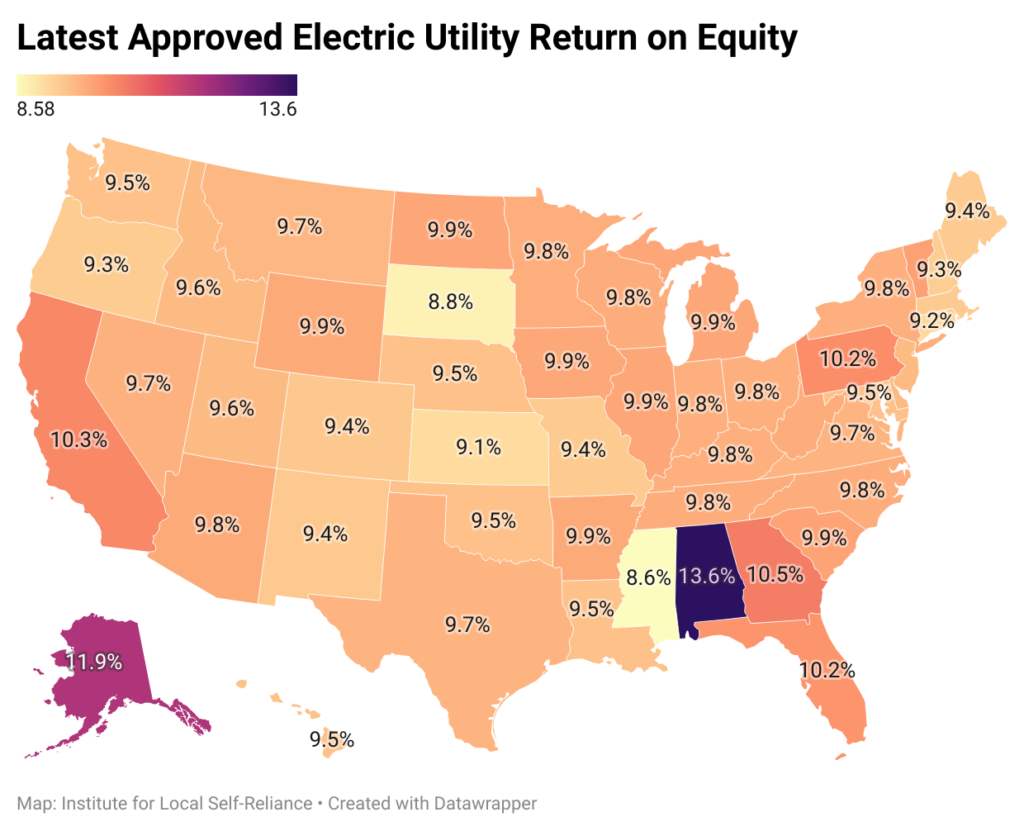
The following map shows the latest return on equity approved by state regulators in each state. This percentage is the amount utility shareholders earn in profit on every dollar the utility spends on new power lines or power plants.
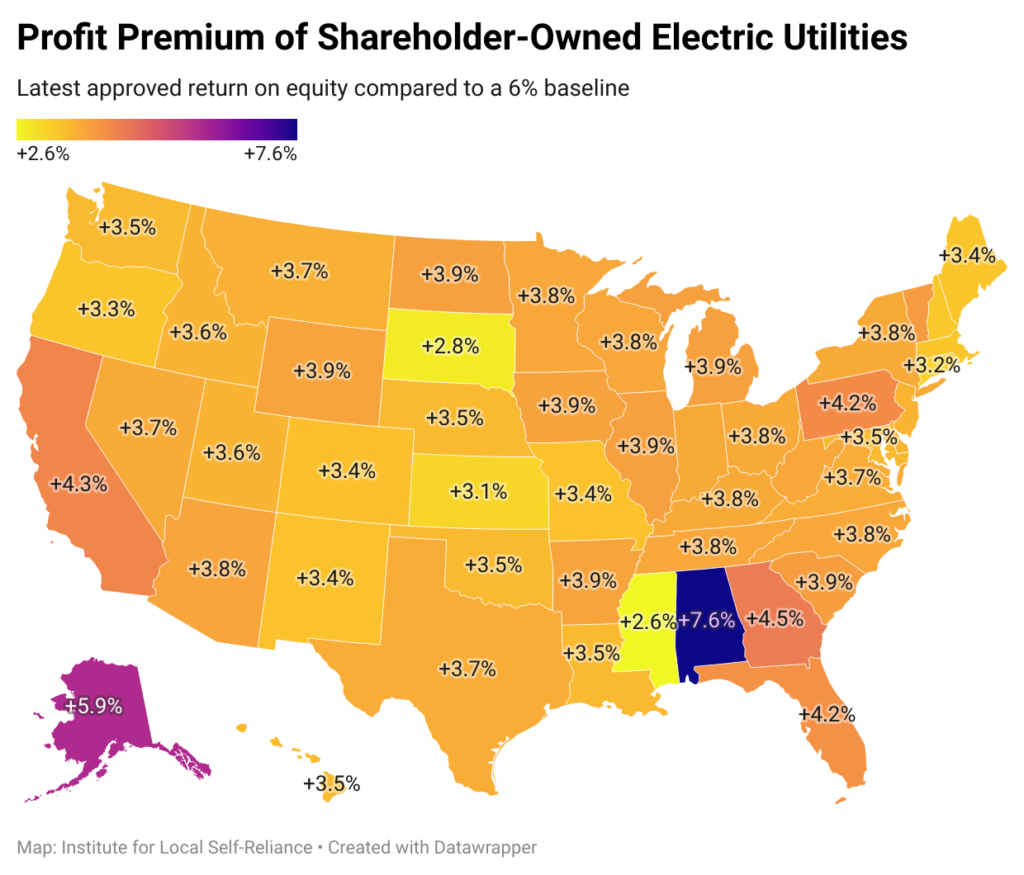
The following map illustrates how much more utilities get paid than they ought to earn. It subtracts a fair rate of return – the 6 percent offered by Ellis – from the premium rate state regulators have actually given utility companies. This excess profit is what causes the average residential customer to overpay utility shareholders by $300 per year.
The utility business model exacerbates the profit problem
The way utilities make money multiplies the effect of these excessive profit rates, creating a double whammy for consumers. The more utilities spend on capital investment in new grid infrastructure, the more they are allowed to raise prices to guarantee profits to investors. This business model discourages cheaper, non-capital solutions like energy efficiency and grid maintenance.
Utility grid spending has exploded in recent years, outpacing electricity sales and inflation combined. Analyses of high electricity prices have found that runaway utility spending on new infrastructure – made worse by unreasonable profit rates – is a main or major culprit. For each dollar of capital utilities invest in infrastructure, they extract as much as 50 cents in profits from customers.
Millions of households across all 50 states are already economically burdened by energy costs. Amid the dismantling of federal support for clean energy, the recommitment of many utilities to coal and other fossil fuels, and the rapid development of data centers, electricity prices are expected to climb even further. Lawmakers can take steps now to act in the interest of consumers – rather than utility shareholders.
Policy solutions for state and local lawmakers
Cut utility profit rates: State utility commissions can lower electric bills practically overnight by reducing utility profit rates. We know that utilities can maintain high-quality service with lower profit rates because they did so in the 1970s and early 1980s, before risk premiums increased. Returning profit rates to those lower levels can also more than offset any increases in borrowing costs that might result from impacts to credit ratings.
Pay utilities for performance: Adjusting incentives to pay utilities for performance instead of capital investment can save consumers billions. State legislators can look to Hawaii’s example as the first state to fully disconnect utility profits from spending. Aligning utility profit motives with performance, or at least efficient investment, can lower electricity bills.
Clear the way for local power and storage: Local solar and batteries make electricity in the same place it’s used, and more of each saves everyone money. Models suggest that scaling up distributed energy resources like rooftop solar, batteries, and smart thermostats could cut future grid costs by half a trillion dollars. State and local legislators can remove barriers to scaling up these resources by streamlining permitting and zoning requirements, allowing non-utility ownership of solar projects, and fairly compensating solar owners through net metering.
Five Tactics for Fighting Utility Rate Gouging – Episode 226 of Local Energy Rules
Mark Ellis spent years as a chief economist and chief of corporate strategy for investor-owned utilities. He now testifies in support of intervenors. Here are...
Greetings From Hawaii, Where Utility Profit Depends on Performance — Episode 130 of Local Energy Rules
For this episode of the Local Energy Rules podcast, host John Farrell and guest Isaac Moriwake discuss how Hawaii’s new performance-based utility regulation will adjust...