Catalyzing distributed and diverse local composting across the country to cut wasted food, enhance soil, protect the climate, and build community.
Education and Outreach for Residential Composting Programs Grants (RCP Grants)
Led by the Institute for Local Self-Reliance (ILSR) in collaboration with World Wildlife Fund (WWF), the Education and Outreach for Residential Composting Programs Grants (RCP Grants) will focus on increasing the collection and composting of residential food waste through community engagement. Grants range from $75,000 to $250,000.
Webinar – Rural Community Composting: From Operations to Outreach
What does local composting look like in places with lower population density? How do you conduct successful education and outreach in small towns? In this webinar, you’ll hear success stories and lessons learned from three community composting operations in rural and tribal communities. Join live on December 8th at 1:30 p.m. ET.
El compostaje local es una de las formas más sencillas y efectivas en que las comunidades pueden ejercer su poder para proteger el planeta. La interactiva ILSR Kit de Compostaje Local tiene los recursos que necesita para promover el compostaje local —como compostador, agricultor, legislador, defensor o funcionario del gobierno local— todo en un solo lugar.
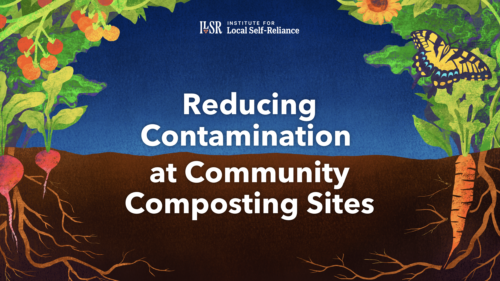
Reducing Contamination at Community Composting Sites
ILSR’s Reducing Contamination at Community Composting Sites is a virtual course for community composters looking to create the highest-quality compost from collected food scraps.
17 Case Studies Model Local Government Programs and Partnerships with Community Composters
Partnerships between local governments and community composters have the power to transform a city’s capacity to embrace more sustainable alternatives of waste management. These 17...
Mantener el compost local: una hoja de ruta para que los gobiernos locales fomenten la prosperidad de la comunidad mediante el compostaje.
Un informe que ofrece orientación a los municipios para apoyar y colaborar con iniciativas locales de compostaje, cumpliendo sus objetivos de compostaje y fomentando al mismo tiempo innumerables beneficios económicos e intersectoriales.
Iniciativa comunitaria de compostaje
Manténgase al día con nuestro boletín informativo, The Compost Pile.
Qué hacemos
Catalyze distributed and diverse local composting around the country in order to cut wasted food, enhance soils, support local food production, and protect the climate while addressing community prosperity and equity issues.
En nuestra serie de seminarios web, exploramos una variedad de temas relevantes para los compostadores comunitarios, desde el clima hasta los permisos de transporte.
Nuestro mapa ofrece una ilustración interactiva de cómo las comunidades buscan desarrollar la capacidad y las empresas de compostaje a nivel local.
Nuestra visión
Comunidades prósperas y equitativas que practican el compostaje para reducir los residuos, mejorar el suelo, proteger el clima y fortalecer la comunidad.