Community Leaders On the Power of Locally Owned Clean Energy
Locally owned clean energy projects are helping communities grow jobs, build wealth, and make their own decisions — even as the federal government cuts support for clean energy.
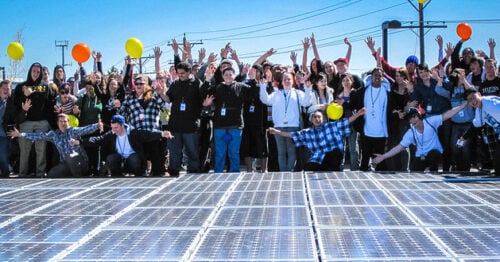
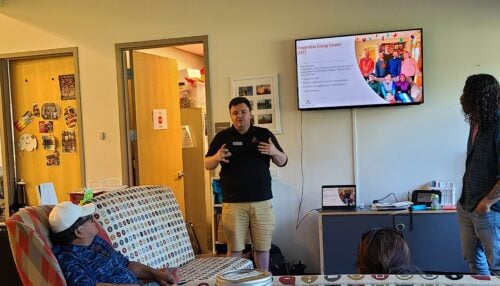
In spring 2025, three energy democracy experts joined a webinar highlighting ILSR’s report, Advantage Local: Why Local Energy Ownership Matters. Crystal Huang of People Power Solar Cooperative, Sachiko Graber of Cooperative Energy Futures and Waxwing Consulting, and Yesenia Rivera of Solar United Neighbors laid out how communities across the country are breaking down barriers to build local projects and bring the benefits of clean energy home.
Maximizing Community Benefits
When communities develop their own energy projects, they get to keep more of the financial benefits instead of sending off the profits to a third party. In the webinar, Graber explained how this local revenue sharing works at co-ops like Cooperative Energy Futures:
“[E]very one of our members is a co-owner of the resources that we develop. As the co-op profits, those profits are redistributed to the members, and we take off that margin of profit that usually would be skimmed off by the utility and that we would never see again.”
The economic benefits of local energy ownership include local job growth, community investment, and wealth building — in addition to the more commonly discussed bill savings and profit sharing. Rivera shared how the Boston Community Solar Cooperative has prioritized local siting for their clean energy efforts:
“[Local siting] meant infrastructure investment, that meant access to workforce development. And beyond just cutting down their energy bills, they were able to generate wealth for the community.”
Cooperative Energy Futures and Boston Community Solar Cooperative are able to direct these benefits to their members and communities because local ownership gives them decision-making power over energy development. “We believe everybody should have a say on where their energy comes from and what their energy source is,” said Rivera. “This transition to clean energy is happening no matter what. The bottom line is: Who gets to control it? Who gets to benefit from it?”
Creative Solutions for Local Ownership
Community projects are finding creative ways around barriers to local clean energy.
Huang explained how People Power Solar Cooperative deploys popular education, engaging resources, and community workshops to empower its members to build democratic energy projects. In Huang’s opinion, this helps people see themselves as more than just a consumer of energy:
“I really feel like the biggest barrier to local ownership is around our relationship with energy, our relationship with power, our relationship with ownership, and our relationship with governance.”
Community projects can also break through physical barriers to local energy ownership. “Not everybody has access to their own roof or a roof in good enough conditions to install solar. That’s why we’re building several resiliency centers in Puerto Rico,” shared Rivera. “When there’s no power, there’s a place for seniors to go to charge their phone, take a little breather, store their medicines, and for the community in general to have a place to come to when the power is off,” she continued.
Groups like People’s Solar Energy Fund are figuring out how to access affordable financing for community energy projects. “[I]f you don’t have the right relationships, if you don’t have the right cashflow model, if you don’t have the right history of financial transactions, it can be extremely difficult to access the type of financing that you need in order to build one of these projects,” Graber shared. People’s Solar Energy Fund provides access to affordable financing for community-owned solar projects and also aggregates these projects to unlock lower costs for insurance and other services.
What’s Next for Community Projects?
By working together, community energy projects can overcome attacks on clean energy from Republicans in Congress, the Trump Administration, and monopoly utility companies. Communities are sharing their knowledge and resources with each other, pooling their projects to access financing, and advocating for better policies at the state and local level — ultimately building the power they need to take on these threats to a clean, equitable, and democratic energy future.
“It’s happening locally, but there are also ways for us to stack to overcome those barriers by working together, even across the country, even as we’re still rooting ourselves in our local communities,” Graber explained.
Listen in on our February 2025 webinar for more on how communities are taking control of clean energy to maximize local benefits. For a deeper dive into the advantages of local clean energy ownership — and the challenges — read our recent report Advantage Local.
For timely updates from the Energy Democracy Initiative, follow John Farrell on Twitter or Bluesky, and subscribe to the Energy Democracy weekly update.