How This City Got Low-Income Solar On The Utility’s Dime — Episode 265 of Local Energy Rules
San Diego may be the only city to have secured upfront funding from utility shareholders to make clean energy cheaper.
The Minnesota Public Utilities Commission recently approved the sale of Allete Energy to private equity firm BlackRock and a Canadian pension fund. The Citizen’s Utility Board of Minnesota fought against the acquisition. They’ve also spoken out about the affordability threat of excessive utility profits, the absence of consumer protection in utility mergers, and why we still need consumer advocates even though the concept of public regulation was to protect the public from for-profit utility interests.
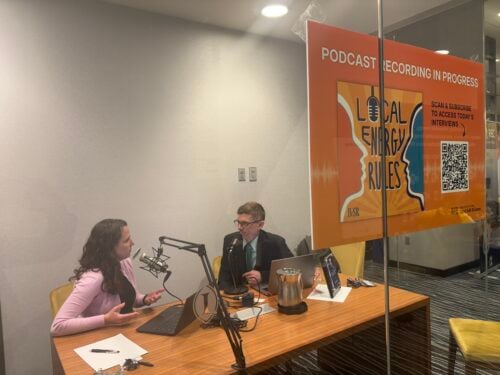
For this episode of the Local Energy Rules Podcast, host John Farrell is joined by Annie Levenson-Falk, Executive Director of the Citizens Utility Board of Minnesota.
Listen to the full episode and explore more resources below — including a transcript and summary of the episode.
Apple Podcasts Spotify YouTube
Podcast (localenergyrules): Play in new window | Download
Annie Levenson-Falk:
What we’re seeing in the utility data, just like every other area of the economy, is just an increasing divide.
*****
John Farrell:
Hey, you’ve stumbled on some bonus content from my two-day, nine interview podcast recording marathon at the Gateway to Solar Conference in October, 2025. Please consider donating to ILSR to keep conversations like this flowing. Now here’s my conversation with Annie Levenson-Falk from consumer advocate Citizens Utility Board of Minnesota about the affordability threat of excessive utility profits, the missing consumer protection and utility mergers, and why we still need consumer advocates, even though the concept of public regulation was to protect the public interest from for-profit utility interests.
*****
John Farrell:
Annie, I’ve been waiting to have you on this podcast forever. Thanks so much for taking the time.
Annie Levenson-Falk:
Yeah, thanks for inviting me.
John Farrell:
Citizens Utility Board to me is one of my favorite organizations because you’re out there doing consumer advocacy in a space where most of the voices are talking about what utilities want and not what consumers want, or thinking about utilities or developers or somebody else. And here you are actually caring about the people who pay the bills. So thank you for that.
Annie Levenson-Falk:
Thanks so much.
John Farrell:
Let’s start off though, asking you about a really big thorny subject, which I talked to your colleague Brian Edstrom about on a previous podcast, which is this buyout of Allete slash Minnesota Power slash I don’t know how many other corporate names that are nested in there, a utility serving Northern Minnesota. So BlackRock, big private equity firm had a partner, a Canadian pension firm, CIP, I think, they closed the deal on Friday last week, or they got permission to close the deal from the Minnesota Public Utilities Commission. Notably, as Brian and I talked about, this deal didn’t seem to be in the consumer interest based on what we knew at the time. The administrative law judge who was overseeing this agreed with your organization and many others that this was a bad idea and the commission gave it a unanimous approval on Friday. Maybe just like what is going on here and then can you talk a little bit about what guardrails, if any, are in place and maybe then we can get into how confident are you that they will work?
Annie Levenson-Falk:
Big question there. Wow. Okay, so just to lay out kind of the facts of what happened. So yeah, Minnesota Power Allete, which is actually just one company, which serves electric service to much of Northern and Northeastern Minnesota, is getting bought out by two private investment companies.
One is Global Infrastructure Partners, GIP, which is wholly owned by BlackRock. They’re going to own 60% of Allete, and the Canadian Pension Plan Investment Board, which is like Canada Social Security, they’ll own 40%. And this was a big enough deal that they needed a number of federal approvals. They needed a small state approval in Wisconsin and they had everything else done. So the Minnesota PUC’s approval was the last thing that they needed and they got that last Friday. So barring an appeal to court of that decision, it looks like this is going forward.
The primary benefit of the sale, the reason that was pitched here in Minnesota, is to help Minnesota Power access capital — that they’re need a lot of capital to invest in all of the infrastructure that the utility is going to need in coming years, which nobody disputed.
As Brian told you last time he was here. At the same time, Minnesota Power has been telling this US Securities and Exchange Commission that they have plenty of access to capital under their current structure and public markets. So there’s a contradiction there that, in our opinion, wasn’t really ever explained. But the PUC here, as you said, they unanimously approved it, so it’s going to happen. They did set a number of conditions on the deal and got commitments out of the companies to try to help mitigate some of the potential harms. And there are some commitments, there’s some good stuff, especially in the short term. So there’s things like some rate credits, $50 million in rate credits that are committed. The companies have committed another $10 million to low income weatherization funding. They’re agreeing not to request to increase their ROE, which I believe is already the highest return on equity of any Minnesota electric company. So it’s not low, but they’re not going to ask for it to go higher for five years.
John Farrell:
And just to put it in context, I mean we’re talking about between nine and 10% return on their invested capital, right?
Annie Levenson-Falk:
9.78%.
John Farrell:
Okay.
Annie Levenson-Falk:
Yes.
John Farrell:
Okay, so not a low number. Anybody out there got your money in a mutual fund? Let me know if you’re making that kind of return.
Annie Levenson-Falk:
So there’s a number of commitments like that. The buyers have promised that they’ll provide the capital that Minnesota Power is projecting it needs in the next five years. There’s some questions about how enforceable that commitment is, but they’ve made the commitment and presumably we’ll follow through with it.
John Farrell:
I appreciate your use of the word presumably there.
Annie Levenson-Falk:
We have some questions about legal enforceability, but the commission did not share those questions. So like I said, there are some good things in the short term. None of those commitments eliminate the fundamental risks in taking a public utility company private. So I mean, while I appreciate the efforts of the PUC commissioners and others to get those commitments and to make it a much better deal than it otherwise would have been, we still have concerns about what happens, especially most of those commitments end after five years. And then what? — is a big question the even commissioners themselves highlighted when they were speaking last Friday and approving the deal. So we still have some concerns, but like I said, barring an appeal it’s going forward. So we need to start thinking about how do you make sure that regulation stays strong in this new scenario.
John Farrell:
I have two sort of pointed questions about this. One would be how many of the members of the commission have terms that extend beyond that five year protective period?
Annie Levenson-Falk:
Yeah, not many. They serve six year terms, so probably one if I had to guess.
John Farrell:
I mean I don’t question their belief that they can oversee, or at least will have the opportunity to evaluate future requests for increase of return on equity or rate increases. I guess I’m just very skeptical when I look at the record of commissions across the country or others in holding down utility return on equity to reasonable levels or resisting rate case requests that, just to put it in context, like the $50 million rate credit. So I don’t know how many customers Minnesota Power has. How many, do you know?
Annie Levenson-Falk:
It’s probably about 140,000, but they have 10 that are really huge or industry.
John Farrell:
So I mean just to spin it out for a second, let’s just say all the $50 million was for residential customers, which maybe it isn’t. You get, I don’t know what three or four months of your utility bill paid, basically, if I do the math right on 50 million bucks?
Annie Levenson-Falk:
Most of the $50 million will probably go to large industry. On a typical year it’s about two thirds or more of their sales.
John Farrell:
So I guess the point I’m trying to make here is the kind of rate credit we’re talking about might be like, let’s just say it’s like a 25%, 20% reduction to your bill for a year as a residential customer, maybe something like that. Nice but not transformative. And then those rate credits run out and now you’re back to paying the bill you used to pay and how long do they have to wait before they can come and ask for a rate increase
Annie Levenson-Falk:
A year.
John Farrell:
Okay. Asking this because I actually did a research report on this, I don’t know, eight to 10 years ago kind of looking at the aftermath of other mergers and takeovers and most of those rate credits that were offered to sweeten the deal for our public utilities commission for approval were subsumed many times over by subsequent rate increase requests that came very soon after those approvals.
Annie Levenson-Falk:
And just to put it in context, I mean $50 million, it is a lot of money. It sounds like a lot of money. It is a lot of money, but this deal is $6.2 billion, so it’s kind of a drop in the bucket in that context.
John Farrell:
Do you anticipate there being an appeal of this? I feel like I have followed a few other commission decisions in Minnesota. There’s a lot of defference in the courts to the commission, this was a unanimous decision, it doesn’t seem like you’d have a great opportunity to win on appeal. But on the other hand, you did have an administrative law judge who in the record said this is not a good deal.
Annie Levenson-Falk:
And the large industrial customers, I mean the steel and iron facilities and Enbridge, others like that, they agreed as well. So I don’t know how likely an appeal is. The commission’s going to issue a written order and that’s what would actually be appealed, and that’ll probably be a month or two before we see that. So I don’t know how to gauge that likelihood of an appeal.
John Farrell:
That’s fair enough. I obviously have been doing a lot of looking at the role that utilities play in this operating within a system in which they make their money by investing capital and things and earning that return on equity. We’ve talked about Minnesota Powers 9.78, I think you said, percent — pretty generous for a very low risk investment and there’s been a lot of good research out in the past couple of years illustrating that that’s likely much higher than it ought to be for a similar low risk investment. And that has fairly significant impact. I mean, I think Mark Ellis former utility executive estimates as much as $300 a household per year. I did the numbers on Minnesota. I think it’s about half that maybe in Minnesota that might be attributable specifically to return on equity. Unpublished. Return on equity is one piece of it. But I guess I’d love you to just be expansive here. Citizens Utility Board is looking broadly at affordability for consumers. What do you see as some of the big cost drivers in terms of where rates have been going up recently, where you think they’re going to be going up?
Annie Levenson-Falk:
We have been paying a lot of attention to this. There are some, I mean, Minnesota is not seeing necessarily the same huge rate increases so far that you’ve seen in the North East or other places where the rates are just absolutely exploding. But there are real warning signs and some not just warning signs, but the affordability problems are really increasing here in Minnesota too. There’s over 90,000 households had their gas shut off last year in Minnesota, which is by far the most of any year that we’ve have records. And arrears for customers who are past due, they owe far more than they did before COVID, and that’s just really stubbornly high. And so I think what we’re seeing in the utility data, just like every other area of the economy, is just an increasing divide. Most people are still able to afford their bills, but there’s been some increase in the number of customers who have fallen behind and the folks that are in the hole are in a much deeper hole and having trouble getting out of it.
So there’s kind of two different ways you can approach that. One is making sure that overall utility rates are no higher than they have to be for everybody. And ROE is an absolute top of the list for that. The ROEs are much higher than they need to be and they need to start coming down. So we’re intervening in Xcel’s rate case right now. Xcel has a lower, ROE than Minnesota Power, they have 9.25%.
John Farrell:
Oh, that’s so much lower. Oh my goodness [said sarcastically].
Annie Levenson-Falk:
Goodness. They say they need 10.3, so they’re in asking for more. So the return on equity is basically what they’re authorized to get on what the commission authorizes them to earn on their capital investments. But we have expert witness testimony that calculates their actual costs of equity, which is investors’ expected return, and that’s about 7.7%. If you set ROE above 7.7% approximately, anything above that the utility will create shareholder value when it issues new shares, when it has new investment. So it’s stock sells at a premium. If you reduce, ROE below 7.7? The stock sells at a discount to the utility company’s book value and it kind of destroys shareholder value in the process. So that’s what the conversation needs to be. But that whole discussion is just about what’s the impact on current shareholders. So the utility will come and say, we can’t attract capital unless you give us a high enough ROE.
That’s according to our expert witness. And the analysts like Mark Ellis and others that you’ve said, that’s a different conversation. The utility will be able to attract capital because if the stock price goes down, it’s a discount, people will buy it, they see it as a good deal, more new investors will come in. So it’s not prohibiting the utility from getting capital and it’s not necessarily impacting rate payers, but you still have to make sure that it’s fair for investors. So anyway, Xcel’s cost of equity is about 7.7%. Any return on that is creating value for shareholders. Anything return above that, like I said, they’re earning 9.25% right now. That’s way too high. The difference between 7.7 and 9.25 is about $200 million a year in Minnesota rates.
John Farrell:
Which is we were talking before about the context between the rate credits that were being offered in the Minnesota Power merger against the value of that deal here. So we’re talking about four times more that people are paying for that ROE premium with Xcel, which is lower than Minnesota Powers. Now, I know the numbers are a little different because you’ve got different size of utility and whatnot, but we’re talking about a lot of money that people are paying essentially unnecessarily to pad shareholder profits or shareholder return, not attracting additional capital, not necessarily lowering the cost of business or anything like that.
Annie Levenson-Falk:
Yeah, I think there’s a good argument that you want the return on equity be a little higher than cost of equity. You want shareholders to be able to earn value by making investment. That’s a good thing, but it doesn’t need to be that big of a difference. And so there’s no question in my mind in many other experts that ROE needs to come down and it has to happen gradually because you don’t want to have shock on the investors. That would not be fair. That would not be a fair balance of interest. But gradually over time, those ROEs have to come down. So in Xcel’s rate case CUB is recommending 9.0, which is a very incremental, but it would be a $34 million savings. What Xcel’s asking for is a third of their rate increase is just due to their increased ROE. Which is entirely unwarrented.
John Farrell:
I’ve heard someone else that I talked to about this said there’s also sort of a social problem, for lack of a better term. If you were successful in driving down the ROE for Xcel energy for example, and you just said, oh, we actually want them to get down to 7.7%, sort of ignoring the impact on the current shareholders for a moment. And just looking at more in this context of raising capital, since that’s the justification behind the takeover of Minnesota Power, I could see there being an issue there of like, oh, well, if I invest in utility stocks or I’m a fund manager who invest in utility stocks, Xcel energy is at a 7.7 ROE, every other utility in the country is basically above nine, I’m just going to stop buying Xcel stock. I’m not going to get as nice of a return as I might if I invested in all these other utilities. I don’t know. Do you think that’s an issue you have to see the downward pressure happening everywhere at the same time? Or is it safe to say that we can actually attack this at a state level?
Annie Levenson-Falk:
So first of all, I’m not a finance person, so give me this caveat there, but I’ve spent a lot of time talking with our expert who’s Steve Kihm, who in a lot of respects often agrees with Mark Ellis. And he has evidence in his testimony about the time in the eighties when returns on equity are actually lower than cost and the utilities were still able to earn, to get new investment, because those new folks are just looking at, if I say a low stock price, that’s not a bad thing for them. That’s probably good. They’ll come in and buy and the market will equalize, they’ll make some money in the process. And I think you also run into, usually how utilities come in is they come in with a list of peers and they say, our peers are making more than us. We need to make more. And that’s just a never ending cycle of spiraling ROEs, and that’s not how you need to look at it. They need to look at what the actual cost is and then what is a reasonable amount above or below that if there are arguments for that. But look at the cost and then judge where a fair return is based on that.
John Farrell:
Alright, I’m not going to make you nerd out on ROE any longer.
Annie Levenson-Falk:
Nobody wants to hear that.
John Farrell:
Because I am interested in some of the other things that you’re looking at in terms of affordability. Obviously this one — ROE — is so important because we’re talking about essentially just making certain investors more wealthy or paying more in electricity bills to make some select people better off without seeing necessarily system improvements. Where are the other places that you see affordability opportunities?
Annie Levenson-Falk:
So I kind of started and I lost the thread. I started by saying there’s two different ways to look at it. One is reducing rates to as low as they reasonably can overall. And there’s other things you can do there. But another thing is looking at… The affordability problems and energy, they’re not equal across the board. There’s some households that really struggle to pay, have really high energy burdens, and you can focus assistance on those households or even look at not thinking of it as assistance. What is the cost to serve those households? And in some cases they’re cheaper to serve and maybe they should have lower rates or maybe a time of use rate would be more representative of their costs. But things like late payment fees, for example, they are really exorbitantly high. I was surprised when we started digging into this. Minnesota utilities usually use about one and a half percent per month is what they charge in late fees, which is 18% a year, which is higher than some credit cards.
John Farrell:
Wow.
Annie Levenson-Falk:
Yeah. When you think about a monopoly company that’s providing a public service, should they be charging credit card level interest? The credit cards do that because that’s where their money comes from. The utilities ostensibly do it because the idea is that you have some penalty if you don’t pay. So it makes people pay, but there’s actually not evidence that late payment fees work that way. There’s some evidence from other states that actually when you get rid of the late fees, then people can afford their bills than they pay them more timely. So that’s one thing that we’re arguing for on the accelerate case too. You have customers that owe thousands of dollars in racked up late fees. Clearly it’s not working. It can be 20%, 50% of somebody’s balance. It’s not working. So that’s one, is reducing or we would say eliminate those fees. Reconnection fees, similarly, it’s a very small amount of money if you were to spread that among all rate payers, you would barely notice if few cents a month. But it really can have an effect on the folks that are really struggling the most to pay. And then of course things like energy assistance, which is under threat federally, I think it’s okay for this year once they finally pass budget in Congress, knock on wood, but the Trump administration has said they want to cut it. We need more, not less. So programs like that.
John Farrell:
I guess I go through two or three different directions here. One is affordability of utilities is to some degree just a broader economic problem of do people make enough money to afford the basic things that they need? So it’s always a little frustrating when I feel like we play this sort of whack-a-mole game of it pops up in food and so we have SNAP benefits, it pops up in energy and we have energy assistance. There’s never enough money in those programs to serve everybody who needs it. It’s really disappointing when it becomes a political football and people who are just looking to make ends meet aren’t able to have access. I guess another piece of the context though, the Center For Biological Diversity did some analysis of shutoffs like kind of 2022, shortly after the end of the pandemic. And their analysis was, I think it was the 10 largest investor owned utilities in the country if just you took all the money that people owed on their utility bills and it was like a fraction of the CEO salaries. So you gave the context, which I think is really helpful of, hey, if we got rid of late fees and disconnection fees, it’s just pennies on other people’s bills if we spread it all around. But do we have to spread it all around? Why? I mean, if it’s not really that much money, why might we not say to a utility like your charge ought to be to make it essential that everybody gets access to this. And if you can’t figure out a way to do that more equitably, maybe your CEO should pay the price.
Annie Levenson-Falk:
Yeah. Well, another piece of context I gave was the how much we pay in return on equity for Xcel and our very small step of reducing ROE saves $34 million. But if you look at their cost versus return right now is $200 million. I’m not saying we can just take that $200 million and red designated something else this year that would not be fair. But you can’t say there’s not money available. It’s a question of how we’re using it.
John Farrell:
I wanted to ask you about this broader issue around consumer advocacy and utility rates. And I actually asked somebody about this in one of the other podcasts I did yesterday too. I find it a little weird that, so the structure of the system was in the early 19 hundreds, you had intense competition between for-profit, small utility companies to basically figure out who was going to serve. And they were not only competing with each other, they were competing with a lot of cities that were saying, let’s have publicly owned utility companies and there won’t be profits and whatnot. And this is essential public service. And part of the way that the titans of the electric industry resolved this conflict was to say, we will be publicly regulated monopolies. You’ll give us rate regulation, so you’ll tell us how much we can earn, but in return, you’ll protect our territory from competition. Competition not just from each other, but also from these encroaching cities, counties, whatever, who are saying we should have public ownership of this system, which I find is too often not talked about.
Anyway, the point is when we created the system of public regulation, the idea was that these state regulators were going to preserve the public interest by ensuring that the utility earnings, the utility was essentially subject through public regulation for the same pressures it would experience if it were in a competitive market. And so the public interest really was to be served through these utility commissions. Why is it that we need, for example, a consumer advocate office, an attorney general’s office in the state? Why is it that we need a philanthropically funded nonprofit organization like Citizens Utility Board? What does it say about our system that we need all of these external entities to protect the public interest when we ostensibly set it up such that these public agencies, these state agencies, are supposed to be doing that?
Annie Levenson-Falk:
Yeah, that’s quite a question. First of all, I would just say that despite everything you just said, Minnesota is in the fortunate position of having an attorney general’s office and a Citizens Utility Board and the Department of Commerce, we don’t always see eye to eye, but they do a lot to defend rate payers as well. So that’s three groups right there. Not to mention all the other intervenors. And some states have none. So despite everything, we’re doing a lot better than alot of other places.
But the way that utility regulation works is it depends on intervening parties to bring things into the record. And maybe a hundred years ago it was simpler, probably was a lot simpler and less difficult to do that. But these are enormous corporations and the dockets are super complicated and it takes a ton of effort. It takes a ton of discovery and just creativity and poking around and persistence to even find some of the evidence that’s going on and to build the records of the commission’s needs. So to think that the commission could do it themselves, it’s just not set up that way. I think when you talk about private ownership, private equity instead of public, it’s going to be much harder. There’s discovery in the next Minnesota power rate case is just going to be like wild. It’s going to take a lot of work.
John Farrell:
Because a lot of the information you might normally be able to get from public filings are not going to be available. Right.
Annie Levenson-Falk:
And because of how it complicates things to have multiple corporate layers of private equity companies now owning and to a large degree controlling decision making of the local utility, which is new. So I don’t know what to say about it. It’s hard. It just takes a lot of work. And that’s just kind of how the system is set up.
John Farrell:
Do you think, I mean, I do recall at one point in the past, I like five years in Minnesota, we passed legislation to increase funding to the Public Utilities Commission. And at the time, I think I saw someone say that maybe it was per capita or something that Minnesota had one of the lowest funded commissions in the country, which is amazing to me because I actually think when I’ve worked with the staff there, when I’ve seen the diligence that they put into the information, they try to gather to support the decisions of the commission, I see a lot of work there. But in theory, we could give the commission twice as much, five times as much, 10 times as much money, more proportionate to the size of the utility companies that’s trying to regulate so that they wouldn’t have to rely so much on independent intervenors, especially because, I mean, this has changed a little bit in recent years, but it’s often been very hard for intervenors to get compensated. Minnesota is one of a few states that offer that where you can intervene in proceeding before the commission and you can actually get paid after the fact. Notably.
Annie Levenson-Falk:
Sometimes. Yeah, it’s still tough to access in a lot of cases, but yeah.
John Farrell:
I guess I’m just kind of curious. I’m not suggesting that money is unlimited here, but that there could be more resources put into the entity who is really charged with doing the oversight.
Annie Levenson-Falk:
And some of this is getting kind of semantic, but in a lot of states they have, most states, have commissioned staff that’s charged with developing that record. That staff in Minnesota is at the Department of Commerce. So we talk about Department of Commerce. That’s like analogous to commission staff in other states. Absolutely. They could use more resources. I think the Attorney General’s office is severely under-resourced when it comes to utility proceedings. And I think if you put more money into the ags office, that would pay back multiple times over in terms of rate savings, most likely. And the same with intervenor compensation. That’s the idea.
John Farrell:
I mean, just to put it in context, I think I’ve tossed around a few times in Minnesota that the investor owned utilities combined have somewhere north of a hundred lobbyists. Most of those though are not people at the state capital. They are actually folks who are signed up as lobbyists because they work on these regulatory proceedings. I mean, not all of them are full-time necessarily or whatever the number is not a one for one, each one is an individual person. But I think it just gives a sense of the scope of how many people and how much money they have at their disposal to do this intervention and how rationally, of course, they’re doing it in the interest of the company, not necessarily in the public interest. We ought to be funding at least as much that public service portion. Yeah, I don’t know. I’m so glad that the Citizens Utility Board exists, Annie, but I’m also really disappointed that it feels necessary in order to get the outcomes that are good for consumers.
Annie Levenson-Falk:
Yeah, I think absolutely. We on the intervenor side, have a hard time keeping up. I think also there’s things folks can do, even if you’re not a PUC intervenor that can help to sway the balance. So obviously the PUC is making decisions based on the record in front of us, but the record alone is not enough. And a lot of what the PUC is doing is a judgment call. So they’re trying to figure out where is the balance of the public interest, and that’s just judgment. There’s no way around that. And they’re also people that exist in a world of politics and media and all of that. And so that surround sound of what’s going on, I think can have a big impact on the case too. So folks doing work outside the PUC, I also just want to give a shout out to those folks, and that is a really important part of the overall picture.
John Farrell:
Annie, thank you so much for taking the time to chat with me about this stuff. I’m going to be very interested to see if there’s an appeal of this Minnesota Power takeover, and I’m curious as well, if you’ll be playing a role in that. But thanks so much for all the work that you’ve done to you, to Brian, to everyone at Citizens Utility Board who’s put so much of your time on the line to try to make sure that Minnesota consumers get a fair deal.
Annie Levenson-Falk:
Thanks so much, John.
*****
John Farrell:
Thanks for listening to one of my nine mini podcasts from the 2025 Gateway to Solar Conference with Annie Levenson-Falk from Citizens Utility Board of Minnesota. We’ll have links on the show page to my conversation with her colleague, Brian Edstrom and other ILSR resources about utility return on equity.
Even these mini versions of Local Energy Rules are produced by myself and Ingrid Behrsin with editing provided by audio engineer Drew Birschbach. And as always, we’re talking about taking on concentrated power to transform the energy system. Until next time, keep your energy local and thanks for listening.
Levenson-Falk has five recommendations for how Minnesota policymakers can do more to put ratepayers on equal footing with the state’s investor-owned utilities. Making these changes would help address the energy affordability crisis for consumers.
“You can’t say there’s not money available. It’s a question of how we’re using it.”
See these resources for more behind the story:
This is the 249th episode of Local Energy Rules, an ILSR podcast with Energy Democracy Director John Farrell, which shares stories of communities taking on concentrated power to transform the energy system.
Local Energy Rules is produced by ILSR’s John Farrell and Ingrid Behrsin. Audio engineering by Drew Birschbach. Featured Photo Credit: Ingrid Behrsin.
For timely updates from the Energy Democracy Initiative, follow John Farrell on Twitter or Bluesky, and subscribe to the Energy Democracy newsletter.
San Diego may be the only city to have secured upfront funding from utility shareholders to make clean energy cheaper.
Oregon tries to tie utility profits to climate, cost, and reliability targets through performance-based regulation.
Rural electric co-op members should use this new toolkit to swap coal debt for clean, affordable energy.
NOLA’s Community Lighthouse initiative creates local hubs with rooftop solar and portable batteries to save lives after storms.