$150,000 Grant Program for Composters in Historically Underserved Communities
ILSR will provide $150,000 in sub-grants to selected composters in historically underserved communities in New England and New York City.
Podcast (buildinglocalpower): Play in new window | Download
We hear it again and again on this show: neighborhoods that are presumed less likely to fight back are taken advantage of by huge corporations and monopolies. Through predatory decisions and massive market power, a chain grocery store erodes a historically black neighborhood into a food desert. Amazon locates a massive warehouse, and its associated noise, congestion, and pollution, into an already vulnerable area of town. The Target in the BIPOC neighborhood is demonstrably worse than the Target in the rich, white part of town. Now we’re seeing the same pattern play out with the question of where to put AI data centers and their enormous environmental demands. The tech companies making these decisions seek out the neighborhoods that have the least political capital, neighborhoods that Brenda Platt calls “areas of least political resistance.” And she would know.
Brenda Platt“Let me make a point about local control: The hallmark of any functioning democracy is civic engagement.”
Brenda Platt, director of ILSR’s Composting for Community Initiative, has been fighting for sustainability, recycling, reuse, and composting for a bit longer than I’ve been alive. Throughout her nearly 40 year career, Brenda has taken a leading role in shifting the waste industry away from expensive, polluting, and inefficient trash incinerators. Today she’s working tirelessly to not only encourage sustainable waste alternatives like composting, but she’s fighting to ensure that such programs remain under community control and influence. Compost, she says, has to be local by default. It’s silly to ship banana peels across the country, so it’s best to figure out local and sustainable waste alternatives. Here to catch us up on her recent work, Brenda is today’s guest. Listen in to hear the story of her influential work, her reflections on how the incinerator fight resonates today, and her memories of working with beloved ILSR co-founder David Morris.
Danny Caine
We hear it again and again on this show. Neighborhoods that can’t fight back are taken advantage of by huge corporations and monopolies. Through predatory decisions and massive market power, a chain grocery store forces a historically black neighborhood to become a food desert. Amazon puts a huge warehouse and its associated noise, congestion, and pollution into an already disadvantaged area of town. The target in the BIPOC neighborhood is demonstrably worse than the target in the rich white part of town. the same pattern play out with the question of where to put AI data centers and their huge environmental demands. Companies making these decisions seek out the neighborhoods that are least able to fight back, neighborhoods that Brenda Platt calls areas of least political resistance. And she would know.
Brenda Platt, director of ILSR’s Composting for Community initiative, has been fighting for sustainability, recycling, reuse, and composting for a bit longer than I’ve been alive. Throughout her nearly 40-year career, Brenda has taken a leading role in shifting the waste industry away from expensive, polluting, and inefficient trash incinerators. Today, she’s working tirelessly to not only encourage sustainable waste alternatives like composting, but she’s fighting to ensure that such programs remain under community control and influence. Compost, she says, has to be local by default. It’s silly to ship banana peels across the country, so it’s best to figure out local and sustainable waste alternatives. Here to catch us up on her recent work, Brenda is today’s guest. Keep listening to hear the story of her influential work, her reflections on how the incinerator fight resonates today, and her memories of working with beloved ILSR co-founder David Morris.
Danny Caine
Brenda Platt, thank you so much for joining us on Building Local Power. Really thrilled to have you
Brenda Platt
Great to be with you.
Danny Caine
So I just coming off of more than 10 years of apartment living where I didn’t have much backyard to speak of. And when I did, I didn’t have any control over I’m a homeowner now. I just bought my first house and I’m really interested in getting started composting, whether it’s in my backyard or through a community program. So I’ve got a leading compost expert on the program. I’m going to start by asking you, where do I start?
Brenda Platt
I’m here for you, Danny. Congratulations, by the way. Well, you know, I don’t know if you’re a gardener not, but if you have trees in your backyard or any plants that you care about, mean, composting can be a great option because compost is a soil amendment. And we’re so good at removing all those fall leaves every year that, you know, our trees are starved for that organic matter. So, you know, you don’t have to be a gardener to start where to start?
Well first let me just say that composting is super flexible. So if you want to do it passively and not learn a whole lot or spend a lot of time, you can do it. But if you really want to speed up the process and produce really good compost, you can do it more actively and learn a lot. really, you can engage in composting whatever level you want. But you will need a compost bin of some sort.
You can do it in open piles, but if you’re doing food scraps, we generally recommend that you do it somewhat enclosed and you need some space for the bin. You need some basic tools like a pitchfork. You need a source of water. You need a ready supply of leaves or twigs or some kind of carbon rich material to mix with your food scraps. yeah, you can get started. We have lots of great resources on our website. You can just Google home composting and it’ll come right up.
Danny Caine
I will definitely look for those and link to them in the show notes for others in a similar boat. had a feeling you would say you had great resources. I’m excited to dive in. So I am just beginning my compost journey. have been at ILSR for 40 years now, tell us about that journey. you get here? How have your professional interests evolved until ultimately you’ve become one of the US’s leading compost experts?
Brenda Platt
Well, I first joined ILSR in 1986, and I started as the, quote, staff engineer. I have a degree in mechanical engineering. And at that time, I was very much involved with Neil Seldman, one of ILSR’s co-founders, fighting the proliferation of trash incinerators across the country. There were hundreds planned, mostly in areas of least political resistance, poor urban areas, rural communities, and to be clear, trash incineration is the most polluting and the most expensive way that we address our trash problems. We defeated most of them. A handful of them did get built.
But one of the things that I was inspired to do, actually from our David Morris, who sadly passed away recently, really saw that one way to fight the proliferation of these trash incinerators was to document the alternative and document communities with the highest recycling and composting levels, which I became the expert on. I think our first report was called Beyond 25 % Recycling because one of the reasons that the incinerator proponents were selling their expensive wares was saying, ⁓ a community couldn’t recycle more than 15 % of their waste. So recycling is just a small solution. So David Morris really saw that we needed to document communities that it in a significant and substantial way and share out that information share what one community is doing so another could learn and the second report we did a few years later was called beyond 40% recycling record setter record setting recycling composting programs which then led to cutting the waste stream in half and then further reports on zero waste planning so, spurred by David Morris and Neil Seldman I became the expert on the best ways that communities could be recycling and And also reuse by the way, we documented the jobs through reuse, recycling and composting compared to
And recycling to sorting materials alone is like 10 times more jobs than burning or burying materials. But when you make new products from the old, it’s like, hundreds of new jobs and reuse is even more because it’s very labor intensive. So making the case for diverting materials from landfills and incinerators on an economic ground, on economic grounds and the benefits to local economies was really what helped to defeat these incinerators.
Danny Caine
That’s a really interesting argument. I’ve heard the flip side where people argue against recycling because it’s labor intensive, but as a job creator, as an economic engine, I think it makes perfect sense that this creates more jobs than incinerating our landfills. talk a little bit more about David Morris later on, but in this past series of episodes, we’ve been talking about him a lot. It’s been really enjoyable to dive into those old reports resources. So I’m looking forward to finding them and sharing them with our listeners.
I’m glad you mentioned the incinerator fight and what you called, think really eloquently, areas of least political With our team at Building Local Power really interested in ⁓ data centers and data center siting, we’ve done an episode about the environmental cost of AI. We’re thinking about this. I think really similar things are happening where these tech companies are finding areas of least political resistance and putting their data centers there because they perceive that there will be less opposition. Does the data center thing remind you of the incinerator fight? if so, what can we learn from your decades of experience with this?
Brenda Platt
Yeah, absolutely. You know, in our battle against trash incinerators, the frontline communities fighting each of those sites became the experts. They knew more than their local officials about the financials, about the pollution. They formed national coalitions to share information.
They sometimes passed laws about siting, and in the case of incinerators, it might be something like, hey, you can’t site this polluting facility within a certain number of miles of a school. But they also propose the alternative solutions. And so I think that will also be key. I mean, if they’re being cited in communities because of jobs, maybe it’s not directly the solutions have to do with data centers, but maybe there’s the coalitions that form are fighting for better industries for their communities, of which there are many.
Danny Caine
You were fighting against incinerators and for reuse. It’s not enough to just oppose something. You have to propose an alternative too.
Brenda Platt
It helps and you know on the flip side you could say that when you’re fighting for solutions and what you want your community to do sometimes that’s harder if you’re not fighting for something that’s bad so this could be an opportunity fighting the bad to bring in some good jobs and good industries into your community it could be seen as an opportunity.
Danny Caine
Well, I certainly hope the activists of today look towards the trash incinerator for those lessons. I think it’s one thing activists can really do is look to past fights for insights on today’s. So this idea, it’s really interesting becoming the experts. it makes me think of local self-reliance, basically. Like you have to take ownership of the knowledge and the fight.
This reminds me of a discussion I had with John Farrell for our last episode about the importance of not just solar power, like locally owned, community owned, community controlled solar power, or like locally owned municipal broadband. We also think a lot about private equity and this kind of big money. And I’ve read a couple things that make it seem like, you know, private equity was big on waste management in landfill for a while. Now it seems like they might be kind of sniffing around reuse and recycling. So they’re maybe focusing on quote unquote cleaner technology. Why is it important to keep recycling, reuse, composting within local control and out of this kind of control of the big money in private equity firms?
Brenda Platt
First, let me make a point about local control. I mean, the hallmark of any functioning democracy is civic engagement. And so this kind of ties back to being engaged in your community and fighting the bad and promoting the good that you want to see there. And when it comes to policies and rules, mean, David Morris used to say, we make the rules and the rules make us. you know, passing good policy and doing away with archaic policies is really important.
And when it comes it’s no different in this sector. And big waste, the big waste companies are motivated by profits, but often the best solutions to addressing waste or just pick whatever sector you want are local or their prevention or they’re community scaled. When it comes to the waste sector, there are just four big companies that dominate the $91 billion waste industry. Think about that.
Four companies, $91 billion, and only two of those own about half of the landfill volume. That’s a lot of money lining the pockets of just a handful of big corporations. And if you consider the alternatives to wasting, waste prevention, reuse and repair, recycling, composting, much of that can be done locally ⁓ with financing incentives. Those are the rules. ⁓ training, education, and or with local businesses. So big waste of course doesn’t want to lose market share, so they’re also invested in recycling and composting. But really local governments as they roll out their solid waste plans and often a local government has to do a 10-year solid waste every decade ensures that they have disposal capacity and local governments have a lot of agency with their procurement and contracting and the policies they pass. So they can really design those policies, design those bids to favor systems and businesses that actually bring the most benefits to their local communities.
And so this is where I think there’s a lot potential in our community. If our local governments aren’t doing this, this is interested advocates and citizens need to get engaged and push for this.
Danny Caine
I imagine there might be some local politicians who are experts in waste and sustainable practices, but I also imagine there are many, many more who got into local government out of a feeling of citizenship, out of a desire to make things better, not necessarily to build sustainable waste and rules. And I’m sure the big waste companies have suggestions that they’re very vigorous in telling these governments as they create these plans.
So, know, if I’m a city council member or mayor and I want to have good but I don’t know how, like, where do I look? What should I do? How do I make sure this 10-year plan is a good one, is sustainable, has community control and, you know, resists the pull of the big waste monopolies?
Brenda Platt
Yeah, it’s a great question. Zero Waste USA, there’s Coalition as a national group that local governments often join. There’s the U.S. Composting Council, has lots of local governments. But if you’re a city council member, one of your jobs is to approve your local city And the waste budget, solid waste management, which is mostly collecting the garbage, is one of the largest line items in the budget.
So it’s not something that’s like very minor. It’s going to be police, fire, schools, and waste. Those are going to be your big ones. And so now in most of our urban cities, households can put out an unlimited number of trash cans. And that’s viewed as, that’s a service. We don’t want to deal with that. But nobody expect you to use as much energy or as much water and pay the same price. But for some reason, cities are expected to pick up and unlimited amounts of trash or trash cans that you put out of the curb. And one of the solutions is we have hundreds of communities in the US doing is called volume or weight-based trash fees.
If you’re paying by your trash can or your bag of and your recycling and composting is costing less, then you have a direct economic incentive to produce less material. And that’s going to control cost if you’re a city council or in charge of your public works department. And there’s just so many options that a local government can do. And you don’t have to do all of them. You don’t have to have a 50-acre site for composting. But there’s small things you can do. There’s large things you can do and everything in between.
You just have to get on the road and on the path to reducing waste. And there’s many of examples of for instance, one of our guides is how do you incorporate reuse, recycling and composting into climate action plans? and there’s examples of communities all across the country that are doing this. So we have a lot of resources for local government on things they could be taking up and learning from other communities.
Danny Caine
My first reaction to the idea of weight-based trash collecting is that it’s got to be a hard sell to the citizens. But then you mentioned it’s a way to save money. So is that how you get people to sign up? Is like, you could save money. paying for trash that’s not being collected. And if you recycle and you compost, you could actually save some serious money on trash collecting.
Brenda Platt
Yeah, you can. I mean, there are major cities in the US that do this. In the West Coast, it’s very prevalent. But San Francisco is an example. industrial small cities. New England, Worcester, Massachusetts does this in a per bag fashion. So, yeah, I mean, tax bill be much higher because everybody’s producing so much garbage.
Danny Caine
It’s an economic argument aiming at the pocketbook that’s nonetheless for the climate too. You mentioned all your great resources. I’m always so impressed by everything you do on the compost team and all the great resources you have, some of which will be linked in the show notes.
One program I think is really cool is you’re running a $150,000 program to send mini grants to historically underserved communities for community composting programs. Why is it important to start or support composting programs in these communities and what are the obstacles that have historically prevented it?
Brenda Platt
Well, this is our second year doing this, so we’re really thrilled about this program. Listen, let me just start by saying that our burn and bury wasting paradigm has disproportionately harmed communities of color and has led to the concentrated power within a handful of companies that I already mentioned. our wasting and our throwaway economy has really impacted poor urban communities. know, this is just a drop in the bucket and the funding that’s really needed, $150,000 is not much.
We’re giving away 15 grants of $10,000 each. So if anybody’s listening this podcast and has more money, we would love to grow the fund, by the but really what we’re trying to support is not just existing community composting projects, also if you’re an urban farm or you’re Native Indian community and you’re growing food and you and composting is really can be viewed as an accessory activity to growing food and gardening and building healthy soils and you don’t know anything about composting you know, you can apply for this money and we can help support you.
This is a way to draw more people into the act of composting and giving them the resources they need. So even with the money, you get access to our training to learn how to do composting better. get connected to our community composter coalition, which is close to 400 organizations across the country. We have a whole networking, sharing best practices and learning from each other. So it’s really a way to build the movement as well. So when we’re just seeding this money and we hope to grow it nationally, right now the only groups that are eligible for this funds are in New England, coastal New England states and New York City. And so with more money, we hope to grow it to the rest of the country.
Danny Caine
You call it a drop in the bucket, but I think it’s important work to to even get this much money into those communities for these projects. So I want to talk a little bit about success stories. And you mentioned a couple. but I want to talk specifically about a success story, especially nowadays, there seem to be these political headwinds towards climate change denial, towards defunding scientific programs.
Can you tell us about a composting or sustainability success story despite the challenging environment for that kind of work?
Brenda Platt
Let me start by, behavioral expert I know, Julie Cook, she’s with the University of Waterloo in Canada. And she has shared with me that just some context on climate change and why we haven’t been able to move the needle on that, that too often, you know, it’s a tremendous abstract and seemingly distant problem, much of the time, like we focus on the doom and gloom narrative. And that doesn’t really help us.
She says we would be much better off if we emphasize the co-benefits of climate action. And that’s really going to help mobilize more people to participate in climate mitigation or really adaptation as we’re at, not only individually, but collectively too as communities. And so when we talk about composting, you know, it’s, think why composting is such a win-win activity or program for so many things is it, by the way, let me clarify that.
Composting is a win-win for the climate because waste, when it ends up in a landfill, contributes to methane, which is very potent climate, greenhouse gas, right? But when you make compost as a soil amendment and you put that black gold into your soil, it acts as a carbon and storing carbon. So it’s really a win-win. And not only that, but…
Since your soil is healthier, you’re helping your plants grow and the roots be deeper. And so you’re helping with photosynthesis. So it’s just got so many climate benefits. When it’s used in communities, and let’s just use a city like Baltimore, which during the summer when we’re under a heat dome like we are now, poorer communities have less tree canopy and more concrete.
So the heat island impacts are so blistering in those communities. But when you use compost to then build your soil and grow food in green neighborhoods and plant trees, so it’s a win-win. So if we can then sell composting as like it reduces pollution, it helps green your neighborhoods. It’s going to help protect your trees and plants. It’s going to, your local neighborhood garden that’s composting is going to engage your youth and help keep them off the streets. This is where we can make the connections and get people engaged because it’s really about climate change in a way that you’re framing it that’s improving our quality of Contrast that with like the current narrative, which kind of presents climate as like this series of disruptions to our comfortable lifestyle and a burden on society. So we kind of have to flip the narrative.
But back to your question of who’s doing good I wish I could point to one city and say, that’s the model. But typically I go, this city has this and this community has this. And if you could integrate the best features of the best programs, you could be the model. So that’s actually an invite to anybody listening to become that city. But let me just give you a few examples.
Like Philadelphia, the Department of Prisons has a community composting initiative. So they have an orchard they’re growing trees, but they also do composting on site. And so they’re incarcerated individuals, do get hands-on vocational training about using compost in the orchard, about how to compost so when return to society, they can be placed in jobs. And they’re also now just recently launched that program. So they’re taking food scraps from outside the prison system. And so that’s all happening within the city of Philadelphia. At the same time, they’re partnering with a local independent business, not one of the big waste companies. So in this case, it’s Bennett Compost, which also is working with other parts of the city at recreation centers. And so Bennett being rooted in Philadelphia is doing education outreach and just has so many more kind of co-benefits to the city.
⁓ Another thing that Philadelphia is doing in their parks and rec department and the urban ag is they’ve started a community composting network. So they have like a dozen sites where they’re training people at whether it’s gardens or playgrounds to do composting on site and engage youth and neighborhoods. So that’s just one example.
DC has the Department of Parks and Recs also has a community composting network at 56 sites at gardens. It’s all volunteer based drop off sites. DC at the same time you can bring your food scraps on the weekends to farmers markets and they started a pilot curbside program with 9,000 households and they’ve partnered with two different local businesses to some of those programs. So just good examples local agencies, not just one, it can be parks, can be public works, urban ag offices, just doing things locally.
Danny Caine
Those are great examples. Thanks for sharing those. And you were talking about Baltimore. A couple months ago, we had newly elected Baltimore Councilman, Zach Blanchard on the show. And our conversation did touch on that incinerator and the heat dome and the kind of neighborhood climate dynamics of Baltimore. So if you’re interested in that stuff, have a listen. to that. Zach is a really inspiring guy. All right, our final question, Brenda.
We talked a little bit about him, but I think everybody at ILSR is thinking about David Morris these days to his recent passing. I mean, you’ve worked with him longer than most. how is he influencing your work today? How do you think about his legacy with what you do? How is the spirit of David guiding you today?
Brenda Platt
Wow, do we have another hour? know, I’ll just start by saying that local, what an enduring concept, right, to build healthy, equitable communities. He had the vision and he clearly laid out how we worked right from the beginning. Like it was research, it was technical assistance, it was information dissemination. I found really so enduring in his legacies that not only did he and the other co-founders have that vision, but then really spurred us to put the hard numbers, the research to back that vision. And in a lot of our initiatives and the composting work is no different. We really document the early adopters.
You know, the early majority won’t do something unless it’s been proven successful from the early adopters. But by us documenting early adopters and sharing success stories and amplifying them, we help things replicate and share those lessons learned, get people learning from each other. mentioned all the reports I did over many decades on the best recycling and composting programs. And that work that David really spurred really helped institutionalize recycling in this country. Now, you know, people can complain about recycling and it’s not perfect, but it’s certainly better than burning and, you know, burying our materials. right? And the notion how we do it really matters. Who benefits? Who owns the infrastructure? Who owns the systems, whose pockets are being lined and who are we engaging and who is making the decisions is completely enduring in our work.
And I’ll just share also that that the Institute when it was first founded, you know, was a neighborhood group in the Adams Morgan area of Washington, D.C. in those early days, the institute was actually composting in the townhouse, which, you know, I hadn’t really remembered because that predated me joining ILSR, but they had gardens. They were collecting and composting 500 pounds of vegetable scraps per week from nearby community controlled food stores. And they were growing food, including like 180 pounds per week of sprouts that they were selling.
I just love that that history also included from the very beginning, composting. But you asked earlier, like my trajectory here, when I did all those reports on the best communities, you couldn’t get to 50 % recycling if you weren’t composting And those reports were just focusing on yard trimmings. So, cause it’s such a big portion of what we set out the curb every week, right?
But food waste now is at least a quarter of what we throw away. And it’s heavy, right? Food waste is wet. And compost is inherently local. We can’t ship our banana peels from the East Coast to the West Coast to be made into compost. And even the final product tends to be used local economies, the compost. So you’re going to be using it in your backyard, Danny. I know, right?
Danny Caine
Yeah.
Brenda Platt
And so, and if you can’t compost in your backyard, you know, there may be a community site that you can join. And if you can’t join a community site, like exercise your civic, engagement muscle to get your local officials to start a program, which is something David would want us all to be doing.
Danny Caine
It’s really inspiring. Composting is something that’s local by default. It has to be local, whether it’s on your roof or within your community. Platt, thank you so much for joining us and sharing all of your insights and stories with us. It was a great conversation.
Brenda Platt
You’re welcome. Thank you.
Danny Caine
My conversation with Brenda Platt was so rich with resources and recommendations, it was hard to round them all up. Regardless, I’ve tried to do so in the show notes. Check those out to find links to her report from 1990, Beyond 40%. You’ll also find links to groups like Zero Waste USA and the U.S. Composting both of which Brenda mentioned in the context of crafting good municipal waste policy.
On the topic of municipal policy, I’ve also linked to a model municipal ordinance for encouraging community composting written by Brenda and her team. I also want to call attention to a short film called Burning Injustice about the fight to shut down one of the last incinerators in California. I talked about the film and the fight with Riverbank, California Mayor Rachel Hernandez on an earlier episode of Building Local Power.
You can watch the film and listen to the episode via the links in the show notes. This episode of Building Local Power was produced by me, Danny Caine, with the help of Reggie Rucker. I did the editing with help from Téa Noelle, who also composed the music. Thank you so much for listening and see you in two weeks.
ILSR will provide $150,000 in sub-grants to selected composters in historically underserved communities in New England and New York City.
ILSR’s Composting for Community policy team has once again worked with Maryland Delegate Boyce to introduce the Solid Waste Disposal Surcharge and Wasted Food Reduction...
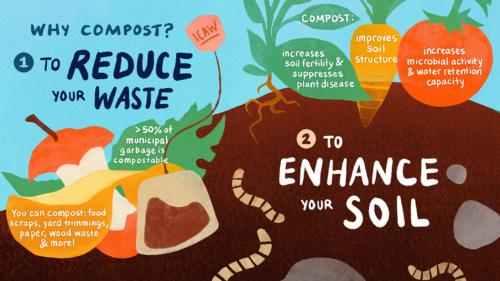
Composting cuts waste, enhances soil, protects the climate, and builds community (including jobs). Use our new graphics to share these benefits! … Read More
ILSR’s Composting for Community Initiative supported the development of a new toolkit to guide communities affected by wildfires and other sources of pollution on how...