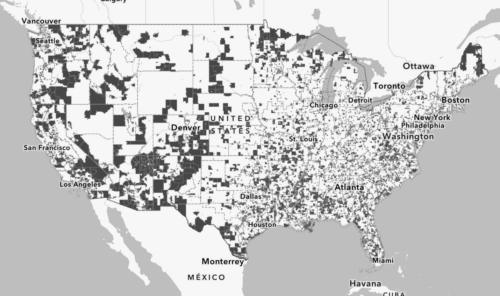
To illuminate how consolidation shapes food access, ILSR created an interactive map that shows food deserts alongside the location of different types of grocery stores — independent, small chains, large chains, and megachains like Walmart and Kroger.
Millions of Americans live in communities that are both low-income and lacking a grocery store, also known as food deserts. Not having a place to buy fresh food nearby imposes a daily hardship and indignity on life, deepens health inequities, and weakens communities.
For decades the U.S. grocery industry was remarkably competitive, with independent grocers thriving alongside large chains. Virtually every neighborhood and small town had a grocery store, and many had several. Then, in the early 1980s, the government stopped enforcing the Robinson-Patman Act, a critical antitrust law that leveled the playing field for small retailers by prohibiting price discrimination by suppliers. Food deserts and higher prices followed.
ILSR’s interactive map shows where grocery stores are — and whether they are independent or part of a consolidated chain. By displaying the locations of different types of stores alongside food-desert areas, this map helps users explore how corporate concentration has reshaped food access across the United States.
How to Use This Map
You can explore your congressional district to see grocery store locations color-coded by type to visualize which stores are independent grocery stores, small chains, large chains, and megachains like Walmart and Kroger. You can also easily visualize food deserts where low-income residents live more than a mile (in urban areas) or 10 miles (in rural areas) from the nearest supermarket.
Search by location: Enter your congressional district to zoom in on your area or click through various congressional districts to compare communities across the country.
Compare store types: The color coding makes it easy to see whether your community is served primarily by independent grocers, regional chains, or national megachains.
Visualize food deserts: Shaded areas show census tracts designated as food deserts by the USDA, where low-income residents lack nearby access to fresh food.
Please email us with any corrections on store types: [email protected].
Special acknowledgements to Stacy Mitchell and Susan Holmberg for their thought partnership on this project.
INDEPENDENT BUSINESS INITIATIVE
Sign up for updates on the fight for a level playing field
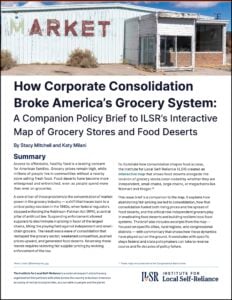
How Corporate Consolidation Broke America’s Grocery System
ILSR's brief explains how corporate consolidation fueled high food prices, and the critical role independent grocers play in building resilient local food systems.