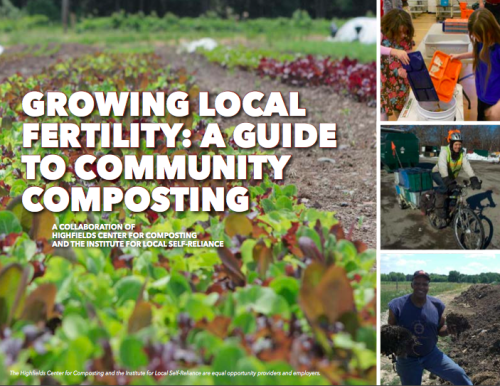
Composting can take place at many levels – backyard, block, neighborhood, schoolyard, community, on-farm, and regional – and in urban, suburban, and rural areas. Composting at the local level circulates dollars in the community, promotes social inclusion and empowerment, greens neighborhoods, builds healthy soils, supports local food production and food security, embeds a culture of composting know-how in the community, sustains local jobs, and strengthens the skills of the local workforce. When materials are collected and transported out of the community for processing, few if any of these benefits are realized at the local level.
Community composting is thriving but needs support to grow further. ILSR’s report, Aumentar la fertilidad local: guía para el compostaje comunitario, describe iniciativas exitosas, sus beneficios, consejos para replicarlas, pasos clave para comenzar y la necesidad de apoyo del sector privado, público y sin fines de lucro. Producido en colaboración con Centro de Compostaje Highfields en Hardwick, Vermont, Fomentando la fertilidad local perfiles de 31 programas modelo en 14 estados y el Distrito de Columbia. Los programas van desde urbanos hasta rurales e incluyen sitios de demostración/capacitación, escuelas, universidades, sistemas de recolección impulsados por pedales, cooperativas de propiedad de trabajadores, huertos comunitarios y granjas que emplean múltiples técnicas de compostaje. Muchas, pero no todas, son empresas sin fines de lucro impulsadas por una misión. Su característica distintiva es mantener el proceso y el producto lo más local posible al tiempo que involucran a la comunidad a través de la participación y la educación.
DESCARGAS
Aumentar la fertilidad local: guía para el compostaje comunitario – FULL REPORT
Resultados de la encuesta de ILSR a compostadores comunitarios Octubre de 2013
Aumentar la fertilidad local: guía para el compostaje comunitario se basa en el trabajo apoyado por una subvención de los Programas de Servicios Públicos (Utilities Programs), del Departamento de Agricultura de los Estados Unidos, y fue producido por Compostaje de ILSR hace$en $e Proyecto y el Centro de Compostaje Highfields.
Damos la bienvenida a sus comentarios sobre esta guía e invitamos a los compostadores de la comunidad a compartir sus lecciones aprendidas y consejos para la replicación.
Contáctenos en [email protected]