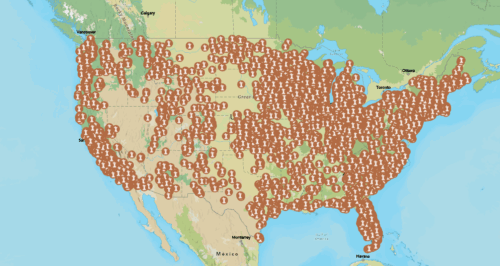
The newest update to the EPA’s Excess Food Opportunities Map adds over 450 community composters, further solidifying local composters as key agents in the effort to divert wasted food.
The U.S. Environmental Protection Agency (EPA) has released the newest version of the Excess Food Opportunities Map (EFOM). With almost a million data points, this interactive map supports a nationwide effort to divert excess food from landfills and incineration facilities.
ILSR collaborated with the EPA to include 483 community composting sites in the most recent update, including the over 400 member organizations of our Community Composting Coalition. Now, map users can find these sites included in the “composting facilities” layer of the map.
You can also explore ILSR’s Composting for Community Map, which provides an interactive illustration of how communities pursue locally based composting capacity and enterprises, and how states help or hinder the growth of local programs. This map includes the 483 sites that have now been integrated into the EPA’s EFOM.
Map Purpose and Highlights
This resource aims to increase public knowledge related to sources of excess wasted food across industrial, commercial, and institutional sectors, as well as highlight alternative destinations for predicted waste.
Additionally, the EFOM helps users understand excess food as a resource that can be intentionally redirected through the lens of environmental justice, food access, and food assistance programming. The map can further be used to identify gaps in infrastructure and guide excess food management decisions at the local level.
Primarily, the Excess Food Opportunities Map calls attention to over 900,000 generators of estimated excess food. These generators include:
- Educational institutions
- Correctional facilities
- Food manufacturers, producers, and sellers (both wholesale and retail)
- Healthcare facilities
- Hospitality institutions
- Restaurant and food services
Also highlighted are almost 15,000 prospective recipients of excess food. These food waste recovery opportunities consist of:
- Composting facilities
- Food banks, pantries, and soup kitchens
- Anaerobic digestion sites
- Communities with source-separated organics programs.
The Significance of Community Composters
The Coalition’s representation on the map affirms community composters as vital contributors to the composting sector and the larger sustainable food movement. With only 10% of the nearly 5,000 commercial composting operations in the U.S. accepting wasted food, community composters help paint a more complete picture of organics management options across the country.1
Moreover, the co-benefits of locally based composting go beyond fighting food waste. These programs increase local jobs, create opportunities for youth development, nurture resilient soils, and encourage deeper community engagement. Community composting fosters healthier, more productive, and more sustainable communities and environments.
In addition to the ILSR’s community composter data, the EFOM gathers data from a variety of sources. Its data is sourced from the EPA’s Disaster Debris Recovery Tool, Hunger Free America, and the USDA’s Local Food Directories, Food Access Research Atlas, and Food Environment Atlas.
For more information on how this map was created, visit the EPA’s informational page about the Excess Food Opportunities Map.