Welcome to ILSR's complete library of resources and publications. Use the filtering tools below to find just the content you're seeking, or subscribe to the RSS feed here.
ILSR Responds to the CFPB’s Proposed Guardrails for Digital Banking
ILSR supports the Consumer Financial Protection Bureau’s proposed “open banking” rule to establish important guardrails for digital banking. But it needs additional provisions to ensure...
Small Businesses, Consumers and Antimonopoly Advocates Urge Congress to End the Swipe Fee Duopoly
ILSR co-hosted a virtual press event alongside consumer advocates, antimonopoly reformers, and small businesses urging Congress to pass the Credit Card Competition Act.
Getting Capital to Underserved Entrepreneurs: Some Pandemic Lessons
In Nonprofit Quarterly, ILSR Senior Researcher Kennedy Smith describes the federal Equitable Lending Leaders program and some of its biggest lessons.… Read More
Helping Lending Programs Reach Underserved Small Business Owners
ILSR and Recast City have collaborated on Equitable Lending Leaders, a program to help small business lending programs reach underserved entrepreneurs and small business owners.
Statement from the Institute for Local Self-Reliance on Today’s Reintroduction of the Bank Merger Review Modernization Act
As community and local financial institutions disappear or merge with larger banks, more entrepreneurs and business owners are struggling to obtain the capital they need
Greenpenny Puts Community Banking to Work for Clean Energy — Episode 123 of Local Energy Rules
For this episode of the Local Energy Rules podcast, host John Farrell speaks with Greenpenny’s Jason MacDuff. They discuss what’s needed for a prompt clean...
In The Washington Post: Small Pharmacies Beat Big Chains at Delivering Vaccines. Don’t Look So Shocked
Stacy Mitchell explains why independent pharmacies are beating the chains in vaccine distribution. Small pharmacies have proved remarkably nimble, while CVS and Walgreens have stumbled.
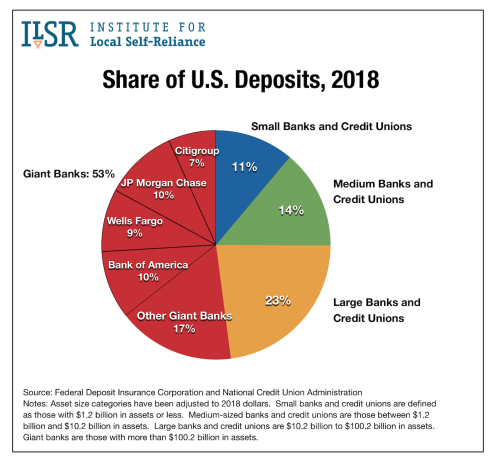
Report: Fewer Small Businesses are Receiving Federal Relief Loans in States Dominated by Big Banks
A significantly larger number of federal relief loans are reaching small businesses in states where small, local banks comprise a greater share of the market.
In American Prospect: Amazon Uses Lending to Control Small Business
ILSR's Shaoul Sussman explains that it's almost impossible for businesses selling on Amazon to borrow from private banks, forcing entrepreneurs to borrow from Amazon itself.