It is illegal for dominant retailers like Walmart and Amazon to use their power over suppliers to secure lower prices and other benefits while simultaneously raising the prices for competing, smaller stores. This predatory tactic is known as price discrimination, a practice that has been illegal under the federal Robinson-Patman Act (RPA) since the 1930s but has largely gone unenforced for the past half-century. Enforcing and strengthening bans on price discrimination, including RPA, and enacting state bans would help lower prices for shoppers, create new markets for farmers and food manufacturers, and ensure small grocers and other stores can compete fairly.
For decades, federal antitrust enforcers used the Robinson-Patman Act (RPA) to ensure fairness and a level playing field across the retail economy. Congress passed the Act in 1936 after dominant chain supermarkets like A&P and Kroger began using their power to pressure suppliers into giving them lower prices and other preferential treatment compared to smaller stores. For decades through the 1970s, federal Trade Commission (FTC) enforcement against these sweetheart deals fostered a diverse supermarket industry in which both unionized supermarket chains and smaller independent grocers could coexist and thrive. Competition, innovation, and low prices were the norm.
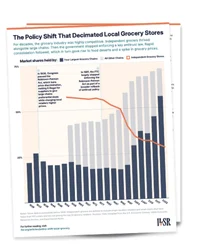
Since the 1980s, when the misguided Consumer Welfare Standard all but ended RPA enforcement, big-box stores, large supermarket chains, and conglomerate consumer goods companies have overwhelmed the retail industry. With no one willing to stop price discrimination, the Walmarts, Amazons, and Krogers of the world have bullied their suppliers with impunity. That has triggered waves of consolidation among those suppliers. Ttoday, PepsiCo, Unilever, ConAgra, and other conglomerates fill the shelves at supermarkets and box stores and use their size to strike sweetheart deals with their largest retail customers. Meanwhile, independent grocers and small retailers have closed by the thousands and lost market share, falling from 53 percent of retail sales in 1982 to just 22 percent in 2017. This consolidation, driven by price discrimination, has directly led to higher grocery prices for shoppers.
The loss of independent grocers due to rampant price discrimination has caused and exacerbated both high food prices and food deserts across the country. During the years when the FTC vigorously enforced the RPA, food deserts were rare. Even communities that would today be considered “underserved” often had access to multiple grocery stores and other food retailers. Today, food deserts plague both urban neighborhoods and small towns alike, largely because of the policy choice not to enforce RPA. Without independent grocers to compete with, chain supermarkets have raised food prices across the board — and reaped record profits.
In the final months of the Biden Administration, the FTC restarted enforcement of the Robinson-Patman Act by filing two lawsuits — one against powerful wine and spirits distributor Southern Glazer’s and another, more significant, against massive food and drink conglomerate PepsiCo. The PepsiCo lawsuit accused Pepsi of conspiring with Walmart to raise the price of drinks Pepsi sold to every other retailer, while offering Walmart whatever discounts and special promotions it demanded. The effect, the FTC claimed, was to increase prices that consumers paid for Pepsi products across the economy. Sadly, the Trump-era FTC abandoned the lawsuit, which only saw the full light of day through ILSR’s intervention. The unredacted details of the case underscore the importance of RPA and price-discrimination enforcement at the federal and state level.
Price discrimination remains rampant in retail industries beyond groceries. Amazon, for example, has been accused of conspiring with big book publishers to ensure Amazon sells books for less than brick-and-mortar stores. Major drug manufacturers have been credibly accused of offering favorable pricing to major drug middlemen that it doesn’t offer to independent buyers for the same drugs. Enforcing price-discrimination laws would create fairness across the retail economy. Here are steps policymakers should take to ensure that happens.
What federal lawmakers and enforcers can do to end price discrimination
Vigorously enforce the Robinson-Patman Act. As noted, decades of assertive RPA enforcement created a diverse and competitive retail industry. The unsealed Pepsico complaint revealed how powerful retailers and suppliers work together to raise prices for shoppers and unfairly crush smaller stores. A renewed commitment to RPA enforcement would help lower grocery prices for consumers, create new markets for farmers, and reestablish small grocers as the heart of their communities. While the FTC is the primary RPA enforcement agency, the Department of Justice’s antitrust division can also enforce the law.
Pass laws that strengthen and clarify the RPA. Restrictive statutory language and several pro-bigness court decisions have limited the reach and effectiveness of RPA enforcement. Because of the language of the law, for example, it can be difficult for enforcers or private plaintiffs to prove a retailer knowingly violated the law. Notably, the law also does not apply to services, which has allowed discrimination to run rampant for credit card processing, telecommunications, and so on. Lawmakers should introduce and pass legislation that removes loopholes and streamlines enforcement, particularly against powerful retailers who demand sweetheart deals from suppliers. A bill introduced by Senator Cory Booker would strengthen retail price discrimination by allowing states to seek monetary damages from companies violating the Robinson-Patman Act, incentivizing states to enforce the law. That bill remains pending.
What state lawmakers and enforcers can do to end price discrimination
Introduce and strengthen local price discrimination laws. According to ILSR research, only nine states currently have price discrimination bans that mirror or go beyond the Robinson-Patman Act. Attorneys general in states with price discrimination laws should look for opportunities to enforce those laws in state court. And lawmakers in states without a price discrimination ban should introduce and pass prohibitions to ensure pricing fairness within their states’ borders. Meanwhile, at least four states have introduced legislation that would strengthen protections against price discrimination in the grocery industry. State lawmakers nationwide should introduce and pass similar bills to end rampant price discrimination in food retailing.
What small businesses can do to combat price discrimination
Victims of price discrimination should consider lawsuits. Private enforcement of RPA is not uncommon. Indeed, several recent RPA lawsuits have resulted in victory for plaintiffs. Small businesses — retailers, suppliers, or wholesalers — who believe they are being discriminated against by powerful suppliers and retailers should consider suing under RPA to stop that illegal discrimination. ILSR partner organization Small Business Rising also offers a portal for small business owners to submit their stories of price discrimination to support advocacy efforts.
In The Nation: Ron Knox on Fairness and the Robinson-Patman Act
The FTC's lawsuit against Southern Glazer's Wine and Spirits, utilizing the Robinson-Patman Act, could be an opportunity to restore fairness to the American economy